Buying Guide
The Best French Press in 2026
Four picks for full-bodied immersion coffee — ranked on carafe material, capacity, filter design and how well they hold heat. Plus why a coarse, even grind makes or breaks the cup.
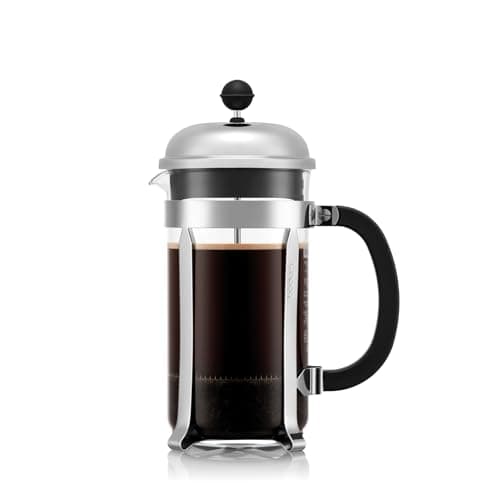
A French press is the most forgiving way to make a rich, full-bodied cup of coffee: no paper filters, no gooseneck kettle, no technique to master — just steep and plunge. Because the metal filter lets the coffee's oils through, you get a heavier, rounder body than pour over or drip. Our overall pick is the Bodum Chambord, the design that defined the category, but the right press for you depends on how much you hate grit, whether you want coffee to stay hot for an hour, and how much you want to spend.
How we picked
We don't run a test lab, and we won't pretend to. Every press here was evaluated against its published manufacturer specifications, the design details that decide clarity, heat retention and durability, and verified owner feedback — our full approach is on the methodology page. For a French press specifically, we weighted:
- Filter design. A single mesh screen is standard; a double or dual-stage filter (Espro) traps far more fines for a cleaner cup with less sediment.
- Carafe material.Borosilicate glass is neutral-tasting and lets you watch the brew, but it's breakable; stainless steel is nearly indestructible and holds heat.
- Insulation. Single-wall glass loses heat fast; double-wall vacuum stainless keeps coffee hot long after the plunge.
- Capacity and value.Most presses are sold by number of small "cups"; we list ounces so you can match it to how much you actually brew.
At a glance
The field side by side. Tap any "view" button for the live Amazon price; the number on Amazon at checkout is the one that applies.
| French press | Material | Filter | Insulated? | Price |
|---|---|---|---|---|
| Bodum Chambord (34oz) | Borosilicate glass | 3-part mesh | No | $39.69Buy |
| Espro P3 | Borosilicate glass | Double micro-filter | No | $39.94Buy |
| Frieling (36oz) | Stainless steel | Dual screen | Yes (double-wall) | $139.95Buy |
| Bodum Brazil (34oz) | Borosilicate glass | 3-part mesh | No | $19.99Buy |
Prices shown are from Amazon as of October 17, 2026 and change often — the button always goes to the current listing. Some links may earn us a commission at no extra cost to you.
Best overall: Bodum Chambord French Press (34oz)
The Chambord is the archetype: a borosilicate glasscarafe in a polished stainless steel frame, topped by Bodum's three-part stainless mesh plunger. It looks the part on any table, the glass is heat-resistant and taste-neutral, and every part — carafe, filter screens, plunger — is replaceable, so a cracked beaker doesn't mean a new press. The 34 oz size (8 small cups) suits a couple or a small household.
| Material | Borosilicate glass, steel frame |
|---|---|
| Capacity | 34 oz / 1 L (8 cups) |
| Filter type | 3-part stainless mesh |
| Insulated | No (single-wall glass) |
| Care | Dishwasher-safe (disassembled) |
What we like: timeless design, neutral-tasting glass, replaceable parts, and a fair price for what it is. The downsides: single-wall glass loses heat quickly (decant if you won't drink it straight away), the mesh lets some fines through, and glass can break if you knock it. For most people it's still the one to buy.
Best filtration: Espro P3 French Press
If grit at the bottom of the cup drives you up the wall, the Espro P3 is the fix. It uses a double micro-filter— two nested mesh screens instead of one — that traps the fine particles a standard press lets through. The filter also seals against the carafe wall as you plunge, which effectively stops the brew, so the coffee doesn't keep extracting and turning bitter while it sits. The result is noticeably cleaner and clearer than any single-mesh press.
| Material | Borosilicate glass |
|---|---|
| Capacity | 32 oz |
| Filter type | Double micro-filter (2 screens) |
| Insulated | No (this glass model) |
What we like: the cleanest cup here by a clear margin, and the seal-and-stop plunge means less bitterness if you're slow to pour. The downsides: the fine double filter needs a bit more effort to press and to clean, and it costs more than a Chambord. If clarity is your priority, it earns it.
Best insulated: Frieling Double-Wall French Press (36oz)
The Frieling trades glass for double-wall vacuum stainless steel, and that changes how a press fits into your morning. Coffee stays hot long after you plunge, so a slow second cup isn't a lukewarm one, and there's no beaker to shatter — this is the press you buy if durability and heat retention matter more than watching the brew. The 18/10 stainless body has a mirror finish and is fully dishwasher-safe.
| Material | 18/10 stainless steel |
|---|---|
| Capacity | 36 oz |
| Filter type | Dual-screen mesh |
| Insulated | Yes (double-wall vacuum) |
| Care | Dishwasher-safe |
What we like: keeps coffee hot for a long time, essentially unbreakable, dishwasher-safe, and built to last for years. The downsides: it's the most expensive press here, you can't see the brew through the walls, and the metal screen still passes a little more sediment than the Espro. For daily, no-fuss use, it's the durable choice.
Best budget: Bodum Brazil French Press (34oz)
The Brazil is the Chambord's value sibling. You get the same borosilicate glass carafe and the same three-part stainless mesh filter, wrapped in a simpler BPA-free plastic frame and handle instead of the polished steel. The coffee it makes is identical to the Chambord's — you're only paying less for the housing.
| Material | Borosilicate glass, BPA-free frame |
|---|---|
| Capacity | 34 oz / 1 L (8 cups) |
| Filter type | 3-part stainless mesh |
| Insulated | No (single-wall glass) |
What we like: the same cup as the Chambord for less, and light enough to travel or keep at the office. The downsides: the plastic frame feels its price and won't last as long as steel, and like all glass presses it loses heat fast and can break. As a first French press on a budget, it's the smart pick.
How to choose a French press
A few questions settle it.
How much do you hate sediment?Every metal filter passes some fines — that's part of the French press character. If a little silt at the bottom bothers you, the double-filter Espro P3 is the cleanest cup here. If you don't mind it, a standard mesh (Bodum) is fine and easier to clean.
Glass or stainless? Glass is neutral-tasting and lets you see the brew, but it loses heat fast and can break. Stainless (Frieling) is nearly indestructible and keeps coffee hot, at a higher price and with no view of the brew.
What capacity?Buy for the number of cups you actually pour at once — a press works best brewed near full. Remember the "cups" on the box are small; a 34 oz press is about two to three mugs.
And the grinder, again.No press can fix an uneven grind. Pair whichever you pick with a burr grinder set coarse — start with our best burr grinders and the grind size chart. Curious how a press compares to an AeroPress? See AeroPress vs French press.
The bottom line
For most people the Bodum Chambordis the right buy — the classic design, a neutral glass carafe and replaceable parts at a fair price. Hate grit? The Espro P3 makes the cleanest cup of any press here. Want coffee that stays hot and a press that survives your kitchen? The stainless Frieling. On a budget, the Bodum Brazilbrews the same cup as the Chambord for less. Whichever you choose, put the effort into a coarse, even grind — that's what separates a rich cup from a muddy one.
Still weighing a press against a stovetop pot? Moka pot vs French press sets the two side by side, and coffee brewing methods, comparedcovers the whole field. If the press is for a campsite rather than a kitchen, the stainless Frieling is the one that travels — see best travel and camping coffee gear, because a glass carafe in a car boot rarely ends well.
Still choosing between brewing methods rather than between presses? Our French press vs pour over comparison sets full immersion against percolation on body, clarity, grind and the gear each one needs.
Frequently asked questions
What grind should I use for a French press?
Coarse and even — roughly the texture of coarse sea salt. Grounds that are too fine slip past the metal mesh into your cup and over-extract into bitterness, which is the usual cause of a muddy French press. A burr grinder that produces uniform coarse particles makes the single biggest difference to the cup.
Why is there sediment at the bottom of my French press coffee?
A French press uses a metal filter, so some fine particles always pass through — that's part of its full-bodied character. Grinding coarser and using a grinder that produces fewer fines reduces it. If you want a genuinely grit-free cup, a double-filter press like the Espro P3 traps far more of the fines than a standard single mesh.
Is a glass or stainless steel French press better?
It depends on your priorities. Glass is taste-neutral and lets you watch the brew, but it loses heat quickly and can break. Stainless steel, especially a double-wall model like the Frieling, keeps coffee hot much longer and is nearly indestructible, though it costs more and you can't see the brew.
How many cups does a 34 oz French press make?
About two to three standard mugs. The 'cups' printed on French press packaging are small — roughly 4 oz each — so a 34 oz (8-cup) press yields around 34 ounces total. Presses brew best filled near their rated capacity, so buy for the amount you usually make at once.
Should I leave the coffee in the French press after plunging?
No — decant it. Coffee left sitting on the grounds keeps extracting and turns bitter, and in a single-wall glass press it also cools fast. Pour it into a mug or a carafe right after plunging. The Espro's sealing filter slows extraction, but decanting is still the safest habit.
Sources
Keep reading
Buying your first setup?
See how we pick — compiled specs, cost-per-shot math, and honest trade-offs — then dig into the guides. No fake test lab, no rankings for hire.