Buying Guide
The Best Coffee Scale for Espresso & Pour Over in 2026
Three honest picks that get you to repeatable coffee — a do-it-all overall, a pour-over specialist, and a tiny budget scale that fits a drip tray — chosen on published specs.
A coffee scale is the cheapest upgrade that makes your coffee repeatable. Great coffee is a ratio — a specific weight of grounds in, a specific weight of liquid out — and you can't hit the same ratio twice by eye. Weigh your dose and your yield to 0.1 gram, run the clock, and a good shot stops being luck: you can copy it tomorrow, or change one thing and know exactly what you changed.
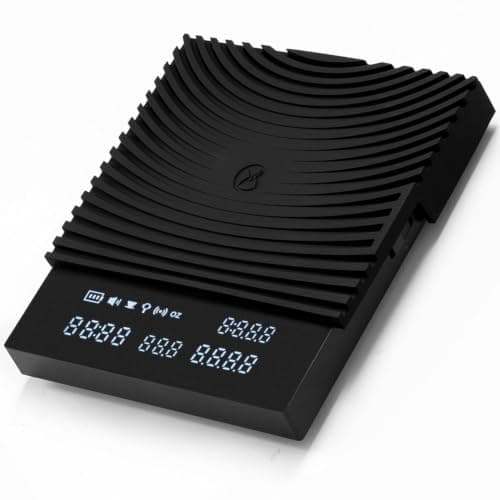
Our overall pick is the Timemore Black Mirror Basic 3: 0.1 g precision, a built-in timer, and even a real-time flow-rate readout, at a price that undercuts most rivals. For pour over, the plain, dependable Hario V60 Drip Scale is all most people need, and the tiny Weightmanis the cheapest way to start weighing espresso on the drip tray. Here's how to choose.
Why 0.1g precision and a timer matter
Espresso is a tight ratio at small weights. A typical shot might be an 18 gram dose pulled to a 36 gram yield — a 1:2 ratio — and being off by half a gram on the dose is a real change in strength and extraction. A scale that reads only to whole grams can't see that; 0.1 gram resolutioncan. That precision is what lets you set a target like "18 in, 36 out, in about 28 seconds" and actually hit it — and how many grams for a double shot gives the right target for your basket rather than ours.
The timeris the other half. Extraction is a function of time as well as weight, so watching the seconds tells you whether the grind is right: a shot that gushes out too fast is ground too coarse; one that drips forever is too fine. Weighing the yield and timing the pour together is the fastest way to dial in a grinder — see how to pull a shot for the full routine, and the grinder that feeds it, which matters more than any other piece of gear. Not convinced you need one yet? Do I need a scale for espresso makes the case from the arithmetic.
For pour over, the same logic applies at bigger numbers: you weigh the coffee and the water to hit a brew ratio (often around 1:16), and time the bloom and pours. A flow-rate readout— grams per second, shown live — is a nice extra for espresso geeks watching how the shot builds, but it's not essential.
How we picked
We don't run a test lab, and we don't pretend to. Every scale here was evaluated against its published manufacturer specifications, the design details that decide whether it's actually usable at the machine, and verified owner feedback — our full approach is on the methodology page. For a coffee scale specifically, we weighted:
- Resolution.0.1 gram is the standard for espresso and serious pour over; 1 gram scales are too coarse for a dose.
- Built-in timer. Weight and time together are the point; a separate stopwatch is a hassle.
- Size and fit.For espresso, the scale has to fit under the portafilter on the drip tray; a big kitchen scale won't.
- Response speed, water resistance and value— a slow or splash-shy scale is a daily annoyance.
At a glance
The three side by side. Tap any "view" button for the live Amazon price; the number on Amazon at checkout is the one that applies.
| Scale | Precision | Timer | Flow rate | Best for | Price |
|---|---|---|---|---|---|
| Timemore Black Mirror Basic 3 | 0.1 g | Yes | Yes | Best overall | $59.00Buy |
| Hario V60 Drip Scale | 0.1 g | Yes | No | Pour over | $46.11Buy |
| Weightman Espresso Scale | 0.1 g | Yes | No | Budget / espresso | $13.99Buy |
Prices shown are from Amazon as of October 17, 2026 and change often — the button always goes to the current listing. Some links may earn us a commission at no extra cost to you.
Best overall: Timemore Black Mirror Basic 3
The Black Mirror does everything most home baristas need and then some. It reads to 0.1 gram, has a built-in timer, and adds a real-time flow-rate displaythat pricier scales charge extra for — useful for watching how an espresso shot builds. It's compact enough for a drip tray, charges over USB-C so there are no disposable batteries, and carries the water-resistant coating you want near a machine.
| Precision | 0.1 g |
|---|---|
| Max weight | 2 kg / 2000 g |
| Timer | Built-in (auto and manual) |
| Flow rate | Real-time display |
| Size | Compact (fits most drip trays) |
| Power | USB-C rechargeable |
What we like: espresso and pour over in one scale, flow rate you normally pay a premium for, USB-C charging, and a great price. The honest downsides: the flow-rate and timing modes take a few minutes to learn, and there's no phone app or Bluetooth if you want data logging. For nearly everyone, it's the most scale for the money.
Best for pour over: Hario V60 Drip Scale
Made by the company behind the V60 dripper, this is the no-nonsense pour-over scale. It reads to 0.1 gram, has a simple built-in timer, and its wide, flat top comfortably holds a dripper and carafe. There's no flow rate and no app — you press start and pour — and that simplicity is exactly why it's a long-time pour-over standard.
| Precision | 0.1 g |
|---|---|
| Max weight | 2 kg / 2000 g |
| Timer | Built-in |
| Flow rate | No |
| Power | 2 x AAA batteries |
What we like: dead-simple, reliable, a big enough top for a full pour-over setup, and it comes from the people who make the dripper. The downsides: it runs on AAA batteries rather than USB, the top is a bit large for a cramped espresso drip tray, and it has no flow-rate readout. If you mainly brew pour over, that's no loss.
Best budget: Weightman Espresso Scale
The Weightman is the cheapest scale we'd actually put under a portafilter. It's small enough to sit on an espresso drip tray, reads to 0.1 gram, has a built-in timerand an auto-off, and charges over USB. It won't match a Timemore for polish or features, but it does the core job — weigh the dose, weigh the yield, run the clock — for pocket money.
| Precision | 0.1 g |
|---|---|
| Timer | Built-in |
| Flow rate | No |
| Size | Small (fits under a portafilter) |
| Power | USB rechargeable, auto-off |
What we like: the lowest-risk way to start weighing espresso, genuinely small, and it charges over USB. The downsides: build and response speed are closer to the price than a Timemore's, no flow rate, and quality can vary unit to unit. As a first scale or a spare, it's hard to beat on price.
How to choose a coffee scale
Strip away the marketing and the decision comes down to a few questions.
Espresso, pour over, or both?For espresso the scale must physically fit on the drip tray under the portafilter, so size wins — the Timemore and Weightman fit; a big kitchen scale doesn't. For pour over you want a wider top to hold a dripper and carafe, which is the Hario's strength. The Timemore straddles both.
How many features do you want?A flow-rate readout (Timemore) is fun for espresso geeks and helps you see a shot build, but it's not essential — plenty of excellent coffee gets made with just weight and a timer. Don't overpay for data you won't use.
Power. USB-C rechargeable (Timemore, Weightman) means no disposable batteries; the Hario uses AAAs. A small thing, but it adds up.
The bottom line
For most people, the Timemore Black Mirror Basic 3is the smartest buy — 0.1 gram precision, a timer, flow rate and USB-C, at a price that undercuts the field. If you only brew pour over and want zero fuss, the Hario V60 Drip Scale is the reliable classic. On the tightest budget, the tiny Weightmangets you weighing shots for pocket money. Any of them turns guesswork into a ratio you can repeat — which is the whole point.
Frequently asked questions
Do I really need a scale for espresso and pour over?
If you want the same good cup twice, yes. Great coffee is a ratio of grounds to liquid, and you can't hit it by eye. Weighing the dose and the yield to 0.1 gram — and timing the brew — turns a good shot from luck into something you can repeat and adjust deliberately. It's the cheapest upgrade with the biggest payoff.
Why does a coffee scale need 0.1g precision?
Espresso works at small weights and tight ratios — an 18g dose to a 36g yield, for example — so half a gram is a real change in strength and extraction. A scale that only reads whole grams can't see that difference, while 0.1 gram resolution lets you set an exact target and hit it consistently.
What is the best coffee scale for espresso?
The Timemore Black Mirror Basic 3 is our overall pick: it reads to 0.1 gram, has a built-in timer and a real-time flow-rate display, and is small enough to fit under a portafilter on the drip tray. On a tight budget, the tiny Weightman does the core job for much less.
Is the Acaia Pearl or Lunar worth it over a Timemore?
For most home users, no. The Acaia scales are the pro studio standard — very fast, app-connected and beautifully built — but they cost several times as much and are often sold direct or in limited supply. A Timemore delivers the same repeatable dose-and-yield results for a fraction of the price.
Can I just use a regular kitchen scale?
For pour over you sometimes can, if it reads to 0.1 gram and has a fast response — but most kitchen scales round to whole grams and lack a timer. For espresso, a kitchen scale usually won't physically fit under the portafilter on the drip tray, which is why a compact coffee scale is worth it.
Sources
Keep reading
Buying your first setup?
See how we pick — compiled specs, cost-per-shot math, and honest trade-offs — then dig into the guides. No fake test lab, no rankings for hire.