Single Review
Hario V60 Review
The dripper most of the specialty coffee world learns on. A 60-degree ceramic cone with spiral ribs and one large hole gives you total control over a clean, aromatic cup — as long as you're willing to dial in your grind, pour and ratio.
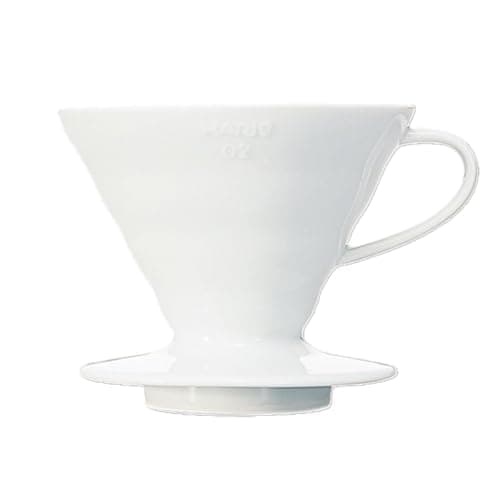
The benchmark pour-over dripper — a 60-degree cone with spiral ribs and one big hole that gives you total control over a clean, aromatic cup — as rewarding as it is demanding of your technique.
- Best for
- Clarity-seeking pour-over drinkers who want to dial in single-origin coffees and don't mind that grind, pour and ratio all matter
- Price context
- The dripper itself is inexpensive; the real spend is the gooseneck kettle, scale and burr grinder it wants to shine
The Hario V60is the dripper most of the specialty coffee world learns on, and it has earned that status. It is a deceptively simple cone — a piece of ceramic, a paper filter, hot water — that in the right hands produces some of the cleanest, most aromatic black coffee you can make at home. The reviewed model here is the ceramic 02 in white, the classic size and finish, and it rewards a careful brewer with a cup that shows off a single-origin coffee's subtler notes better than almost any other method. The catch is right there in the phrase "in the right hands": the V60 gives you total control, which also means it gives you total responsibility.
A note on honesty first: we don't run a lab. This review compiles Hario's published specifications, cross-checks them against verified owner feedback, and does the reasoning — the same method we use on every product, described on our methodology page. We have not put a refractometer to the cup; what follows is what the design and the numbers tell you, framed as plainly as we can.
Who the V60 is for
The V60 is for the drinker who wants clarityabove all — the clean, well-separated flavors that let a washed Ethiopian taste floral and a natural Colombian taste like fruit — and who enjoys the ritual of making it happen. If you like the idea of weighing your coffee and water, controlling your pour, and dialing a brew in until it is exactly right, the V60 is the dripper that gives you the most room to do that. It suits people who mostly brew one or two cups at a time and want to explore single-origin coffees rather than pull espresso or brew a big batch. If you have read our best pour over guide and want the benchmark that everything else is compared to, this is the one that guide names first.
It is the wrong dripper for two kinds of buyer. First, anyone who wants a hands-off, forgiving brew: the V60 punishes a sloppy pour, and a beginner will get better, more consistent cups sooner from a flat-bottom dripper. Second, anyone brewing for a table: the 02 tops out around four cups and asks for your attention the whole time, so it is not the tool for filling a carafe while you do something else. The V60 is a single-cup specialist, and it is proud of it.
What the specs say
The whole design is about one idea: getting water to flow the way you tell it to. The V60 is a 60-degree cone — that angle is where the name comes from — with spiral internal ribs and a single large hole at the bottom. Those three features work together. The steep cone channels water toward a point; the spiral ribs hold the paper filter slightly off the wall so air can escape and the whole coffee bed drains rather than getting stuck against the sides; and the big single hole means the dripper itself imposes almost no restriction, so your poursets the flow rate rather than the geometry. That is the source of both the V60's control and its demands.
| Shape | 60-degree cone |
|---|---|
| Material | Ceramic (this model; also plastic, glass, metal) |
| Size | 02 (this model; range is 01 / 02 / 03) |
| Capacity | 1-4 cups (size 02) |
| Drainage | Single large hole, spiral internal ribs |
| Filters | V60 02 cone papers (required) |
A few practical notes on the range. The V60 comes in three sizes — 01, 02 and 03— where 02 is the everyday size for one to four cups and the one most recipes are written for; 01 is a smaller single-cup dripper and 03 is larger. It also comes in several materials: ceramic (this model), plastic, glass and metal. Ceramic holds brewing heat well, which helps a stable extraction, and it feels the most substantial — the trade-off is that it is heavier and can crack or chip if you drop it, where plastic is cheap and nearly indestructible but retains less heat. One thing is non-negotiable across all of them: the V60 uses its own cone-shaped 02 paper filters. Ordinary flat or wavy filters will not seat correctly, so you commit to buying V60 papers — they are cheap and widely available, but they are a specific consumable.
What it's like to live with
Living with a V60 is living with control, and the first thing you notice is how much your choices show up in the cup. Pour faster and the water drains quicker for a lighter, brighter, more delicate result; pour slower and steadier and you build more body and sweetness. Grind a touch finer to slow the flow and extract more, coarser to speed it up and pull back. Change your coffee-to-water ratio and the whole balance shifts. With a flat-bottom dripper a lot of this is smoothed out for you; with the V60 it is all in your hands, which is exactly why it is such a good tool for learning to taste the effect of each variable.
The second thing is that the V60 genuinely wants supporting gear, more than any other dripper. A gooseneck kettle is close to essential: the narrow spout lets you place water precisely and pour at a slow, controlled rate, which is most of the technique. A coffee scalewith a timer lets you weigh your coffee and water and repeat a brew you liked, turning a lucky cup into a repeatable one. And an even, medium grind from a burr grinder matters here as much as anywhere — uneven grounds extract unevenly and blur the clarity that is the whole reason to own a V60. Dial your setting in with our grind size chart and adjust a notch at a time.
The third is that, for all its reputation, the V60 is not fussy to maintain. The ceramic 02 holds its heat well through a brew, rinses clean in seconds, and there are no moving parts or consumable seals — only the paper filters. Give the ceramic a rinse with hot water before brewing to warm it and rinse the paper (which also removes any papery taste), and clean it with hot water afterward. The only real handling caution is the ceramic itself: it is heavier than plastic and will chip or crack if it meets a hard floor, so it is the one part of the ritual to be gentle with.
The technique caveat — read this first
This is the single most important thing to understand before you buy: the V60 is the least forgiving dripper of its kind, by design.Because the large single hole lets your pour set the flow, a rushed or uneven pour, a grind that is off, or a careless ratio all show up clearly in the cup — sometimes as a thin, sour brew, sometimes as a muddy, over-extracted one. This is not a defect; it is the flip side of the control that makes the V60 so rewarding. But it means a first brew can be worse than what you would get from a more forgiving flat-bottom dripper, and that surprises people who expected "just add water."
The honest framing is this: the V60 has a learning curve, and it is worth climbing only if the payoff — a clean, expressive, dialed-in cup — is something you actually want. Give it a gooseneck kettle, a scale and a consistent grind, follow a recipe for a few brews, and it becomes second nature and the cups become excellent. Try to use it casually, with a spouted kettle and pre-ground coffee, and it will feel finicky and inconsistent. Match your commitment to the tool and it is superb; expect a set-and-forget brewer and you will be frustrated.
Alternatives worth considering
If the V60's clarity appeals but its demands do not, a flat-bottom dripperis the friendlier route to a consistent cup. Something like the Kalita Wave uses a flat bed and three small holes to even out an imperfect pour, so you get very good coffee without perfect technique — the trade is a little less control for the tinkerer. Both sit in our best pour over roundup alongside the V60 if you want to compare them directly.
If you love the idea of the cone but brew for more than one person, the Chemex is the natural step up: it is a cone dripper and carafe in one, with thick bonded filters that make an exceptionally clean, bright pot of several cups at once. It is a close cousin of the V60 in philosophy but a different tool in practice, and our sibling Chemex vs V60 comparison weighs the two head to head. And whichever manual dripper you land on, the real upgrades are the same: a gooseneck kettle and a coffee scale will do more for your cup than swapping the dripper ever will.
Verdict
The Hario V60 is the benchmark pour-over dripper for a reason. Its 60-degree cone, spiral ribs and single large hole give you more control over the brew than any comparable dripper, the ceramic 02 holds its heat for a stable extraction, and the payoff — a clean, aromatic, expressive cup that shows off a good single-origin — is genuinely hard to beat at home. The catch is honest and consistent: that same control makes it the least forgiving dripper of its kind. It is technique-dependent, it really wants a gooseneck kettle and a scale, it is a single-cup specialist, and the ceramic can crack if you drop it. Buy it to learn, to dial in, and to chase clarity, and it will reward you for years; buy it expecting a hands-off cup and a flat-bottom dripper will make you happier. For the clarity-seeking brewer willing to put in a little practice, the V60 is as good as the entry point to great pour over gets.
What we liked
- 60-degree cone, spiral ribs and one large hole give unmatched control over the brew
- Pour faster for a lighter cup or slower for more body — total flavor flexibility
- Ceramic 02 body holds brewing heat well for a more stable extraction
- Produces an exceptionally clean, aromatic cup that shows off single-origin coffees
- Cheap, widely available filters and a huge community of dialed-in recipes
- Available in ceramic, plastic, glass and metal, and in sizes 01, 02 and 03
What gave us pause
- Highly technique-dependent — grind, pour rate and ratio all noticeably change the cup
- Really wants a gooseneck kettle and a scale to brew consistently
- Single-cup focus; the 02 tops out around four cups and needs attention throughout
- Ceramic is heavier and can crack or chip if dropped
Frequently asked questions
Is the Hario V60 hard to use?
It's the least forgiving of the common drippers, by design. Because the large single hole lets your pour set the flow rate, grind, pour speed and ratio all noticeably change the cup, so a first brew can be worse than what a more forgiving flat-bottom dripper gives. With a gooseneck kettle, a scale and a consistent grind, though, it becomes second nature quickly — and that's when the cups get excellent.
Do I need a gooseneck kettle and scale for the V60?
Effectively yes, if you want consistent results. A gooseneck kettle lets you place water precisely and pour slowly, which is most of the V60 technique, and a scale with a timer lets you weigh coffee and water so you can repeat a brew you liked. You can brew without them, but the V60 is the dripper that benefits most from both.
What size Hario V60 should I buy, 01, 02 or 03?
The 02 is the everyday size and the one most recipes are written for — it brews one to four cups and is the version reviewed here. The 01 is a smaller single-cup dripper, and the 03 is larger for bigger brews. For most home drinkers, the 02 is the right starting point.
Which V60 material is best — ceramic, plastic, glass or metal?
Ceramic (the model here) holds brewing heat well for a stable extraction and feels the most substantial, but it's heavier and can crack if dropped. Plastic is cheap, light and nearly indestructible but retains less heat; glass and metal sit in between on looks and heat. For a countertop brewer at home, ceramic is a popular, well-rounded choice.
What filters does the Hario V60 use?
It requires V60 cone-shaped paper filters in the matching size (02 for the 02 dripper). Ordinary flat or wavy filters won't seat correctly against the cone and spiral ribs, so you commit to buying V60 papers. They're inexpensive and widely available, but they are a specific consumable rather than a generic one.
Sources
Keep reading
Buying your first setup?
See how we pick — compiled specs, cost-per-shot math, and honest trade-offs — then dig into the guides. No fake test lab, no rankings for hire.