Buying Guide
The Best Espresso Machine Under $500 in 2026
Six machines that make genuinely good espresso for less than $500 — chosen on published specs, portafilter size and long-term value. And the one purchase that matters more than any of them.
Under $500 is the sweet spot for home espresso: it's enough to buy a machine that pulls real, 9-bar shots without stepping into prosumer territory. The six below span roughly $150 to the top of the range, and each is the strongest pick for a specific buyer — whether you want lattes with zero skill, a machine you'll keep for a decade, or the smallest possible footprint.
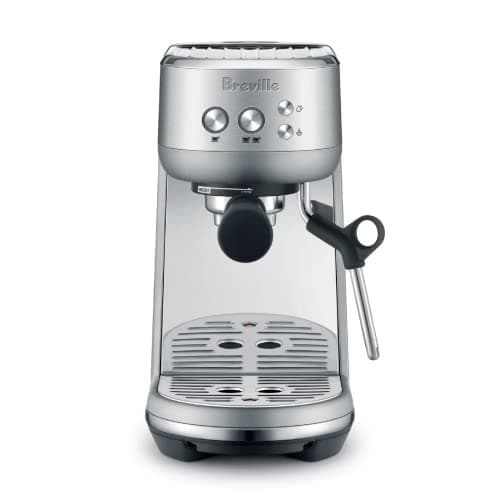
Our overall pick is the Breville Bambino: it heats in about three seconds, fits anywhere, and makes espresso good enough that most people never outgrow it. But before you spend a cent on the machine, read the next section — because with a fixed budget, where you spend the money matters more than which machine you choose.
Start here: the grinder matters more than the machine
For espresso, the grinder changes what's in the cup more than the machine does. Espresso is brewed by forcing water through a tightly packed puck at about 9 barof pressure, and that only works if the grind is fine, even and adjustable in tiny steps. A great machine cannot rescue an inconsistent grind — but a good grinder makes a modest machine punch far above its price.
So the advice almost no beginner wants to hear: don't sink your entire budget into the machine. With a fixed budget, a mid-priced machine paired with a real grinder beats an all-in-one-priced machine fed by a cheap blade grinder, every single time. Start with our best grinders for espresso guide, and see the true cost of home espresso for the full running-cost picture.
How we picked
We don't run a test lab, and we don't pretend to. Every machine here was evaluated against its published manufacturer specifications, the design details that decide how it performs and how forgiving it is, and verified owner feedback — our full approach is on the methodology page. For machines under $500 specifically, we weighted:
- Portafilter size and type. A 58mm portafilter (Gaggia) uses commercial-standard accessories and grows with you; a 54mm (Breville) has a strong ecosystem of its own; a small pressurized basket (Dedica, Stilosa, Casabrews) is forgiving but caps your ceiling.
- Heat-up time and temperature stability. ThermoJet and thermoblock machines are ready in seconds, which makes daily use painless.
- Milk steaming. Automatic (Bambino Plus) versus manual wand (everything else) is the biggest ease-of-use fork if you want milk drinks.
- Build and honest value— and whether the machine is a dead end or something you can keep and improve as your technique does.
At a glance
The field side by side. Tap any "view" button for the live Amazon price; the number shown at checkout is the one that applies.
| Machine | Portafilter | Milk | Best for | Price |
|---|---|---|---|---|
| Breville Bambino | 54mm | Manual wand | Best overall | $299.95Buy |
| Breville Bambino Plus | 54mm | Automatic | Milk drinks | $499.95Buy |
| Gaggia Classic Evo Pro | 58mm | Manual wand | Growing into | $505.09Buy |
| De'Longhi Dedica | Pressurized | Manual wand | Compact | $249.00Buy |
| De'Longhi Stilosa | Pressurized | Manual wand | Budget | $149.95Buy |
| Casabrews 3700 | Pressurized | Manual wand | Ultra-budget | $99.99Buy |
Prices shown are from Amazon as of October 17, 2026 and change often — the button always goes to the current listing. Some links may earn us a commission at no extra cost to you.
Best overall: Breville Bambino (BES450)
The Bambino is the machine we point most under-$500 buyers toward, because it removes the two things that frustrate people most: waiting for warm-up and inconsistent shot temperature. Its ThermoJet heater is ready in about three seconds, it runs a real 54mm portafilterwith low-pressure pre-infusion, and it's small enough to live on any counter. You steam milk yourself with the wand — the one skill worth learning. We cover it in depth in our Breville Bambino review.
| Portafilter | 54mm (pressurized + non-pressurized baskets) |
|---|---|
| Boiler | ThermoJet (fast heat-up, ~3s) |
| Pump pressure | 15 bar (9 bar at the puck) |
| Pre-infusion | Yes (low-pressure) |
| Milk | Manual steam wand |
| Water tank | 47 oz / 1.4 L |
| Footprint | ~7.7 in wide |
What we like: fast, consistent, compact, and a genuine skill-builder you won't outgrow quickly. The honest downsides: the manual wand has a learning curve (that's the point), the single thermocoil means you brew then steam, and like anything at this level it needs a real grinder to shine. Want the machine to steam milk for you? Step up to the Plus below.
Best for milk drinks: Breville Bambino Plus (BES500)
Everything the Bambino does, plus an automatic steam wandthat texturizes milk to a temperature and texture you set — hands-off microfoam without learning to steam. For someone whose whole reason for buying is a reliable latte or flat white every morning, it's the shortest path there.
| Portafilter | 54mm |
|---|---|
| Boiler | ThermoJet (~3s heat-up) |
| Pump pressure | 15 bar (9 bar at the puck) |
| Milk | Automatic + manual steam modes |
| Milk temp/texture | Adjustable, automatic |
| Water tank | 64 oz / 1.9 L |
What we like: the auto-steam genuinely works and removes the hardest beginner skill, and the tank is bigger than the standard Bambino's. The downsides: it costs more, and purists will still prefer steaming by hand for full control. If milk drinks are the point, this is the pick.
Best to grow into: Gaggia Classic Evo Pro
If you suspect this hobby is going to stick, the Gaggia Classic Evo Pro is the machine you buy once. It uses a 58mm commercial portafilter— the café standard, so every tamper, basket and accessory fits — in a rugged, largely stainless body that's famously repairable and moddable. It asks more of you than a Breville, and rewards it. See our full Gaggia Classic Evo Pro review.
| Portafilter | 58mm (commercial standard) |
|---|---|
| Boiler | Single aluminum boiler |
| Heating element | ~1425 W |
| Pump pressure | 15 bar (mod to 9 bar common) |
| Milk | Manual steam wand (commercial-style) |
| Build | Largely stainless, repairable |
| Heat-up | ~5-10 min to temperature |
What we like: bulletproof build, the 58mm ecosystem, and a huge community of guides and mods — this machine can genuinely last a decade. The downsides: single boiler means you brew then steam, heat-up is slower than a Breville, and it's the least plug-and-play pick here. That's the trade for a machine you won't replace.
Best compact: De'Longhi Dedica Deluxe (EC685)
At just six inches wide, the Dedica is the answer when counter space is the real constraint. It heats fast via a thermoblock, has a usable manual frothing wand, and squeezes a full little machine into a footprint narrower than a cereal box.
| Width | ~6 in (very compact) |
|---|---|
| Portafilter | Pressurized basket |
| Boiler | Thermoblock (fast heat-up) |
| Pump pressure | 15 bar |
| Milk | Manual frothing wand |
| Water tank | ~35 oz / 1 L |
What we like: genuinely tiny, quick to heat, and tidy. The downsides: the narrow body means a small drip tray and a slightly fiddly wand, and the pressurized basket caps how far you can push quality. Buy it for the footprint, not the ceiling.
Best budget: De'Longhi Stilosa (EC260)
The Stilosa is the cheapest honest way to find out whether home espresso is your thing. It uses a pressurized basketthat forces crema even from supermarket pre-ground, a 15-bar pump and a manual wand — no bells, but it makes real, hot espresso for the price of a few bags of specialty beans.
| Portafilter | Pressurized basket |
|---|---|
| Pump pressure | 15 bar |
| Milk | Manual steam/frothing wand |
| Water tank | ~34 oz / 1 L |
| Body | Plastic with stainless accents |
What we like: the lowest-risk entry to the hobby, and surprisingly capable with a decent grind. The downsides: the pressurized basket masks grind quality (great early, a ceiling later), the plastic build feels its price, and temperature control is basic. A perfect first step, not a forever machine.
Best ultra-budget: Casabrews 3700
The Casabrews 3700 is the lowest-cost stainless machine we'd actually recommend. You get a 20-bar pump, a steam wand, a pressure gauge and a metal body for close to the price of the plastic Stilosa — a lot of machine for very little money, if you go in with realistic expectations.
| Pump | 20-bar (pressurized basket) |
|---|---|
| Milk | Manual steam wand |
| Gauge | Pressure gauge included |
| Body | Stainless steel |
| Water tank | ~34 oz / 1 L |
What we like: the most machine-per-dollar here, and a real metal build. The downsides: quality control varies unit to unit, the 20-bar figure is marketing (9 bar at the puck is what matters), and the pressurized basket is forgiving but limiting. A great low-risk starter, not an heirloom.
How to choose under $500
Strip away the marketing and the decision comes down to a few questions.
Pressurized vs non-pressurized basket.A pressurized (dual-wall) basket forces crema regardless of your grind, so it's forgiving while you learn — but it hides grind quality and caps how good your espresso can get. A non-pressurized basket (Bambino, Gaggia) rewards a good grind with genuinely better shots. If you know you're serious, start non-pressurized; if you're cautious, start pressurized and upgrade the basket later.
54mm vs 58mm portafilter.58mm is the commercial standard, so accessories are everywhere and the machine grows with you (Gaggia). 54mm (Breville) has its own strong, well- supported ecosystem. A small pressurized basket ties you to the machine's own parts.
Manual vs automatic milk.A manual wand teaches you microfoam and gives full control; an automatic wand (Bambino Plus) does it for you. If lattes are the goal and you don't want to practice steaming, pay for automatic.
And, again, the grinder.Whatever you pick, pair it with a real burr grinder and keep it inside your budget — start with our best espresso grinders, and use the how to pull a shot guide to dial it in.
The bottom line
For most people under $500, the Breville Bambinois the smartest buy — fast, compact, forgiving and good enough to keep for years. Want lattes with no steaming skill? The Bambino Plus. Think you'll fall down the rabbit hole? Buy the Gaggia Classic Evo Pro once and grow into it. Tight on space or money? The De'Longhi Dedica, Stilosa or Casabrews 3700 get you pulling shots for less. Just remember the rule that outranks the machine: put real money into the grinder.
If your budget is not actually fixed at $500, our best home espresso machinesguide spans the whole category — budget pump machines through all-in-ones and bean-to-cup — with one pick per type of buyer.
Frequently asked questions
What is the best espresso machine under $500?
For most people, the Breville Bambino. It heats in about three seconds, runs a real 54mm portafilter with pre-infusion, and is forgiving enough to learn on while still making genuinely good espresso — leaving room in a $500 budget for a proper grinder. If milk drinks are the priority, the Bambino Plus adds an automatic steam wand; if you want a machine to grow into, the Gaggia Classic Evo Pro is the buy-once option.
Should I spend more on the espresso machine or the grinder?
Split a fixed $500 budget so the grinder gets real money, not the leftovers. Espresso depends on a fine, even, adjustable grind, and no machine can compensate for an inconsistent one. A modest machine with a good burr grinder beats a pricier machine fed by a cheap blade grinder every time.
Can you get a good espresso machine for under $500?
Yes — under $500 is arguably the value sweet spot. Machines like the Breville Bambino and Gaggia Classic Evo Pro pull real 9-bar shots and, paired with a decent grinder, rival far more expensive setups. You only need to spend more once you want built-in grinders, dual boilers or one-touch milk.
Do cheaper machines use pressurized baskets?
Usually, yes. The De'Longhi Dedica, Stilosa and Casabrews 3700 ship with pressurized (dual-wall) baskets that force crema regardless of grind, which is forgiving for beginners but limits ultimate quality. The Bambino includes both pressurized and non-pressurized baskets; the Gaggia uses a non-pressurized commercial basket.
Is the Gaggia Classic Evo Pro better than the Breville Bambino?
They're built for different buyers. The Gaggia has a rugged 58mm commercial build you can mod and keep for a decade, but it heats slowly and asks more of you. The Bambino heats in seconds and is far more plug-and-play. Choose the Gaggia to grow into the hobby; choose the Bambino for speed, size and ease.
Sources
Keep reading
- Gaggia Classic Pro vs Breville Bambino Plus →
- Best home espresso machines →
- Best espresso machine under $300 →
- Best espresso machines with a built-in grinder →
- Best espresso machine for beginners →
- Best espresso machines under $1000 →
- Best grinders for espresso →
- Breville Bambino review →
- The true cost of home espresso →
Buying your first setup?
See how we pick — compiled specs, cost-per-shot math, and honest trade-offs — then dig into the guides. No fake test lab, no rankings for hire.