Comparison
Breville Barista Express vs Bambino: Which to Buy?
Same espresso engine, two completely different philosophies. The Barista Express bakes a grinder into one big box; the Bambino is tiny, cheap and instant but leaves the grinder to you. Here's the honest breakdown, and why the grinder question decides it.
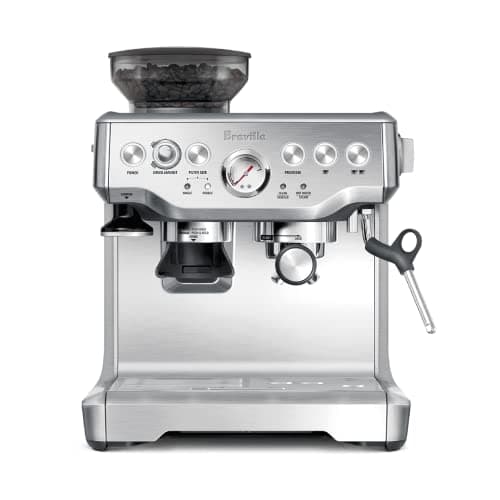
The Breville Barista Express (BES870) and the Bambino (BES450) are the two machines first-time buyers cross-shop most, and it's easy to see why: they're the same brand, they pull espresso the same way, and they land in overlapping price territory once you add everything up. But they answer a very different question. The Barista Expressis an all-in-one — it builds a real burr grinder into one machine, so beans-to-cup lives in a single box. The Bambinothrows the grinder out, shrinks the machine to the size of a toaster, heats almost instantly, and costs less — on the condition that you buy a separate grinder to feed it.
A note on method first: we don't run a test lab. This comparison lines up the two machines' published specifications, cross-checks them against verified owner feedback, and does the reasoning — the same approach we describe on our methodology page. Prices move constantly, so we quote qualitative brackets, never stale numbers — the live figure is in the buy boxes below. Here's exactly where these two overlap, where they split, and which one is the smarter buy for you.
The short answer
Buy the Barista Express if you want one purchase, one footprint, one thing to learn— the grinder is built in and tuned to the machine, so you go from whole beans to a finished shot without researching, buying and finding counter space for a separate grinder. Buy the Bambino if you want the same espresso for less money in a much smaller machine, you value a near-instant heat-up, and you're willing to pair it with a standalone burr grinder — which, dollar for dollar, will usually out-grind the Express's built-in unit. One is convenience in a big box; the other is a smaller, cheaper core plus a grinder you choose. That grinder decision is the whole comparison, and we come back to it below.
The real differences
Four things separate these machines. One of them — the grinder — drives the whole decision; the other three shape how the machine lives on your counter.
1. The grinder: built-in vs none. This is the reason both machines exist. The Barista Express has an integrated stainless conical burr grinderwith 16 grind settings and dose control that grinds straight into the portafilter on demand — no separate appliance, no extra counter space, one workflow to learn. The Bambino has no grinder at all; it depends entirely on a separate burr grinder to reach its potential. That single difference cascades into everything else: price, size, and how good your shots actually get.
2. The heater. The Bambino uses Breville's ThermoJet system, which reaches extraction temperature in about three seconds— the feature that keeps people brewing daily instead of giving up on a slow warm-up. The Barista Express uses a ThermoCoil boiler with PID temperature control: warm-up is quick but not the near-instant three seconds of the Bambino, and it wants a short warm-up and a flush or two to bring the group up to temperature before your first shot. The trade is that PID holds brew temperature steady near 200°F shot to shot — a genuine stability feature the base Bambino doesn't advertise.
3. The footprint and tank. This is not a small difference. The Barista Express is a large countertop appliance at roughly 15.9 inches wide with a 67 oz / 2 Ltank — it wants real counter space and a permanent home. The Bambino is toaster-sized at about 7.7 inches wide with a 47 oz / 1.4 Ltank — it fits almost any kitchen and tucks away easily. If counter space is your hard constraint, this alone can decide it.
4. The dose tools. The all-in-one design lets Breville include workflow aids the bare Bambino has no need for: the Express ships with a Razor dose trimming tool, a dosing funnel and an integrated tamper, which take much of the guesswork out of dialing the dose. On the Bambino, dosing and tamping happen at your separate grinder and tamp station.
| Built-in grinder | Express: yes (conical burr, 16 settings) | Bambino: none (buy separate) |
|---|---|
| Heater | Express: ThermoCoil + PID | Bambino: ThermoJet (~3s heat-up) |
| Footprint | Express: large (~15.9 in wide) | Bambino: tiny (~7.7 in wide) |
| Water tank | Express: 67 oz / 2 L | Bambino: 47 oz / 1.4 L |
| Everything else | Identical: 54mm, 15 bar (9 at puck), pre-infusion, manual wand, single boiler |
The grinder question (read this before you decide)
For espresso, the grinder shapes the cup more than the machine does — a fine, even, adjustable grind is what makes a 9-bar shot possible. That's why this comparison isn't really Express vs Bambino; it's built-in grinder vs the grinder you'd buy separately for the same total money. And here's the honest part most all-in-one marketing skips: the Barista Express's built-in grinder is good, not class-leading. Sixteen settings dial in most beans, but it's coarser adjustment than a dedicated espresso grinder with stepless or micro-adjustment, and it's locked to the machine— you can't upgrade it without replacing the whole appliance.
Now do the math the other way. The Bambino costs less than the Express, and the difference is roughly the price of a standalone grinder. Put that saving into a real burr grinder and, dollar for dollar, that separate grinder will typically out-grind the Express's built-in unit— and when you eventually want to upgrade, you swap the grinder without touching the machine. So a Bambino plus a good grinder can pull a better shot than a Barista Express at a similar all-in cost, while taking a modular path you can improve one piece at a time.
At a glance
The two side by side. The espresso row is shared; everything below it is where the machines actually differ. Tap a "view" button for the live Amazon price — the number shown at checkout is the one that applies.
| Feature | Barista Express (BES870) | Bambino (BES450) |
|---|---|---|
| Espresso core | 54mm, 9 bar, pre-infusion | 54mm, 9 bar, pre-infusion |
| Built-in grinder | Yes (conical burr, 16 settings) | No (buy a separate grinder) |
| Heater | ThermoCoil + PID | ThermoJet (~3s heat-up) |
| Milk | Manual steam wand | Manual steam wand |
| Water tank | 67 oz / 2 L | 47 oz / 1.4 L |
| Footprint | Large (~15.9 in wide) | Tiny (~7.7 in wide) |
| Best for | One-box grind-to-cup | Small space + separate grinder |
| Check price | $699.95Buy | $299.95Buy |
Prices shown are from Amazon as of October 17, 2026 and change often — the button always goes to the current listing. Some links may earn us a commission at no extra cost to you.
Who each is for
Buy the Barista Express (BES870) ifyou want the grinder question solved in a single purchase and you don't want to research, buy and site a separate grinder on day one. You get a real conical burr grinder, PID temperature stability and the Razor dose tool in one machine with one learning curve — the simplest smart route to grind-to-cup espresso at home. The honest cons: it's large and wants real counter space, the built-in grinder is very good rather than class-leading and can't be upgraded on its own, grinding straight into the portafilter can be messy and static-prone, and the single boiler means you brew then steam. Accept those, and it's the benchmark all-in-one for a reason.
| Type | Semi-automatic, all-in-one (integrated grinder) |
|---|---|
| Grinder | Stainless conical burr — 16 grind settings, dose control |
| Portafilter | 54mm (single & dual wall baskets) |
| Boiler | ThermoCoil with PID temperature control |
| Pump pressure | 15 bar (9 bar at the puck) |
| Milk | Manual steam wand |
| Water tank | 67 oz / 2 L (removable) |
| Dimensions | ~15.9 x 13.1 x 12.4 in |
Buy the Bambino (BES450) ifyou want the same espresso engine in the smallest, cheapest package, you love the near-instant three-second heat-up, and you're happy to pair the machine with a standalone burr grinder — which is where the money you save is far better spent. It fits any counter, it's ready before you've found a cup, and it gives you a modular setup you can upgrade one piece at a time. The honest cons: you must buy a grinder separately(budget for a good one from the start), the manual wand takes practice, the single thermocoil means brew-then-steam, and the small drip tray fills quickly. If you already own a grinder — or want the best possible shot per dollar — this is the smarter buy.
| Portafilter | 54mm (non-pressurized & pressurized baskets included) |
|---|---|
| Boiler | ThermoJet — heats in ~3 seconds |
| Pump pressure | 15 bar (9 bar at the puck) |
| Pre-infusion | Low-pressure pre-infusion |
| Milk | Manual steam wand |
| Grinder | None (pair a separate burr grinder) |
| Water tank | 47 oz / 1.4 L (removable) |
| Dimensions | ~7.7 x 12.6 x 12.2 in |
One more fork worth naming: if milk drinks with zero skill are the real goal, the automatic-steam Breville Bambino Plusis the sibling to look at — same tiny footprint as the Bambino, but it textures milk for you instead of asking you to learn the wand. It still has no grinder, so the grinder budgeting above applies to it too.
The verdict
Because the extraction is the same, this decision comes down to a single question: do you want the grinder built in, or bought separately? Choose the Barista Expressif convenience, a single footprint and one purchase matter most — it solves the grinder problem that trips up most first-time buyers, adds PID stability and a genuinely useful dose tool, and remains the default all-in-one. Choose the Bambinoif you want the same shots for less in a far smaller machine, you value the instant heat-up, and you'll put the savings into a real standalone grinder — the path that usually buys better espresso per dollar and lets you upgrade the grinder later without replacing the machine.
Still weighing them individually? Read our full Barista Express review and Bambino review. Leaning Bambino? Start your grinder search in the best grinders for espresso. And if the built-in convenience is what you're after, see where the Express sits against its rivals in best espresso machines with a built-in grinder.
Frequently asked questions
What is the difference between the Breville Barista Express and the Bambino?
They share the same espresso engine — a 54mm portafilter, a 15-bar pump delivering 9 bar at the puck, low-pressure pre-infusion, a single boiler and a manual steam wand — so they can pull the same quality shot. The differences are everything around the extraction: the Barista Express (BES870) has a built-in conical burr grinder, PID temperature control, a Razor dose tool and a large ~15.9-inch-wide body with a 67 oz / 2 L tank, while the Bambino (BES450) has no grinder, uses a ThermoJet heater that's ready in about three seconds, and is toaster-sized at about 7.7 inches wide with a 47 oz / 1.4 L tank.
Does the Barista Express or the Bambino make better espresso?
At the puck, neither is inherently better — they use the same 54mm basket, the same 9 bar of pressure and the same pre-infusion, so with identically ground coffee they pour the same quality shot. What decides the cup is the grind. The Barista Express includes a good (not class-leading) built-in grinder; the Bambino relies on a separate grinder you choose. A Bambino paired with a strong standalone grinder can actually out-perform the Express's built-in unit at a similar total cost.
Do I need a separate grinder for the Breville Bambino?
Yes, for its best results. The Bambino has no built-in grinder, and espresso quality depends heavily on a fine, even, adjustable grind. It works with pre-ground coffee in its pressurized basket, but pairing it with a dedicated burr grinder is what unlocks café-quality shots. Budget for a good grinder from the start — the money you save versus the all-in-one Barista Express is best spent there.
Is the Barista Express's built-in grinder good enough?
For most buyers, yes — it's a stainless conical burr grinder with 16 settings and dose control that makes genuinely good espresso out of the box, and having it built in is the whole point of the machine. Be clear on its ceiling, though: the adjustment is coarser than a dedicated espresso grinder, the burr is a rung below the standalone grinders enthusiasts graduate to, and it's locked to the machine, so you can't upgrade it without replacing the whole appliance.
Which is better for a small kitchen, the Barista Express or the Bambino?
The Bambino, by a wide margin. It's about 7.7 inches wide and toaster-sized, so it fits almost any counter, while the Barista Express is a large all-in-one at roughly 15.9 inches wide that wants a permanent home and real counter space. If space is your hard constraint, the Bambino plus a compact grinder is the better fit — and the pair still solves grind-to-cup, just in two smaller pieces.
Sources
Keep reading
Buying your first setup?
See how we pick — compiled specs, cost-per-shot math, and honest trade-offs — then dig into the guides. No fake test lab, no rankings for hire.