Single Review
Breville Barista Express (BES870XL) Review
The all-in-one that taught a generation to pull a shot at home — built-in conical grinder, PID temperature control and a real 54mm portafilter in one box. Here's the honest breakdown, specs first.
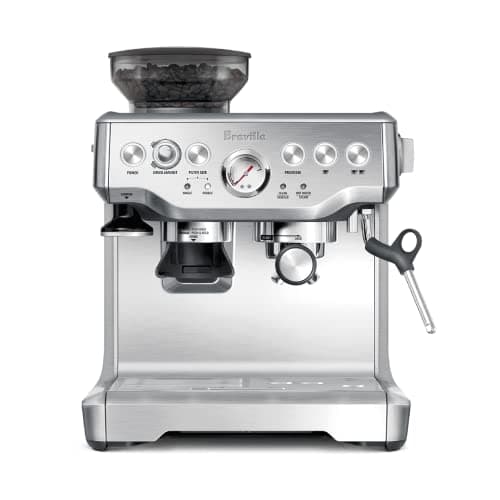
The benchmark all-in-one: a genuine grinder, PID temperature control and a steam wand in one footprint, at a price that still makes it the simplest smart route to café drinks at home.
- Best for
- One-purchase buyers who want grind-to-cup espresso without a separate grinder
- Price context
- Mid-tier all-in-one; frequently discounted and often the best value in grind-to-cup
The Breville Barista Express is the machine that put "everything in one box" on the map. It folds a real conical burr grinder, PID temperature control and a manual steam wandinto a single footprint, so a beginner can go from whole beans to a finished shot in about a minute without buying a separate grinder first. For a huge number of people, it's the machine that turned home espresso from an idea into a daily habit — and years after launch it remains the default recommendation for "one purchase, one thing to learn."
A note on honesty first: we haven't run this machine in a lab. This review compiles the published specifications, cross-checks them against verified owner feedback, and does the reasoning — the same method we use on every product, described on our methodology page. Prices move constantly, so we quote brackets, not stale numbers — the live figure is in the buy box below.
Who the Barista Express is for
The Barista Express is aimed at the buyer who wants realespresso — 9 bar at the puck, pre-infusion, a proper portafilter — but doesn't want to research, buy and find counter space for a separate grinder on day one. It's the classic all-in-one: the grinder is built in and tuned to the machine, so the whole workflow (grind, dose, tamp, brew, steam) lives in one appliance with one learning curve.
It is not the machine for someone who wants the espresso made forthem at a button press — that's a super-automatic. And it's not the pick for someone who already owns a good standalone grinder, or who wants the very best possible shot: in that case a simpler machine plus a dedicated grinder from our best grinders for espresso guide will out-perform any built-in. The Barista Express occupies the sweet spot between those two: hands-on, but with the grinder question already solved.
What the specs say
The Barista Express is a semi-automatic, single-boiler machine with an integrated grinder. Three specs do most of the work. The 54mm portafilteris smaller than a commercial 58mm, but Breville's ecosystem means bottomless portafilters, precision baskets and tampers are easy to find. PID temperature control holds brew temperature steady near 200°F, which is a real improvement over cheaper machines that swing around a thermostat. And low-pressure pre-infusion gently wets the puck before ramping to full pressure, which improves extraction evenness.
| Type | Semi-automatic, all-in-one (integrated grinder) |
|---|---|
| Grinder | Stainless conical burr — 16 grind settings, dose control |
| Bean hopper | 1/2 lb (about 250 g), sealed |
| Portafilter | 54mm (single & dual wall baskets) |
| Boiler | ThermoCoil with PID temperature control |
| Pump pressure | 15 bar (9 bar at the puck) |
| Pre-infusion | Low-pressure pre-infusion |
| Milk | Manual steam wand |
| Water tank | 67 oz / 2 L (removable) |
| Dimensions | ~15.9 x 13.1 x 12.4 in |
The built-in grinder — the whole point
The grinder is the reason to buy this machine over a bare Bambino. It's a stainless conical burr unit with 16 grind settingsand dose control, and it grinds straight into the portafilter on demand. For espresso, the grinder shapes the cup more than the machine does — a fine, even, adjustable grind is what makes a 9-bar shot possible — so having a real burr grinder built in, rather than reaching for pre-ground coffee, is what lets the Barista Express make genuinely good espresso out of the box.
Be honest about its ceiling, though. Sixteen settings is enough to dial in most beans, but it's coarser adjustment than a dedicated espresso grinder with stepless or micro-adjustment, and the burr is a rung below the standalone grinders serious hobbyists graduate to. It's also locked to the machine: you can't upgrade the grinder without replacing the whole appliance. For most buyers that trade — convenience and space for a slightly lower grind ceiling — is exactly the right one. If it isn't for you, that's the signal to buy a separate machine and grinder instead.
What it's like to live with
Day to day, the Barista Express is a guided, hands-on ritual rather than a push-button appliance. You grind a dose into the portafilter, use the included Razor dose trimming tool to level the puck to the right amount, tamp, lock in and pull. The Razor is a genuinely clever touch: it takes most of the guesswork out of dose, which is one of the two biggest causes of inconsistent home shots (grind being the other). Pre-infusion and PID then do their part to keep the extraction even and the temperature steady.
The heater is a ThermoCoil, so warm-up is quick but not the near-instant three seconds of the Bambino's ThermoJet — give it a short warm-up and a couple of flushes to bring the group up to temperature before your first real shot. Once you've found your grind setting and dose, morning espresso becomes a repeatable few-minute routine. If you like being part of making the coffee — and improving at it — that involvement is the appeal. If you'd rather the machine handle everything, it will feel like work. New to the workflow? Our how to pull an espresso shot guide walks through dialing it in, and why is my espresso bitter covers the most common first-week problems.
The single-boiler reality
The most important limitation to understand is the single ThermoCoil boiler. It heats water for brewing orfor steaming, but not both at once, so the workflow is brew first, then switch to steam. For one or two milk drinks that's a minor pause; if you regularly make several cappuccinos back to back, the wait between brewing and steaming — and re-cooling to brew again — adds up. This is the fundamental difference between the Barista Express and a dual-boiler or heat-exchanger machine, and it's the main thing you give up at this price.
The manual steam wand itself is capable of proper microfoam for latte art, but like any manual wand it rewards practice — expect a learning curve before your milk pours cleanly. That's a feature, not a flaw, for someone who wants to learn; it's a chore for someone who wants milk texturized automatically. If automatic milk is the goal, the Bambino Plus is the machine to look at instead.
Barista Express vs Impress vs Bambino
Three Breville machines get cross-shopped constantly, and the differences are simple. The Bambino (and Bambino Plus) is the same great espresso engine withouta grinder — smaller, faster to heat, cheaper, but you supply your own grinder. The Barista Express adds the built-in grinder and the Razor dose tool. The Barista Express Impress goes one step further with its Impress Puck System, which doses a consistent amount and assists your tamp— removing the fussiest beginner step for a higher price.
Put simply: buy the Bambino if you already own (or want to buy) a great standalone grinder and value a tiny footprint; buy the Barista Express if you want the grinder built in and one machine to learn; and step up to the Impress if consistent puck prep is the part that intimidates you. We line all three up against the wider field in best espresso machine under $1000, and compare Breville against its biggest rival in Breville vs De'Longhi.
Cleaning & maintenance
An all-in-one asks a little more upkeep than a bare machine, and it's worth going in with eyes open. The grinder needs the occasional cleanout to clear old grounds and oils; the group and portafilter benefit from a regular backflush with the included blind basket and cleaning tablets; and, depending on your water hardness, the machine will prompt a descalefrom time to time. Using the included water filter (and softer or filtered water) slows scale build-up considerably. None of this is difficult, but skipping it is the fastest way to shorten the machine's life — budget a few minutes a week and a longer clean every month or two.
Alternatives worth considering
If you want the same all-in-one idea with easier, more repeatable pucks, the Barista Express Impressadds assisted tamping. If milk drinks are your main goal and you're happy to pair the machine with a separate grinder, the Bambino Plusautomates milk in a far smaller footprint. If you'd rather split the budget for a better grinder and a machine you can tinker with for a decade, a Gaggia Classic Evo Pro plus a standalone grinder is the enthusiast route. And if you want zero involvement, a super-automatic pours a drink at a button press. We rank the whole field around this price in best espresso machine under $1000.
The two closest alternatives are both Brevilles, and the choice between them is narrower than it looks: Barista Express vs Pro vs Impress compares all three on the only things that actually differ — the heater, the grind resolution, and whether the machine preps the puck for you.
Verdict
The Barista Express earns its status as the default all-in-one. It solves the grinder question that trips up most first-time buyers, adds PID stability and a genuinely useful dose tool, and does it all in one machine that a beginner can grow into rather than out of. Go in understanding the deal: it's a hands-on, single-boiler machine that rewards a little practice and a little maintenance, and its built-in grinder is very good rather than class-leading. Accept that, and it remains one of the smartest ways to start pulling real espresso at home — which is exactly why it's been the benchmark for so long. Before you buy, it's worth reading the true cost of home espresso so the running costs hold no surprises.
What we liked
- Grinder, PID temperature control and steam wand in one machine — beans to espresso in about a minute
- Integrated conical burr grinder with dose control means no separate grinder to buy on day one
- PID keeps brew temperature steady shot to shot — a genuine step up from thermostat machines
- Real 54mm portafilter with a huge Breville accessory ecosystem (bottomless portafilters, precision baskets, tampers)
- The Razor dose trimming tool takes most of the guesswork out of dialing the dose
- Enormous owner community and wide parts/support availability
What gave us pause
- Single ThermoCoil boiler: you brew, then steam — no simultaneous brewing and steaming
- The built-in grinder is good, not class-leading, and it's locked to the machine — you can't upgrade it on its own
- Grinding straight into the portafilter can be messy and static-prone; retention isn't zero
- Larger and heavier than a Bambino — it wants real counter space
- Microfoam on the manual wand takes practice (that's the craft, but know it going in)
- Regular backflushing and descaling are required to keep it healthy — the maintenance is real
Frequently asked questions
Is the Breville Barista Express good for beginners?
Yes — it's one of the most popular beginner espresso machines precisely because the grinder is built in, so there's no separate grinder to research and buy on day one. It has a real 54mm portafilter, PID temperature control and a Razor dose tool that makes puck prep more repeatable. The trade-off is that it's hands-on: you still grind, dose, tamp and steam yourself, and the manual steam wand takes practice.
What is the difference between the Barista Express and the Barista Express Impress?
Both are all-in-one machines with the same espresso engine and a built-in grinder. The Impress adds Breville's Impress Puck System, which doses a consistent amount and assists your tamp with a guided lever — removing the single biggest cause of inconsistent home shots. The Impress costs more and adds a little routine to each shot; the standard Barista Express uses the manual Razor dose tool and your own tamp.
Does the Barista Express need a separate grinder?
No — that's the point of it. The Barista Express has an integrated conical burr grinder with 16 settings and dose control, so you can go from whole beans to espresso without buying anything else. A dedicated standalone grinder can out-grind the built-in one, but for most buyers the convenience and saved counter space are worth the small drop in ultimate grind quality.
Can the Barista Express make lattes and cappuccinos?
Yes. It has a manual steam wand that can texturize microfoam for lattes, cappuccinos and flat whites — you steam the milk yourself, which takes some practice. Because it's a single-boiler machine, you brew first and then steam rather than doing both at once, so back-to-back milk drinks are a little slower than on a dual-boiler machine. If you'd rather the machine texturize milk automatically, look at the Bambino Plus.
How much maintenance does the Barista Express need?
Plan on a little regular upkeep: rinse and occasionally clean the grinder, backflush the group with the included blind basket and cleaning tablets, and descale periodically based on your water hardness. Using the included water filter and softer or filtered water slows scale build-up. None of it is hard, but keeping up with it is what keeps the machine running well for years.
Sources
Keep reading
Buying your first setup?
See how we pick — compiled specs, cost-per-shot math, and honest trade-offs — then dig into the guides. No fake test lab, no rankings for hire.