Single Review
Breville Barista Pro (BES878) Review
The Barista Express rebuilt for speed: a ThermoJet heater that reaches brew temperature in about three seconds, a Baratza-burr grinder with 30 settings and an LCD in place of the pressure gauge. Here's the honest breakdown, specs first.
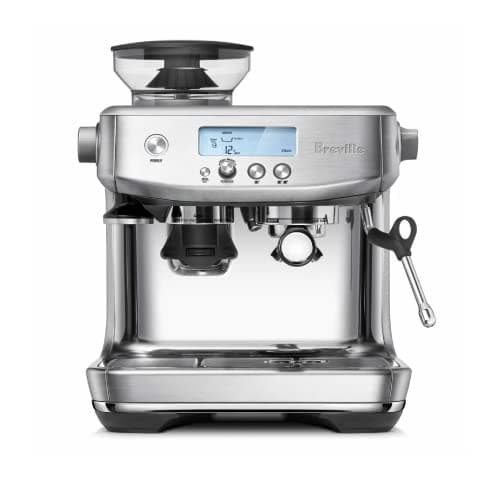
The all-in-one for a household that cannot wait: the same 54mm brew path as the Barista Express with a heater that is ready in about three seconds, an instant switch from espresso to steam, and the best grinder Breville fits to a manual machine — you still do every step of the puck prep by hand.
- Best for
- Busy households making several drinks back to back who want the grinder built in and refuse to wait for a boiler
- Price context
- Upper-mid-tier all-in-one; a step above the Barista Express and close to the Barista Express Impress
The Breville Barista Pro is what you get when Breville takes the Barista Express— the machine that defined the all-in-one — and rebuilds it around one complaint: waiting. The ThermoCoil boiler that made the Express take a warm-up is replaced by the ThermoJet heating system, which Breville rates at about three seconds to extraction temperature, with an instant switch from espresso to steam. Around that heater sit a better grinder (Baratza-made burrs, 30 settings against the Express's 16), digital PID temperature control and an LCD that animates the grind and the shot. The 54mm brew path, the Razor dose tool and the manual steam wand carry straight over.
A note on honesty first: we have not run this machine in a lab. This review compiles Breville's published specifications and the BES878 instruction book, cross-checks them against named hands-on reviews and long-term owner reports, and does the reasoning — the same method we use on every product, described on our methodology page. Prices move constantly, so we talk in brackets, not stale numbers; the live figure is in the buy box below.
Who the Barista Pro is for
The Barista Pro is for the household where the machine has to serve more than one person before anyone leaves the house. That is the buyer the ThermoJet was built for: no warm-up, no pause while the boiler climbs from brew temperature to steam temperature, and no cool-down flush before the next shot. If your Barista Express morning has ever been three people standing around a machine that is "heating," the Pro is the direct fix, and it keeps everything else that made the Express the default all-in-one: the grinder built in, one appliance, one learning curve.
It is notthe machine for someone whose shots come out differently every morning and who wants the machine to fix that. The Barista Pro leaves every step of puck prep in your hands — grind, dose, trim, tamp — and the usually-cheaper Barista Express Impress automates the two steps beginners get wrong. It is also not for the buyer who already owns a good standalone grinder: in that case a Bambino Plus gives you the same ThermoJet heater and 54mm brew path in half the footprint, and your grinder will out-grind the built-in one. And if you want a drink made for you at a button press, that is a super-automatic, a different class of machine.
What the specs say
On paper the Barista Pro is a semi-automatic, single-heater machine with an integrated grinder, and the sheet reads like a Barista Express with three lines changed. The heater is a ThermoJet rather than a ThermoCoil. The grinder carries Baratza European Precision Burrs with 30 grind settingsrather than Breville's own 16-step unit. And the analog pressure gauge is gone, replaced by an LCD with grinding and extraction progress animations. Everything else is the shared Breville formula: a 54mm stainless portafilter, a 15 bar Italian pump that delivers low-pressure pre-infusion followed by 9 bar extraction, PID temperature control, a manual steam wand, a 250 g locking hopper and a 2 L removable tank.
| Type | Semi-automatic, all-in-one (integrated grinder) |
|---|---|
| Grinder | Conical burr — Baratza European Precision Burrs, 30 settings (default 15) |
| Bean hopper | 8.8 oz / 250 g, locking, removable |
| Portafilter | 54mm stainless steel, commercial-style spouts |
| Heating | ThermoJet — extraction temperature in ~3 seconds |
| Temperature control | Digital PID, ±2°C; shot temperature adjustable from the menu |
| Pump pressure | 15 bar Italian pump; low-pressure pre-infusion, 9 bar extraction |
| Shot control | Volumetric 1 & 2 cup presets (approx. 30 ml / 60 ml), manual, programmable |
| Milk / hot water | Manual 360° swivel steam wand; dedicated hot water outlet |
| Water tank | 68 fl oz / 2 L, removable, replaceable water filter |
| Dimensions | ~16.1 x 13.8 x 13.1 in (W x D x H) |
| Weight | ~19.5 lb |
| Power | 1680 W, 120 V, 60 Hz; auto-off after 30 minutes |
| In the box | Razor dose trimming tool, Dosing Funnel 54, single & dual wall baskets (1 & 2 cup), 480 ml milk jug, water filter, cleaning disc, tablets, brush and wand tool, descaling powder |
Two lines deserve a second look. The adjustable shot temperatureis a real menu setting on this machine — you enter SHOT TEMP and turn the dial hotter or cooler, and the LCD shows where you are. And the volumetric controlis more flexible than a pair of preset buttons suggests: the 1 CUP and 2 CUP presets stop the shot automatically at roughly 30 ml and 60 ml, holding either button runs a manual pre-infusion for as long as you hold it, and a custom volume can be programmed and remembered. Breville's baskets are designed around roughly 8 to 11 g for the single and 16 to 19 g for the double. For a machine aimed at repeatable mornings, those features matter more than the screen they are displayed on.
Three seconds: what the ThermoJet actually changes
The ThermoJet is the reason this machine exists. Breville's claim is that it achieves the optimum extraction temperature in 3 seconds, and that it uses up to 32 percent less energy annually than a thermoblock system because it is not holding a mass of metal hot between drinks. In practice that produces three changes a Barista Express owner will feel on the first morning. There is no warm-up to wait through when you switch the machine on. There is no pause between pulling the shot and steaming the milk — the machine transitions from espresso temperature to steam temperature almost instantly. And there is no cool-down flush before the next shot, because the heater simply drops back to brew temperature.
Be precise about what it does notchange. This is still a single heating system: you brew, then you steam, never both at the same time. The switch is fast enough that most owners stop noticing, but a household that wants to texture milk while a shot pulls needs a dual-boiler or heat-exchanger machine, which is a different and considerably more expensive class. And "ready in three seconds" refers to the water, not the metal around it. The machine stays cold at idle — Home Explained's year-long review calls running one or two blank shots to heat the portafilter and cup "rather a necessary step," and Coffeeness notes that the group and cup tray do not warm until the machine has been used a few times. The manual itself recommends purging the group head before a shot for consistent temperature. Budget fifteen seconds of flushing into your routine and the three-second claim holds; skip it and your first shot of the day will run cooler than the rest.
The Baratza-burr grinder — the second reason to buy it
Breville does not make the burrs in this machine. The Barista Pro carries Baratza European Precision Burrs, the same burr maker whose standalone Encore ESP tops our best grinder for a Breville guide, and it offers 30 grind settingswhere the Barista Express offers 16. The default setting is 15, the machine shows the current setting on the LCD, and the hands-free dosing runs on a timer — 9.5 seconds for a single basket and 13 for a double by default, adjustable with the GRIND AMOUNT dial — so a full dose lands in the portafilter without you holding anything. When the 30 steps do not reach a bean, the instruction book documents an adjustable upper burr that shifts the whole range finer or coarser, which is how Home Explained dialed in lighter roasts that the stock setting could not reach. Both burrs are removable for cleaning.
Now the honest half. Three hands-on sources agree on the same limits. Coffeeness, testing in 2025, found the grinder "really noisy," saw "quite a bit of clumping" and "some grind retention in the chute," and felt that a single step between settings could be too big a jump for fine-tuning. Home Explained measured retention at as much as half a gram, which is a nuisance if you swap beans or single-dose, and judged consistency "not as good as some of the standalone grinders on the market" while still calling it very good for most people. That matches our reading of the spec: 30 stepped settings is a real improvement on 16, but a dedicated espresso grinder with stepless or micro-stepped adjustment from our best grinders for espresso guide still has more room to dial a shot in. And the grinder is locked to the machine— it cannot be upgraded on its own. For a buyer who wants one purchase and one footprint, that is the right trade. For a buyer who suspects they will chase lighter roasts and finer control, it is the signal to buy a Bambino and a separate grinder instead.
What it's like to live with
The daily routine is the Barista Express routine, minus the waiting. Lock the portafilter into the grinding cradle and press it to start the timed dose — or fit the included Dosing Funnel 54 first, which keeps grounds inside the basket instead of on the tray. Level the puck with the Razortrimming tool, tamp with the integrated 54mm tamper, lock in and press 1 CUP or 2 CUP. The LCD shows PRE-INFUSE, then a shot clock counts up as the espresso runs, and the volumetric preset stops it for you. Breville's own guide is that the flow should begin after roughly 8 to 12 seconds and pour like warm honey; earlier than 7 means coarser grind or under-dosing, later than 13 means too fine. If you are new to reading a shot, our how to pull an espresso shot guide walks through that logic, and why is my espresso bitter covers the first-week fixes.
The LCD is where opinions split. The shot clock is genuinely useful — Home Explained singles it out as the feature that made hitting a 25 to 30 second extraction easy — and the grind animation tells a beginner what the machine is doing. But it replaced the Barista Express's analog pressure gauge, and experienced users miss it: Coffeeness wrote that it hoped the gauge would return on newer Brevilles. A gauge shows you channeling and a choked puck as they happen; a timer only tells you how long it took. Neither is essential, but if you learned espresso on a gauge, know that this machine asks you to read the pour instead.
A few smaller things are worth knowing before the box arrives. The dry puck feature pulls excess water out of the spent puck after the shot, so it knocks out clean. The machine switches itself off after 30 minutesof inactivity, which with a three-second heater costs you nothing. There is an accessory storage tray behind the drip tray, the drip tray has a full indicator, and the cup clearance is tall enough for a mug. Coffeeness's 2025 unit arrived without a dosing funnel, which it called a staggering omission; Breville's current US product page and instruction book both list the Dosing Funnel 54 in the box, so check the contents when yours arrives rather than assuming either way.
Milk and hot water
The steam wand is fully manual, on a 360-degree swivel, driven by the same ThermoJet that heats the brew water — which is why it is ready the moment the shot finishes. Breville's instructions have you purge the wand briefly, then hold the tip just under the surface at the three o'clock position of the jug to stretch the milk, then submerge it to spin the vortex until the jug is hot to the touch, which the manual puts at 140 to 149°F. Home Explained times a jug at around 50 seconds, quicker than the Express, and rates the texture as very good with the usual caveat that microfoam quality is mostly the person, not the wand. This is the craft part of the machine: it will reward a few weeks of practice with proper latte art, and it will frustrate anyone who wanted the milk done for them. If that is you, the Bambino Plus and the Barista Touch models automate texturing; our how to steam milk guide is the shortcut for everyone else.
The second outlet is the one the Bambino line lacks: a dedicated hot water spout, selected with the same steam dial, for Americanos and for pre-heating cups. It runs for up to 60 seconds before shutting itself off (you still turn the dial back manually). It is a small feature that turns out to be the single most useful accessory for a ThermoJet machine, because it is the fastest way to put heat into a cold cup and a cold portafilter before the first shot.
Barista Pro vs Barista Express vs Express Impress
All three grinder-equipped Brevilles share the same 54mm portafilter, 15 bar pump, low-pressure pre-infusion and PID, so the decision is about what each one fixes. The Barista Express is the original and the cheapest: ThermoCoil with a warm-up, 16 grind settings, a pressure gauge and a manual wand. The Barista Pro fixes waiting: ThermoJet in three seconds, instant espresso to steam, 30 grind settings, adjustable shot temperature, LCD shot clock — but every step of puck prep stays manual. The Barista Express Impress fixes inconsistency: its Impress Puck System doses intelligently and assists the tamp, which removes the two steps that produce most bad home shots, while keeping the slower ThermoCoil.
Put simply: buy the Express if budget rules and you do not mind the wait; buy the Pro if the machine has to serve several people quickly and you enjoy the hands-on prep; buy the Impress if your shots vary from one morning to the next and you want the machine to take that variable away. Our Barista Express vs Pro vs Impress comparison lines the three up feature by feature, and the best Breville espresso machineguide decodes the whole lineup, including the Touch models that add automatic milk on top of the Pro's engine. One clarification on portafilter fit: like every current Breville, the Pro is 54mm, not the commercial 58mm standard — our portafilter size guide explains what that means for the accessories you will buy later.
Cleaning & maintenance
The Barista Pro asks for the same upkeep as any all-in-one, and the instruction book is unusually specific about it. The water filter in the tank should be replaced every two months, more often in a hard-water area, and Breville says doing so reduces how often the machine needs descaling. The LCD raises a FLUSH alertwhen the group needs a cleaning cycle with the included cleaning disc and tablets — that cycle is separate from descaling — and a DESCALEcycle runs from the menu in three stages (coffee, hot water and steam) using the included descaling powder. Both burrs lift out for cleaning, and the grinder chute will need an occasional brush-out given the retention owners report. None of it is hard; skipping it is the fastest way to shorten the machine's life. Our how to descale an espresso machine guide covers the routine, and what water to use in an espresso machine explains why the filter interval matters more than any cleaning product.
Alternatives worth considering
If you like everything about the Pro except the manual puck prep, the Barista Express Impressautomates dosing and tamping and usually costs a little less, but you give up the three-second heater for the slower ThermoCoil. If you want the Pro's speed and automatic milk, the Barista Touch Impress is the same ThermoJet and 30-setting grinder with Auto MilQ texturing and a touchscreen, at a much higher price. If you already own a good grinder or want to buy one, the Bambino Plus delivers the same ThermoJet heater and 54mm brew path in half the footprint with an automatic wand, and a standalone grinder from our best grinders for espresso guide will out-grind any built-in. If you would rather have a 58mm machine you can repair and modify for a decade, a Gaggia Classic Evo Pro plus a grinder is the enthusiast route at similar total money. And if bean-to-cup at a button press is the real goal, our best espresso machines with a grinder roundup puts the Pro beside the super-automatics it competes with, while best espresso machine under $1000 ranks the whole field in its bracket.
Verdict
The Barista Pro does exactly what its name change promises: it takes the Barista Express formula and removes the waiting. A heater that is ready in about three seconds, an instant handover from shot to steam, a genuinely better grinder with twice the adjustment range, adjustable shot temperature and a shot clock add up to the most capable manual all-in-one Breville makes. Go in understanding the deal. The machine is cold until water runs through it, so your routine starts with a blank shot. The grinder is good rather than great, and it is noisy, clumpy and retentive enough that bean-swappers will purge. The gauge is gone. And you still do every step of the puck prep yourself, which is precisely why the usually-cheaper Impress beats it for a beginner whose shots vary. If your household's problem is speed, not consistency, the Barista Pro is the right Breville — and before you buy, read the true cost of home espresso so the running costs hold no surprises.
What we liked
- ThermoJet heater reaches extraction temperature in about three seconds and switches from espresso to steam instantly — the wait that defines the Barista Express is gone
- Baratza European Precision Burrs with 30 grind settings, plus an adjustable upper burr to extend the range — the finest adjustment on any Breville manual all-in-one
- Digital PID holds brew temperature to within ±2°C, and the shot temperature is adjustable from the menu
- Volumetric 1-cup and 2-cup presets, a manual override, programmable volumes and an on-screen shot clock take the guesswork out of repeating a good shot
- Dedicated hot water outlet for Americanos and pre-heating cups, which the Bambino line does not have
- Real 54mm portafilter with the whole Breville accessory ecosystem behind it, and a 2 L tank that gets a household through the morning
What gave us pause
- Every step of puck prep is still manual — the usually-cheaper Barista Express Impress doses and tamps for you, and beats the Pro on shot-to-shot consistency
- The pressure gauge from the Barista Express is gone, replaced by an LCD — many experienced users miss it
- Hands-on reviewers report the grinder is noisy, clumps, and retains roughly half a gram between doses, so switching beans means purging
- The group head and cup tray stay cold at idle; owners run one or two blank shots to heat the portafilter and cup before the first real one
- Single heating system: you brew, then steam — the switch is near-instant, but it is never simultaneous
- Large and heavy at roughly 16 x 14 x 13 in and about 19.5 lb, and Breville-locked: you cannot upgrade the grinder without replacing the whole machine
Frequently asked questions
What is the difference between the Breville Barista Pro and the Barista Express?
They share the same 54mm portafilter, 15 bar pump with low-pressure pre-infusion, PID temperature control and manual steam wand. The Barista Pro replaces the Express's ThermoCoil boiler with a ThermoJet heating system that reaches extraction temperature in about three seconds and switches from espresso to steam instantly, upgrades the grinder from 16 settings to Baratza European Precision Burrs with 30 settings and an adjustable upper burr, adds an adjustable shot temperature from the menu, and swaps the analog pressure gauge for an LCD with a shot clock. The Express is cheaper and still needs a warm-up.
Is the Breville Barista Pro good for beginners?
Yes, with one caveat. The grinder is built in, the LCD shows the grind and the shot progressing with a timer, the volumetric presets stop the shot for you, and the Razor tool and Dosing Funnel make dosing repeatable. But every step of puck prep - grind, dose, trim, tamp - is still done by hand, and the manual steam wand takes practice. A beginner whose shots vary from day to day may be better served by the Barista Express Impress, which doses and assists the tamp automatically.
Does the Barista Pro really heat up in 3 seconds?
Breville rates the ThermoJet heating system at about three seconds to optimum extraction temperature, and hands-on reviewers confirm there is no boiler warm-up and the switch to steam is near-instant. What the figure does not cover is the metal: the group head, portafilter and cup tray stay cold at idle, so owners run one or two blank shots through the group before the first real shot of the day. Budget that flush into the routine and the claim holds in practice.
Does the Breville Barista Pro have a pressure gauge?
No. The Barista Pro replaced the Barista Express's analog pressure gauge with an LCD that animates the grinding and extraction progress and shows a shot clock. The timer is useful for hitting a 25 to 30 second extraction, but a gauge shows channeling and a choked puck as they happen, and several experienced reviewers say they miss it. The Barista Express and the Barista Express Impress both keep the gauge.
Can the Barista Pro brew and steam at the same time?
No. It has a single ThermoJet heating system, so you pull the shot and then steam the milk. The transition between the two is almost instant on this machine, which is its whole point, but brewing and steaming simultaneously requires a dual-boiler or heat-exchanger machine, which is a different and more expensive class of equipment.
How much maintenance does the Barista Pro need?
Breville's instruction book says to replace the water filter every two months (more often in hard-water areas), which reduces how often the machine needs descaling. The LCD raises a FLUSH alert when a group-cleaning cycle with the included cleaning disc and tablets is due, and a separate DESCALE cycle runs from the menu in three stages using the included descaling powder. The upper and lower burrs lift out for cleaning, and owners report enough retention in the grinder chute that it benefits from an occasional brush-out.
Sources
- Breville — the Barista Pro (BES878) product page: Baratza European Precision Burrs with 30 grind settings, ThermoJet to optimum extraction temperature in 3 seconds and up to 32% less energy than thermoblock, 15 bar Italian pump, low-pressure pre-infusion followed by 9 bar extraction, volumetric shot control, dimensions, included accessories
- Breville — the Barista Pro BES878 US instruction book (PDF): components and rating (120 V, 1680 W), 8.8 oz / 250 g hopper, 68 fl oz / 2 L tank, 30 grind settings and default 15, default grind times, adjustable upper burr, adjustable shot temperature, hot water outlet and 60-second stop, preset shot volumes, 30-minute auto-off, milk temperature, water filter interval, FLUSH and DESCALE cycles, in-the-box list
- Amazon listing for BES878BSS via the Creators API (checked 2026-09-19): model number, In Stock / New condition, feature bullets incl. PID ±2°C and LCD, item weight 19.5 lb, 2-year limited warranty
- Coffeeness — Breville Barista Pro review (hands-on, updated May 22, 2025): grinder noise, clumping and chute retention, step size between settings, loss of the pressure gauge, cold group and cup tray at idle, dosing funnel omission on their unit
- Home Explained — Breville Barista Pro long-term review (about one year of daily use): retention up to 0.5 g, adjustable inner burr for lighter roasts, blank shots to preheat the group, shot-clock usefulness, ~50-second milk steaming
Keep reading
- Barista Express vs Pro vs Impress: which should you buy? →
- Best Breville espresso machine (whole lineup decoded) →
- Breville Barista Express (BES870) review →
- Breville Bambino Plus (BES500) review →
- Best espresso machines with a built-in grinder →
- Best grinder for a Breville espresso machine →
- How to pull an espresso shot →
Buying your first setup?
See how we pick — compiled specs, cost-per-shot math, and honest trade-offs — then dig into the guides. No fake test lab, no rankings for hire.