Buying Guide
The Best Grinder for a Breville Espresso Machine
A Bambino is only as good as the grind you feed it. Six grinders that reach espresso fineness, adjust finely enough to dial a 54mm basket in, and fit the way a Breville is actually used.
The single most common question from a new Breville owner is some version of which grinder do I buy for this thing, and it is the right question to be asking. A Bambino or Bambino Plus ships with no grinder at all, and the machine cannot compensate for what it is fed. Pre-ground coffee in a 54mm basket gives you one grind setting, chosen months ago by a roaster who had no idea which machine it was going into.
This page is narrower than our general best-grinder-for-espresso guide: every pick here is judged specifically on how it behaves next to a Breville — the 54mm basket, the counter space a Bambino leaves you, and the fact that Breville's machines heat in about three seconds, so a slow grinder becomes the thing you wait for.
First: does your Breville actually need a grinder?
Half the Breville espresso range already has one built in, so before you buy anything, check which side of the line your machine sits on. The naming is the tell, and we decode the whole lineup on our best Breville espresso machine page.
| Breville model | Built-in grinder? | Needs a separate grinder |
|---|---|---|
| Bambino (BES450) | No | Yes — this page is for you |
| Bambino Plus (BES500) | No | Yes — this page is for you |
| Barista Express (BES870XL) | Yes — conical burr, 16 settings | No |
| Barista Express Impress (BES876) | Yes — conical burr, 25 settings | No |
| Barista Pro (BES878) | Yes — Baratza burrs, 30 settings | No |
| Barista Touch / Touch Impress | Yes — 30 settings | No |
If you own a Barista-anything, the grinder is inside the machine and a second one is a want, not a need. If you own a Bambino or Bambino Plus, the grinder is the missing half of the setup and it deserves a real share of the budget. Our Barista Express vs Bambino comparison works through that trade if you have not bought the machine yet.
What a Breville actually needs from a grinder
We rank on published specifications and manufacturer documentation, not on lab tests we did not run — units we claim to have tested: zero, and our full approach is on the methodology page. For this specific pairing, four things decide it.
- It has to reach espresso fineness, and adjust finely once it gets there. Breville's 54mm machines run a 15 bar pump delivering about 9 bar at the puck, which means the grind has to build real resistance. A grinder whose finest setting is "fine-ish" will gush every shot no matter how you tamp. Resolution matters more than the number of settings: what you want is small microns per step, not a big number on the dial.
- The dose is a 54mm basket, not a 58mm one.Breville's single and dual-wall baskets are smaller in diameter than the commercial 58mm standard, so a grinder that throws grounds into a wide 58mm dosing cup will scatter them across your counter on the way in. A 54mm dosing cup, or a grinder that doses straight into the portafilter, is worth more here than it looks on a spec sheet.
- Speed, because a Breville is ready before you are. The ThermoJet heater in the Bambino line reaches temperature in about three seconds. If the grinder takes ninety, the grinder is now the slow part of your morning. This is the one place a hand grinder costs you something real.
- Footprint. A Bambino is roughly 7.7 inches wide and exists precisely because people want espresso without surrendering the kitchen. Pairing it with a fifteen-pound grinder undoes the point.
At a glance
| Grinder | Type | Burrs | Adjustment | Doses into | Price |
|---|---|---|---|---|---|
| Baratza Encore ESP | Electric | 40mm conical | 40 steps (~20µm espresso) | 54mm cup included | $199.95Buy |
| Timemore C3 ESP | Hand | 38mm conical | Stepped dial | Catch cup | $99.00Buy |
| Eureka Mignon Notte | Electric, hopper | 50mm flat | Stepless | Portafilter directly | $299.00Buy |
| DF64 Gen 2 | Electric, single dose | 64mm flat | Stepless | Dosing cup | $389.00Buy |
| Baratza Sette 270 | Electric, hopper | 40mm conical | 270 settings | Portafilter directly | $399.95Buy |
| 1Zpresso J-Ultra | Hand | 48mm conical | 8 microns per click | Catch cup | $199.00Buy |
Prices shown are from Amazon as of Sep 18, 2026 and change often — the button always goes to the current listing. Some links may earn us a commission at no extra cost to you.
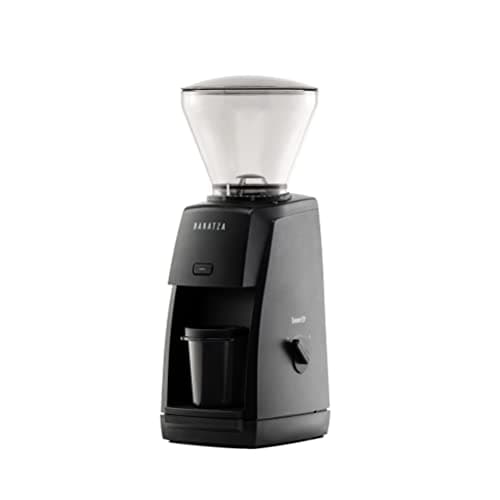
Best overall for a Bambino: Baratza Encore ESP
This is the default answer, and the reason is unusually concrete: the Encore ESP ships with a 54mm dosing cupand a 58mm portafilter adapter in the box. Baratza built it for exactly this situation — an entry semi-automatic with a 54mm basket and no grinder — and it is the only grinder on this page that arrives already sized for a Breville.
Mechanically it is the Encore reworked for the fine end. The 40 stepped settings are split deliberately: 1-20 for espresso at roughly 20 microns per step, and 21-40 for filter at roughly 90 microns. That espresso step size is the number that matters, because it is small enough that one click adjusts the shot rather than overshooting it. The 40mm M2 conical burrs are user-replaceable, which matters on a wear item.
| Burrs | 40mm M2 conical (steel, user-replaceable) |
|---|---|
| Grind settings | 40 stepped (1-20 espresso, 21-40 filter) |
| Espresso step size | ~20 microns per step |
| Filter step size | ~90 microns per step |
| Motor | DC, ~550 RPM, ~70W |
| Bean hopper | 8 oz / 230 g |
| Included | 54mm dosing cup + 58mm portafilter adapter |
What we like for this pairing: the 54mm cup, the espresso-tuned step size, a slow DC motor that does not heat the grounds, and Baratza's US parts and repair channel — the same reason its burrs turn up inside Breville's own Barista Pro.
The honest cons: it is stepped, not stepless, so occasionally the setting you want sits between two clicks. It is hopper-fed, so some coffee stays in the machine between doses and switching beans means purging. And it does not dose hands-free into the portafilter — you grind into the cup, then transfer.
Our full Baratza Encore ESP review covers the burr set in detail, and Encore vs Encore ESP explains why the plain Encore is the wrong one for espresso.
Best budget pairing: Timemore Chestnut C3 ESP
If the machine ate the budget — which is what usually happens — this is the cheapest grinder we would put in front of a Breville and still expect a real shot. The 38mm S2C stainless conical burrs and the espresso-tuned adjustment on the ESP variant reach genuine espresso fineness, which is the bar almost nothing else at this price clears.
Paired with a Bambino it works well, with one honest caveat about the morning: the machine is hot in three seconds and you will be cranking for a minute or so. Some people find that a pleasant ritual and some find it a chore, and it is worth being honest with yourself about which you are before buying.
What we like: espresso-capable grinding for well under a hundred dollars, no counter space used, and nothing to break. The honest cons: smaller burrs than the J-Ultra mean more effort and slightly less consistency at the extremes, the adjustment is less precise, and you dose into a catch cup rather than the basket.
Best step up: Eureka Mignon Notte
The Notte is the first grinder on this page that is genuinely stepless, and on a 54mm basket that is a meaningful upgrade — a smaller basket is less forgiving of a grind that lands one click too coarse. 50mm flat steel burrsand Eureka's micrometric knob let you land anywhere on a continuous dial instead of choosing between two clicks.
It also suits how a Bambino is used. Dosing is manual — you hold the portafilter against the switch and the grounds go straight into the basket — so there is no dosing cup, no transfer and no spilled grounds. The chassis is hand-assembled metal and narrow enough to stand beside a Bambino without dominating the counter.
| Burrs | 50mm flat (steel) |
|---|---|
| Adjustment | Stepless (micrometric knob) |
| Grind range | Espresso to pour over |
| Dosing | Manual (press portafilter to grind) |
| Hopper | ~5.5 oz bean hopper |
| Build | Metal case, hand-assembled in Italy |
The honest cons: stepless means there is no number to write down, so note your setting before you change beans. It is hopper-fed, so retention is real and Eureka does not publish a figure — we will not invent one. And there is no timer or grind-by-weight, so you watch the grounds and stop it yourself.
Our Eureka Mignon Notte review has the full picture, and it sits in the middle of our best espresso grinders under $500 bracket.
Best single dose: DF64 Gen 2
If you buy small bags and rotate roasts, the hopper is the problem, not the burrs. The DF64 Gen 2 is a true single-dose grinder: you weigh beans in, grind, and the manufacturer quotes under 0.1 g of retentioneven without using the bellows — which is the figure that makes weighing a dose for a 54mm basket meaningful at all.
It is also simply the most grinder here. 64mm flat stainless burrs driven by a 250W motor at around 1400 RPM, with stepless adjustment and a plasma generator in the exit chute to kill the static that flat burrs otherwise produce.
| Burrs | 64mm flat (stainless steel) |
|---|---|
| Adjustment | Stepless |
| Motor | 250W, ~1400 RPM |
| Dosing | Single dose (50 g bellows hopper) |
| Retention | Under 0.1 g (manufacturer figure) |
| Static control | Plasma generator (ionizer) |
| Size / weight | 10" D x 5.2" W x 12" H, ~15 lb |
The honest cons, and they are real next to a Bambino: at roughly 15 lb and 12 inches tall it is a much bigger object than the machine it is feeding, which rather defeats the compact machine you chose. Single dosing is a slower routine — weigh, pour, puff the bellows. And the DF64 is sold under several brand names by different distributors, so warranty and support quality vary by seller in a way Baratza and Eureka do not.
Best hands-free dosing: Baratza Sette 270
The Sette is the one grinder here designed to grind into a portafilter rather than into a cup you then tip. It holds the portafilter in a cradle and pushes grounds straight down at 3.5-5.5 g per second, which on a machine that is hot in three seconds keeps the whole routine under a minute.
The adjustment is unusual and useful: 270 settings from 30 macro positions crossed with 9 micro positions, over a published range of 230-950 microns. Its straight-through path means retention is about half a gram — not single-dose territory, but far below a conventional hopper grinder.
| Burrs | 40mm conical (stainless steel) |
|---|---|
| Adjustment | 270 settings (30 macro x 9 micro) |
| Grind range | 230-950 microns |
| Grind speed | 3.5-5.5 g per second |
| Motor | 290W (110-120V US) |
| Hopper | 9.7 oz beans / 5.6 oz grounds container |
| Retention | About half a gram (straight-through path) |
| Warranty | 1-year limited |
The honest cons: it is the loudest grinder on this page by a wide margin, which is a real consideration at 6am with a machine as quiet as a Bambino. The portafilter cradle is sized generously and a 54mm Breville portafilter sits in it rather than locking to it, so check your alignment the first few times. And it costs roughly what the Bambino does.
Best hand grinder: 1Zpresso J-Ultra
The finest adjustment on this page belongs to a hand grinder. The J-Ultra's external adjustment ring moves 8 microns per click, with 100 clicks per rotationand 500 clicks across its full range — finer resolution than any electric here, for less than half the price of most of them.
On a 54mm basket that resolution is genuinely useful, because the margin between a gusher and a choke is narrower in a smaller basket. The 48mm titanium-coated conical burrs also grind noticeably faster than the smaller C3, so the cranking is shorter than you expect.
| Type | Manual (hand) grinder |
|---|---|
| Burrs | 48mm conical, titanium-coated stainless (heptagonal) |
| Adjustment | External ring, 100 clicks/rotation, 8 microns per click |
| Total range | 500 clicks across 5 rotations |
| Capacity | 35-40 g |
| Weight | 670 g (1.5 lb) |
| Included | Cleaning brush, blower, case for the foldable handle |
The honest cons: it is still a hand grinder, so it is you doing the work every single morning, and a household where several people want drinks will tire of it fast. There is no hands-free dosing. And the numbered ring is a joy right up until someone else moves it.
How much to spend, relative to the machine
The rule this site keeps repeating applies most sharply here: for espresso, the grinder changes what is in the cup more than the machine does. A Bambino with a well-dialed grind beats a far more expensive machine fed an inconsistent one, every time.
A useful way to think about it is that a Bambino-class machine and its grinder should cost roughly the same, and if anything the grinder should tip higher rather than lower. Spending $300 on the machine and $40 on a blade grinder produces worse coffee than spending $150 on each — and a blade grinder is not a budget espresso grinder, it is a non-starter, because it makes boulders and dust in the same batch and you cannot build even resistance across a puck with either. Our burr vs blade explainer covers why, and the best home espresso setup shows what a complete, balanced kit costs.
Two accessories punch above their weight alongside any of these: a scale so the dose is a number rather than a guess, and a WDT tool to break up clumps before you tamp. Both cost less than the difference between two of the grinders above.
How to choose
Work down this list and the six become one.
- Do you own a Barista-series Breville? Then you already have a grinder. Spend the money on better beans and puck prep instead.
- Is this your first grinder, with a Bambino on the counter? Buy the Encore ESP. The 54mm dosing cup and the 20-micron espresso steps make it the least fiddly starting point in the category.
- Is the budget genuinely tight? The Timemore C3 ESP, and be honest about the daily minute of cranking.
- Do you want to grind straight into the portafilter and press a button? The Mignon Notte if quiet and stepless matter; the Sette 270 if speed matters more than noise.
- Do you rotate roasts and weigh every dose? The DF64 Gen 2— accepting that it will be the biggest object on the counter.
- Do you want the finest adjustment for the least money, and enjoy the ritual? The 1Zpresso J-Ultra.
Whichever you land on, the next thing to read is how to pull an espresso shot, because a new grinder does not dial itself in — and if the shots come out sour or thin at first, check which basket your Breville is using, since a pressurized one will hide most of what your new grinder is doing.
Frequently asked questions
What is the best grinder for a Breville Bambino?
The Baratza Encore ESP for most people. It is the only grinder in the category that ships with a 54mm dosing cup — the size a Breville basket actually takes — and its 40 settings are split so that 1-20 cover espresso at roughly 20 microns per step, which is fine enough to dial a shot in rather than overshoot it. If the budget is tight, the Timemore Chestnut C3 ESP reaches espresso fineness by hand for far less.
Do I need a grinder for the Breville Barista Express?
No. The Barista Express, Barista Express Impress, Barista Pro, Barista Touch and Barista Touch Impress all have a conical burr grinder built in — 16 settings on the Express, 25 on the Impress and 30 on the Pro and Touch models. Only the Bambino and Bambino Plus ship without one. A separate grinder alongside a Barista is a want, not a need.
Does a Breville need a 54mm grinder?
Grinders do not have a portafilter size — the machine does. Breville's espresso machines use a 54mm portafilter, so what matters is that the grounds land in a 54mm basket without spraying across the counter. A grinder that includes a 54mm dosing cup (the Encore ESP does) or doses straight into the portafilter (the Mignon Notte and Sette 270 do) makes that easier. Any grinder that reaches espresso fineness will work with a funnel.
Can I use pre-ground coffee in a Bambino instead of buying a grinder?
It will brew, but you give up the only adjustment that matters. Pre-ground coffee is one fixed grind size chosen by the roaster, so when a shot runs too fast or too slow you have nothing to change. It also stales quickly once ground. Pre-ground works best in the pressurized (dual-wall) basket the Bambino includes, which creates artificial back-pressure — useful as a stopgap, but it caps what the machine can do.
How much should I spend on a grinder for a Breville?
As a rough planning rule, roughly what you spent on the machine, and if anything tip the balance toward the grinder rather than away from it. For espresso the grinder changes the cup more than the machine does, so a modest machine with a well-dialed grind beats an expensive machine fed an inconsistent one. Blade grinders are not a budget option — they produce boulders and dust in the same batch and cannot build even resistance in a puck.
Is a hand grinder good enough for a Breville Bambino?
Yes, on grind quality — the 1Zpresso J-Ultra adjusts in 8-micron clicks, finer than any electric on this page. The catch is workflow, not quality: the Bambino's ThermoJet heater is ready in about three seconds and you will still be cranking. For one or two drinks a day that trade is fine; for a household making several drinks each morning, an electric grinder is the right answer.
Sources
- Baratza — Encore ESP specifications: 40mm M2 burrs, 40 stepped settings, espresso and filter step sizes, included 54mm dosing cup and 58mm adapter
- Breville — the Barista Pro (BES878) product page: 30 grind settings, Baratza European Precision Burrs
- Breville — the Barista Express Impress (BES876) product page: 54mm portafilter, 25 grind settings
- Breville — the Bambino (BES450) instruction book: 54mm portafilter, ThermoJet heating, 15 bar pump
- Eureka — Mignon Notte product page: 50mm flat burrs, stepless micrometric adjustment
- DF64 Coffee — DF64 Gen 2 single dose grinder specifications (64mm burrs, 250W, plasma generator, retention)
- Whole Latte Love — Baratza Sette 270 published specifications (270 settings, 230-950 microns, 3.5-5.5 g/sec, 290W)
- 1Zpresso — J-Ultra specifications (48mm coated conical burr, 100 clicks/rotation at 8 microns, 35-40 g capacity)
- Timemore — Chestnut C3 ESP specifications: S2C burr set
Keep reading
Buying your first setup?
See how we pick — compiled specs, cost-per-shot math, and honest trade-offs — then dig into the guides. No fake test lab, no rankings for hire.