Buying Guide
The Best WDT Tools in 2026
A WDT tool is the cheapest upgrade that makes your shots consistent. Here's how the needles kill channeling, what thickness and fit to look for, then the right tool for each buyer — with honest cons.
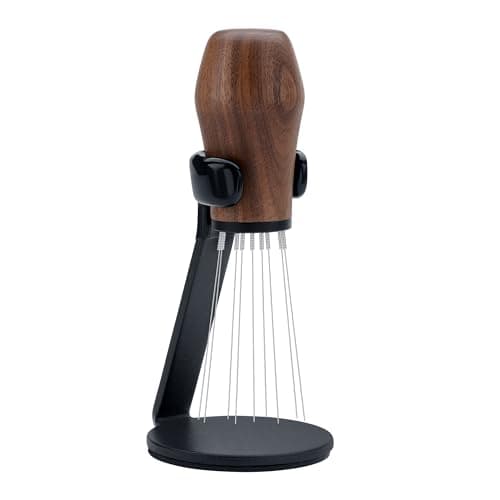
A WDT tool — short for the Weiss Distribution Technique— is a handle of very fine needles you stir through the ground coffee in your portafilter basket. It sounds trivial, and it's one of the biggest improvements you can make to a home espresso shot for the least money. Fresh grounds clump as they fall into the basket, and those clumps create dense and loose patches that water races around rather than through — the fault called channeling. Break the clumps up with fine needles and the coffee sits evenly, water meets uniform resistance, and extraction evens out. Sour, spurting, inconsistent shots usually clean right up.
Our overall pick is the Normcore WDT Distribution Tool with Stand V3, because it gets the details right — enough fine needles, a comfortable handle and a stand that keeps them safe — at a price that makes it an easy first upgrade. But there's a good value option, a premium hands-free distributor, and a leveler that pairs perfectly with any of them. Below, what WDT actually does, then the picks with honest trade-offs. WDT is one piece of the puck-prep toolkit; the full set, including tampers and a bottomless portafilter, is in our best espresso tamper & puck-prep guide.
What WDT is (and why it works)
Espresso forces water through a packed bed of coffee at around 9 bar. For the shot to extract evenly, the water has to meet the same resistance everywhere across the puck. The problem is that ground coffee doesn't fall into the basket evenly — static and clumping leave dense knots and loose gaps. Water, like everything, takes the path of least resistance: it bores through the loose spots (over-extracting them and picking up bitterness) while barely touching the dense ones (leaving them sour and under-extracted). That's channeling, and it's the single most common reason a home shot tastes off. If yours does, start with our espresso channeling guide, which ranks the five causes in the order they usually turn out to be, or why is my espresso bitter if the taste is the symptom you are chasing.
WDT fixes it before it starts. You stir a cluster of fine needlesthrough the dose, which shears the clumps apart and redistributes the grounds into a uniform, fluffy bed. Do it well and there are no dense knots for water to avoid and no loose gaps for it to bore through — the extraction evens out and the shot gets sweeter and more repeatable. It's the first step in the full puck-prep routine covered in our how to pull an espresso shot guide. A few details decide whether a WDT tool actually does the job:
- Needle thickness. You want fine needles, roughly 0.3–0.4mm. Thinner needles (around 0.25–0.3mm) slip between grounds and shear clumps without dragging the bed around; anything much thicker starts pushing coffee rather than separating it, and does less useful work.
- Needle count. More needles cover more of the basket per pass, so the stir is more even and faster. A cluster of eight or nine fine needles is the sweet spot for a home tool.
- A stand or holder.Fine needles bend if they're knocked or tossed in a drawer. A stand keeps them straight, upright and safe between shots — a small thing that protects the tool.
- Portafilter fit.The needles need to reach into your basket without the tool fouling the rim. Match the tool to your basket — 58mm for most machines, 54mmfor Breville, 51mm for some De'Longhi. Adjustable tools that span several sizes are the safe bet if you're unsure.
One more thing: WDT is distribution inside the bed, not levelingof the surface. After you stir, many people run a leveler or distributor across the top to flatten the bed, then tamp. WDT and a leveler do different jobs and pair naturally — which is why we've included one leveler below alongside the needle tools.
How we picked
We don't run a test lab, and we won't pretend to. Every tool here was evaluated against its published manufacturer specifications, the design details that decide whether it actually distributes the grounds well, and verified owner feedback — our full approach is on the methodology page. For WDT tools specifically, we weighted:
- Needle fineness and count.Fine needles (roughly 0.25–0.4mm) in enough numbers to shear clumps without dragging the bed around.
- Fit and reach.The right depth and diameter for common baskets — 58mm, 54mm, sometimes 51mm — or an adjustable design that spans them.
- Stand and storage. A holder that keeps the fine needles straight and protected between shots, because bent needles are the main way these tools fail.
- Build and repeatability.A comfortable handle, a stable stir, and — on the premium picks — a design that removes technique so results are the same every time.
- Honest fit for the buyer. A great-value tool, a well-made all-rounder and a hands-free distributor do different things. We say who each is for.
At a glance
The field side by side. Tap any "view" button for the live Amazon price — the number shown at checkout is the one that applies.
| Tool | Needles / type | Fit | Best for | Price |
|---|---|---|---|---|
| Normcore WDT V3 | 9 needles, 0.35mm | With stand | Best overall | $32.69Buy |
| MHW-3BOMBER | 0.4mm, adjustable (+ spares) | 51 / 54 / 58 mm | Best value | $25.99Buy |
| Normcore Planetary V3 | Planetary rotating needles | 58 mm | Premium / adjustable | $99.99Buy |
| Normcore Leveler | Spinning leveler (not needles) | 58.5 mm | Pairing / leveling | $39.99Buy |
Prices shown are from Amazon as of October 17, 2026 and change often — the button always goes to the current listing. Some links may earn us a commission at no extra cost to you.
Best overall: Normcore WDT Distribution Tool with Stand V3
The Normcore WDT Tool V3is the one we'd hand almost anyone, because it nails the details that matter. It uses nine fine stainless-steel needles at 0.35mm— thin enough to shear clumps rather than push the bed around, and enough of them to distribute the whole dose evenly in a few seconds. It sits on a walnut handle that feels good in the hand and comes with a matching standthat keeps the needles straight and safe between shots. It's well made, it's inexpensive, and it does the single most important puck-prep job better than most.
| Needles | 9-prong stainless steel, 0.35 mm |
|---|---|
| Handle | Walnut |
| Includes | Matching stand / holder |
| Job | Break up clumps, distribute grounds (WDT) |
| Fits | Used inside the basket (works with 54 / 58 mm) |
What we like: the biggest improvement per dollar in espresso, fine needles that do real work, a genuinely nice walnut handle, and a stand so the needles don't bend in a drawer. The honest cons: like all fine-needle tools the needles will bend if you're rough with them, and it adds a stepto your routine — a few seconds of stirring before every shot. Neither is a real drawback for what it delivers. If you buy one WDT tool, buy this.
Best value: MHW-3BOMBER WDT Tool
The MHW-3BOMBER WDT Tool is the pick if you want the most tool for the least money. It runs 0.4mm stainless needles— slightly thicker than the Normcore's, still fine enough to break up clumps — and, smartly, it ships with spare needles, which matters because bent needles are the usual failure. It sits on a magnetic stand that holds it upright and it's built to fit 51, 54 and 58mm portafilters with an adjustable needle range, so it works across machines and is a safe buy if you own more than one or aren't sure of your basket size.
| Needles | 0.4 mm stainless steel (spares included) |
|---|---|
| Adjustable | Yes — needle range adjusts |
| Stand | Magnetic |
| Fits | 51 / 54 / 58 mm portafilters |
| Job | Break up clumps, distribute grounds (WDT) |
What we like: excellent value, a magnetic stand, spare needles in the box, and genuine cross-machine fit for 51/54/58mm baskets — a lot of flexibility for little money. The honest cons: the 0.4mm needles are a touch thicker than the finest tools, so they shear very tight clumps slightly less cleanly; and an adjustable, multi-part tool has more pieces to keep track of than a fixed one. For most home setups, none of that outweighs the price.
Best premium / adjustable: Normcore 58mm Planetary WDT Tool V3
The Normcore 58mm Planetary WDT Tool V3 is the tool for people who want to take their own hand out of the equation. Instead of you stirring freehand, it uses a planetary (rotating) motion: the needles orbit and spin at once, so a single twist sweeps them across the wholebasket in an even, repeatable pattern rather than wherever you happened to poke. That's the appeal — near hands-free, consistent distribution every time, sized for 58mm baskets. If you want the most repeatable WDT and are willing to pay for it, this is the premium pick.
| Type | Planetary / rotating distributor (WDT) |
|---|---|
| Motion | Needles orbit and spin for whole-basket coverage |
| Fit | 58 mm baskets |
| Best for | Hands-free, repeatable even stirring |
| Job | Break up clumps, distribute grounds evenly |
What we like: the planetary motion makes the stir consistent and near-automatic, which removes the technique variance a freehand tool leaves in — genuinely useful if your hand-stir is inconsistent. The honest cons: it's the priciest way to do WDT by a wide margin, the moving mechanism is more to clean and more that can wearthan a simple needle handle, and it's 58mm-specific, so Breville 54mm owners need a different tool. Buy it for the repeatability, not to save money.
Best pairing: Normcore Distribution / Leveler Tool (58.5mm)
Be clear on what this one is: the Normcore Distribution / Leveler Tool is not a WDT needle tool. It's an adjustable-depth spinning leveler for 58mmbaskets — you rest it on the basket and spin, and its angled fins sweep the surface of the grounds flat to a set depth. We include it because it's the natural companion to a WDT tool: WDT breaks up clumps and distributes the coffee inside the bed, then a leveler flattens the surface so your tamp lands even. Together they cover the whole distribute-then-level step before you tamp.
| Type | Spinning leveler / distributor (not a needle WDT tool) |
|---|---|
| Diameter | 58.5 mm |
| Fits | 58 mm portafilters |
| Depth | Adjustable |
| Material | Stainless steel |
What we like: a flat, even surface with almost no technique, adjustable depth to match your dose, and a solid stainless build that pairs neatly with a needle tool. The honest cons: it does not break up clumps lower in the basket— that's WDT's job, so it complements a needle tool rather than replacing it — and it's 58mm only. Some baristas skip levelers entirely once their WDT and tamp are dialed in; think of this as the finishing companion, not the main event.
How to choose a WDT tool
Strip away the model names and it comes down to four questions.
What's your budget? WDT is the cheapest fix in espresso, so almost any real tool beats none. If you want the best all-rounder, the Normcore V3is the pick. If you want maximum flexibility for the least money — including spare needles and multi-size fit — the MHW-3BOMBER is the value buy. Only step up to the Planetary if repeatable, hands-free distribution is worth the premium to you.
What does your machine take? Match the tool to your basket. Most machines are 58mm; Breville is 54mm; some De'Longhi machines are 51mm. The MHW-3BOMBER's 51/54/58mm fit is the safe choice if you own more than one machine or aren't sure of your size, while the Normcore Planetary and leveler are 58mm-specific. The sizing details are covered further in our tamper & puck-prep guide.
Freehand or hands-free?A needle handle (Normcore V3, MHW-3BOMBER) is cheap, effective and gives you full control — the standard choice. A planetary distributor removes your hand from the stir for the most repeatable result, at a higher price and with more to clean. Both are real WDT; the difference is consistency versus cost.
Do you also want a leveler? WDT distributes inside the bed; a leveler flattens the surface. They pair well, so if you want the complete distribute-then-level step, add the Normcore Leveler— just remember it doesn't replace the needle tool. And none of this substitutes for a good grind and a consistent tamp; WDT pairs with a calibrated tamper, and the whole toolkit only shines on a decent machine and grinder — start with our best espresso machine for beginners guide.
The bottom line
For most people, the Normcore WDT Tool V3is the smartest buy — fine 9-prong needles, a nice walnut handle and a stand that protects them, all for little money. On a tighter budget, or if you own machines of different basket sizes, the MHW-3BOMBER is the value pick with spare needles, a magnetic stand and 51/54/58mm fit. If you want the stir taken out of your hands entirely, the Normcore Planetary V3 is the premium, most-repeatable option. And whichever needle tool you choose, the Normcore Leveleris the natural companion for flattening the bed — just remember it levels the surface rather than breaking up clumps, so it adds to a WDT tool rather than replacing it.
Keep the fundamentals in view: fine needles, a stand so they don't bend, and a fit that matches your basket. Stir first, level, then tamp. WDT is the cheapest upgrade to shot consistency there is, and it pairs with the rest of the puck-prep kit in our best espresso tamper & puck-prep guide. Once your shots are even, the other half of a great flat white is the milk — see our sibling best milk frothing pitcher guide.
Frequently asked questions
What is a WDT tool and what does it do?
WDT stands for the Weiss Distribution Technique. A WDT tool is a handle of very fine needles you stir through the ground coffee in your portafilter basket before tamping. Fresh grounds fall in clumps, which make water channel through the loose spots and skip the dense ones — causing uneven, sour, spurting shots. Stirring with the needles breaks up those clumps and distributes the coffee evenly, so water meets uniform resistance and extraction evens out. It's the single most effective fix for channeling.
What needle thickness is best for WDT?
Fine needles, roughly 0.3 to 0.4mm. Thinner needles (around 0.3mm) slip between the grounds and shear clumps apart without dragging the whole bed around; the Normcore V3's 0.35mm and the MHW-3BOMBER's slightly thicker 0.4mm needles both sit in this sweet spot and work well. Anything much thicker starts pushing coffee rather than separating it, so it does less useful distribution work.
Does a WDT tool fit both 54mm and 58mm portafilters?
It depends on the tool. Needle tools are used inside the basket, so many work across sizes, but some are built for a specific diameter. Most machines use 58mm baskets; Breville machines use 54mm; some De'Longhi machines use 51mm. The MHW-3BOMBER is explicitly built to fit 51, 54 and 58mm, which makes it the safe choice if you own more than one machine, while the Normcore Planetary tool and the Normcore leveler are 58mm-specific.
Is a WDT tool the same as a distribution or leveling tool?
No — they do different jobs and pair well. A WDT tool uses fine needles to break up clumps and distribute the coffee inside the bed. A distribution or leveling tool (like the Normcore Leveler) has a flat spinning face that sweeps the surface of the grounds level to a set depth before you tamp. WDT works inside the puck; a leveler flattens the top. The best routine is WDT first, then level, then tamp — the leveler adds to a WDT tool rather than replacing it.
Is a WDT tool worth it?
For most home espresso setups, yes — it's arguably the best value upgrade in coffee. A WDT tool costs very little and removes the single most common cause of sour, inconsistent, spurting shots, which is channeling from clumpy grounds. It won't fix a bad grinder or the wrong grind size, but paired with a decent grind and a consistent tamp it makes your shots noticeably more even and repeatable for a few dollars.
Sources
Keep reading
Buying your first setup?
See how we pick — compiled specs, cost-per-shot math, and honest trade-offs — then dig into the guides. No fake test lab, no rankings for hire.