Guide
Espresso Channeling: What Causes It and How to Fix It
Channeling is water taking a shortcut through the puck instead of soaking all of it, and it is the reason a shot can taste sour and bitter at the same time. Here is how to see it, the five causes in order, and what actually fixes each one.
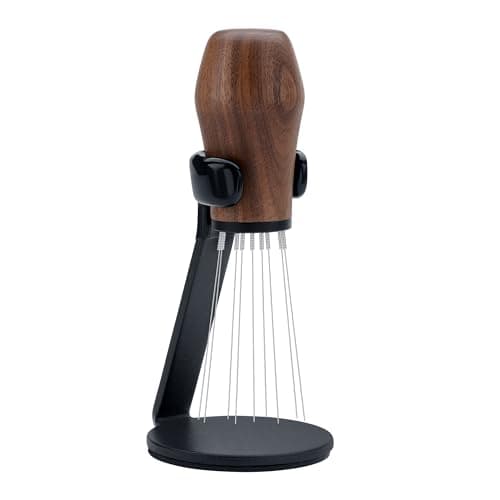
Channeling is water finding a low-resistance path through your coffee puck and racing through it instead of soaking the whole bed evenly — and in the overwhelming majority of home setups the cause is grind clumps, which a WDT tool fixes for the price of a bag of beans. The reason it matters is that a channeled shot is over-extracted and under-extracted at the same time: the coffee along the channel gets blasted and tastes bitter, while the coffee the water never reached gives up nothing and tastes sour and thin. No grind adjustment fixes that, because the problem is not how fine the coffee is — it is that the bed is not uniform.
If your shots are inconsistent morning to morning on the same beans and the same setting, channeling is the first thing to suspect. Here is how to see it, and the five causes ranked by how often they turn out to be the real one.
What channeling actually is
An espresso puck is a bed of ground coffee compressed into a basket, and pressurised water is pushed through it. Water, like everything else, takes the easiest available route. If the bed is uniformly packed, there is no easy route and the water has to permeate the whole thing, extracting evenly. If there is a crack, a gap along the basket wall, a soft spot where a clump broke apart, or a dip the tamp did not reach, the water funnels there.
Two things follow. First, the flow rate goes up, because part of the bed has stopped resisting — which is why channeled shots often run fast even at a grind setting that should be slow. Second, the extraction becomes spatially uneven: coffee in the path of the channel is over-extracted, coffee outside it is barely touched, and both end up in the same cup.
That combination is the signature. A shot that is onlybitter usually means over-extraction — see why is my espresso bitter. A shot that is only sour usually means under-extraction — see why is my espresso sour. A shot that is harsh, hollow and bitter and sour at once, and inconsistent between pulls, is the channeling signature.
How to spot it
There are four signs, in descending order of reliability:
- A jet or spray from the naked basket. With a bottomless portafilter you are watching the underside of the puck directly. Even extraction looks like the whole surface weeping, then streams converging into one. Channeling looks like a thin jet firing sideways, or a spray, usually from the edge.
- A shot that runs faster than the grind setting should allow.If you have ground finer twice and the shot is still fast, you are probably not fixing resistance — you are fixing it in one place and losing it in another.
- Visible holes, craters or a pitted surface on the spent puck. A crater is where the water went. A hole straight through the middle is a textbook centre channel.
- Blonde, pale streaks in the stream while the rest is still dark, which is exhausted coffee coming through early.
The five causes, in the order worth checking
| Cause | What it looks like | The fix |
|---|---|---|
| Grind clumps | Random channels, inconsistent shot to shot | WDT tool - stir the grounds in the basket |
| Uneven distribution | Channel on one side, repeatable | Settle and level the bed before tamping |
| Tilted or drifting tamp | Channel at the high edge | Calibrated tamper, tamp level |
| Wrong dose for the basket | Edge channeling, or a screen imprint | Weigh the dose; match it to the basket |
| Basket, screen or machine | Same spot every time, on every bean | Clean the screen, check the basket |
That ordering is deliberate. The first three are puck prep and account for most home channeling; the last two are worth checking once the first three are under control rather than before.
1. Grind clumps — the most common cause
Ground coffee clumps. Static makes particles stick together, and fine espresso grinds are the worst offenders because the particles are small and the static charge is relatively large. Every grinder produces some clumping; hopper-fed grinders with long chutes produce more, and dark, oily roasts clump more than light ones.
A clump in the basket is a lump of coffee with a different density from everything around it. Tamping does not fix it — you compress the bed around the clump, and when water hits it the clump either resists more than its surroundings (water goes around) or breaks apart under pressure (water goes through the void). Either way: channel.
The fix is WDT— the Weiss Distribution Technique, which is a formal name for stirring the grounds in the basket with fine needles before you tamp. It takes about ten seconds, costs almost nothing, and it is the single highest-return change most home setups can make. Our best WDT tools guide ranks the field.
2. Uneven distribution
Grounds falling from a grinder chute land in a mound, and a mound tamped flat is not the same as a flat bed tamped flat — the coffee under the peak ends up denser than the coffee at the edges. That produces a repeatable channel, usually on one side, which is how you tell it apart from clumping (clumping moves around).
Three fixes, cheapest first. Tap and settle: a couple of firm taps of the portafilter on the bench levels the surface for free. NSEW: level the surface with a finger or a straight edge in four directions. Or a distribution tool, which is a spinning leveler set to a depth that flattens the top of the bed before the tamp lands.
Note the distinction, because it is a common and expensive confusion: a distribution tool levels the surface, while WDT fixes the interior. They are not substitutes. If you can only do one, do WDT.
3. A tilted or inconsistent tamp
A tamp that goes in at an angle leaves one side of the bed denser than the other, and water goes to the low-density side. A tamp whose pressure varies from shot to shot changes the bed density from shot to shot, which is a good explanation for a setup that channels on Tuesday and not on Wednesday.
What matters is level, not hard. Once the coffee is compressed, extra force does almost nothing to flow rate but makes tilt more likely because you are fighting the tamper. A calibrated, spring-loaded tamper removes the pressure variable entirely by clicking at a set force — which, more importantly, makes it easier to concentrate on keeping the thing flat. Our how to tamp espresso guide covers the technique in detail, including the self-levelling trick of resting the tamper on the basket rim.
4. Wrong dose for the basket
Every basket has a design dose, and both directions of error cause channeling:
- Under-dosed. Too little coffee leaves excess headspace above the puck. The puck can lift and crack under pressure, and water pools above it and then finds the weakest point. This is a classic cause of edge channeling.
- Over-dosed. Too much coffee and the puck touches the shower screen when the group is locked in. You get a screen imprint on the puck, the bed is disturbed as you lock in, and the coffee at the edges gets compressed differently from the middle.
The fix is a scale, not a judgment call. A standard 58mm double basket is usually around 18 g; smaller 51mm and 54mm baskets hold less. Our how many grams for a double shot guide gives the doses by basket size, and do I need a scale for espresso makes the case for weighing in the first place. A wet, uneven puck after the shot is a related symptom with its own page: why is my espresso puck wet.
5. Basket, screen and machine
Once puck prep is consistent and you still channel in the same place every single time, look at the hardware:
- A dirty or scaled shower screendistributes water unevenly, so one area of the puck gets hit harder from the start. This is the most common hardware cause and the easiest to fix — see how to clean an espresso machine for backflushing and screen removal, and how to descale for the scale half of the job.
- A cheap or damaged basket. Baskets vary in hole pattern quality, and a dent in the rim or a deformed base changes how the puck sits.
- Grind consistency itself. A grinder producing a very wide particle distribution gives you a bed with built-in density variation, which is channeling waiting to happen. This is the real argument for a better grinder, and it is covered in best grinders for espresso and burr vs blade.
One hardware exception worth naming: if your machine has a pressurized basket, channeling is mostly not your problem, because the restrictor hole rather than the puck is controlling the flow. You will also get far less benefit from any of the tools below. Our pressurized vs non-pressurized portafilter guide tells you which you have.
A routine that does not channel
Order matters, and this sequence removes the causes in the order they occur:
- Weigh the doseinto the basket — the same number every time, matched to your basket size.
- WDT. Stir with fine needles through the full depth of the bed for about ten seconds, working the edges as well as the middle.
- Level the surface. Tap to settle, or use a distribution tool set so it just kisses the top of the bed.
- Tamp level, with consistent force. Rest the tamper on the basket rim to square it up before pressing.
- Lock in gently. Slamming the portafilter into the group can crack a puck you just prepared.
- Watch the extraction. Through a bottomless basket if you have one, which tells you immediately whether any of the above worked.
The full shot method, including ratio and timing, is in how to pull an espresso shot.
The tools that fix it
Four tools, in the order we would buy them. All four are picks from our best espresso tampers and puck prep tools guide, where each gets a longer treatment and the 54mm versus 58mm sizing question is sorted out.
| Tool | Job | Fits | Price |
|---|---|---|---|
| Normcore WDT Tool V3 | Break up clumps inside the basket | 54 / 58mm | $32.69Buy |
| 58mm bottomless portafilter | See the channel as it happens | 58mm machines | $29.99Buy |
| Normcore 58.5mm Distribution Tool | Flatten the bed surface | 58mm | $39.99Buy |
| Normcore 58.5mm Tamper V4 | Remove tamp pressure variance | 58mm | $42.99Buy |
Prices shown are from Amazon as of October 10, 2026 and change often — the button always goes to the current listing. Some links may earn us a commission at no extra cost to you.
WDT tool: Normcore WDT Tool V3
Who it is for: everyone pulling espresso through an open basket. If you buy one thing off this page, buy this.
| Needles | 9-prong stainless steel, 0.35 mm |
|---|---|
| Handle | Walnut |
| Includes | Matching stand / holder |
| Job | Break up clumps, distribute grounds (WDT) |
| Fits | Used inside the basket (works with 54 / 58 mm) |
What we like: the biggest improvement per dollar in espresso, needles fine enough at 0.35 mm to shear clumps rather than push them around, and a stand so the needles do not bend in a drawer. The honest cons: fine needles bend if you are roughwith them, and it adds a step to your routine — about ten seconds of stirring before every tamp.
Bottomless portafilter: the diagnostic
Who it is for: anyone with a 58mm machine who wants to stop guessing.
| Type | Bottomless (naked) portafilter |
|---|---|
| Size | 58mm |
| Includes | Double basket, wood handle |
| Job | Show the underside of the puck during extraction |
What we like: it turns an invisible problem into an obvious one, it is cheap, and it also makes the machine easier to clean because there are no spouts to clog. The honest cons: it sprayswhen you channel — which is the point, but it does mean coffee on the counter while you are learning. It only pours into one cup, so it is not for serving two espressos at once. And fitment is specific: check your portafilter size before buying, because 54mm Breville machines need a different part.
Distribution tool: Normcore 58.5mm
Who it is for: the person whose channel appears in the same place every time and who wants a repeatable flat bed without thinking about it.
| Type | Spinning leveler / distributor (not a needle WDT tool) |
|---|---|
| Diameter | 58.5 mm |
| Fits | 58 mm portafilters |
| Depth | Adjustable |
| Material | Stainless steel |
What we like: a flat, repeatable surface in one twist, adjustable depth so you can set it to your dose, and it makes a tilted tamp much less likely. The honest cons: it levels the surface only — it does not fix clumps below the surface, so it is not a substitute for WDT. Set too deep it compresses the bed unevenly, which creates the problem it is meant to solve. And it is 58.5 mm, so check your basket.
Calibrated tamper: Normcore 58.5mm V4
Who it is for: the person whose shots vary day to day for no reason they can identify.
| Type | Spring-loaded calibrated tamper |
|---|---|
| Diameter | 58.5 mm |
| Springs | Swappable (adjustable force) |
| Job | Apply the same tamp pressure every shot |
What we like: it makes the tamp stop being a variable, swappable springs let you pick a force and keep it, and the extra width gets closer to the basket wall than a 58.0 mm tamper. The honest cons: a calibrated tamper controls force, not angle— you can still tamp crooked, so technique still matters. And it is the least important of the four tools here: clumps cause more channeling than tamp pressure does.
Frequently asked questions
What is channeling in espresso?
Channeling is water finding a low-resistance path through the coffee puck and racing through it instead of permeating the whole bed. It makes a shot over-extracted and under-extracted at the same time: coffee along the channel is blasted and tastes bitter, coffee the water never reached gives up nothing and tastes sour and thin. The shot usually also runs faster than the grind setting should allow.
What causes espresso channeling?
In most home setups, grind clumps - static makes fine espresso grinds stick together, and a clump has a different density from the coffee around it, so water either goes around it or through the void when it collapses. After that, in order: uneven distribution of grounds in the basket, a tilted or inconsistent tamp, a dose that does not match the basket, and finally hardware causes like a dirty shower screen or a damaged basket.
How do I know if my espresso is channeling?
The clearest test is a bottomless portafilter: even extraction looks like the whole underside of the puck weeping and converging, while channeling looks like a thin jet or spray, usually from the edge. Without one, look for a shot that runs fast despite a fine grind, craters or holes in the spent puck, pale streaks in the stream, and a cup that tastes bitter and sour at once rather than one or the other.
Does a WDT tool stop channeling?
It is the single most effective fix for the most common cause. WDT means stirring the grounds in the basket with fine needles before tamping, which breaks up the clumps that create density variation in the bed. It takes about ten seconds, the tools are inexpensive, and no amount of tamping or grind adjustment achieves the same thing - tamping compresses the bed around a clump rather than removing it.
Is a distribution tool the same as a WDT tool?
No, and they are not substitutes. A distribution tool is a spinning leveler that flattens the surface of the grounds before you tamp. A WDT tool uses fine needles to stir the full depth of the bed and break up clumps inside it. Surface flatness and interior uniformity are different problems; if you can only buy one, buy the WDT tool.
Can tamping harder stop channeling?
No, and it often makes things worse. Once the coffee is compressed, extra force changes flow rate very little, but pressing harder makes a tilted tamp more likely - and a tilted tamp leaves one side of the bed less dense, which is exactly where water will go. Aim for level and consistent rather than hard; a calibrated spring-loaded tamper removes the pressure variable so you can concentrate on keeping it flat.
Does channeling happen with a pressurized basket?
Much less, because a pressurized basket's restrictor hole rather than the coffee puck is controlling the flow and generating the crema. That is why machines with pressurized baskets are forgiving of poor puck prep - and also why puck prep tools buy you far less on them. Check which basket you have before spending on WDT tools and distributors.
Sources
- Specialty Coffee Association - espresso brewing and extraction standards
- National Coffee Association - Espresso brewing guidance
- Normcore - WDT Tool V3, 58.5mm Distribution Tool and 58.5mm Spring-Loaded Tamper V4 product specifications (needle count and gauge, adjustable depth, swappable springs)
- Baratza - grinder cleaning and static guidance (clumping, chute retention)
Keep reading
Buying your first setup?
See how we pick — compiled specs, cost-per-shot math, and honest trade-offs — then dig into the guides. No fake test lab, no rankings for hire.