Guide
How Many Grams for a Double Shot of Espresso?
The short answer is about 18 grams in and 36 grams out — but the number that is actually right for you is set by your basket, not by the internet. Here is the dose by basket size, and how to find yours.
A double shot of espresso is about 18 grams of dry coffee in and about 36 grams of liquid espresso out, pulled in roughly 25–30 seconds. That is a 1:2 ratio, and it is the standard starting recipe for a 58mm double basket. If your machine uses a smaller basket — 54mm on a Breville Bambino, 51mm on a De'Longhi Dedica — the dose is smaller, and the right number is printed on or designed into your basket rather than chosen by you. Below is the dose by basket size, how to confirm yours, and why both halves of the ratio need weighing.
The important thing to understand first is that 18 g is not a magic number. It is the design dose of the most common basket. Your basket's number may be 14 g or 20 g, and matching it matters far more than matching ours.
The short answer
| Dose (dry coffee in) | ~18 g for a standard 58mm double basket |
|---|---|
| Yield (liquid espresso out) | ~36 g, i.e. about twice the dose |
| Ratio | 1:2 (a 'normale' shot) |
| Shot time | ~25-30 seconds from pump start |
| Measured how | By weight, on a 0.1 g scale - both sides |
| Tighter ratio | 1:1 to 1:1.5 - a ristretto, more concentrated |
| Looser ratio | 1:3 - a lungo, longer and thinner |
Those three numbers — dose, yield, time — are the whole recipe. Write them down, change one thing at a time, and espresso stops being guesswork. Our how to pull an espresso shot guide covers the full method around them, and ristretto vs espresso vs lungo covers what happens when you change the ratio deliberately.
Dose by basket size
Basket diameter is the single biggest determinant of your dose, because a wider basket holds more coffee at the same bed depth. Here is the territory for the three sizes this site covers, with the yield that goes with each at a 1:2 ratio:
| Basket | Typical machines | Double dose | Yield at 1:2 |
|---|---|---|---|
| 58mm | Gaggia Classic Pro, Rancilio Silvia, commercial | ~18 g (14-20 g baskets exist) | ~36 g |
| 54mm | Breville Bambino, Bambino Plus, Barista line | ~18-19 g per Breville's Razor dose | ~36-38 g |
| 51mm | De'Longhi Dedica, Dedica Maestro Plus | Smaller - typically low-to-mid teens | About twice the dose |
| Pressurized basket | Most machines under $200 | Follow the manual's scoop/dose | Ratio matters less - see below |
Two of those rows need honesty rather than a number. 51mm De'Longhi basketsare small even by 51mm standards and De'Longhi does not publish a gram dose for them in documentation we will quote as the manufacturer's, so the only reliable figure is the one you measure from your own basket using the method below. And on a pressurized basket, the restrictor hole rather than the puck sets the resistance, so dose precision buys you much less — our pressurized vs non-pressurized portafilter guide explains why.
Why the basket sets the dose, not you
A basket is a fixed volume with a fixed depth, and the puck has to fit inside it with the right amount of headspace— the gap between the top of the tamped puck and the shower screen when the group is locked in. Get the dose wrong in either direction and the problem is mechanical, not a matter of taste:
- Too little coffee leaves excess headspace. Water pools above the puck, the puck can lift and crack under pressure, and the shot channels. The symptom is a fast, thin, sour shot and a soupy, pitted puck.
- Too much coffeeand the puck touches the screen when you lock in. You get a screen imprint on the puck, the bed is disturbed as the portafilter goes in, and the edges compress differently from the middle — which is channeling from the other direction.
Both failure modes are covered in detail in espresso channeling and why is my espresso puck wet. Dose is the cheapest variable to get right, and it is the one most people never actually measure.
The other half: yield, and why you weigh the cup too
Espresso is defined as a ratio of two weights, which means measuring only the dose is doing half the job. The second number is the yield: the weight of liquid espresso in the cup, not its volume.
The reason it must be weight rather than volume is crema. Crema is foam, its volume varies enormously with roast level and bean age, and it collapses while you watch. A shot judged by the line on a shot glass silently changes ratio every time you open a new bag of beans — a fresh dark roast will look like a full double at 28 g of liquid, and a three-week-old light roast will look short at 40 g.
So: put the cup on the scale, tare it, start the pump, and stop at roughly twice your dose. For an 18 g dose that is about 36 g in the cup. Our do I need a scale for espresso guide makes the full case, and coffee-to-water ratio covers the equivalent numbers for filter brewing.
How to find your basket's dose in one morning
If you do not know your basket's design dose — and most people with a 51mm or 54mm machine do not — this takes ten minutes:
- Check the manual and the basket itself first.Many baskets are stamped with a dose, and Breville's machines ship a Razordosing tool that trims the puck to exactly the right height for their baskets — which is effectively the dose printed in hardware.
- Start at a sensible numberfor your diameter: 18 g for 58mm, 18–19 g for 54mm, and for 51mm start lower and work up.
- Tamp level and lock in, then take the portafilter straight back out without running water. Look at the puck surface.
- Read the imprint.A clear circular mark from the shower screen means you are over-dosed — go down a gram. No mark at all and a deep gap means you may be under-dosed; go up a gram. A faint kiss of a mark is about right.
- Write the number down and stop changing it. From then on, grind size is your adjustment, not dose.
That last point is the whole discipline. Dose and yield are constants you set once per basket; grind is the dial you turn when the shot runs fast or slow.
What about a single shot?
A single basket is roughly halfa double — commonly around 7–9 g on a 58mm single, pulled to about twice that in the cup. In practice almost nobody pulls singles at home, and there is a good reason: a single basket is narrower and deeper, which makes it harder to prepare evenly and much more prone to channeling than a double. Most home machines ship a double basket as the default and most recipes assume it.
If you want a smaller drink, the usual approach is to pull a normal double and use less of it, or to pull a ristretto— the same 18 g dose stopped at around 18–27 g of yield, which is more concentrated rather than smaller in strength. That is covered in ristretto vs espresso vs lungo.
Why ounces and 'shots' do not work
You will see a double espresso described as 2 fluid ounces, and at a café that is a reasonable description of what lands in the cup. As a recipe it fails for three reasons:
- Crema inflates volume unpredictably, as above, so two shots of identical weight can have visibly different volumes.
- Ground coffee cannot be dosed by volume accurately. A scoop of dark roast and a scoop of light roast hold different masses, because roasting removes water and mass. A tablespoon is not a dose.
- Whole-gram kitchen scales cannot resolve the difference between a 17.4 g and an 18.2 g dose, which is roughly the width of the useful window on a standard double. 0.1 g precision is the one specification that is not negotiable.
The scale you need
Three requirements, in order: 0.1 g precision, a platform that physically fits under your portafilter on the drip tray, and a timer. Flow rate is a nice extra. These are picks from our best coffee scales guide, where each gets a longer treatment.
| Scale | Precision | Timer | Flow rate | Price |
|---|---|---|---|---|
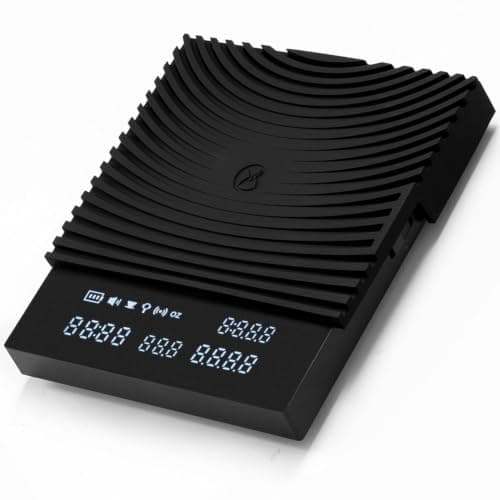
| Timemore Black Mirror Basic 3 | 0.1 g | Yes | Yes | $59.00Buy |
| Weightman Espresso Scale | 0.1 g | Yes | No | $13.99Buy |
| Hario V60 Drip Scale | 0.1 g | Yes | No | $46.11Buy |
Prices shown are from Amazon as of October 10, 2026 and change often — the button always goes to the current listing. Some links may earn us a commission at no extra cost to you.
Best overall: Timemore Black Mirror Basic 3
Who it is for: anyone who wants one scale that handles espresso and pour over without compromise.
| Precision | 0.1 g |
|---|---|
| Max weight | 2 kg / 2000 g |
| Timer | Built-in (auto and manual) |
| Flow rate | Real-time display |
| Size | Compact (fits most drip trays) |
| Power | USB-C rechargeable |
What we like: espresso and pour over on one scale, a flow-rate readout you normally pay a premium for, USB-C charging, and a footprint that still fits a drip tray. The honest cons: it costs more than the budget options and the flow-rate display is a nicety rather than a necessity for dialing a dose in.
Best budget pick: Weightman Espresso Scale
Who it is for: the person who just wants to start weighing doses today.
| Precision | 0.1 g |
|---|---|
| Timer | Built-in |
| Flow rate | No |
| Size | Small (fits under a portafilter) |
| Power | USB rechargeable, auto-off |
What we like: the lowest-risk way to start weighing espresso, genuinely small enough for a drip tray, and USB charging. The honest cons: build and response speed are closer to the price than a Timemore's, there is no flow-rate display, and auto-off can cut out mid-routine while you are still prepping.
Best if you also brew filter: Hario V60 Drip Scale
Who it is for: the household that pulls espresso and brews pour over, French press or an AeroPress on the same scale.
| Precision | 0.1 g |
|---|---|
| Max weight | 2 kg / 2000 g |
| Timer | Built-in |
| Flow rate | No |
| Power | 2 x AAA batteries |
What we like: dead simple and reliable, a platform big enough for a full pour-over setup, and it comes from the people who make the dripper. The honest cons: AAA batteries rather than USB, no flow rate, and the larger top is less convenient on a cramped espresso drip tray than the two scales above.
For the filter side of the ratio, our coffee-to-water ratio guide has the numbers, and how to make pour over coffee uses them.
Frequently asked questions
How many grams of coffee are in a double shot of espresso?
About 18 grams of dry coffee for a standard 58mm double basket, pulled to roughly 36 grams of liquid espresso in about 25 to 30 seconds - a 1:2 ratio. Smaller baskets take less: 54mm Breville baskets sit around 18 to 19 grams per Breville's own Razor dosing tool, and 51mm De'Longhi baskets are smaller again. The right number is set by your basket, not by a universal figure.
How many grams should a double shot of espresso weigh in the cup?
About twice the dose, so roughly 36 grams for an 18 gram dose. That is the 1:2 'normale' ratio. Weigh it rather than measuring volume, because crema is foam whose volume varies with roast level and bean age and collapses as you watch - a shot judged by the line on a glass changes ratio every time you open a new bag.
Is 18 grams too much for a double shot?
Not on a standard 58mm double basket, which is designed around roughly that dose. It would be too much for a smaller basket. The test is headspace: tamp, lock the portafilter in, take it straight back out without running water and look at the puck. A clear circular imprint from the shower screen means you are over-dosed; a faint kiss of a mark is about right.
How many grams for a single shot of espresso?
Roughly half a double - commonly around 7 to 9 grams on a 58mm single basket, pulled to about twice that in the cup. Very few people pull singles at home because a single basket is narrower and deeper, which makes it harder to prepare evenly and much more prone to channeling. Most home machines ship a double basket and most recipes assume one.
Can I measure my espresso dose with a tablespoon?
Not accurately. Ground coffee cannot be dosed by volume reliably because density changes with roast level - a scoop of dark roast holds less mass than the same scoop of light roast, since roasting drives out water and mass. A 0.1 gram scale is the only way to dose repeatably, and whole-gram kitchen scales cannot resolve the difference between 17.4 and 18.2 grams, which is about the width of the useful window on a double basket.
Does the dose change if I change beans?
Slightly, and the grind definitely does. A dark roast is less dense than a light roast, so the same 18 grams fills the basket a little higher and may need a gram of adjustment to keep the headspace right. The bigger change is grind: go darker and you need to grind coarser, go lighter and you need to grind finer, for the same shot time.
Sources
- Specialty Coffee Association - espresso brewing standards (dose-to-yield ratio, extraction)
- National Coffee Association - Espresso brewing guidance
- National Coffee Association - How to brew coffee (measurement and ratios)
- Breville - Barista series instruction books (Razor dosing tool, 54mm basket dose and puck trimming)
- Timemore - Black Mirror Basic 3 specifications (0.1 g precision, 2 kg capacity, flow rate, USB-C)
- Hario - V60 Drip Scale specifications (0.1 g precision, 2 kg capacity, built-in timer)
Keep reading
Buying your first setup?
See how we pick — compiled specs, cost-per-shot math, and honest trade-offs — then dig into the guides. No fake test lab, no rankings for hire.