Single Review
Breville Smart Grinder Pro Review
The grinder that grinds straight into your portafilter. The Smart Grinder Pro pairs 60 stepped settings with a dose timer adjustable in 0.2-second increments and cradles for both 54mm and 58mm baskets - a genuinely convenient espresso-capable grinder whose limits are all in the word 'stepped'.
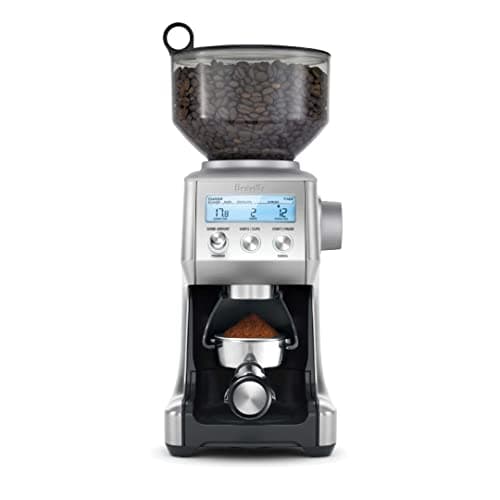
The most convenient espresso-capable grinder near its price - 60 settings, a programmable 0.2-second dose timer and cradles that hold a 58mm portafilter under the chute - held back by a stepped dial that eventually puts the shot you want between two settings.
- Best for
- Owners of a Breville or De'Longhi machine who want to grind straight into the portafilter and brew filter coffee on the same grinder
- Price context
- Entry-bracket money for a grinder with mid-bracket convenience features; well below the stepless flat-burr grinders it competes with on espresso
The Breville Smart Grinder Prois the grinder most people buy with their first real espresso machine, and the reason is not grind quality — it is the shape of the thing. It comes with two portafilter cradles, one for 50–54mm baskets and one for 58mm, so the grounds go from burr to basket without a container in between. Add 60 stepped settings, a programmable timer adjustable in 0.2-second increments and an LCD that remembers what you did last time, and you have a grinder that makes the daily routine easy in a way that grinders costing twice as much do not.
What it is not is a precision espresso instrument. Breville does not publish a burr diameter or a micron-per-step figure for this grinder, the dial is stepped rather than stepless, and the dose is timed rather than weighed. This review is about where that line falls: what the Smart Grinder Pro genuinely does well, and the point at which a dialing-in session stops being possible.
A note on honesty first: we do not run a lab. This review compiles Breville's published specifications and retailer specification sheets and does the reasoning — the same method we use on every product, described on our methodology page. Units we claim to have tested: zero. Where Breville publishes no figure, we say so rather than estimating one.
Who the Smart Grinder Pro is for
Buy it ifyou own a Breville or De'Longhi semi-automatic machine, drink the same bag of beans all week, and want grinding to take five seconds and one button press. It is the natural partner to a Breville Bambino or a De'Longhi Dedica, and it is the grinder our best grinder for a Breville machine guide keeps coming back to for exactly that reason — the large cradle holds a 58mm basket under the chute, which is what a Barista Express owner replacing a built-in grinder actually needs.
Do not buy it if you are chasing a specific shot. The stepped dial will eventually put the fineness you want between setting 12 and setting 13, and the only tools you have left are the dose and the basket. If that sentence sounds like your kind of problem, skip to the alternatives— a stepless grinder solves it and the price difference is smaller than it looks.
What the specs say
Breville publishes less about this grinder than most manufacturers at this price, so it is worth being clear about which numbers come from where. The settings count, timer increment, cradle sizes, display behavior and dimensions are Breville's own. The hopper capacity, wattage, weight and warranty come from retailer specification sheets. The burr diameter is published by nobody, which is a real gap on a grinder sold on its espresso ability.
| Burrs | Stainless steel conical (diameter not published) |
|---|---|
| Grind settings | 60 stepped |
| Dose control | Programmable timer, 0.2-second increments |
| Display | LCD - grind setting, grind time, shots or cups |
| Portafilter cradles | Small 50-54mm; large 58mm (both included) |
| Other outlets | Sealed grounds container; gold-tone or paper filter holder |
| Hopper | 450 g (retailer specification) |
| Power | 165 W (retailer specification; 230 V market figure) |
| Dimensions | 8.5" x 6.3" x 15.3" (214 x 160 x 389 mm) |
| Weight | ~6 kg (retailer specification) |
| Housing | Stainless steel |
| Included | Both cradles, grounds container with lid and sealing cap, burr brush |
| Warranty | 2 years |
The dose timer is the real feature
Most grinder reviews lead with burrs. On this grinder the feature that changes your mornings is the timer, because of the increment: 0.2 seconds. At a typical home-grinder throughput, two tenths of a second is a fraction of a gram, which means the timer is fine enough to land a repeatable dose rather than merely a rough one. You set it once for your basket, and the LCD counts the shots so you know when the burrs have done a few hundred doses and want a clean.
That matters more than it sounds because of what it replaces. On a grinder with no timer, you hold a button and watch a scale, which means two hands and attention every single morning. Here you lock the portafilter into the cradle, press once, and walk away. It is the closest thing to an automatic workflow at this money.
The caveat is the one every timed grinder shares: a timer delivers seconds, not grams. Fresh beans flow differently from beans two weeks older, and a dose set at 18.0 g in week one can be 17.2 g in week three without the timer noticing. You still want a scale on the counter — our best coffee scale guide covers the cheap ones that are good enough, and do I need a scale for espresso explains why this is the variable worth controlling first.
Is the Smart Grinder Pro good enough for espresso?
Yes, with a real asterisk. It reaches espresso fineness comfortably and the bottom of its range is fine enough to choke a machine, which is the test that matters — a grinder that cannot go too fine cannot be dialed in at all. Plenty of good shots have been pulled on this grinder.
The asterisk is resolution. Espresso is the only brew method where a change of roughly 20 microns visibly moves the shot, and the espresso band is narrow — our grind size chartshows how narrow compared with every other method. With 60 settings spread across a range that reaches French press, the steps at the fine end are wider than a dedicated espresso grinder's. When setting 11 runs the shot in 22 seconds and setting 12 runs it in 34, the usual compromise is to leave the grind alone and change the dose — which fixes the flow rate and moves the ratio, so you are now brewing a different drink to hide a grinder limitation.
In practice that means the Smart Grinder Pro is excellent while you are learning and increasingly frustrating once you start chasing specific shots. If you are reading why is my espresso sour or why is my espresso bitterand the answer keeps being “go one step finer” when one step is too much, you have found the ceiling of this grinder rather than a mistake in your technique.
Filter coffee on the same grinder
This is where the 60-setting range earns its keep. The top of the dial goes coarse enough for French press, and the grinder ships with a holder for a gold-tone or paper filter basket alongside the sealed grounds container — so a drip brewer and an espresso machine can share one grinder without an adapter.
The trade is the same one every wide-range grinder makes: a dial that spans espresso to French press cannot have fine steps at both ends, and you will be re-dialing every time you switch methods. The LCD helps, because the setting number is written on the screen rather than guessed from a knob position. If you genuinely brew both every day, our best grinder for espresso and pour over guide ranks the field on exactly that double duty, and our best grinder for French press guide covers the coarse end on its own terms.
The honest limits
It is hopper-fed, and it retains.Grounds sit in the chute and the exit path between doses, which means a few grams of yesterday's coffee in today's basket. That is a non-issue if you drink one bag all week and a real issue if you rotate single origins. The single-dose grinders in our best single-dose grinders guide exist for that buyer.
Static is real with oily beans. A stainless chute and a plastic grounds container hold a charge, and dark roasts make it worse. Grinding into the portafilter rather than the container sidesteps most of it, which is a point in favor of using the cradles as intended.
Conical burrs at this price are the compromise.A 50mm flat burr set — as on the Eureka Mignon Notte— generally produces a tighter particle distribution than a conical burr set of the kind used here. Our flat vs conical burr explainer is the longer version. You are buying convenience, not the best grind in the bracket.
And the cheapest fix for all of this is not expensive. See the best espresso grinder under $1000guide for what the full ladder above this grinder looks like — and note how much of the real improvement happens in the first step up, not the last.
Alternatives worth comparing
| Grinder | Adjustment | Doses into | Why you'd pick it instead |
|---|---|---|---|
| Baratza Encore ESP | 40 stepped (~20 microns across the espresso range) | 54mm cup + 58mm adapter | Published step sizes and a dial that spends half its range on espresso, plus user-replaceable parts |
| Eureka Mignon Notte | Stepless micrometric | Portafilter (press to grind) | 50mm flat burrs and no steps to fall between - the upgrade that fixes this grinder's one real flaw |
| Breville Smart Grinder Pro | 60 stepped (resolution not published) | 50-54mm and 58mm cradles | The timer, the two cradles and the price - the most convenient of the three |
The head-to-head worth reading is Baratza Encore ESP vs Breville Smart Grinder Pro, which is the decision most buyers at this price are actually making. The short version: the Encore ESP publishes its step sizes and is the better espresso grinder; the Smart Grinder Pro is the better appliance.
Verdict
The Smart Grinder Pro is the right first espresso grinder for a lot of people and the wrong second one for almost everybody. What it gets right is the daily reality of making coffee: a 58mm cradle in the box, a dose timer fine enough to repeat, a display that remembers your recipe, a metal body and a two-year warranty, at entry-grinder money. What it gets wrong is the one thing espresso cares about most, which is how small your smallest adjustment can be.
Buy it if your machine is a Bambino, a Dedica or a Stilosa, you drink one bag of beans at a time, and you want grinding to be the easy part of the morning. Skip it if you have already learned to dial in and keep finding the setting you want sitting between two clicks — at that point the $300 bracket is where the fix lives, and our best grinders for espresso guide ranks the whole field.
What we liked
- Grinds directly into a 58mm portafilter - the large cradle is included, not an accessory
- Programmable dose timer adjustable in 0.2-second increments, so a repeat dose is one button press
- 60 settings cover espresso through French press on one grinder
- LCD shows grind setting, grind time and shot count, so you can write a recipe down and return to it
- Stainless steel housing and a 450 g hopper for the price of a plastic entry grinder
- Two-year manufacturer warranty and widely available replacement burrs
What gave us pause
- Stepped, not stepless - the shot you want will sometimes sit between two settings
- Breville publishes no burr diameter and no micron-per-step figure, so adjustment resolution cannot be compared on paper
- Doses by time, not weight, so the dose drifts as beans age and you still need a scale
- Hopper-fed with real retention - a poor fit if you change beans every few days
- Conical burrs at this price are beaten on particle distribution by 50mm flat burr grinders only a little more expensive
- The grounds container and chute attract static, which is messier with dark, oily roasts
Frequently asked questions
Is the Breville Smart Grinder Pro good for espresso?
It is good enough to make espresso and not fine-grained enough to chase a specific shot. The bottom of its 60-setting range reaches genuine espresso fineness - fine enough to choke a machine, which is the test that matters - and it grinds directly into a 50-54mm or 58mm portafilter. The limit is resolution: Breville publishes no micron-per-step figure, and because the same dial has to reach French press, the steps at the fine end are wider than a dedicated espresso grinder's. Most owners hit that ceiling only once they start dialing in seriously.
What size burrs does the Breville Smart Grinder Pro have?
Breville publishes that they are stainless steel conical burrs but does not publish a diameter, and we are not going to estimate one. That absence is itself useful information: a grinder sold on espresso ability that will not state its burr diameter or its micron-per-step resolution cannot be compared on paper with a Baratza or a Eureka, both of which publish both figures.
Does the Smart Grinder Pro fit a 58mm portafilter?
Yes. Two cradles are included - a small one for 50-54mm baskets and a large one for 58mm - so it holds the portafilter under the chute and grinds straight into the basket with both hands free. That is the main practical reason it is so often paired with Breville and De'Longhi machines.
Breville Smart Grinder Pro vs Baratza Encore ESP - which should I buy?
Buy the Encore ESP if you care more about the shot and the Smart Grinder Pro if you care more about the routine. The Encore ESP publishes its step sizes - roughly 20 microns across settings 1 to 20, which it dedicates to espresso - and its parts are user-replaceable. The Smart Grinder Pro answers with a programmable 0.2-second dose timer, an LCD with a shot counter, a 450 g hopper and both portafilter cradles in the box. We have a full head-to-head between the two on the site if you want the long version.
Can the Smart Grinder Pro grind for French press and pour over?
Yes - the coarse end of its 60-setting range goes to French press, and it ships with a holder for a gold-tone or paper filter basket as well as the sealed grounds container. The compromise is that a dial spanning espresso to French press cannot have fine steps at both ends, so expect to re-dial every time you switch methods. The LCD at least shows the setting number, so a written recipe works.
How much coffee does the hopper hold?
Retailer specification sheets list the bean hopper at 450 g. Breville's own product page does not publish the figure, which is why we attribute it. The hopper seals with a lid and the grounds container has its own lid and sealing cap, but a hopper-fed grinder still exposes beans to air, so do not treat a full hopper as bean storage.
Does the Smart Grinder Pro retain grounds between doses?
Yes, as all hopper-fed grinders do. A few grams sit in the chute and exit path between doses, so the first shot after a bean change includes some of the previous coffee. If you drink one bag at a time that is irrelevant; if you rotate single origins weekly, a single-dose grinder with published sub-0.1 g retention is the better buy.
Sources
- Breville - the Smart Grinder Pro (BCG820) product page: 60 grind settings, stainless steel conical burrs, precision digital timer in 0.2-second increments, LCD showing grind setting / grind time / shots or cups, small 50-54mm and large 58mm portafilter cradles, grounds container with lid and sealing cap, burr cleaning brush, stainless steel housing, dimensions 8.5 x 6.3 x 15.3 in
- Retailer specification sheets for the Breville BCG820BSS (450 g bean hopper, 165 W, ~6 kg, 24-month warranty, 389 x 214 x 160 mm)
- Baratza - Encore ESP specifications (40mm M2 conical burrs, 40 stepped settings split 1-20 espresso / 21-40 filter, roughly 20 and 90 micron steps, 54mm dosing cup and 58mm adapter, user-replaceable parts)
- Eureka - Mignon Notte specifications (50mm flat steel burrs, stepless micrometric adjustment, hopper capacity, Italian assembly)
- Amazon product listing for the BCG820BSS - model identity verified against brand and model in the listing title, current availability and live price capture
- Specialty Coffee Association - grind, extraction and brewing fundamentals
Keep reading
Buying your first setup?
See how we pick — compiled specs, cost-per-shot math, and honest trade-offs — then dig into the guides. No fake test lab, no rankings for hire.