Comparison
Flat vs Conical Burr Grinders: What's the Difference?
Two burr shapes, endless online arguments. Here is what each geometry actually does to the cup — uniformity, retention, heat, noise and price — and why the flat-versus-conical choice is a preference-and-budget call, not a winner-takes-all.
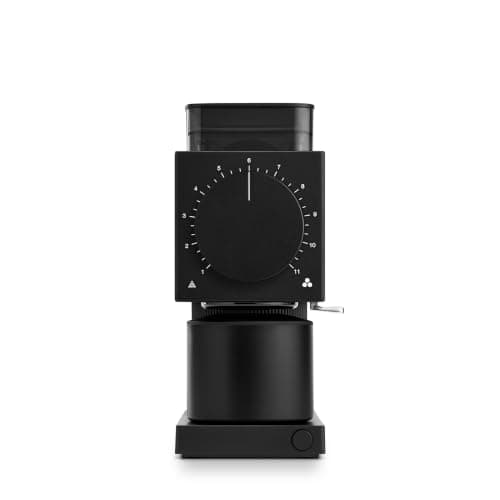
Once you have decided on a burr grinder over a blade grinder, the next question you will trip over is flat burrs versus conical burrs. It is one of the most argued-about topics in home coffee, and most of the noise makes it sound like a settled contest where one shape is simply better. It is not. Both geometries make genuinely excellent coffee; they just get there a little differently, and each carries a set of trade-offs in flavor character, retention, heat, noise and price. This guide explains what actually differs so you can pick the one that suits your taste, your brew method and your budget.
The short answer
Flat burrs are two ring-shaped burrs that face each other; beans are flung across the flat cutting surfaces and ground as they travel to the outer edge. They tend to produce a very uniform grind that many drinkers describe as giving clarity— distinct, defined, brighter-tasting flavors — which is why they are prized for light roasts and higher-end espresso. Conical burrs are a cone-shaped inner burr sitting inside a ringed outer burr; beans fall through the gap by gravity. They are efficient, forgiving, usually quieter and lower in retention, tend to cost less, and are often described as producing a rounder cup with a touch more body. Neither is universally superior. If you want maximum clarity and will spend for it, lean flat; if you want a forgiving, quiet, affordable grinder — or any hand grinder — lean conical.
How each geometry works
Flat burrsare a pair of parallel, ring-shaped burrs with cutting teeth on their facing surfaces. Beans drop into the center, and the spinning burr throws them outward across the flat gap; as a particle travels from the middle to the rim it is cut down to roughly the size set by the gap before centrifugal force ejects it. Because every particle takes a similar path across the same cutting geometry, flat burrs are known for a tight, even output. Home flat grinders commonly use 64mm burrs — the size in the Fellow Ode Gen 2 and the DF64 Gen 2 — while compact espresso models like the Eureka Mignon Notte use 50mm flats.
Conical burrsuse a cone-shaped inner burr nested inside a ring-shaped outer burr. Beans fall into the gap and gravity pulls them down through a narrowing channel, where they are crushed progressively finer until they drop out the bottom. This geometry is efficient and self-feeding, it works well at low motor speeds, and it packs neatly into a small body — which is exactly why nearly every hand grinder, from a Comandante to a 1Zpresso, uses conical burrs. The Baratza Encore's 40mm conical set is the archetype of an affordable, dependable filter grinder.
A quick myth to clear up: burr size is not the same as burr shape. A bigger burr (flat or conical) mostly grinds faster and cooler; the flat-versus-conical question is about the shape of the cut, not the diameter. We cover size separately in our best burr grinder guide.
Uniformity and flavor: clarity vs body
This is the difference people actually taste, and it is the most misunderstood. When manufacturers and specialty roasters talk about flat burrs, they describe a more uniform particle output — more of the grounds landing in a narrow band of sizes. In the cup, many drinkers read that as clarity: separated, well-defined flavors, brighter acidity, and the kind of transparency that shows off a single-origin light roast. That reputation is why flat burrs dominate competition espresso and premium filter grinders like the Ode.
Conical burrs are often described as producing a slightly broader spread of particle sizes — a little more fine material alongside the larger particles — which many people perceive as more body, texture and a rounder, more forgiving cup. Neither result is "wrong"; it is a genuine matter of preference, and plenty of world-class coffee is pulled on both. The honest truth is that the gap between two goodgrinders of different shape is usually smaller than the gap between a good grinder and a mediocre one — and far smaller than the gap between any burr grinder and a blade. Extraction still comes down to an even grind at a repeatable setting, which is the whole point of our burr vs blade explainer.
Retention and workflow
Retention is how much old coffee a grinder holds onto between doses — grounds trapped in the burr chamber and exit path. As a general tendency, conical grinders retain less: gravity pulls grounds straight down and out, so a well-designed conical hopper grinder leaves little behind. Flat grinders can hold a bit more, because grounds are thrown outward and can cling around the larger cutting surface before they exit. That matters most if you like to switch beans often, since stale retained grounds mix into the next dose.
But this is a tendency, not a rule, and modern single-dose designs flip it. The flat-burr DF64 Gen 2is built specifically to beat retention — an anti-popcorn device, a declumping chute and an ionizer take it to near zero, so what you weigh in is what you get out. So if low retention is your priority, a hopper-fed conical is the easy default, while a purpose-built single-dose flat grinder gets you there too. Match the workflow to how you actually brew.
Speed, heat and noise
Conical burrs are efficient and happy at low RPM, which keeps friction, heat and static down; a slow-turning conical grinder runs cool and comparatively quiet. Hand grinders, all conical, are nearly silent. Flat-burr grinders often spin faster and, especially with large 64mm burrs, can be quicker through a dose but louder and a touch warmer while doing it — the Mignon Notte, for instance, is a flat grinder owners note is not sound-dampened and grinds with a sharp pitch. None of this scorches your coffee in a home setting, but if a quiet morning grind matters to you, conical (or a hand grinder) has the edge.
Grinding speedtracks burr size and motor more than shape. A big flat grinder is usually fast; so is a big conical. A small hand grinder of either type is slow because you are the motor. Do not buy a shape expecting speed — buy the burr size and drivetrain that fits your volume.
Price and ease of use
Cost is where the shapes diverge most predictably. Conical burrs are cheaper to manufacture and are simply more forgiving of small dial errors, which is why they dominate the entry and mid range and nearly every hand grinder — the Baratza Encore, the 1Zpresso and Comandante hand grinders, and most sub-premium electrics are conical. Flat-burr grinders skew higher up the price ladder, both because the burrs and alignment cost more and because they are marketed on that clarity reputation. There are affordable exceptions — the DF64 brought 64mm flats to a reasonable price — but on the whole, if budget is tight, conical gets you excellent coffee for less.
On ease, conical burrs' forgiveness is a real everyday advantage: a click off your target still gives a drinkable cup, which makes them friendlier for beginners. Flat burrs can be a little more sensitive around the espresso range — a small move shifts the shot more — which is exactly what an experienced user chasing a specific profile wants, but can frustrate a newcomer. If you are just starting out, a forgiving conical grinder shortens the learning curve.
Flat vs conical at a glance
| Factor | Flat burrs | Conical burrs |
|---|---|---|
| Grind uniformity | Very uniform; narrow particle spread | Even, slightly broader spread |
| Cup character (typical) | Clarity, brightness, definition | Body, texture, forgiveness |
| Retention | Can hold a little more (single-dose designs cut it to near zero) | Usually lower, especially hopper-fed |
| Heat and noise | Often faster but louder and a touch warmer | Cool and quiet at low RPM |
| Price tendency | Skews higher (some budget exceptions) | Cheaper; dominates entry and mid range |
| Ease for beginners | More sensitive to small changes | More forgiving of dial errors |
| Common examples | Fellow Ode Gen 2, DF64 Gen 2, Mignon Notte | Baratza Encore, 1Zpresso, Comandante |
Which to choose for espresso vs filter
For espresso, both shapes are proven — the shape matters less than reaching espresso fineness with fine adjustment. If you chase clarity and brighter, single-origin light-roast shots and can spend more, a flat grinder like the 50mm Eureka Mignon Notte or the single-dose DF64 Gen 2 rewards you. If you want forgiveness, lower cost or a hand grinder, conical is the way: the value pick for a first espresso setup is the conical Baratza Encore ESP, and every espresso-capable hand grinder is conical. Our full best grinder for espresso guide ranks both shapes together.
For filter and pour over, flat burrs' clarity is a genuine draw — the 64mm flat Fellow Ode Gen 2 is a filter specialist built for exactly this, delivering clean, well-separated flavors across pour over, drip and French press (note that Fellow states it is not suitable for espresso). If you would rather have one forgiving, repairable, affordable grinder for everyday brewed coffee, the conical Baratza Encore is the classic all-rounder. See our best grinder for pour over picks to match a grinder to your dripper.
A flat filter specialist, the Ode — read the long-term details in our Fellow Ode Gen 2 review:
The forgiving conical all-rounder for everyday filter, the Baratza Encore:
The verdict
There is no universal winner in flat versus conical — only the shape that fits you. Choose flat burrs if you value uniformity and clarity, brew light-roast filter or chase defined espresso, and are willing to pay a little more and tolerate a bit more noise: the Ode for filter, the Notte or DF64 for espresso. Choose conical burrsif you want a forgiving, quiet, low-retention grinder that costs less — or any hand grinder — with the Encore as the everyday filter default. Both make coffee that will embarrass a blade grinder and outperform a mismatched machine. Spend your energy on getting a good grinder with an even grind and repeatable settings; the burr shape is the last, smallest choice, and either way you win. Compare the full field in our best burr grinder guide.
Frequently asked questions
Are flat or conical burrs better?
Neither is universally better. Flat burrs tend to produce a more uniform grind that many describe as giving clarity and brighter, more defined flavors, which is why they are popular for light roasts and premium espresso. Conical burrs are efficient, forgiving, quieter, usually lower in retention and cheaper, and are often described as giving a rounder cup with more body. It is a preference-and-budget decision, not a contest one shape wins.
Do flat burrs really taste different from conical burrs?
There is a real, if subtle, tendency: flat burrs often read as clarity and separation, conical as body and roundness. But roast level, dose, recipe, burr alignment and grinder quality move the cup as much as the shape does, and the difference between two good grinders is far smaller than the difference between a burr grinder and a blade grinder. Treat clarity-versus-body as a starting hypothesis, not a rule.
Are conical burrs good for espresso?
Yes. Both flat and conical burrs make excellent espresso; what matters more is that the grinder reaches espresso fineness with fine, repeatable adjustment. Conical burrs are common, forgiving and used in every espresso-capable hand grinder, and the conical Baratza Encore ESP is a top value pick. Flat grinders like the Eureka Mignon Notte or DF64 Gen 2 are favored when you want maximum clarity in the shot.
Why are most hand grinders conical?
Because the conical geometry self-feeds by gravity, packs neatly into a small body, works well at the low speeds a hand crank produces, and costs less to make. That is why hand grinders from Comandante to 1Zpresso to Timemore all use conical burrs. They also run cool and nearly silent, which suits a manual grinder used a dose at a time.
Do flat burrs have more retention than conical?
As a general tendency, yes, flat grinders can hold a little more coffee in the chamber because grounds are thrown outward across a larger surface, while conical grinders let gravity pull grounds straight out. But it is model-dependent: purpose-built single-dose flat grinders like the DF64 Gen 2 use anti-popcorn and anti-static features to cut retention to near zero, so what you weigh in is what you brew.
Sources
Keep reading
Buying your first setup?
See how we pick — compiled specs, cost-per-shot math, and honest trade-offs — then dig into the guides. No fake test lab, no rankings for hire.