Single Review
De'Longhi Dedica Deluxe Review (EC685M)
The narrowest real espresso machine you can buy — about six inches of counter for a 15 bar pump, a thermoblock that is ready in roughly half a minute and a stainless shell. Here is what the width costs you, and the one spec that sets its ceiling.
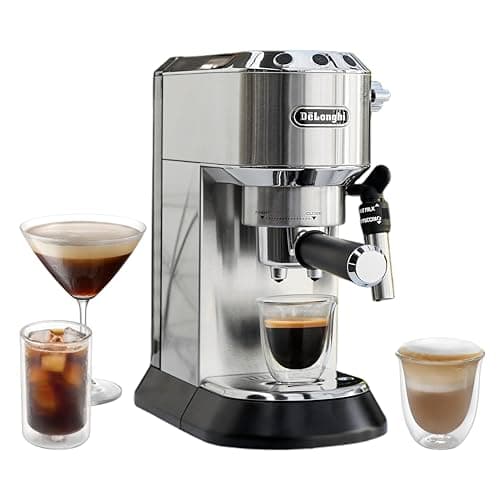
The best answer on the market to a specific question — how do I pull real espresso on a counter that has no room for an espresso machine. About six inches wide, stainless, 15 bar, hot in roughly 30 seconds, with an adjustable frother and programmable shot volumes. The ceiling is set by its stock 51mm pressurized baskets: they make it forgiving with a cheap grinder and they cap how good the shot can get, and the 51mm aftermarket is thin.
- Best for
- Small kitchens, apartments, offices and dorms — anyone who wants a genuine portafilter machine and has a narrow strip of counter rather than a corner
- Price context
- Mid-entry tier — well above the Stilosa, below the Breville Bambino; a grinder is still a separate purchase
Almost every espresso machine is designed as though your kitchen had a spare corner. The De'Longhi Dedica Deluxe (EC685M)is designed as though it had a spare six inches, and that single decision explains everything good and everything limiting about it. De'Longhi calls it the slimmest pump coffee maker around; at about 149 mm wide it takes roughly the lateral space of a large mug and still contains a 15 bar pump, a thermoblock that retailer spec sheets put at around 30 seconds to brewing temperature, and a real 51mm filter holder.
It is also, quietly, one of the most misunderstood machines in its class — because the spec that decides how good its espresso can get is not the pressure, the wattage or the stainless shell. It is the basket. The Dedica ships with pressurized (dual-wall) filters, and that is a ceiling rather than a setting. Everything below works through what that means.
A note on method first: we have not run this machine in a lab. This review compiles De'Longhi's published specifications, cross-checks them against retailer spec sheets and the current US listing, flags the places those sources disagree, and does the reasoning — the same approach described on our methodology page. Units we claim to have tested: zero.
Who the Dedica is for
Three buyers, specifically. The first has a small kitchen and has already worked out that a Barista Express-sized all-in-one is not going to happen. For that person the Dedica is less a compromise than the only sensible answer, which is why it also leads our best compact espresso machines thinking.
The second is moving up from pods. The Dedica is the smallest step from a capsule machine to a machine where you control the dose, the grind and the tamp — it even accepts E.S.E. pods if you want to keep one foot in the old world while you learn. If you are weighing those two worlds against each other, espresso machine vs Nespresso lays out the trade.
The third is an office, a studio apartment or a holiday rental: something that needs to make a real cappuccino, heat up fast, switch itself off, and not own the counter. The 20-minute auto shut-off and the roughly 30-second heat-up are built for exactly that pattern.
It is the wrong machine for two people. If you want to chase shot quality — non-pressurized baskets, 18 g doses, puck prep, a bottomless portafilter to watch extraction — the 51mm standard will frustrate you and a 54mm or 58mm machine will not. And if you make four milk drinks in a row every morning, a single thermoblock switching between brew and steam will feel slow.
What the specs say
Three figures in the table below need a word of explanation, because the published sources genuinely disagree and we would rather print the disagreement than pick a number.
The tank.The US Amazon listing describes a 35 oz tank; De'Longhi's European spec sheet for the same EC685 body lists 1.1 L, which is about 37 oz. Either way it is a small tank in a narrow machine, mounted at the back.
The weight. De'Longhi's spec sheet says 4.2 kg (about 9.3 lb); some US listings publish 8.8 lb. The practical point is the same: this is a light machine, and a light machine can shift on the counter when you twist a portafilter into the group.
The power. US and EU spec sheets list 1,300 W; some EU trims of the same machine are published at 1,350 W. Wattage here buys heat-up speed, not better coffee — a distinction our espresso machine buying guide spends some time on, because it is one of the four specs that most often mislead buyers.
What six inches actually buys
The Dedica's width is not a styling exercise, it is an engineering result: the machine is deep and tall rather than wide, so the tank sits behind the body instead of beside it and the group, pump and thermoblock stack vertically. At roughly 33 cm deep and 30.3 cm high it needs more counter depth than you might expect, and it needs clearance above for the tank lid.
Measure that before you buy, because it is the one dimension people get wrong. A machine six inches wide that cannot be filled under your wall cabinets is not a narrow machine, it is a machine you carry to the sink. Our compact espresso machine roundup ranks the whole field on published footprint for this reason.
The second thing the width buys is a pleasant surprise: the drip tray is a double tray that lifts out, so the same machine takes a demitasse and a tall latte glass of up to about 12 cm. Narrow machines usually solve height by making you remove the tray entirely and brew into a puddle.
What the width costs is thermal mass. A thermoblock heats water on demand through a small metal block rather than holding a reservoir of hot water, which is exactly why it is ready in roughly half a minute and exactly why it holds temperature less steadily than a boiler machine under load. For one or two drinks that trade is overwhelmingly in your favor. For six it is not.
The 51mm pressurized basket ceiling
This is the section that matters. The Dedica's stock filters are pressurized— dual-wall baskets with a single tiny exit hole behind the visible bottom plate. They generate crema mechanically by forcing the coffee through that restrictor, which means they produce a thick-looking shot almost regardless of what your grinder did.
That is genuinely useful if you are grinding with something mediocre, and it is the reason the Dedica gets a reputation for being easy. It is also a ceiling: because the restrictor is doing the work, improvements in grind, dose and tamp stop paying off past a certain point. Our pressurized vs non-pressurized portafilter explainer walks through the mechanism in full, and it applies to this machine more directly than to almost any other on this site.
The second half of the problem is the 51mmdiameter. Breville's consumer range is 54mm; commercial and enthusiast machines are 58mm; 51mm is the smallest common standard and the aftermarket reflects that. Non-pressurized 51mm baskets, bottomless portafilters and precision tampers all exist, but the catalog is a fraction of what 58mm owners enjoy, and they are specialty rather than shelf items. Our portafilter size guide covers what fits what before you spend money on accessories.
There is a dose consequence too, and it catches people out. A 51mm basket is narrower, so a typical aftermarket non-pressurized 51mm basket is specified for around 12.5 gof ground coffee rather than the 18 g a 58mm double takes. Recipes written for an 18 g in, 36 g out double do not transfer — you scale the dose down and keep the ratio, which our grams in a double shot guide explains how to do.
So: buy the Dedica knowing that the stock experience is forgiving and capped, and that the upgrade path exists but is narrow. If being able to chase a shot matters more to you than counter space, that is an argument for a 54mm Breville or a 58mm machine rather than an argument against this one.
Milk, and what the frother can actually do
The Dedica uses De'Longhi's adjustable manual frother— the patented manual cappuccino system — which is an aerating wand with a selector that changes the balance of air to steam. Turn it one way for stiff cappuccino foam, the other for a flatter latte texture.
That design is a deliberate trade. An aerating wand introduces air for you, which is why beginners get usable foam on the first try and why a bare commercial tip takes weeks of practice. The same mechanism is why genuine latte-art microfoam — the dense, glossy, paint-like milk you pour patterns with — is hard here: the wand is making bubbles on purpose. You can get close by keeping the selector toward the latte end and working the jug, but this is not a machine that rewards a milk obsession.
The practical limit is the single thermoblock. Brewing and steaming happen at different temperatures, so the machine has to transition between them, and there is a wait each way. A cappuccino is comfortable. Two cappuccinos and an espresso for guests is a sequence you plan. Our how to steam milk guide covers the technique and cappuccino vs latte covers which texture you are actually aiming for.
Living with it
What you still need to buy.A grinder, first and above everything. The Dedica is a machine, not a setup, and a pressurized basket will mask a bad grinder only up to the point where it also masks a good one. If you want this machine to be worth its price in two years, pair it with a real burr grinder — our best espresso grinders under $300 and best grinder for a De'Longhi guides both cover the fitment question, and do I need a grinder for espresso makes the case. After that: a scale, a 51mm tamper, and descaling solution.
Water, then descaling.Thermoblocks are narrow-channel heaters, which makes them fast and makes them vulnerable to scale. This is the machine where water choice is not optional — what water to use in an espresso machine covers it, and how to descale an espresso machine covers the routine. Scale is what kills machines in this class, not pump failure.
The ready light. It reports the heater, not the group head and the portafilter. Pull a blank shot of water through the locked-in portafilter before the real one so the metal is hot; on a light machine with a small thermoblock that single habit does more for consistency than any accessory. Our how to pull an espresso shot guide puts the whole sequence in order.
Trim names.EC685M is the metallic/silver trim; EC685.BK, EC685.W and EC685.R are the same machine in black, white and red, and De'Longhi has sold Dedica variants under other suffixes (the Dedica Arte and Dedica Maestro are different, more featured machines). Buy on the EC685 number rather than on the word Dedica.
Alternatives worth checking first
| Machine | Why you would pick it instead | Basket | Price |
|---|---|---|---|
| De'Longhi Stilosa (EC260) | Much cheaper, same pressurized-basket ceiling — the right call if the money is better spent on the grinder | Pressurized | $149.95Buy |
| Breville Bambino | 54mm basket, a far bigger accessory market and a real steam wand — but wider and more expensive | 54mm | $299.95Buy |
| Baratza Encore ESP | Not a machine — the grinder to pair with the Dedica if you only have budget for one more thing | n/a | $199.95Buy |
Prices shown are from Amazon as of October 17, 2026 and change often — the button always goes to the current listing. Some links may earn us a commission at no extra cost to you.
The two head-to-heads worth reading before you commit: Stilosa vs Dedica works through whether the extra money buys enough, and Breville Bambino vs De'Longhi Dedica is the real cross-brand decision at this level. The brand-wide view is in best De'Longhi espresso machines.
Verdict
The Dedica Deluxe is the right machine for a narrow counter and the wrong machine for an ambitious one, and it is unusually honest about which it is. Six inches wide, stainless, 15 bar, hot in roughly half a minute, programmable shot volumes, an adjustable frother and a cup warmer — everything a daily cappuccino needs, in a footprint nothing else at this price matches.
What you are accepting is the ceiling: pressurized 51mm baskets that make the machine forgiving and keep it from getting much better than good, a thin accessory market at that diameter, and a single thermoblock that asks you to wait between brewing and steaming. If those three sentences describe a machine you would be happy with in two years, buy it with confidence and spend the next money on the grinder. If they read like limits you will push against, a 54mm Breville is the smaller regret.
What we liked
- About six inches wide — De'Longhi's own claim is the slimmest pump coffee maker around, and no competing machine at this price is close
- Thermoblock heating that retailer spec sheets put at roughly 30 seconds to brew temperature, against several minutes for a machine with a real boiler
- A genuine 51mm filter holder with 1-cup and 2-cup filters, not a capsule system — you control dose, grind and tamp
- Automatic Flow Stop with programmable 1-cup and 2-cup volumes, so the shot stops at the same place every morning without you standing over it
- Adjustable manual frother: you set the foam-to-steam balance rather than accepting one fixed setting
- Stainless steel shell, a cup warmer, a double drip tray that adjusts for tall glasses, and a 20-minute auto shut-off
- At 1,300 W into a small thermoblock it is genuinely a plug-in-and-go machine, which suits an office or a second kitchen
What gave us pause
- The stock baskets are pressurized (dual-wall): they manufacture crema through a restrictor, which makes the machine forgiving with a mediocre grinder and also caps how good the espresso can get
- 51mm is the smallest common basket standard, so the aftermarket for non-pressurized baskets, bottomless portafilters and tampers is much thinner than for 54mm or 58mm
- A 51mm basket holds a smaller dose than a 54mm or 58mm — non-pressurized 51mm baskets are commonly specified around 12.5 g, so recipes written for an 18 g double do not transfer
- Single thermoblock: you brew, then you wait for it to come up to steam temperature, which makes back-to-back milk drinks slower than the specs suggest
- No PID, no pressure gauge and no shot timer — the ready light reports the heater, not the group
- Narrow means small: the tank is modest and sits at the back, so refilling under a low cabinet is awkward
- The frother aerates for you, which is what makes it easy and also what makes true latte-art microfoam hard
- Published weights disagree between De'Longhi's spec sheet (4.2 kg) and some US listings (8.8 lb) — it is a light machine either way, which means it can shift when you lock in the portafilter
- No grinder in the box, and a cheap grinder is the fastest way to waste this machine
Frequently asked questions
Is the De'Longhi Dedica worth it?
Yes, if counter space is the constraint that is actually shaping your decision. At about six inches wide it is the narrowest real portafilter machine on the market, and it still gives you a 15 bar pump, a thermoblock that retailer spec sheets put at roughly 30 seconds to brewing temperature, programmable shot volumes and an adjustable milk frother. If you have room for a wider machine and you care about chasing shot quality, a 54mm Breville is the better buy because its baskets and accessory market are not the bottleneck.
What size portafilter does the De'Longhi Dedica use?
51mm. That is the smallest common basket standard - Breville's consumer machines use 54mm and commercial-style machines use 58mm - so the market for non-pressurized baskets, bottomless portafilters and precision tampers is much thinner. A non-pressurized 51mm basket is also typically specified around 12.5 g rather than the 18 g a 58mm double takes, so espresso recipes written for larger baskets need scaling down.
Does the Dedica come with pressurized baskets?
Yes. The EC685 ships with pressurized (dual-wall) filters, which force the coffee through a single small hole to generate crema mechanically. That makes the machine forgiving with a mediocre grinder, and it also caps how much better your espresso gets as your grind and puck prep improve. Non-pressurized 51mm baskets are available from third parties if you want to remove that ceiling.
How long does the De'Longhi Dedica take to heat up?
Retailer specification sheets for the EC685 cite about 30 seconds to brewing temperature, which is what a thermoblock buys you over a boiler machine that needs several minutes. Steaming is a separate temperature, so there is an additional wait when you switch from brewing to milk and back. Treat the ready light as information about the heater rather than about the group head - run a blank shot of water through the locked-in portafilter first so the metal is warm.
Can you make latte art with the De'Longhi Dedica?
It is difficult. The Dedica uses De'Longhi's adjustable manual frother, an aerating wand with a selector that changes the air-to-steam balance. Aeration is what makes it easy for beginners to get foam, and it is also what makes the dense glossy microfoam latte art needs hard to achieve. Keeping the selector toward the latte setting and working the jug gets you closer, but a bare steam tip on a 54mm or 58mm machine is the tool for that job.
What is the difference between the De'Longhi Dedica and the Stilosa?
The Dedica is the better object in nearly every way that affects daily use: a stainless shell rather than plastic, a 51mm filter holder rather than a basic basket assembly, thermoblock heating, an adjustable frother instead of a fixed panarello, Automatic Flow Stop, a cup warmer and about six inches of width against the Stilosa's 13.5. Both ship with pressurized baskets, so neither has a higher ceiling on shot quality - which is exactly why a fixed low budget is better spent on the Stilosa plus a real grinder.
Do I need a grinder with the De'Longhi Dedica?
Yes, and it is the single most important thing you buy after the machine. Nothing in the box grinds coffee, and while the pressurized basket will hide a poor grind better than a non-pressurized one, it also means a bad grinder puts a hard limit on the machine. A burr grinder with real espresso adjustment is the right pairing; pre-ground supermarket coffee cut for drip is the fastest way to waste this machine.
Sources
- De'Longhi - Dedica DeLuxe (EC685M) US product page: 15 bar pressure, thermoblock technology, adjustable manual milk frother, ground coffee or E.S.E. pods, 20-minute auto shut-off, removable double drip tray (cups up to 12 cm), 15 cm width described as the slimmest pump coffee maker around, 2-year warranty
- Retailer specification sheets for the De'Longhi EC685 body (1.1 L / 35 oz tank, 1,300 W, 14.9 x 33 x 30.3 cm, 4.2 kg, thermoblock cited at about 30 seconds, cup warmer, Automatic Flow Stop with programmable 1-cup and 2-cup volumes, patented manual cappuccino system)
- Kaffeemacher - 51mm filter baskets for the De'Longhi Dedica 685/885 (confirms the 51mm standard; 20mm-height non-pressurized basket specified for 12.5 g of ground coffee)
- Amazon product listing for the De'Longhi EC685M Dedica Deluxe - model identity, 35 oz tank, current availability and live price capture
- Specialty Coffee Association - espresso brewing standards
- National Coffee Association - espresso brewing basics and water guidance
Keep reading
Buying your first setup?
See how we pick — compiled specs, cost-per-shot math, and honest trade-offs — then dig into the guides. No fake test lab, no rankings for hire.