Buying Guide
The Best Compact Espresso Machines in 2026
Counter space is the real constraint in most kitchens. These machines are chosen on published footprint first — then on whether they still make espresso worth drinking.
Most espresso machine guides rank on shot quality and treat size as a footnote. For a lot of kitchens that gets the priority exactly backwards: if it does not fit, nothing else about it matters. Apartment counters, galley kitchens, offices and dorm rooms all have the same constraint, and it is measured in inches of free counter, not in bars of pressure.
So this guide starts with published dimensionsand works back to the coffee. The good news is that the compromise is far smaller than it used to be — our top pick is roughly six inches wide and still steams milk properly. The bad news is the part nobody mentions, which is that the machine is not the only thing that needs counter space. We get to that in the footprint everyone forgets.
What 'compact' actually means
"Compact" on a box is a marketing word, so it is worth defining. For espresso machines the dimension that matters is width, because counter space is almost always constrained left-to-right rather than front-to-back — you are fitting a machine into a gap between a kettle and a toaster. Depth matters second, and only becomes critical if you have cabinets that overhang.
Height matters more than people expect, for a reason that catches buyers out: if your machine lives under a wall cabinet, you need clearance to lift the water tank out and refill it. A machine that technically fits can still be a daily annoyance if you have to drag it forward every morning to top it up. Check the tank position, not just the height.
How we picked
We don't run a test lab, and we won't pretend to. Every machine here was assessed against manufacturer-published specifications and dimensions, the design decisions that determine how it lives in a small kitchen, and verified owner feedback — our full approach is on the methodology page. The weighting for this list:
- Published footprint, width first. A machine only qualifies if the maker publishes dimensions we can cite.
- What the size costs you.Small machines give something up — steam power, tank size, build material, or the ability to use fresh beans at all. We name it each time.
- Whether it still makes real espresso. A genuine pump-driven or lever-driven extraction, not a machine that only drips.
- Daily livability: tank access, drip tray capacity, warm-up time, and how much counter it needs around it, not just under it.
At a glance
Six machines, smallest compromise to smallest object. Tap any "view" button for the live Amazon price; the number shown at checkout is the one that applies.
| Machine | Type | Milk | Best for | Price |
|---|---|---|---|---|
| Breville Bambino | Pump, fresh grounds | Automatic steam wand | Compact overall | $299.95Buy |
| De'Longhi Dedica Deluxe | Pump, fresh grounds | Manual wand | Narrowest full machine | $249.00Buy |
| De'Longhi Stilosa | Pump, fresh grounds | Panarello wand | Budget | $149.95Buy |
| Nespresso Essenza Mini | Capsules | None (add frother) | Smallest footprint | $179.95Buy |
| Wacaco Nanopresso | Hand pump | None | No counter space at all | View at Amazon |
| Flair 49 Pro | Manual lever | None | Control without a footprint | $359.00Buy |
Prices shown are from Amazon as of October 17, 2026 and change often — the button always goes to the current listing. Some links may earn us a commission at no extra cost to you.
Best compact overall: Breville Bambino (BES450)
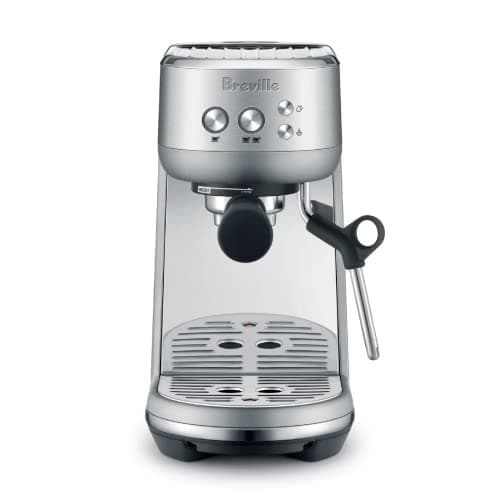
The Bambino is the machine we point most small-kitchen buyers toward, because it is the point where the size compromise stops costing you coffee. Breville publishes its dimensions as 11.9 × 6.1 × 13.5 inches, so it presents a narrow face of about six inches to your counter while putting its bulk front-to-back — exactly the right shape for a gap between appliances.
What makes it punch above the size is the heating system. Breville's ThermoJet reaches extraction temperature in about three seconds, which in a small kitchen is a genuinely different experience from waiting for a boiler. It runs a 54 mm portafilterwith an 18 g dose and a 15-bar pump delivering 9-bar extraction — real espresso specs, not a shrunken imitation.
| Dimensions (published) | 11.9 x 6.1 x 13.5 in |
|---|---|
| Heat-up | ThermoJet — extraction temperature in ~3 seconds |
| Portafilter | 54 mm, 18 g dose |
| Pump | 15 bar pump, 9 bar extraction |
| Milk | Automatic steam wand with microfoam texturing |
| Body | Stainless steel |
What we like: the footprint-to-capability ratio is the best here by some distance, the three-second start is transformative if you are making coffee in a hurry, and the automatic wand genuinely produces microfoam rather than just hot bubbles. The honest downsides: there is no built-in grinder, so budget counter space and money for one; the drip tray is small and needs emptying often; and at this price you are close to machines that offer more if space were not your constraint. Full detail in our Breville Bambino review.
Narrowest full machine: De'Longhi Dedica Deluxe (EC685)
The Dedica has been the default answer to "I have almost no counter" for years, and it earns it on one number: De'Longhi builds it under six inches wide— published at roughly 5.9 in / 14.9 cm — in a stainless steel body. It is genuinely startling in person; it takes up about as much lateral room as a large travel mug.
Underneath the slimness it is a conventional 15-bar pump machine with a manual frothing wand and a thermoblock heater, so it warms quickly and pulls a real shot. It ships with pressurized baskets, which makes it forgiving with supermarket coffee and a modest grinder.
| Width (published) | ~5.9 in / 14.9 cm |
|---|---|
| Pump pressure | 15 bar |
| Heating | Thermoblock — short warm-up |
| Milk | Manual frothing wand |
| Baskets | Pressurized (single and double) |
| Body | Stainless steel front |
What we like: nothing else with a portafilter and a steam wand takes so little width, the steel finish looks better than its price, and it is easy to live with. The honest downsides: the water tank is small and sits at the back, so tight under-cabinet installs make refills awkward; the pressurized baskets cap how good the shot can get; and the wand froths well but gives less control than the Bambino's.
Best compact budget pick: De'Longhi Stilosa (EC260)
If the constraint is money as well as space, the Stilosa is the honest floor. It is small, light, mostly plastic, and it has a real 15-bar pump driving a pressurized basketand a panarello frothing wand — which is to say it makes actual espresso rather than strong drip.
Its compactness comes partly from being lightweight, which is a double-edged quality: it is easy to lift into a cupboard when you are done, and it also slides on the counter when you lock in the portafilter. For a first machine in a small space, at this price, that is a reasonable trade.
What we like: the cheapest genuine entry to home espresso, small and stowable, and very little to go wrong. The honest downsides: the pressurized basket masks grind quality and caps the ceiling, the panarello froths without giving you real microfoam control, and the build feels its price. A first step rather than a machine you grow into — the full picture is in our De'Longhi Stilosa review.
Smallest footprint: Nespresso Essenza Mini
If the honest answer is that you have room for a kettle and nothing else, the Essenza Mini is the smallest machine Nespresso makes and the smallest thing here that plugs into a wall. It brews capsules at high pressure, comes up to temperature in well under a minute, and disappears into a corner.
The trade is total and worth stating plainly: you cannot use fresh beans. Capsules mean consistent, no-skill results and no grinder to house — which for a genuinely tiny kitchen may be the whole reason to pick it — but you have permanently traded the ceiling for the convenience, and you are tied to buying pods.
What we like: nothing else takes this little space, there is no learning curve, and cleanup is a spent capsule. The honest downsides: pod cost adds up, there is no milk system at all (you will want a separate milk frother), and it is a pod machine, not an espresso machine in the sense the rest of this list means. Our espresso machine vs Nespresso comparison covers that trade in full.
Best for zero counter space: Wacaco Nanopresso
The Nanopresso solves the problem differently: it has no footprint at all, because it lives in a drawer. It is a hand-pumpedbrewer roughly the size of a water bottle that builds genuine espresso-range pressure through a manual piston — no electricity, no plumbing, no permanent home on the counter.
It is the right answer for a dorm room, an office desk, a camper van, or any kitchen where the real constraint is that there is no free surface whatsoever. You add hot water from a kettle, add grounds, and pump.
What we like: it stores in a drawer, needs no power, travels anywhere, and makes a surprisingly credible small shot. The honest downsides: every cup is manual effort, the volume is small, there is no milk steaming, and you still need hot water from somewhere. We cover it alongside the other hand-powered options in best manual espresso machines.
Best compact manual lever: Flair 49 Pro
The Flair is for the small-kitchen owner who refuses to compromise on the shot. It is a manual lever press: you pull the lever yourself, which means you control the pressure profile directly — something no machine on this list under four figures offers. It disassembles into its own carry case, so its counter footprint between uses is zero.
It is also the most demanding thing here. There is no pump, no boiler and no steam wand; you bring your own hot water, you grind fine and precisely, and you do the work. In exchange you get a genuinely excellent shot from something that does not live on your counter.
What we like: full control of the extraction, top-tier shot potential, no permanent footprint, and nothing electronic to fail. The honest downsides: a real learning curve, it demands a good espresso grinder more than any other pick here, one shot at a time, and no milk texturing at all.
How to choose
Measure first, then answer two questions.
Do you want to use fresh beans?If yes, you need machine width plus grinder width — and the Bambino is the best all-round answer, with the Dedica taking the win if every inch counts and the Stilosa if the budget is the tighter constraint. If no, the Essenza Mini removes the grinder from the equation entirely, which in a very small kitchen is a legitimate and honest choice.
Do you need it to live on the counter at all?If the answer is no — if you would rather store it between uses — the Nanopresso and the Flair 49 Pro change the shape of the problem completely, at the cost of doing the work by hand every time.
And whichever way you go, remember that milk is the other constraint. Only the Bambino, Dedica and Stilosa steam milk; the other three need a standalone frother if you drink lattes. If milk drinks are the point of the purchase, start with our best espresso machines for lattes instead and treat size as the second filter.
Frequently asked questions
What is the best compact espresso machine?
For most small kitchens, the Breville Bambino (BES450). Breville publishes its dimensions as 11.9 x 6.1 x 13.5 inches, so it presents a roughly six-inch face to the counter while putting its bulk front-to-back, and it still runs a 54 mm portafilter, 9-bar extraction and an automatic steam wand. If you need the absolute narrowest full machine, the De'Longhi Dedica Deluxe is published at under six inches wide.
How narrow can an espresso machine actually be?
Among full pump machines with a portafilter and steam wand, roughly six inches is the practical floor — the De'Longhi Dedica Deluxe is published at about 5.9 in / 14.9 cm wide and the Breville Bambino at about 6.1 in. Capsule machines go smaller still, and hand-powered brewers like the Wacaco Nanopresso have no permanent footprint because they store in a drawer.
Do compact espresso machines make worse espresso?
Not necessarily any more. The Bambino runs the same 54 mm portafilter, 18 g dose and 9-bar extraction as much larger machines. What small machines genuinely give up is elsewhere: smaller water tanks and drip trays that need frequent emptying, less steam power for large milk volumes, and no room for a built-in grinder. The shot itself is mostly unaffected.
Do I still need a grinder with a compact espresso machine?
Yes, for every pick here that uses fresh beans. That's the footprint most buyers forget — a compact electric espresso grinder still wants four to six inches of width, so measure for machine plus grinder, not machine alone. In a genuinely tight kitchen, a hand grinder is the better answer: it matches entry-level electrics for espresso grind quality and stores in a drawer.
What's the smallest espresso machine that steams milk?
Among the picks here, the De'Longhi Dedica Deluxe at about 5.9 inches wide, with the Breville Bambino just behind at about 6.1 inches — and the Bambino's automatic wand produces better microfoam. The Nespresso Essenza Mini, Wacaco Nanopresso and Flair 49 Pro have no milk system at all, so you'd need a standalone frother alongside them.
Will a compact espresso machine fit under my kitchen cabinets?
Check height and water tank access together, not height alone. Most compact machines are 12-14 inches tall, which usually clears a standard cabinet, but the tank often lifts out of the top or the back — so a machine that technically fits can still mean dragging it forward every time you refill. Measure your clearance, then look at where the tank sits.
Sources
- Breville — Bambino (BES450) specifications: dimensions, ThermoJet, 54 mm portafilter, 9 bar extraction
- De'Longhi — Dedica Deluxe (EC685) specifications and dimensions
- De'Longhi — Stilosa (EC260) specifications
- Nespresso — Essenza Mini specifications
- Wacaco — Nanopresso specifications
- Flair Espresso — Flair 49 Pro specifications
Keep reading
Buying your first setup?
See how we pick — compiled specs, cost-per-shot math, and honest trade-offs — then dig into the guides. No fake test lab, no rankings for hire.