Buying Guide
The Best Manual Espresso Machines in 2026
Lever presses and hand pumps that pull a real 9-bar shot with no pump, no PID and often no electricity at all. Chosen on published specs, with the compromises stated plainly.
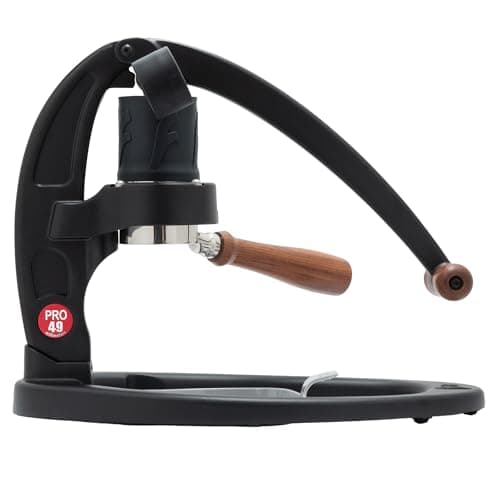
A manual espresso machine removes the two most expensive parts of an espresso setup — the pump and the boiler — and hands both jobs to you. You boil water in a kettle, you generate the pressure with a lever or a hand pump, and in return you get a machine with almost nothing to break, a footprint the size of a mixing bowl, and control over the shot that normally costs four figures to buy in an electric machine.
The catch is that manual espresso is a skill purchase, not a convenience purchase. Nothing here steams milk. Nothing here is fast. And every one of them is only as good as the grinder feeding it. Our overall pick is the Flair 49 Pro, because it gives you a live pressure gauge, an all-stainless brew path and a real bottomless basket without asking for a power outlet — but the right answer genuinely changes if you are buying for travel, for a first lever, or to keep for a decade.
What counts as a manual espresso machine
"Manual" gets used loosely. On this page it means one thing: you supply the brewing pressure. There is no electric pump forcing water through the puck. Two mechanisms dominate.
Direct lever presses(Flair, ROK) use a lever and piston to push water through the basket. The lever gives you leverage and, crucially, lets you shape the pressure across the shot — a gentle pre-infusion, a ramp to peak, a decline as the puck gives way. That profiling is something most sub-$1,000 electric machines simply cannot do.
Hand pumps (Wacaco) use a small piston you stroke repeatedly, building pressure in short bursts. They are far more portable and far less controllable, and the small baskets limit dose. They make excellent concentrated coffee; the top of the range makes genuine espresso.
How we picked
We do not run a test lab and we do not pretend to. Every machine below was assessed against its manufacturer's published specifications, the design details that decide how a lever actually behaves, and verified owner feedback — the full method is on our methodology page. For manual espresso specifically we weighted five things:
- Basket size and dose.A 49mm or 58mm basket taking 16–20g behaves like a real espresso basket. A 39mm basket taking 8g does not, however good the coffee is.
- Pressure feedback.A gauge turns "push and hope" into a repeatable recipe. Every lever here except the ROK has one; neither Wacaco pump does.
- Materials in the water path. Stainless steel and silicone, not plastic, where hot water and coffee travel.
- Thermal behavior. Whether the brew cylinder needs preheating before every shot, and whether the machine helps you with that.
- Serviceability. Seals, pistons and screens should be replaceable parts, not a reason to buy a new machine.
At a glance
The field side by side. Tap any button for the current listing; the number at checkout is the one that applies.
| Machine | Type | Basket | Dose | Gauge | Where to buy |
|---|---|---|---|---|---|
| Flair 49 Pro | Lever press | 49mm | 12-20 g | Yes | $359.00Buy |
| Flair Classic | Lever press | 40mm | 12-18 g | Yes | View at Flair Espresso (direct) |
| Flair 58 Plus 2 | Lever + preheat | 58mm | 16-20 g | Yes | View at Flair Espresso (direct) |
| ROK EspressoGC Classic PLUS | Twin-arm lever | Standard + SmartShot | Not published | No | View at ROK Coffee (direct) |
| Wacaco Picopresso | Hand pump | 52mm naked | 18 g | No | View at Amazon |
| Wacaco Nanopresso | Hand pump | 39mm | 8 g (16 g kit) | No | View at Amazon |
| Flair 2GO | Folding lever | 40mm | 12-18 g | Yes | $169.00Buy |
Prices shown are from Amazon as of Sep 18, 2026 and change often — the button always goes to the current listing. Some links may earn us a commission at no extra cost to you.
Best all-manual lever: Flair 49 Pro
The 49 Pro is the machine most people should buy if manual espresso is the goal rather than a novelty. Flair lists an all-stainless brew path— piston, cylinder and valve plunger — so nothing plastic touches hot water or coffee, and the 49mm portafilterships with both a bottomless and a pressurized basket, taking a 12–20g dose. That range is wide enough to run a normal 18g double the way an electric machine would.
| Type | Manual lever press (no electricity) |
|---|---|
| Portafilter | 49mm, bottomless + pressurized baskets |
| Dose | 12-20 g |
| Brew pressure | 6-9 bar, integrated gauge |
| Water capacity | 90 ml (yield up to 55 ml) |
| Brew path | All stainless steel; redwood portafilter handle |
| Weight / size | 7 lb; 13.5 x 7.5 x 11 in |
| Warranty | 5-year limited |
What we like: the gauge plus the wide dose range make this the most teachablelever here — you can watch pressure build, hold a pre-infusion, and repeat what worked. The bottomless basket shows channeling immediately, which shortens the learning curve. Build quality and the five-year warranty suggest a machine you keep.
The honest cons: 49mm is a slightly unusual size, so the accessory ecosystem is smaller than the 58mm world of tampers, screens and distributors. It is heavy for what it is, the brew cylinder wants a preheat rinse for the best shot, and there is no steam wand— milk drinks mean a separate milk frother. At seven pounds it is a countertop machine, not a travel one.
Best first lever: Flair Classic
The Classic is the press that started the current manual revival, and it is still the least expensive way to reach a genuine 9-bar shot. It uses a smaller 40mm portafilter on a 12–18g dose, includes a pressure gauge, and — the detail that matters most in daily use — ships with a thin-walled brew cylinder that does not need preheating, which removes the most annoying step of early Flair ownership.
| Type | Manual lever press (no electricity) |
|---|---|
| Portafilter | 40mm bottomless 2-in-1 + flow control portafilter |
| Dose | 12-18 g (max output ~40 ml) |
| Brew pressure | ~9 bar, gauge included |
| Water capacity | 60 ml |
| Materials | Cast aluminum frame, stainless brew head |
| Weight / size | 5 lb; 12.5 x 6.25 x 10 in assembled |
| Warranty | 3-year |
What we like: the lowest cost of entry to real lever espresso, a gauge at a price where most rivals omit one, and a genuinely small footprint. It is also the easiest of the Flairs to take apart and clean.
The honest cons: the 40mm basket and 60ml reservoir cap what you can brew — this is a single-double machine, and a long ristretto-to-lungo range it is not. The cast aluminum frame feels lighter in the hand than the 49 Pro or the 58, and like every Flair it brews only, so no steamed milk. It is also not stocked on Amazon, so the link below goes to Flair. If you already know you want an 18g double every morning, skip to the 49 Pro.
Best 58mm flagship: Flair 58 Plus 2
The 58 Plus 2 is the one manual machine here that stops feeling like a compromise. It uses the commercial 58mm standard, so every tamper, distributor, puck screen and bottomless basket on the market fits, and it adds the thing every other lever asks you to do yourself: an integrated preheat controller in the base with three settings (low, medium, high) mapped to dark, medium and light roasts. An articulating shot mirror lets you watch extraction from the bottomless portafilter without contorting.
| Type | Manual lever press with electric preheat |
|---|---|
| Portafilter | 58mm; high-dose, low-dose and pressurized baskets |
| Dose | 16-20 g |
| Preheat | Integrated controller, 3 settings (dark/medium/light) |
| Water capacity | 90 ml (yield up to 55 ml) |
| Brew path | All stainless steel; walnut portafilter and tamper |
| Weight / size | 12 lb; 17.5 x 13 x 6.5 in |
| Warranty | 5-year limited |
What we like: 58mm compatibility is a genuine long-term advantage, the preheat controller removes the most tedious part of lever espresso, and the stainless brew path plus five-year warranty put it in buy-once territory. Shot control is better than most semi-automatic machines at similar money.
The honest cons: it is the most expensive machine on this page by a wide margin, it needs a power outlet for the preheater (so it is no longer strictly off-grid), and at twelve pounds and 17.5 inches long it demands real counter space. It still does not steam milk, and it is direct-purchase only. If your budget stretches this far and milk drinks matter, compare it honestly against the machines in our best espresso machines under $1000 guide before committing.
Best built to last: ROK EspressoGC Classic PLUS
The ROK takes a different mechanical route: two arms you press down together, driving a piston through a glass-composite chamberthat ROK says reduces friction and behaves better thermally than metal. The result is easier to operate consistently than a single tall lever — and the SmartShot basket included in the Classic PLUS is designed to produce a drinkable shot without precise tamping, which is the most common beginner failure.
| Type | Twin-arm manual lever (no electricity) |
|---|---|
| Baskets | Standard basket + SmartShot basket |
| Manufacturer pressure claim | 5-10 bar |
| Extraction time | ~25-30 seconds |
| Materials | Aluminum, stainless steel, glass-composite, silicone |
| Weight / size | 5.3 lb; 7 x 7 x 12.5 in |
| Also included | Manual milk frother, dosing funnel, spoon/tamper, double adapter |
| Warranty | 10-year |
What we like: a ten-year warranty is the longest here by a distance, and with no pump, no boiler and no descaling routine there is very little to fail. The included hand frother means milk drinks are possible out of the box, and the compact 7-inch square footprint suits small kitchens.
The honest cons: no pressure gauge, so you are calibrating by feel and taste rather than by number — a real step down from the Flairs for anyone who wants repeatable recipes. ROK does not publish a basket dose figure, which makes recipe planning fuzzier. The twin-arm action takes practice to keep even, the SmartShot basket that helps beginners also masks grind problems a bottomless basket would expose, and the marketplace listings we found had no buyable offer — so buy it from ROK.
Best espresso that travels: Wacaco Picopresso
Most portable espresso makers make strong coffee. The Picopresso is the one that makes espresso a specialty drinker would recognize, because Wacaco gave it the two things the rest lack: a naked (bottomless) portafilter with a 52mm basket, and an 18g double dose— the same dose you would run on a countertop machine. It weighs 12.35 oz and fits in a jacket pocket.
| Type | Manual hand pump (no electricity) |
|---|---|
| Basket | 52 mm, naked portafilter |
| Dose | 18 g (double) |
| Water capacity | 80 ml |
| Maximum pressure | 18 bar (261 PSI) |
| Weight / size | 12.35 oz (350 g); 2.8 x 3.07 x 4.17 in |
| In the box | Double basket, tamper, distribution tool, funnel, scoop, brush, case |
| Warranty | 2-year |
What we like: a real 18g dose and a naked portafilter mean the shot responds to grind and puck prep exactly like espresso should, and the included distribution tool and tamper are not afterthoughts. Nothing else this size gets close.
The honest cons: it demands an ultra-fine grindand rewards good puck prep more than anything else here — a mediocre hand grinder will ruin it. Pumping an 18g puck by hand is genuinely hard work, there is no gauge, the 80ml chamber means one drink at a time, and you still need boiling water from somewhere. It is a travel tool that happens to be excellent, not a replacement for a countertop lever.
Best budget portable: Wacaco Nanopresso
The Nanopresso is the Picopresso's cheaper, simpler sibling and the most-carried espresso maker in the world for good reason. It pumps to a claimed 18 bar, weighs 11.9 oz, and has an integrated cup, so the entire coffee kit is one object in a bag. Wacaco says it needs 15% less pumping force than the older Minipresso.
| Type | Manual hand pump (no electricity) |
|---|---|
| Filter basket | 39 mm |
| Dose | 8 g standard (16 g with add-on barista kit) |
| Water capacity | 80 ml |
| Maximum pressure | 18 bar (261 PSI) |
| Weight / size | 11.9 oz (336 g); 6.14 x 2.44 x 2.8 in |
| Materials | BPA-free polymers, stainless steel, silicone |
| Warranty | 12-month |
What we like: the lowest cost of entry to pressurized coffee anywhere on this page, genuinely pocketable, and the integrated cup makes it the honest choice for hiking, hotel rooms and office drawers. Easy to clean under a tap.
The honest cons: the 8g standard basket is half an espresso dose, so out of the box this is a concentrated single, not a double — you need the add-on 16g basket to approach a real double. The body is polymer rather than metal, there is no gauge and no bottomless option, and the small basket makes it much less responsive to great beans than the Picopresso. Buy it for portability, not for the ceiling.
Best packable lever: Flair 2GO
If the Wacaco pumps feel like a compromise but a 7lb press will not fit in your luggage, the 2GO is the middle path: the Flair lever mechanism engineered to fold down to 3.5 x 7 x 3.25 inches and drop into a 9.5-inch custom case, gauge and tamper included. It uses the same 40mm bottomless 2-in-1 portafilter and no-preheat cylinder as the Classic, so the shot quality is lever espresso, not pump espresso.
| Type | Folding manual lever press (no electricity) |
|---|---|
| Portafilter | 40mm bottomless 2-in-1 |
| Dose | 12-18 g (yield ~45 ml) |
| Brew pressure | 6-9 bar, gauge included |
| Water capacity | 60 ml |
| Folded size | 3.5 x 7 x 3.25 in (case 9.5 x 5.25 x 4 in) |
| Weight | 4 lb (3.7 lb in case) |
| Warranty | 1-year limited |
What we like: a real pressure gauge and a real bottomless basket in something you can pack, plus the no-preheat cylinder that makes hotel-room brewing realistic. For anyone who travels often but refuses to give up shot control, this is the honest answer.
The honest cons: at 4 lb packed it is dramatically heavier than a Wacaco, assembly and teardown add a step at both ends of a trip, the 1-year warranty is the shortest in the Flair range, and the 40mm basket and 60ml reservoir cap the dose exactly as on the Classic. If you travel light, take the Picopresso; if you travel by car, take the 2GO.
Also considered, and why it is not a pick
The Cafelat Robotdeserves its reputation: an aluminum-and-stainless twin-lever press with no plastic in the water path, a gauge on the Barista version, and a 15–18g professional basket. We have left it off the ranked list for one honest reason — supply. Cafelat sells it in batches through its own store and specialty dealers, and at the time of writing the current batch was sold out with the next expected weeks later. We do not rank things you cannot reliably buy. If you find one in stock at a dealer, it is a legitimate rival to the Flair 49 Pro.
We also excluded spring-lever machinessuch as the La Pavoni Europiccola and the prosumer levers above it. They are beautiful, and they do have boilers and steam wands — which makes them electric machines with a lever rather than manual machines, and puts them in a different price and skill bracket entirely.
And if what you actually want is strong, concentrated stovetop coffee rather than true 9-bar espresso, a moka pot does that for a fraction of any price here. Our moka pot vs espresso machine comparison lays out the pressure difference and who each one suits.
How to choose a manual espresso machine
Start with the basket, not the brand.Basket diameter decides dose, and dose decides what drinks you can make. 58mm (Flair 58 Plus 2) matches commercial standards and every accessory made. 49mm (Flair 49 Pro) and 52mm (Picopresso) run a full 18g double. 40mm (Flair Classic, 2GO) and 39mm (Nanopresso) are smaller doses — fine for a single, limiting for a flat white.
Decide whether you want a gauge.A pressure gauge is what turns manual espresso from a party trick into a repeatable recipe. If you like measuring things — and manual espresso rewards it — buy a machine with one. If you would rather learn by feel and taste, the ROK is honest about the trade.
Budget for the grinder before the machine. This is not optional advice on a manual machine. Hand pressure gives you no headroom to fight an inconsistent grind, so a stepless or fine-stepped burr grinder matters more here than on any electric machine. Our best hand grinders guide pairs naturally with a lever, and burr vs blade explains why a blade grinder will make any of these machines miserable.
Plan for milk. Only the ROK bundle includes a milk tool, and it is a hand frother. If cappuccinos are the point of buying an espresso machine, either add a milk frother or look at a machine with a steam wand in our best espresso machines for beginners guide instead.
Do the math on running cost.Manual machines have no descaling, no pump to fail, and no standby draw — which changes the long-run numbers meaningfully against an electric setup. Our true cost of home espresso guide shows the per-shot arithmetic.
The bottom line
For most people who want manual espresso at home, the Flair 49 Pro is the pick: a full 18g-capable basket, a live gauge and a stainless brew path with no power needed. Buying your first lever, or testing whether you enjoy the ritual? The Flair Classic. Want the 58mm accessory ecosystem and a preheat controller that does the fiddly part for you? The Flair 58 Plus 2. Want the longest warranty and the least fuss? The ROK EspressoGC. And for the road, the Picopresso makes real espresso, the Nanopresso makes it cheapest, and the Flair 2GO takes a proper lever with you.
Whichever you choose, spend the next chunk of budget on the grinder, not on the machine. On a manual press, that is where the shot is actually decided.
Frequently asked questions
What is the best manual espresso machine?
For most home buyers, the Flair 49 Pro. Its 49mm portafilter takes a 12-20g dose with both bottomless and pressurized baskets, it has an all-stainless brew path, and its integrated gauge shows 6-9 bar during the shot so you can repeat what works. If you want commercial 58mm accessory compatibility and a built-in preheat controller, the Flair 58 Plus 2 is the step up; for travel, the Wacaco Picopresso is the only pocket-sized option with a full 18g double basket.
Do manual espresso machines make real espresso?
Yes, if they reach roughly 9 bar with a proper dose. Lever presses like the Flair and ROK generate 6-10 bar by hand, and Wacaco's pumps claim up to 18 bar, so the pressure is genuinely espresso-range — unlike a moka pot, which brews at about 1-2 bar. The variable is you: the shot is only as consistent as your grind, your puck prep and your lever technique.
Do you need electricity for a manual espresso machine?
Not for brewing. Every machine here generates pressure by hand and none heats its own water, so you boil water in any kettle and pour it in. The one exception is the Flair 58 Plus 2, whose base includes an electric preheat controller — the brewing is still fully manual, but you need an outlet to use the preheater.
Can a manual espresso machine steam milk?
No. None of these machines has a steam wand, because there is no boiler. The ROK EspressoGC Classic PLUS bundle includes a handheld manual frother, and for everything else you would add a separate milk frother. If milk drinks are the main reason you want espresso, a machine with a real steam wand will serve you better.
Is a manual espresso machine good for beginners?
It can be, with the right expectations. There is very little to break and no descaling, and a pressure gauge makes the process visible in a way most cheap electric machines do not. But there is no automation to hide mistakes, so a beginner needs a decent burr grinder and patience for the first few weeks. The Flair Classic is the low-risk way in; the ROK's SmartShot basket is the most forgiving of imperfect tamping.
What grind do you need for a manual espresso machine?
Fine — espresso-fine, and finer still for the small-basket Wacaco pumps, which Wacaco specifies as ultra-fine. Because you supply the pressure by hand, an inconsistent grind is immediately obvious: the lever either drops through with no resistance or refuses to move. A burr grinder with fine, small adjustments is essential; see our grind size chart for starting points.
Sources
- Flair Espresso — Flair 49 Pro product page and specifications
- Flair Espresso — Flair Classic product page and specifications
- Flair Espresso — Flair 58 Plus 2 product page and specifications
- Flair Espresso — Flair 2GO product page and specifications
- ROK Coffee — EspressoGC Classic PLUS product page and specifications
- Wacaco — Picopresso specifications
- Wacaco — Nanopresso specifications
- Cafelat — Robot Barista product page (specifications and stock status)
Keep reading
Buying your first setup?
See how we pick — compiled specs, cost-per-shot math, and honest trade-offs — then dig into the guides. No fake test lab, no rankings for hire.