Buying Guide
The Best De'Longhi Espresso Machine: The Whole Lineup, Decoded
De'Longhi sells more espresso machines than anyone and names them like a car catalog. Here is what Stilosa, Dedica, La Specialista, Magnifica and Rivelia actually mean, which one is right for you, and where every single one of them compromises.
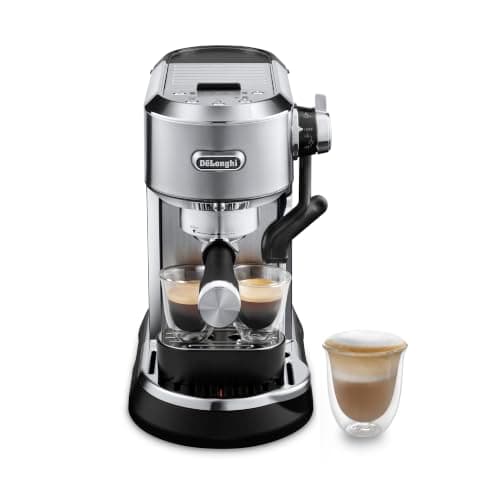
De'Longhi makes more espresso machines than any other brand sold in American kitchens, and the range runs from a plastic-bodied pump machine that costs less than a decent hand grinder to a touchscreen bean-to-cup that grinds two different roasts on demand. That breadth is genuinely useful. The problem is that nothing about the names tells you where a machine sits.
Stilosa, Dedica, Dedica Maestro Plus, La Specialista Arte, La Specialista Arte Evo, La Specialista Maestro, Magnifica Evo, Dinamica, Eletta, Rivelia, PrimaDonna— and behind each of those sits a model number like EC950M or ECAM29084SB that changes the milk system without changing the name on the box. This page fixes that. Every machine below was checked as currently listed and purchasable before we wrote it up, every specification comes from De'Longhi's own documentation or the live product listing, and every pick carries its honest downsides — because all seven of them have some.
What De'Longhi's names and numbers actually mean
De'Longhi's catalog looks chaotic and is actually systematic. Two rules and a handful of words resolve almost the whole range.
Rule one: read the model-number prefix, not the name. It tells you what kind of machine you are looking at, and it never lies.
- EC… = a manual espresso machine. You lock a portafilter into a group head. EC260BK (Stilosa), EC685M (Dedica Deluxe), EC950M (Dedica Maestro Plus), EC9250M (La Specialista Arte Evo) and EC9885M (La Specialista Maestro) are all in this family.
- ECAM… / EXAM… = a fully automatic bean-to-cup machine. There is no portafilter at all; beans go in the top and a drink comes out of a spout. ECAM29084SB (Magnifica Evo) and EXAM44055B (Rivelia) are in this family.
Rule two: the family name sets the price ladder, and the suffix tells you what got automated.
- Stilosa = the entry manual machine. Pump, boiler, pressurized baskets, plastic body. No grinder.
- Dedica = the slim manual machine, built around a footprint roughly six inches wide with a thermoblock instead of a boiler. No grinder.
- La Specialista = a manual machine with a conical burr grinder built in. This is De'Longhi's answer to the Breville Barista range.
- Magnifica → Dinamica → Eletta → Rivelia → PrimaDonna = the bean-to-cup ladder, roughly cheapest to most expensive.
- Maestro= the top trim of its family. It means something different in each one — on the Dedica it buys an automatic steam wand, on La Specialista it buys the Smart Tamping lever and five temperature profiles.
- Plus = automation added to that family's base model. Evo = the refreshed generation of an existing machine.
- LatteCrema= De'Longhi's automatic milk system: a sealed carafe that textures milk for you and goes back in the fridge. It is the single most useful word in the catalog, because it is the difference between steaming milk yourself and not.
How we judged
We rank on published manufacturer specifications and the live product listings, not on lab tests we did not run — machines we claim to have personally tested: zero. We would rather say that plainly than dress borrowed opinions up as first-hand testing. What we do instead is weight the specifications that are objectively verifiable and that genuinely change either the cup or the daily routine.
- Does it have a portafilter at all? This is the first fork in the range and the one that decides everything else. An EC machine hands you dose, grind and puck prep; an ECAM/EXAM machine takes all three away in exchange for a button. Neither is wrong, but they are different hobbies.
- Basket type at the entry end. A pressurizedbasket forces the coffee through a single small hole to fake crema, which means it will produce drinkable espresso from mediocre grounds — and will never reward a better grinder. A non-pressurized basket is the opposite bargain. The Stilosa is pressurized; the Dedica Maestro Plus ships both.
- Milk system. Manual wand (most control, needs practice), automatic wand (repeatable microfoam, no skill) or a LatteCrema carafe (hands-off, more to clean). For most households milk is the majority of drinks made, so this decides daily satisfaction more than shot quality does.
- Temperature control. De'Longhi's Active Temperature Controlgives selectable infusion profiles — three on the Dedica Maestro Plus and Arte Evo, five on the La Specialista Maestro. More profiles means you can match the water to a light roast instead of scalding it.
- Grinder, and how many settings it has. Built in or not, and if built in, whether it steps in 13 or 15 increments. More steps means finer control when you are dialing in a new bag.
- What it asks of you. Counter and cabinet clearance, tank size, whether you need to buy a grinder, and how much of the routine you have to learn.
One number we deliberately ignore: the pump bar rating. Machines on this page advertise 15 bar and 19 bar, and both figures are the pump's maximum rather than the pressure at the coffee. De'Longhi's own product copy says so in plain language — the pump delivers "low pressure during pre-infusion, to the optimal 9 bar of high pressure during extraction." A 19 bar machine is not 27% better than a 15 bar machine. The figure ranks nothing.
At a glance
The whole lineup in one table, cheapest first. Read it left to right and you are watching money buy steps of the process — the grinder, the tamp, the milk — rather than better espresso.
| Machine | Type | Grinder | Milk | Temperature control | Price |
|---|---|---|---|---|---|
| Stilosa (EC260BK) | Manual, pressurized | Separate | Manual frothing wand | None selectable | $104.97Buy |
| Dedica Deluxe (EC685M) | Manual, thermoblock | Separate | Adjustable manual frother | None selectable | $249.00Buy |
| Dedica Maestro Plus (EC950M) | Manual, thermoblock | Separate | Automatic wand (3 textures, 3 temps) | 3 infusion profiles | $418.50Buy |
| La Specialista Arte Evo (EC9250M) | Manual, grind-to-cup | Built in, 15 settings | Commercial-style manual wand | 3 infusion profiles | $699.95Buy |
| La Specialista Maestro (EC9885M) | Manual, grind-to-cup | Built in, 15 settings | LatteCrema Hot + manual wand | 5 infusion profiles | $831.97Buy |
| Magnifica Evo (ECAM29084SB) | Bean-to-cup | Built in, 13 settings | LatteCrema carafe | Automatic | $802.75Buy |
| Rivelia (EXAM44055B) | Bean-to-cup, 2 hoppers | Built in, 13 settings | LatteCrema Hot carafe | Bean Adapt automatic | $1,299.00Buy |
Prices shown are from Amazon as of Sep 18, 2026 and change often — the button always goes to the current listing. Some links may earn us a commission at no extra cost to you.
Best De'Longhi for most people: Dedica Maestro Plus (EC950M)
The Dedica Maestro Plus is the pick for the largest number of households, and the reason is the same one that decides the Breville range: espresso is learnable in a fortnight, and milkis where beginners quietly give up. This is the cheapest machine De'Longhi makes with a genuinely automatic steam wand, and it offers three temperature and three milk texture settings, so a flat white comes out the same on a Tuesday morning as it did on Sunday.
Underneath the milk automation it is a proper little semi-automatic. The 15 bar pump runs low-pressure pre-infusion before settling to about 9 bar at the puck, Active Temperature Control gives three selectable infusion temperatures so you can stop scalding a light roast, and an Advanced Thermoblock gets it brewing within about a minute from cold rather than the ten-minute warm-up a brass boiler wants. It ships with both pressurized and non-pressurized 51mm baskets, which matters more than it sounds: you start on the forgiving basket and graduate to the real one once your grinder is dialed in, without buying anything.
And it is small. At 8.15 inches wideit will slot in where a full all-in-one simply will not go, and because it costs a fraction of a grind-to-cup machine, the money left over goes where this site always says it should — into the grinder.
| Portafilter | 51mm (pressurized + non-pressurized baskets included) |
|---|---|
| Heating | Advanced Thermoblock |
| Pump pressure | 15 bar (9 bar at the puck) |
| Pre-infusion | Yes (low pressure) |
| Temperature control | Active Temperature Control, 3 infusion temperatures |
| Milk | Automatic steam wand, 3 temperatures and 3 textures |
| Water tank | 54 oz, removable |
| Dimensions | 8.15 in W x 13.62 in D x 12.9 in H |
| Weight | 13.67 lb |
| Grinder | None — buy separately |
The honest cons.There is no grinder, and this machine is only as good as the one you pair it with, so budget for it from the start rather than discovering it later. A thermoblock this small has modest steam power, which shows if you try to texture a large pitcher for several drinks in a row — it is happiest on one or two cups at a time. The 51mm portafilter is the smallest of the three mainstream standards, so the aftermarket for baskets and bottomless portafilters is thinner than it is for 54mm or 58mm. And the automatic wand, for all its consistency, gives up the moment-to-moment control a practiced hand keeps.
Pair it with a grinder before you buy anything else — our best espresso grinders under $200 is the right shelf for a machine at this price, and how to steam milk is worth reading even when the wand does it for you.
Cheapest way into the brand: Stilosa (EC260BK)
The Stilosa is the cheapest machine on this page by a wide margin, and it is more honest than its price suggests. It is a real pump machine with a real portafilter and a real frothing wand, built around a stainless steel boiler rather than the aluminum block you might expect at this money, and it comes with single and double filters and a two-level cup holder so a tall latte glass fits.
What you are buying is the shape of espresso for the price of an accessory. The routine is the same as on a machine ten times the price — dose, tamp, lock in, pull, steam — which makes it a genuinely good way to find out whether you like the ritual before committing to it.
| Portafilter | Pressurized basket (single + double filters) |
|---|---|
| Boiler | Stainless steel |
| Pump pressure | 15 bar |
| Milk | Manual panarello steam/frothing wand |
| Water tank | ~34 oz / 1 L |
| Dimensions | 13.5 in W x 8.07 in D x 11.22 in H |
| Weight | 9.48 lb |
| Body | Plastic with stainless accents |
The honest cons.The basket is pressurized, and that is a hard ceiling rather than a quibble: it forces the coffee through a single restrictor hole to manufacture crema, which means it will make drinkable espresso from supermarket pre-ground and will never reward a better grinder or a better bean. The body is plastic, the panarello wand aerates milk rather than texturing it into true microfoam, and the small tank needs refilling often. If your plan is to get serious, you will outgrow it — and that is fine, as long as you know it going in.
Our full De'Longhi Stilosa review goes deeper on where the pressurized ceiling bites, and best espresso machines under $200 puts it against everything else at the money.
Narrowest real espresso machine: Dedica Deluxe (EC685M)
The Dedica Deluxe exists to solve a problem nobody else takes seriously: kitchen counters are full. At roughly six inches wideit occupies about the space of a large mug, and it is not a toy — a 15 bar professional pump, a thermoblock heating system that is ready to brew in well under a minute, and a stainless shell that looks like a machine costing three times as much.
The details are thoughtful in a way the price does not require. The Premium Adjustable Frother lets you dial the ratio of foam to steam rather than giving you one setting; Automatic Flow Stop cuts the shot at a set volume so you are not standing over it; the filter holder takes ground coffee or E.S.E. pods; the double drip tray adjusts for tall glasses; there is a cup warmer on top and an automatic shut-off after 20 minutes.
| Portafilter | 51mm (1-cup and 2-cup filters, E.S.E. pod capable) |
|---|---|
| Heating | Thermoblock |
| Pump pressure | 15 bar |
| Milk | Premium Adjustable manual frother |
| Water tank | 35 oz, removable |
| Width | About 6 in |
| Weight | ~12 lb |
| Extras | Automatic Flow Stop, cup warmer, double drip tray, 20-min auto shut-off |
The honest cons.It is narrow because everything inside it is small: the tank, the drip tray and the steam capacity all reflect the footprint, and steaming milk for two large drinks back to back is not what this machine is for. There is no selectable brew temperature the way there is on the Maestro Plus, the frother is manual, and the slim body means the portafilter and its baskets are on the small side even by 51mm standards. Buy it because the width is a hard constraint, not because it is the cheapest route to the brand — the Stilosa is.
If footprint is the whole problem, our best compact espresso machines roundup ranks the category on published dimensions rather than marketing copy.
Best all-in-one with a built-in grinder: La Specialista Arte Evo (EC9250M)
La Specialista is where De'Longhi stops competing on price and starts competing with the Breville Barista range, and the Arte Evo is the sensible rung of that ladder. A conical burr grinder with 15 settings lives in the top of the machine and doses straight into the portafilter, so the whole grind-to-cup routine happens on one footprint and you never buy a separate grinder.
Two things make it more than a convenience play. The commercial-style steam wand is a proper manual wand that will make real microfoam and latte art rather than the aerating panarello you get lower down the range. And Active Temperature Control offers three selectable infusion temperatures, backed by a 15 bar Italian pump that settles to about 9 bar during extraction. The Evo generation also adds Cold Extraction Technology— a cold brew cycle De'Longhi developed with the Specialty Coffee Association that finishes in under five minutes, which is a genuinely unusual thing to find on an espresso machine. It ships with a complete barista kit: tamper, dosing funnel, tamping mat, milk jug, and single and double filters.
| Portafilter | 51mm (single + double filters included) |
|---|---|
| Grinder | Built-in conical burr, 15 grind settings |
| Pump pressure | 15 bar Italian pump (9 bar at extraction) |
| Temperature control | Active Temperature Control, 3 settings |
| Milk | Commercial-style manual steam wand |
| Cold brew | Cold Extraction Technology, under 5 minutes |
| Dimensions | 11.22 in W x 14.37 in D x 15.87 in H |
| Weight | 21.5 lb |
| In the box | Tamper, dosing funnel, tamping mat, milk jug, filters |
The honest cons.You still tamp by hand — that is what the Maestro's lever buys — and an uneven tamp is the most common cause of a sour, channeled shot, so the technique matters here more than the price suggests. Fifteen grind steps is decent for a built-in grinder but it is stepped, not stepless, so there will be bags where the right setting sits between two clicks. A built-in grinder is also a single point of failure: when it goes, the machine goes with it, which is the standing argument for buying a cheaper machine and a separate grinder instead. And the 51mm platform still caps how far the aftermarket can take you.
Weigh it against the rest of the grind-to-cup category in best espresso machines with a built-in grinder.
Best for going deeper: La Specialista Maestro (EC9885M)
The Maestro is the most machine De'Longhi puts behind a portafilter, and it earns the name in three specific ways rather than by being a bigger version of the Arte Evo.
First, Smart Tamping Technology: you pull a lever and the machine tamps the puck for you, evenly, at the same pressure every time, with no mess on the counter. That removes the step beginners most reliably get wrong and experienced users most reliably get bored of. Second, Active Temperature Control with five infusion temperature profiles— enough range to actually treat a light Ethiopian differently from a dark Italian roast, where three profiles is more of a nudge. Third, it carries both milk systems: a LatteCrema Hot automatic frother for one-touch cappuccinos and a manual commercial-style steam wand(De'Longhi calls the manual mode MyLatte Art) for when you want to pour a rosetta yourself. Very few machines at any price give you both.
The grinder is a 15-setting unit with sensor-controlled dosing for single or double shots, and the 19 bar Italian pump runs low-pressure pre-infusion before settling to about 9 bar at the puck. There are eight drink presets on the panel.
| Portafilter | 51mm, Smart Tamping Station (lever tamp) |
|---|---|
| Grinder | Built in, 15 grind settings, sensor dosing |
| Pump pressure | 19 bar Italian pump (9 bar at extraction) |
| Pre-infusion | Yes (low pressure) |
| Temperature control | Active Temperature Control, 5 infusion temperatures |
| Milk | LatteCrema Hot automatic + manual commercial-style wand |
| Presets | 8 drink presets |
| Dimensions | 16.5 in W x 14 in D x 18.5 in H |
| Weight | 35.27 lb |
The honest cons.It is big and heavy — 16.5 inches wide and over 35 pounds — so measure the cabinet clearance before you commit. It is also the most expensive manual machine in the range by a distance, and a good deal of that money is spent on automation rather than on the brew path: it is still a 51mm thermoblock machine, not a 58mm dual boiler. Two milk systems also means two milk systems to clean, and the LatteCrema carafe has to live somewhere in the fridge. If your goal is the best possible shot rather than the easiest possible one, a simpler machine and a serious standalone grinder is the better spend.
Best bean-to-cup for most kitchens: Magnifica Evo (ECAM29084SB)
Everything above this line asks you to make the coffee. The Magnifica Evo is where De'Longhi's real dominance lives: bean-to-cup machines that grind, dose, tamp, brew and froth behind a closed door while you do something else. For a household where the person making the coffee is not the person who wants a hobby, this is the honest answer.
The Evo generation offers seven one-touch or customized drinks— espresso, cappuccino, latte macchiato, iced coffee, coffee, hot water and a saveable My Latte recipe — from a conical burr grinder with 13 grind settings. The trim we picked carries the LatteCrema System, the sealed carafe that textures dairy and plant milks automatically and goes straight back in the fridge between drinks, which is the single biggest quality-of-life difference between this and the manual-frother trim. An Over Ice recipe adjusts dose and brew for iced coffee rather than just brewing hot coffee over ice, and the brew group is removable so you rinse it under the tap.
| Type | Bean-to-cup super-automatic |
|---|---|
| Grinder | Conical burr, 13 grind settings |
| Drinks | 7 one-touch or customized recipes, incl. Over Ice and My Latte |
| Milk | LatteCrema System carafe (dairy + plant milks), fridge-storable |
| Brew group | Removable (rinse under the tap) |
| Pump pressure | 15 bar |
| Dimensions | 9.45 in W x 17.32 in D x 14.17 in H |
| Weight | 21.16 lb |
The honest cons.A bean-to-cup machine takes the tuning away along with the work. You get 13 grind steps and a strength setting; you do not get dose, basket choice or puck prep, so the ceiling on cup quality is lower than a competent manual machine with a good grinder. It is deep — over 17 inches — so it needs counter run rather than counter width. The milk carafe is another component to clean and store. And the trim trap is real here: make sure the listing you buy is the LatteCrema version and not the manual-frother ECAM29043SB, because the names are identical.
Our full De'Longhi Magnifica Evo review covers the trims in detail, and best super-automatic espresso machines puts it against the rest of the bean-to-cup field.
Best fully automatic: Rivelia (EXAM44055B)
The Rivelia is the flagship, and unlike most flagships it is built around one genuinely new idea rather than a longer feature list. It has two removable 8.8 oz bean hoppers. You pop one out and drop the other in, and the machine switches roasts — a dark roast for the morning, a decaf for the afternoon, without emptying a hopper or purging a grinder. De'Longhi calls it the Bean Switch System, and in a two-person household where one person drinks decaf it solves a problem no other machine at this price addresses.
Around that sits the rest of the flagship kit: 18 preset recipes including latte, cappuccino, cortado, flat white, iced coffee and espresso over ice; an integrated 13-setting burr grinder; the LatteCrema Hot automatic milk system with a one-touch auto-clean cycle; a 3.5-inch color touch display; four user profiles; and Bean Adapt Technology, a guided walkthrough that sets and saves the right grind, dose and infusion temperature for each bean you put in. De'Longhi lists a 19 bar pump, a 47.34 oz water tank and 1450 W at 120 V.
| Type | Bean-to-cup super-automatic |
|---|---|
| Bean hoppers | 2 removable, 8.8 oz each (Bean Switch System) |
| Grinder | Integrated burr, 13 settings |
| Drinks | 18 preset recipes, 4 user profiles |
| Milk | LatteCrema Hot automatic frother with auto-clean |
| Setup | Bean Adapt Technology (guided grind, dose and temperature) |
| Display | 3.5 in color touch display |
| Pump pressure | 19 bar |
| Water tank | 47.34 oz |
| Power | 1450 W, 120 V |
| Dimensions | 9.75 in W x 17 in D x 14.75 in H |
The honest cons.It is the most expensive machine here by a wide margin, and the money buys convenience and flexibility rather than a better shot — a competent manual machine with a serious grinder will out-extract it for less. Each hopper holds 8.8 oz, which is small enough that a heavy-drinking household will refill often. Cold milk drinks need the LatteCrema Cool accessory, which is a separate purchase from De'Longhi. And as with every bean-to-cup machine, a touchscreen and a sealed brew unit are more things that can fail out of warranty than a portafilter machine has.
De'Longhi vs Breville, in one paragraph
These are the two brands most American buyers end up choosing between, and they are good at different things. Breville owns the middle of the manual range: a 54mm portafilter, PID temperature control and an automatic milk wand on machines designed around a first-time owner, with a deep and well-supported accessory ecosystem. De'Longhi owns both ends— nobody else sells a credible pump machine as cheaply as the Stilosa or a slim one as well-executed as the Dedica, and in bean-to-cup it is simply the dominant brand, with the LatteCrema carafe as its best single idea. If you want to learn espresso, Breville's 54mm platform is the easier place to grow. If you want espresso to happen without learning anything, De'Longhi's automatics are better than anyone else's.
We work the head-to-head through in Breville vs De'Longhi, and the mirror of this page — the best Breville espresso machine — decodes the Bambino, Barista Express, Impress, Pro and Touch range the same way.
Where every De'Longhi compromises
Five things are true across this whole lineup, and no amount of money inside the range fixes any of them.
- The manual machines are 51mm. Breville standardized on 54mm and the commercial world runs on 58mm, which means 51mm has the smallest aftermarket of the three. Bottomless portafilters and precision baskets do exist for the Dedica and La Specialista, but the choice is narrower and the parts are harder to find than for either of the other standards. If you expect to go deep into puck prep and basket experiments, that is a real constraint.
- The entry machines are pressurized. The Stilosa ships a pressurized basket, which manufactures crema mechanically. It makes bad coffee drinkable and good coffee no better. The Dedica Maestro Plus solves this by including both basket types; the Stilosa does not.
- The bar number is marketing.Fifteen bar on some models, nineteen on others, and both are the pump's maximum. De'Longhi's own copy says the pump goes from low pressure during pre-infusion to "the optimal 9 bars of high pressure during extraction". Any machine here reaches that. Do not pay for a bigger number.
- The model numbers hide the milk system.This is the single most expensive mistake a De'Longhi buyer makes. The Magnifica Evo name covers both a manual frother wand and a LatteCrema carafe; the Rivelia name covers both a manual steam wand and LatteCrema Hot. The photographs on retail listings are often close enough that you cannot tell. Check the model number, every time.
- Moving up the range buys automation, not extraction.Like Breville's, this lineup sells you steps of the process — the grind, the tamp, the milk, the whole drink. It does not sell you a better cup. A modest machine fed by a good burr grinder will beat an expensive one fed by a mediocre grind, every time, which is why our burr vs blade explainer and best grinders for espresso matter more to your coffee than anything on this page.
How to choose
Work through these in order and seven machines become one.
- Do you want to make the coffee, or just drink it? This is the only question that matters first. If you want the machine to do it, jump to the Magnifica Evo (or the Rivelia if two roasts live in your kitchen) and stop reading. If you want to make it, carry on.
- Do you already own a good burr grinder, or will you buy one? Then buy a grinder-less machine and spend the difference on beans. The Dedica Maestro Plus if you drink milk drinks, the Dedica Deluxe if the counter is genuinely six inches wide, the Stilosa if you are testing whether you like the ritual at all.
- Do you want one box, and no separate grinder? The La Specialista Arte Evo. It is the most sensible grind-to-cup machine De'Longhi makes, and the cold brew cycle is a real bonus rather than a spec-sheet one.
- Do you want one box, and want the tamp and the milk handled too? The La Specialista Maestro— as long as you have measured the 16.5 inches of counter it wants.
Whichever you land on, two things stay true across the whole range. The bar number on the box ranks nothing, and the grinder deserves a bigger share of your budget than feels natural. If you want the whole counter planned in one go, our complete home espresso setup guide pairs machines with grinders, scales and accessories by budget. If you are still deciding between brands, our best home espresso machines roundup covers the whole category with one pick per type of buyer. And once the machine arrives, how to pull an espresso shot and how to steam milk are the two pages that turn it into good coffee.
Frequently asked questions
What is the best De'Longhi espresso machine?
For most households, the Dedica Maestro Plus (EC950M). It is the cheapest De'Longhi with a genuinely automatic steam wand — three milk textures and three temperatures — plus Active Temperature Control with three infusion profiles, a 15 bar pump that pre-infuses at low pressure before settling to about 9 bar at the puck, and both pressurized and non-pressurized 51mm baskets so it grows with your grinder. It is only 8.15 inches wide, and because it costs far less than a grind-to-cup machine it leaves budget for the burr grinder that changes the cup more than the machine does. If you want the grinder built in, the La Specialista Arte Evo (EC9250M) is the sensible all-in-one. If you do not want to make the coffee at all, the Magnifica Evo is the bean-to-cup answer.
What is the difference between the De'Longhi Stilosa, Dedica and La Specialista?
They are three rungs of the same manual ladder. The Stilosa is the entry machine: a stainless steel boiler, a 15 bar pump, a pressurized basket and a panarello frothing wand in a plastic body, with no grinder. The Dedica is the slim machine, about six inches wide, with a thermoblock that heats in well under a minute, an adjustable manual frother and a 35 oz tank — still no grinder. La Specialista is the grind-to-cup family: a conical burr grinder with 15 settings built into the machine, a commercial-style steam wand, and Active Temperature Control with selectable infusion temperatures. All three use a 51mm portafilter.
What does ECAM mean on a De'Longhi model number?
The prefix tells you the type of machine. Model numbers starting with EC (EC260BK, EC685M, EC950M, EC9250M, EC9885M) are manual espresso machines with a portafilter you lock into a group head. Model numbers starting with ECAM or EXAM (ECAM29084SB, EXAM44055B) are fully automatic bean-to-cup machines with no portafilter at all — beans go in the hopper and a finished drink comes out of the spout. The letters at the end are usually the color or finish. Reading the prefix is the fastest way to know what you are looking at, because the family name on the front of the box does not tell you.
What is the LatteCrema System?
LatteCrema is De'Longhi's automatic milk system: a sealed carafe that attaches to the machine, textures milk or a plant-based alternative for you at the press of a button, runs a one-touch clean cycle afterwards, and then goes back in the fridge with the milk still in it. It appears on the Magnifica Evo, the Rivelia and the La Specialista Maestro. It is the single most useful word in the De'Longhi catalog, because it is the difference between steaming milk yourself and not — and it is often the only difference between two machines that share a name.
Do De'Longhi espresso machines use 58mm portafilters?
No. The De'Longhi manual range — Stilosa, Dedica, Dedica Maestro Plus and the La Specialista machines — is built around a 51mm portafilter. Breville standardized on 54mm and the commercial world runs on 58mm, which means 51mm has the smallest aftermarket of the three: bottomless portafilters and precision baskets exist, but the choice is narrower. If you expect to go deep into puck prep and basket experiments, a 58mm machine such as the Gaggia Classic Evo Pro gives you more room to grow.
Is a 19 bar De'Longhi better than a 15 bar one?
No. Both figures describe the pump's maximum pressure, not the pressure at the coffee. De'Longhi's own product copy describes the pump as delivering low pressure during pre-infusion and then 'the optimal 9 bars of high pressure during extraction' — and every machine in this lineup reaches that. Espresso is brewed at roughly 9 bar at the puck regardless of whether the pump is rated 15 or 19. Judge the machines on the grinder, the milk system, the temperature control and the basket type instead.
Which De'Longhi machine is best for beginners?
If 'beginner' means you want to learn to pull a shot, the Dedica Maestro Plus (EC950M) is the best starting point, because it ships with both a pressurized basket that is forgiving on day one and a non-pressurized basket you graduate to once your grinder is dialed in — and its automatic steam wand removes the step most beginners give up on. If your budget is tighter, the Stilosa gets you the same routine for much less, with the caveat that its pressurized-only basket caps how good the coffee can get. If 'beginner' means you do not want to learn anything, the Magnifica Evo is the honest answer.
Sources
- De'Longhi — Dedica Maestro Plus (EC950M) listing specifications: 15 bar pump with low-pressure pre-infusion to 9 bar extraction, automatic steam wand with 3 temperature and 3 texture options, Advanced Thermoblock, Active Temperature Control with 3 infusion temperatures, 54 oz removable tank, dimensions and weight
- De'Longhi — Dedica DeLuxe (EC685M) product page: 15 bar pressure, thermoblock heating system, adjustable manual milk frother, professional filter holder for ground coffee (1 or 2 cups) and E.S.E. pods, double drip tray, cup warmer, 20-minute auto shut-off
- De'Longhi — Rivelia (EXAM44055B) product page: 18+ preset recipes, LatteCrema Hot automatic milk frother, 2 removable bean hoppers, 13-setting burr grinder, 19 bar, 47.34 oz tank, 3.5-inch color touch display, 1450 W at 120 V, 4 user profiles, Bean Adapt Technology
- Amazon listings (Creators API) — current availability, model numbers, product dimensions and manufacturer feature specifications for EC260BK, EC685M, EC950M, EC9250M, EC9885M, ECAM29084SB and EXAM44055B
- Seattle Coffee Gear — specification tables for the La Specialista Arte Evo (51mm portafilter, thermoblock) and Dedica Maestro Plus (51mm portafilter, pressurized and non-pressurized baskets included, 54 oz tank, 1450 W)
- Specialty Coffee Association — espresso brewing standards
Keep reading
Buying your first setup?
See how we pick — compiled specs, cost-per-shot math, and honest trade-offs — then dig into the guides. No fake test lab, no rankings for hire.