Buying Guide
The Best Home Espresso Machines in 2026
Six machines that cover the whole category, from the cheapest honest pump machine to a one-touch bean-to-cup. The right one is decided by how much of the process you want to do yourself, not by which brand is loudest.
A home espresso machine does one mechanical job: push hot water through a compacted puck of finely ground coffee at around 9 bar of pressure. Every machine on this page manages that. What separates them is not whether they can make espresso — it is how much of the process they hand back to you, and how much counter space, practice and money that costs.
That is why a single "best home espresso machine" ranking is usually a bad answer. The machine that is right for someone who wants a flat white in ninety seconds before work is the wrong machine for someone who wants to spend Sunday morning chasing a nine-second first drip. The six picks below are chosen to cover the whole category, one per buyer, and every one is a real product we verified as currently listed and purchasable before writing it up. Each entry carries its honest downsides, because every one of these machines has some.
The question that decides everything
Before comparing specs, answer this: which steps do you want to own?There are four — grinding, dosing and tamping, brewing, and milk — and the category divides almost perfectly by how many of them the machine takes off your hands.
- You own all four (semi-automatic, separate grinder). The Bambino Plus, Gaggia Classic Evo Pro and Stilosa. You buy a grinder separately, dose and tamp yourself, and the machine brews. Highest ceiling for the money, biggest learning curve, most counter clutter.
- The machine grinds, you tamp (all-in-one semi-auto). The Barista Express. One footprint, one purchase, and the grinder is calibrated to the machine. You still control dose, tamp and milk.
- The machine does everything but milk (bean-to-cup). The Magnifica Evo in its manual-frother trim. Press a button, get espresso; froth the milk yourself.
- The machine does everything, and coaches you (guided all-in-one). The Ninja Luxe Cafe Premier. A built-in scale, an assisted tamper and guided grind settings remove most of the ways a beginner gets a bad shot.
There is no hierarchy here. A super-automatic is not a "worse" machine than a semi-auto — it is a different trade, buying consistency and speed with cup ceiling and control. Deciding which trade you want narrows six machines to two in about a minute. If you are brand new to all of this, our home espresso for beginners guide walks the whole setup, and what espresso actually is covers the definitions the marketing copy blurs.
How we judged
We rank on published manufacturer specifications and documentation, not on lab tests we did not run — machines we claim to have tested: zero. That is a real limit and we would rather state it than dress up borrowed opinions as first-hand testing. What we do instead is weight the specifications that are objectively verifiable and that demonstrably change the cup or the daily routine. In order of how much they matter:
- Portafilter size and basket type. A commercial 58mm or a well-supported 54mmopens up bottomless portafilters, precision baskets and tampers for years; a small pressurized basket forces crema from any grind but caps how good the shot can get. This single spec predicts a machine's ceiling better than price does.
- Boiler and temperature control.A fast thermoblock (Breville's ThermoJet), a PID-controlled ThermoCoil, or a traditional single boiler. Temperature stability shot to shot is what makes a result repeatable rather than lucky.
- The milk system. Manual wand, automatic wand, panarello, or a hands-free frother. For most households milk is the majority of drinks made, so this decides daily satisfaction more than shot quality does.
- What it asks of you. Heat-up time, whether you need a separate grinder, whether you can brew and steam at once, and how much counter and cabinet clearance it needs.
- Repairability and parts.An espresso machine is a plumbed appliance with wear parts. Gaskets, screens and seals are consumables, and a brand with a real parts channel is worth money over a decade — something we fold into what home espresso actually costs.
We deliberately ignore one number the boxes shout about: the pump bar rating. A "15 bar" or "20 bar" pump does not brew at 15 or 20 bar; it is the pump's maximum, and the pressure that matters is roughly 9 bar at the puck. Every machine here achieves that, so the number ranks nothing.
At a glance
| Machine | Type | Grinder | Milk | Price |
|---|---|---|---|---|
| Breville Bambino Plus | Semi-automatic, 54mm | Separate | Automatic steam wand | $499.95Buy |
| Breville Barista Express | All-in-one semi-auto, 54mm | Built in (16 settings) | Manual steam wand | $699.95Buy |
| Gaggia Classic Evo Pro | Semi-automatic, 58mm | Separate | Manual steam wand | $505.09Buy |
| De'Longhi Stilosa | Semi-automatic, pressurized | Separate | Panarello wand | $149.95Buy |
| De'Longhi Magnifica Evo | Bean-to-cup super-auto | Built in (13 settings) | Manual frother (base trim) | $875.00Buy |
| Ninja Luxe Cafe Premier | Guided 3-in-1 | Built in (25 settings) | Dual Froth System | $599.00Buy |
Prices shown are from Amazon as of October 17, 2026 and change often — the button always goes to the current listing. Some links may earn us a commission at no extra cost to you.
Best overall for most homes: Breville Bambino Plus (BES500)
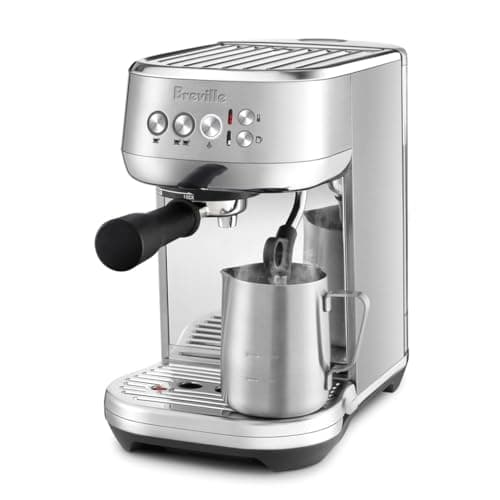
The Bambino Plus is the pick for the largest number of households because it solves the step most people actually fail at. Espresso is learnable; milkis where beginners quietly give up, and this machine textures it for you — an automatic steam wand with three temperature and three texture settings that delivers repeatable microfoam with no practice, while keeping a full manual mode for when you want to learn by hand.
Underneath, it is a proper semi-automatic. A ThermoJet heater reaches brew temperature in about three seconds, so there is no ritual of switching it on and waiting; a real 54mm portafilter with low-pressure pre-infusion means it responds to grind and dose the way an espresso machine should; and a 3-way solenoid valvedrops a drier puck and stops the portafilter "sneezing" when you unlock it. The 64 oz / 1.9 L tank is generous for a machine this narrow.
| Portafilter | 54mm (dual + single wall filters) |
|---|---|
| Boiler | ThermoJet (~3s heat-up) |
| Pump pressure | 15 bar (9 bar at the puck) |
| Pre-infusion | Yes (low-pressure) |
| Milk | Automatic + manual steam (3 temps, 3 textures) |
| 3-way solenoid | Yes (drier puck, no portafilter sneeze) |
| Water tank | 64 oz / 1.9 L |
What we like: hands-free microfoam that is genuinely consistent, a three-second start that makes a weekday shot realistic, a 54mm ecosystem you can upgrade into, and a footprint narrow enough to sit beside a grinder without owning the counter.
The honest cons: there is no grinder, and this machine is only as good as the one you pair it with — budget for it from the start. The single thermocoil means you brew, then steam, never both at once, which shows when you are making drinks for four people. The automatic wand, for all its consistency, gives up the moment-to-moment control a practiced hand keeps. And it costs meaningfully more than the base Bambino, whose espresso is identical — you are paying purely for the milk automation.
We go deeper in our Breville Bambino Plus review, and Bambino vs Bambino Plus settles whether the automatic wand is worth the difference for you.
Best all-in-one: Breville Barista Express (BES870XL)
If you want one box on the counter and one thing to buy, this is still the benchmark. The Barista Express puts an integrated stainless conical burr grinder with 16 settings and dose control in front of a ThermoCoil boiler with PID temperature control at around 200°F / 93°C, feeding the same 54mm portafilter as the Bambino. Beans go in the sealed half-pound hopper; espresso comes out about a minute later.
PID is the specification worth paying attention to. A thermostat machine swings around its target temperature; a PID holds it, which is what makes one shot resemble the last. Combined with the included Razor dose trimming tool— which levels the puck to a repeatable dose — it removes two of the three variables beginners struggle with, leaving only grind size.
| Grinder | Integrated stainless conical burr — 16 settings, dose control |
|---|---|
| Bean hopper | 1/2 lb (about 250 g), sealed |
| Portafilter | 54mm stainless (single & dual wall baskets) |
| Boiler | ThermoCoil with PID (~200°F / 93°C) |
| Pump pressure | 15 bar (9 bar at the puck) |
| Pre-infusion | Low-pressure pre-infusion |
| Milk | Manual steam wand |
| Water tank | 67 oz / 2 L (removable) |
| Dimensions | ~15.9 x 13.1 x 12.4 in (W x D x H) |
What we like: everything in one purchase and one footprint, PID stability that a machine at this price has no obligation to include, the enormous Breville 54mm accessory ecosystem, and an owner community large enough that any problem you have is already answered somewhere.
The honest cons: the built-in grinder is good, not class-leading, and it is welded to the machine — you cannot upgrade it alone, which is the structural weakness of every all-in-one. Grinding straight into the portafilter is messy and static-prone, and retention is not zero. The single ThermoCoil means brew then steam, not both. It is physically large and heavy, and it needs regular backflushing and descaling to stay healthy — the maintenance is real, not optional.
Our Breville Barista Express review covers it in full, and best espresso machines with a built-in grinder compares it against the rest of the all-in-one field.
Best to grow into: Gaggia Classic Evo Pro
Everything else on this page is designed to be convenient. The Gaggia is designed to be kept. It runs the 58mm commercial portafilter standard, which means every cafe-grade basket, bottomless portafilter and tamper on the market fits it, in a largely stainless body built around a single aluminum boiler and a ~1425 W heating element, operated by rocker switches with very little electronics to fail.
That simplicity is the point. This is the machine with the deepest modification and parts community in home espresso — owners routinely fit different baskets, adjust the pump toward a true 9 bar, and rebuild it rather than replace it. If you suspect you are going to fall down the rabbit hole, buying here once is cheaper over ten years than buying twice.
| Portafilter | 58mm (commercial standard) |
|---|---|
| Boiler | Single aluminum boiler |
| Heating element | ~1425 W |
| Pump | 15-bar vibratory (commonly modded toward 9 bar) |
| Milk | Manual steam wand (redesigned, commercial-style) |
| Controls | Rocker switches |
| Build | Largely stainless steel; repairable & moddable |
| Heat-up | ~5-10 min to temperature |
What we like: the 58mm standard, a genuinely repairable metal machine in a category full of disposable ones, a commercial-style steam wand that steams properly, and a parts supply that makes a decade of ownership realistic.
The honest cons: it is the least plug-and-play machine here. Heat-up takes roughly five to ten minutes rather than three seconds, so spontaneous espresso is not on the menu. The single boiler means brew then steam. It rewards effort instead of handing you results, and it is completely dependent on a proper burr grinder that you must buy separately. If you want good coffee without a project, buy something else on this page.
Read the full Gaggia Classic Evo Pro review, or Gaggia Classic vs Breville Bambino for the direct head-to-head that most buyers in this bracket are actually deciding.
Best budget first machine: De'Longhi Stilosa (EC260)
The Stilosa is on this page for one reason: it is about the cheapest honest pump espresso machine worth buying, and there is real value in finding out whether you like this hobby before spending several hundred dollars on it. It has a genuine 15-bar pump, a pressurized basket and a panarello frothing wand, in a plastic body with stainless accents and a roughly 34 oz / 1 L tank.
The pressurized basket is the whole story, good and bad. It restricts the coffee's exit so crema forms regardless of how badly you grind, which is exactly why a first machine should have one — you get a drinkable, good-looking shot on day one, from supermarket coffee, without a grinder.
| Portafilter | Pressurized basket |
|---|---|
| Pump pressure | 15 bar |
| Milk | Manual panarello steam/frothing wand |
| Water tank | ~34 oz / 1 L |
| Body | Plastic with stainless accents |
What we like: the lowest-risk entry into real espresso, a forgiving basket that produces a result immediately, a wand that froths milk for cappuccinos without a separate frother, and a compact, light body that is easy to store if the hobby does not stick.
The honest cons: that same pressurized basket masks grind quality and caps the ceiling— a better grinder will not make this machine much better, which is the opposite of every other pick here. The panarello froths but does not give you microfoam control. The build feels its price, there is no PID and no pre-infusion so temperature stability is basic, and the thin drip tray fills fast. This is a genuine entry point, not a machine you grow into.
The full De'Longhi Stilosa review has the detail, and best espresso machines under $200 covers the rest of the budget field.
Best one-touch bean-to-cup: De'Longhi Magnifica Evo
A super-automatic grinds, doses, tamps and brews behind a closed door, and the Magnifica Evo is the value entry to that world. It uses a steel conical burr with 13 grind settings, a removable brew group you can pull out and rinse under the tap, and a 15-bar pump, producing one-touch espresso, coffee, long and doppio+ drinks with essentially no learning curve.
The removable brew group deserves specific credit: many super-automatics seal that assembly inside the machine, where cleaning depends entirely on automated rinse cycles. Being able to take it out is the difference between a machine you can maintain and one you have to service. Note that the Magnifica Evo is sold in more than one trim — a manual frother wand at the base and a LatteCrema automatic milk carafe higher up — so check which milk system a given listing includes before you buy.
| Type | Bean-to-cup super-automatic |
|---|---|
| Grinder | Steel conical burr (13 grind settings) |
| Milk | Manual frother wand (base trim); LatteCrema carafe on higher trims |
| Drinks | One-touch espresso, coffee, long, doppio+ |
| Brew group | Removable (rinse under the tap) |
| Pump pressure | 15 bar |
What we like: freshly ground bean-to-cup coffee at the lowest sensible entry price, 13 grind settings so you can actually tune it to a bean, a brew group you can clean properly, a genuinely short learning curve, and a footprint that fits a normal kitchen counter.
The honest cons: the build is plasticky and feels like the budget machine it is. On the base trim, lattes are notone-touch — you froth the milk yourself, which surprises buyers who assumed otherwise. The milk system needs diligent daily cleaning, especially the LatteCrema carafe on higher trims. And you get less cup control than any semi-auto here: consistent and forgiving, but not the best espresso on this page. The drink menu and interface are basic next to pricier super-autos.
Our De'Longhi Magnifica Evo review goes further, and best super-automatic espresso machines compares it with the rest of the bean-to-cup field.
Best for a household that drinks more than espresso: Ninja Luxe Cafe Premier (ES601)
Most homes do not drink espresso exclusively. The Luxe Cafe Premier is built for that reality: it makes espresso, drip coffee and cold brew from one appliance, with a built-in conical burr grinder offering 25 settings, a built-in scale that doses by weight, an assisted tamper in the machine, and a Dual Froth System that handles dairy and plant-based milks hands-free across steamed milk, thin froth, thick froth and cold foam presets.
Weight-based dosing is the standout, and it is rare at any price. The single most common reason a beginner's shots are inconsistent is that the dose changes from one shot to the next; a machine that weighs it removes that variable outright. Add Barista Assist guiding grind size and adjusting temperature and pressure, plus three brew temperatures for dark through light roasts, and it is the most hand-holding available on this page.
| Modes | Espresso, drip coffee and cold brew (3-in-1) |
|---|---|
| Grinder | Built-in conical burr, 25 grind settings |
| Dosing | Built-in scale — weight-based dosing per drink |
| Tamping | Assisted tamper built into the machine |
| Milk | Dual Froth System — hands-free, dairy or plant-based |
| Froth presets | Steamed milk, thin froth, thick froth, cold foam |
| Brew temperatures | Three settings for dark through light roasts |
| Dimensions | 15.75 x 15.24 x 20.51 in (L x W x H) |
| Warranty | One (1) year limited |
What we like: nothing else to buy — grinder, scale, tamper and milk system are all in the box; weight-based dosing that removes the biggest beginner error; hands-free frothing that works with oat and almond milk; and three device categories collapsed into one, which is a real space and money saving.
The honest cons: it is big— over 20 inches tall and roughly 15 inches in both other directions, so measure your cabinet clearance before ordering. It is a generalist: a dedicated machine plus a dedicated grinder at similar money will beat it on espresso specifically. Ninja does not publish a pump pressure figure or reservoir capacity, so we cannot verify either and will not guess. The automation that makes it easy also means less hands-on control if you want to learn properly, the warranty is a short one year, and a built-in grinder fault takes the entire machine out of service.
The full Ninja Luxe Cafe Premier review has the detail on Barista Assist and the froth presets.
How to split the budget (the part most buyers get wrong)
The most expensive mistake in home espresso is spending the entire budget on the machine and pairing it with pre-ground coffee or a blade grinder. It is worth being blunt about why.
Where to start depends on the bracket you are shopping. Our best espresso grinders under $200 covers the entry bracket that pairs sensibly with a Stilosa or a Bambino Plus, and best espresso grinders under $500 covers where stepless adjustment and larger flat burrs begin. If you would rather not decide yet, burr vs blade explains the one distinction that is genuinely non-negotiable.
The two all-in-ones on this page — the Barista Express and the Ninja — sidestep the question by including a grinder, and the Magnifica Evo does too. That is a legitimate way to solve it. Just understand you are accepting a fixed grinder you cannot upgrade independently.
How to choose
Work through it in this order and six machines become one. If you are earlier in the process than a shortlist — still deciding between machine types, or working out how to split the budget with a grinder — our espresso machine buying guide runs the seven decisions that sit behind this page.
- Do you want to press a button and walk away? Then bean-to-cup: the De'Longhi Magnifica Evo. Check which milk trim the listing includes — the base one froths manually.
- Do you also make drip coffee or cold brew, and want coaching? The Ninja Luxe Cafe Premier, if you have the counter and cabinet height for it.
- Do you want one purchase, one footprint, but still to tamp and steam yourself? The Breville Barista Express.
- Is a reliable latte or cappuccino the main reason you are buying? The Breville Bambino Plus, plus a real grinder. This is the answer for the largest number of households.
- Do you expect to get deeply into this? The Gaggia Classic Evo Pro, on the 58mm standard, bought once and kept. Accept the slow heat-up and the learning.
- Are you testing whether you like the hobby at all? The De'Longhi Stilosa. Spend little, learn what you actually want, and upgrade deliberately.
Whichever you land on, two things stay true. The pump bar number on the box ranks nothing, and the grinder deserves more of your budget than feels natural. If you would rather buy the whole counter in one go, our best home espresso setup guide pairs each class of machine with a grinder, a scale and the accessories that earn their place. When the machine arrives, how to pull an espresso shot and the grind size chart are the two pages that turn it into good coffee. If your budget is fixed rather than open-ended, our price-tier guides narrow it further: best espresso machines under $500 and best espresso machines under $1000.
Frequently asked questions
What is the best home espresso machine?
For the largest number of households, the Breville Bambino Plus — it heats in about three seconds, runs a real 54mm portafilter with pre-infusion, and its automatic steam wand textures milk to three temperatures and three textures so a good latte needs no practice. Pair it with a proper burr grinder. If you would rather buy one box that includes the grinder, the Breville Barista Express is the benchmark all-in-one; if you want one-touch coffee with no learning curve at all, the De'Longhi Magnifica Evo is the value route into bean-to-cup.
How much should I spend on a home espresso machine?
Budget for a machine and a grinder together, not a machine alone. The cheapest honest pump machines, like the De'Longhi Stilosa, get you pulling shots for very little and are a sensible way to test whether you enjoy the hobby. Mid-range semi-automatics such as the Bambino Plus and the Gaggia Classic Evo Pro are where quality and control really begin, and all-in-ones and bean-to-cup machines cost more because a grinder is built in. Whatever bracket you choose, giving the grinder a real share of the budget improves the cup more than spending the same money on the machine.
Do I need a separate grinder for a home espresso machine?
Yes, unless the machine has one built in. Espresso needs a fine, even, finely adjustable grind because the puck's resistance is what lets the pump build pressure, and pre-ground coffee is neither fresh enough nor adjustable. Of the machines on this page, the Bambino Plus, Gaggia Classic Evo Pro and Stilosa all need a separate burr grinder; the Barista Express, Magnifica Evo and Ninja Luxe Cafe Premier include one.
Is a 15-bar or 20-bar espresso machine better?
Neither number tells you anything useful. It is the pump's maximum pressure, not the pressure at the coffee. Espresso is brewed at roughly 9 bar at the puck, and every real pump machine — including every one on this page — achieves that. Judge a machine on its portafilter size and basket type, its boiler and temperature control, and its milk system instead.
What is the difference between a semi-automatic and a super-automatic espresso machine?
A semi-automatic brews when you tell it to, but you grind, dose, tamp and steam the milk yourself — more work, more control, and a higher ceiling for the money. A super-automatic (bean-to-cup) grinds, doses, tamps and brews behind a closed door at the touch of a button, trading cup ceiling and control for consistency and speed. The Bambino Plus and Gaggia Classic Evo Pro are semi-automatics; the De'Longhi Magnifica Evo is a super-automatic.
Should I buy a machine with a built-in grinder?
It depends on how much you expect to upgrade. A built-in grinder means one purchase, one footprint and a grinder calibrated to the machine — genuinely convenient. The trade is that you cannot upgrade the grinder on its own, and a grinder fault takes the whole machine out of service. If you think you will chase better shots over time, a separate machine and grinder is the more flexible path.
Can you make a real latte or cappuccino at home?
Yes, and the milk system is what decides how easily. A manual steam wand, as on the Barista Express and Gaggia Classic Evo Pro, gives the most control and makes proper microfoam once you have practiced. An automatic wand like the Bambino Plus textures the milk for you to a set temperature and texture. A panarello wand, as on the Stilosa, froths milk but does not give microfoam control. Our guide to steaming milk covers the technique for the manual options.
Sources
- Breville — Bambino Plus (BES500) product page and specifications
- Breville — Barista Express (BES870) product specifications
- Gaggia — Classic Evo Pro product page & specifications
- De'Longhi — Stilosa (EC260) product page and specifications
- De'Longhi — Magnifica Evo (manual frother, ECAM29043SB) specifications
- SharkNinja — Ninja Luxe Café Premier (ES601) specifications: modes, grinder, dosing, dimensions, warranty
- National Coffee Association — espresso brewing basics
- Specialty Coffee Association — espresso brewing standards
Keep reading
- Best espresso machine for beginners →
- Best espresso machines under $500 →
- Best espresso machines with a built-in grinder →
- Best super-automatic espresso machines →
- Best compact espresso machines →
- Best coffee grinders for espresso →
- The true cost of home espresso →
- Black Friday coffee gear deals 2026: buy now or wait? →
Buying your first setup?
See how we pick — compiled specs, cost-per-shot math, and honest trade-offs — then dig into the guides. No fake test lab, no rankings for hire.