Single Review
Ninja Luxe Café Premier (ES601) Review
Ninja's answer to the home espresso market is a 3-in-1 that grinds, weighs, tamps and froths for you. It is genuinely clever automation — and a genuinely large object.
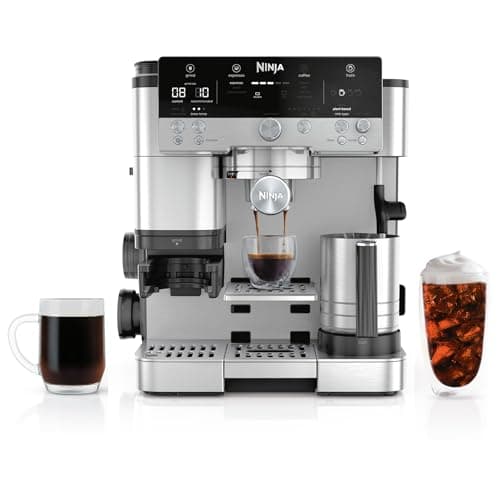
The most hand-holding you can buy at this price: a built-in grinder, a built-in scale, an assisted tamper and guided settings that remove almost every beginner failure point — as long as you have the counter space and accept a generalist rather than a specialist.
- Best for
- Beginners who want espresso, drip coffee and cold brew from one machine and would rather be guided than learn to dial in
- Price context
- Mid-range — priced against a dedicated espresso machine plus a separate grinder
Ninja is not a name most people associate with espresso, and the Luxe Café is the company's serious attempt to change that. The pitch is unusually direct: this machine grinds your beans, weighs the dose itself, helps you tamp, recommends a grind setting, adjusts its own temperature and pressure, froths your milk hands-free, and also makes drip coffee and cold brew.
That is a lot of promises, and the interesting thing is how many of them are backed by real, published hardware rather than marketing language. This review works through what Ninja actually specifies, what the automation genuinely removes from the learning curve, and the two places where the concept costs you something real.
Who it's for
The Luxe Café Premier is aimed squarely at a person who wants cafe drinks at home without learning to be a barista, and who would rather buy one appliance than three.
That is a large and often badly served group. The standard advice for a beginner — buy a semi-automatic machine, buy a separate grinder, learn to dial in, learn to steam milk — is correct for people who want the hobby, and genuinely off-putting for people who just want a good flat white on a Tuesday. This machine is built for the second group, and it is honest about it.
It is not for someone who wants to learn espresso properly. If pulling a shot and understanding why it tasted the way it did is the appeal, the automation here is working against you, and a Breville Bambino plus a real espresso grinder is the better path.
What the specs say
| Modes | Espresso, drip coffee and cold brew |
|---|---|
| Grinder | Built-in conical burr, 25 grind settings (espresso to drip) |
| Dosing | Built-in scale, weight-based per drink |
| Baskets | Single, double and Luxe |
| Tamping | Assisted tamper |
| Milk | Dual Froth System, dairy and plant-based |
| Froth presets | Steamed milk, thin froth, thick froth, cold foam |
| Brew temperatures | Three (low-medium for dark roasts, medium-high for light) |
| Dimensions | 15.75 x 15.24 x 20.51 in |
| Warranty | One (1) year limited |
The two entries doing the most work here are the built-in scale and the 25-setting conical burr grinder. A scale inside the machine, dosing by weight rather than by time or volume, is genuinely uncommon at this price — on almost every rival you either weigh manually with a separate scale or accept a timed dose that drifts as beans age. That single feature removes the most common source of beginner inconsistency.
What Barista Assist actually does
"Barista Assist" is the umbrella name, and it covers three separate things worth separating out, because they are not equally significant.
- Grind size recommendations.The machine suggests where to set the grinder for the drink you have chosen. This is the genuinely useful one — grind is the variable beginners find hardest, and being pointed at a starting range removes days of frustrated guessing.
- Weight-based dosing. The built-in scale doses to a target weight for each drink rather than running the grinder for a fixed time. Real, and the most valuable piece of the system.
- Automated temperature and pressure adjustment. The machine adjusts these itself rather than exposing them. Convenient, and the part that most reduces your control.
Add the assisted tamperbuilt into the machine, and the practical effect is that the three steps where beginners most often go wrong — wrong grind, inconsistent dose, uneven tamp — are handled. Our guide to how to pull an espresso shotexists because those steps are hard; this machine's pitch is that you should not have to read it.
The honest counterpoint: automation sets a ceiling as well as a floor. You cannot chase a specific pressure profile or hold a temperature you have chosen, and the assisted tamper applies its force rather than yours. For the target buyer that is the entire point. For someone who would eventually want a bottomless portafilter and a distribution routine, it is a wall.
The Dual Froth System
Milk is where most home espresso setups actually fail, and Ninja has taken the hands-free route rather than the steam-wand route. The Dual Froth System textures milk automatically, and Ninja specifies it for both dairy and plant-based milks — which matters, because oat and almond milks behave differently under steam and are a common source of disappointing results on manual wands.
There are four presets: steamed milk, thin froth, thick froth and cold foam. That maps neatly onto the drinks people actually order — thin froth for a flat white, thick froth for a cappuccino, cold foam for iced drinks.
What you give up is latte art and fine control. A hands-free system produces consistent, good-enough foam; a bare steam wand in practiced hands produces better microfoam and lets you pour patterns. If you want to learn that skill, our how to steam milkguide covers it — and this is not the machine for it. If you want a reliable cappuccino without a learning curve, this is exactly the machine for it.
The 3-in-1 question
Espresso, drip coffee and cold brew from one appliance is the headline feature, and it deserves a straight assessment rather than either enthusiasm or snobbery.
The case for it is real. Three machines cost more than one, take three times the counter space, and mean three things to clean and descale. A household where one person drinks espresso drinks and another drinks a mug of filter coffee is extremely common, and usually solved badly. Being able to grind whole beans for all three modes is a genuine advantage over owning an espresso machine plus a drip machine you feed pre-ground.
The case against is equally real.A machine that does three things is optimized for none of them. At this price you could buy a dedicated espresso machine and a dedicated grinder that will make a better shot — see best espresso machines under $1000— and cold brew in particular needs no machine at all, since it is coarse grounds steeped in cold water for twelve hours. Our cold brew guide makes that case: a $35 pitcher does the same job.
So the honest framing is that you are paying for consolidation and convenience, not for peak performance in any one mode. Whether that is good value depends entirely on whether you would genuinely have bought the other machines.
The size problem
This is the practical objection that gets least attention and matters most. Ninja publishes the dimensions as 15.75 × 15.24 × 20.51 inches. That is a large appliance — over twenty inches tall, and roughly fifteen inches in both other directions.
Two consequences. It will not fit under a standard wall cabinet in many kitchens, so check your clearance before ordering rather than after. And it occupies a substantial rectangle of counter permanently, because a machine this size is not something you put away.
The counter-argument is that it replaces three appliances, so the comparison is not against one espresso machine but against a machine plus a grinder plus a drip brewer — and on that basis it comes out ahead. But if space is your binding constraint, this is the wrong machine and our best compact espresso machines guide is the right page.
Alternatives
| Instead of the Luxe Café, consider | If you want |
|---|---|
| Breville Barista Express Impress | The same all-in-one idea with a more espresso-focused, hands-on workflow |
| Breville Bambino Plus + separate grinder | Better espresso specifically, and a grinder you keep when you upgrade |
| Philips 3200 LatteGo (super-automatic) | Fully one-touch bean-to-cup drinks with the easiest milk cleaning |
| A compact machine + cold brew pitcher | The same three drinks for less money and far less counter space |
The closest genuine rival is the grind-and-brew Breville family, which shares the built-in-grinder concept but keeps the workflow closer to real espresso. If full automation is what appeals, our best super-automatic machines guide covers bean-to-cup machines that go further still.
The verdict
The Luxe Café Premier is a more serious piece of engineering than Ninja's reputation in this category would suggest. A built-in scale dosing by weight, a 25-setting conical burr grinder, an assisted tamper and guided grind recommendations add up to a machine that removes most of the ways a beginner fails at espresso — and that is a genuinely valuable thing to sell, not a gimmick.
Buy it if you want espresso, filter coffee and cold brew from one machine, you would rather be guided than learn to dial in, and you have the counter space for a large appliance. Skip it if espresso specifically is the point — at this price a dedicated machine and a dedicated grinder will beat it on the shot — or if your kitchen cannot spare a permanent 15-inch square. It is a very good generalist, which is exactly what some people need and exactly what others should avoid.
The machine most buyers weigh this one against is Breville's all-in-one, and we compare them spec by spec in Ninja Luxe Café vs Breville Barista Express.
What we liked
- Genuinely complete — grinder, scale, tamper and milk system in one box, so there is nothing else to buy
- Barista Assist guides grind size and adjusts temperature and pressure, removing the hardest part of learning espresso
- Weight-based dosing from a built-in scale is rare at any price and eliminates the most common beginner inconsistency
- Dual Froth System handles plant-based milks hands-free, with a dedicated cold foam program
- Three brew temperatures let you match dark and light roasts rather than fighting one fixed setting
- Espresso, drip and cold brew from one appliance is a real space and money saving versus three devices
What gave us pause
- Large — over 20 inches tall and roughly 15 inches in both other directions, so it needs serious counter space and cabinet clearance
- A generalist: a dedicated machine plus a dedicated grinder at this price will out-perform it on espresso specifically
- Ninja does not publish a pump pressure figure or water reservoir capacity, so those cannot be verified
- Automation is the point, which means less hands-on control than a semi-automatic for anyone who wants to learn properly
- One-year limited warranty is short next to the repairability of some rivals
- Built-in grinder means a grinder fault takes the whole machine out of service
Frequently asked questions
Is the Ninja Luxe Café a real espresso machine?
Yes — it brews espresso from whole beans through a portafilter with single, double and Luxe baskets, using its own built-in conical burr grinder and an assisted tamper. It is not a pod machine. The caveat worth naming is that Ninja does not publish a pump pressure figure on its product pages, so that specific number can't be verified the way it can with, say, Breville.
Does the Ninja Luxe Café have a built-in grinder?
Yes, a conical burr grinder with 25 grind settings covering espresso through drip. It also has a built-in scale that doses by weight for each drink rather than by a fixed grind time, which is uncommon at this price and removes the most frequent source of beginner inconsistency.
What is Barista Assist on the Ninja Luxe Café?
It's Ninja's umbrella term for three things: grind size recommendations for the drink you've selected, weight-based dosing from the built-in scale, and automatic adjustment of brew temperature and pressure. Combined with the assisted tamper, it handles the three steps beginners most often get wrong — grind, dose and tamp — at the cost of hands-on control.
How big is the Ninja Luxe Café?
Ninja publishes the dimensions as 15.75 x 15.24 x 20.51 inches. That's a large appliance — over 20 inches tall and roughly 15 inches in both other directions — so check your under-cabinet clearance before buying. It's fair to weigh that against the fact that it replaces an espresso machine, a grinder and a drip brewer.
Can the Ninja Luxe Café froth oat milk?
Yes. Ninja specifies the Dual Froth System for both dairy and plant-based milks, with four presets: steamed milk, thin froth, thick froth and cold foam. It's hands-free rather than a manual steam wand, so it produces consistent foam without a learning curve — but it won't give you the microfoam control needed for latte art.
Is the Ninja Luxe Café worth it?
It's worth it if you genuinely want espresso, drip coffee and cold brew from one machine and prefer guidance over learning to dial in — the consolidation is real value. It's not worth it if espresso specifically is the goal, because at this price a dedicated machine plus a dedicated grinder will make a better shot, and cold brew needs no machine at all.
Sources
Keep reading
Buying your first setup?
See how we pick — compiled specs, cost-per-shot math, and honest trade-offs — then dig into the guides. No fake test lab, no rankings for hire.