Buying Guide
The Best Bottomless Portafilters in 2026
A naked portafilter is the cheapest diagnostic tool in espresso. It doesn't improve your shot — it shows you exactly what's wrong with it, which turns out to be the same thing.
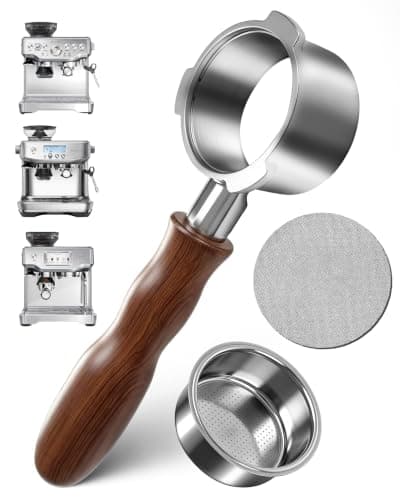
A bottomless — or "naked" — portafilter is an ordinary portafilter with the spouts and the base cut away, so the underside of the filter basket is exposed. Espresso comes straight out of the bottom of the basket in full view.
People buy them expecting better coffee, which is not quite what happens. A bottomless portafilter is a diagnostic tool. It does not change the extraction; it shows you the extraction. And because most home espresso problems are puck-preparation problems that a spouted portafilter hides completely, seeing them is most of the way to fixing them — which is why it does end up improving your coffee, just indirectly.
What a bottomless portafilter actually does
With a normal portafilter, everything that happens underneath the basket is concealed by the metal base and funneled into two spouts. Whether the water passed evenly through your coffee or blasted a hole straight through one side, the shot arrives in the cup looking roughly the same. You only find out something went wrong when it tastes thin and sour, and by then you have no idea which of a dozen variables caused it.
Remove the base and you can watch the whole extraction. A good shot starts as separate droplets across the entire basket, merges into a single dark, glossy stream in the middle, and pours steadily. A bad one squirts sideways, sprays the walls of the machine, or runs pale and fast from one spot. That visual difference is called channeling, and it is the single biggest cause of disappointing home espresso.
Two secondary benefits are real but minor: with no spouts and no base, there is less metal to steal heat from the shot, and there is much less hardware to clean. Neither is the reason to buy one.
One thing to settle before you order: your portafilter diameter. Breville machines are 54mm, Gaggia and most commercial-standard machines are 58mm, and De'Longhi's manual models are 51mm — none of which are interchangeable. Our portafilter size guide lists which machines use which and shows how to measure your own in thirty seconds.
First, the only question that matters: 54mm or 58mm?
Get this wrong and nothing else on this page helps you, because a portafilter that does not fit your group head is a paperweight. Portafilters are sized by basket diameter, and the two sizes are not interchangeable.
| Your machine | Size you need |
|---|---|
| Breville Barista Express / Pro / Touch / Impress | 54mm |
| Breville Bambino / Bambino Plus | 54mm |
| Gaggia Classic / Classic Pro / Evo / E24 | 58mm |
| Most prosumer and commercial machines | 58mm |
| De'Longhi Dedica | 51mm — neither pick here fits |
| De'Longhi Stilosa / most budget machines | 51mm or proprietary — usually no naked option |
The short version: Breville is 54mm, Gaggia Classic is 58mm, and 58mm is the industry standard that most serious machines use. Many budget machines in the under-$200 bracketuse 51mm baskets or proprietary fittings and simply have no bottomless option — and it would not help much anyway, because those machines usually ship with pressurized baskets, which create pressure artificially at a small hole rather than through the coffee puck. A naked portafilter on a pressurized basket shows you almost nothing useful.
Even on the right machine, check the listing names your exact model before buying. Handle shapes and lug positions vary within a brand, and "54mm" alone is not a guarantee of a clean lock-in.
At a glance
| Portafilter | Size | Fits | Basket included | Price |
|---|---|---|---|---|
| 54mm for Barista Express / Pro / Touch | 54mm | Breville Barista line | Check listing | $29.99Buy |
| 54mm for Barista Express, Bambino Plus, Pro | 54mm | Breville Barista + Bambino Plus | Check listing | $34.99Buy |
| 58mm with wood handle | 58mm | Gaggia Classic and 58mm machines | Double-shot basket included | $29.99Buy |
| KNODOS 58mm | 58mm | Gaggia Classic Pro, Evo, E24 | Check listing | $49.99Buy |
Prices shown are from Amazon as of October 17, 2026 and change often — the button always goes to the current listing. Some links may earn us a commission at no extra cost to you.
Best 54mm value: bottomless portafilter for Barista Express / Pro / Touch
If you own a Breville Barista Express, Pro or Touch, this is the straightforward answer. It is a 54mm naked portafilter that does the one job you are buying it for — exposing the base of the basket — without charging a premium for styling.
The Barista line is the most common home machine where a bottomless genuinely pays off, because those machines have a built-in grinder and enough adjustment range that when the portafilter shows you a problem, you can actually act on it.
What we like: the cheapest honest route into naked-shot diagnostics for the most popular 54mm machines. The honest downsides: budget builds vary in finish and handle quality, and you should confirm the listing names your exact model — Breville's Barista variants are not perfectly uniform.
Best 54mm fitment range: for Barista Express, Bambino Plus & Pro
The same idea with broader stated fitment: this one lists the Bambino Plus alongside the Barista Express and Pro. That matters if you own a Bambino Plus, and it matters more if you have two Breville machines and want one portafilter that works across both.
The Bambino Plus is a common upgrade target for exactly the kind of person who wants a naked portafilter — it has real 9-bar extraction and a proper steam wand but no built-in grinder, so puck prep is entirely in your hands and worth seeing.
What we like: wider explicit fitment, and a step up in price that generally buys a better finish. The honest downsides: costs more than the pick above for the same core function, and "fits multiple models" still deserves a check against your exact machine.
Best 58mm value: bottomless portafilter with basket and wood handle
For Gaggia Classic owners and anything else on the 58mm standard, this is the sensible buy, and it has a genuine advantage over the Breville picks: it ships with a double-shot filter basket included.
That matters more than it sounds. Many stock machines ship with pressurized baskets, and a naked portafilter with a pressurized basket in it defeats the entire purpose — you would be watching a stream emerge from a single hole rather than seeing the puck. Getting a non-pressurized double basket in the box means you are ready to diagnose immediately rather than placing a second order.
What we like: complete out of the box, wooden handle looks and feels better than the price suggests, and 58mm fitment covers a wide range of machines. The honest downsides: generic 58mm listings are not all identical in machining quality, and a wooden handle wants hand-washing rather than a dishwasher.
Best 58mm build: KNODOS 58mm for Gaggia Classic Pro / Evo / E24
The step up in the 58mm bracket. KNODOS lists explicit fitment across the Gaggia Classic Pro, Evo and E24, which is more specific than most generic 58mm listings manage and worth paying for if you have had a portafilter that did not seat cleanly.
The practical benefit of a heavier portafilter is thermal: more mass means the basket holds temperature better between shots, which matters on a machine like the Gaggia Classic Pro where temperature stability is the known weak point.
What we like: precise stated fitment for the most common 58mm home machines, and a substantial feel. The honest downsides: it is the most expensive pick here, and the diagnostic benefit — the actual reason to buy a bottomless — is identical to the cheaper option above.
How to read a naked shot
This is the part most guides leave out, and it is the entire value of the purchase. Watch the underside of the basket for the first ten seconds of the shot.
| What you see | What it means | What to fix |
|---|---|---|
| Even droplets across the whole base, merging into one glossy stream | A well-prepared, evenly extracting puck | Nothing — this is the target |
| A jet squirting sideways or spraying the machine | Channeling — water found a weak path | Distribute better: use a WDT tool, tamp level |
| One pale, fast stream from a single point | Severe channeling, or a hole in the puck | Check for a divot from the tamper; redistribute |
| Pours very fast and pale overall | Grind too coarse, or dose too low | Grind finer, or increase the dose |
| Barely drips, then bursts | Grind too fine, or tamped too hard into a blocked puck | Grind coarser; tamp level rather than hard |
| Even at first, then a side jet halfway | The puck cracked under pressure | Improve distribution; check basket dose fits |
The recurring theme is that almost every bad pattern comes down to uneven distribution of grounds before you tamp, not tamping force. Water takes the path of least resistance; if one part of the puck is less dense, all the water goes there, over-extracting that channel and leaving the rest of the coffee untouched. That is why the result tastes simultaneously bitter and sour.
If you are working through this from the start, our how to pull an espresso shot guide covers dose, yield and timing, and why is my espresso bitter covers the taste side of the same diagnosis.
What you'll need alongside it
A bottomless portafilter tells you that your distribution is bad. These are the tools that fix it, and buying the portafilter without at least the first one is a slightly frustrating experience.
- A WDT tool.The single most effective fix for channeling — fine needles stirred through the dry grounds break up clumps and even out density before you tamp. It is cheap and it will do more for your shots than the portafilter itself. See best WDT tool.
- A level tamp.Tilted tamps create a denser side and a looser side, which is a channel waiting to happen. Consistency beats force — best espresso tamper covers calibrated and self-leveling options.
- A non-pressurized basket,if your machine shipped with a pressurized one. Without this the naked portafilter shows you nothing — pressurized vs non-pressurized explains how to tell which is in your machine right now, and what changes when you swap.
- A grinder that can actually hit espresso fine.If your grind is too coarse at its finest setting, no amount of distribution work saves the shot — see best grinders for espresso.
- A towel. Genuinely. The first week is messy.
Frequently asked questions
What size bottomless portafilter do I need?
It depends on your machine's group head, and the sizes aren't interchangeable. Breville Barista Express, Pro, Touch, Bambino and Bambino Plus all take 54mm. Gaggia Classic, Classic Pro, Evo and E24 take 58mm, which is also the standard on most prosumer machines. De'Longhi Dedica and many budget machines use 51mm or proprietary fittings with no naked option available.
Does a bottomless portafilter improve espresso?
Not directly — it's a diagnostic tool, not an upgrade. It doesn't change the extraction, it shows you the extraction, exposing channeling and puck-prep problems that a spouted portafilter hides completely. Because those problems are the main cause of disappointing home espresso, seeing them does end up improving your coffee, just indirectly.
Why does my bottomless portafilter spray everywhere?
That's channeling — water finding a weak, less-dense path through the puck instead of passing through evenly. It was almost certainly happening before you fitted the naked portafilter; you just couldn't see it. The fix is distribution rather than tamping harder: use a WDT tool to break up clumps in the dry grounds, then tamp level.
Can I use a bottomless portafilter with a pressurized basket?
You can, but it defeats the purpose. A pressurized (dual-wall) basket creates back-pressure artificially at a small hole rather than through the coffee, so what you'd watch is a stream emerging from that hole — it tells you nothing about how the puck extracted. If your machine shipped with pressurized baskets, buy a non-pressurized basket at the same time.
What does a good bottomless shot look like?
For the first few seconds you should see even droplets forming across the entire base of the basket, which then merge into a single dark, glossy stream near the center and pour steadily. Sideways jets, sprays hitting the machine, or one pale fast stream from a single point all indicate channeling. Even-then-suddenly-spraying usually means the puck cracked under pressure.
Do I need a WDT tool with a bottomless portafilter?
Effectively yes, if you want the purchase to be satisfying. The naked portafilter will show you distribution problems; a WDT tool is what fixes them. Stirring fine needles through the dry grounds breaks up clumps and evens out density before tamping, which is the single most effective anti-channeling step available and costs very little.
Sources
Keep reading
Buying your first setup?
See how we pick — compiled specs, cost-per-shot math, and honest trade-offs — then dig into the guides. No fake test lab, no rankings for hire.