Buying Guide
The Best Home Espresso Setup in 2026: Three Complete Kits
Nobody buys just an espresso machine. These are three whole setups — machine, grinder, scale and the accessories that earn their place — built for the try-it buyer, the person who knows they'll stick with it, and the one who would rather buy once.
Almost every espresso buying guide answers a question nobody actually has. You are not shopping for a machine in isolation — you are shopping for a counter that makes coffee, and that takes at least three purchases. Buy the machine alone and the first shots come out sour, thin and nothing like the cafe, and the usual conclusion is that the machine was the problem. It rarely was.
So this page is built as three shopping lists, not three rankings. Each one is a complete, working setup at a different level of commitment: a kit to find out whether you like this, a kit for someone who already knows they will stick with it, and a kit bought once and kept. Every product in every list is a real item we confirmed was currently listed and purchasable before publishing, and every one carries its honest downsides — because all of them have some.
What a complete espresso setup actually is
Five things stand between beans and a good shot. Only the first two cost real money, and the order matters more than the brands.
- A grinder that reaches espresso fine, in small steps.Espresso works because a compacted puck of very fine coffee resists water hard enough for the pump to build about 9 bar of pressure. That means the grind has to be fine, even, and adjustable in tiny increments, because the gap between choking the machine and gushing a watery shot is only a few microns wide. Pre-ground coffee cannot be adjusted at all, and a blade grinder produces dust and boulders at once — see burr vs blade.
- A machine that holds temperature and pressure. Every pump machine on this page gets to roughly 9 bar at the puck. What separates them is the portafilter standard, how stable the brew temperature is, and how the milk gets steamed.
- A scale that reads to 0.1 g.This is the cheapest item in every kit and the one that changes results fastest. Espresso is a ratio — roughly 1:2, dose to yield, in about 25–30 seconds. You cannot hit a ratio you are not measuring, and kitchen scales that round to whole grams are useless here.
- Puck prep, once the basics work.A distribution tool or a decent tamper stops water carving a channel through a lopsided puck. Worth buying — but second, not first.
- Fresh beans, ground to order. The cheapest upgrade on this list. A bag roasted in the past month beats a better machine fed stale coffee; our best coffee beans for espresso guide covers roast and freshness.
How we built these kits
We do not run a test lab, and we will not pretend otherwise — setups we have lab-tested: zero. What we do instead is build each list against published manufacturer specifications, check every item is genuinely in stock and purchasable before it goes on the page, and apply four rules:
- The grinder gets a real share. Each kit pairs its machine with a grinder that can actually reach espresso fineness with usable adjustment, rather than a token upgrade over pre-ground.
- Every kit works on day one. Machine, grinder and scale are all in the core list. Nothing here needs a second order before you can pull a shot.
- Nothing is in a list to pad the total. Accessories are split into what the kit needs now and what it can wait for, and we say which is which.
- Upgrade paths, not dead ends.Two of the three kits are built on portafilter standards — Breville's 54mm and the commercial 58mm — with large accessory ecosystems, so the next purchase improves the setup instead of replacing it.
One number we ignore completely: the pump bar ratingon the box. "15 bar" and "20 bar" describe a pump's maximum, not the pressure at the coffee, which is around 9 bar on every real machine here. It ranks nothing.
The three kits at a glance
| Kit | Who it's for | Machine | Grinder | Planning bracket |
|---|---|---|---|---|
| The try-it kit | Finding out whether you enjoy this | De'Longhi Stilosa (EC260) | Timemore Chestnut C3 ESP (hand) | Under about $300 all-in |
| The sweet-spot kit | You know you'll stick with it | Breville Bambino (BES450) | Baratza Encore ESP (electric) | Roughly $550-$650 all-in |
| The buy-once kit | You'd rather not upgrade twice | Gaggia Classic Evo Pro | Eureka Mignon Notte (stepless) | Around the $1,000 mark all-in |
Those brackets are rough planning ranges for a whole list, not quotes — street prices move constantly. The live price sits on the buy row in each section and always comes from the current listing.
The try-it kit: spend little, learn what you actually want
This kit exists to answer one question honestly: do you enjoy making espresso?Plenty of people discover they wanted a good milk drink rather than a hobby, and finding that out for a few hundred dollars is a far better outcome than finding it out for a few thousand. Everything here is deliberately modest, and nothing in it is wasted if you upgrade later — the grinder and the scale both survive the move to a better machine.
| Item | What it is | Role | Price |
|---|---|---|---|
| De'Longhi Stilosa (EC260) | Entry pump machine, pressurized basket | Core | $149.95Buy |
| Timemore Chestnut C3 ESP | 38mm conical hand grinder | Core | $68.00Buy |
| Weightman espresso scale | 1000 g x 0.1 g with timer | Core | $13.99Buy |
Prices shown are from Amazon as of October 17, 2026 and change often — the button always goes to the current listing. Some links may earn us a commission at no extra cost to you.
The machine. The Stilosa is the cheapest machine we are willing to put in a kit, and the reason is that it is a real pump machine rather than a steam toy: it pushes hot water through ground coffee under pressure and steams milk with a panarello wand. It ships with a pressurized (dual-wall) basket, which is exactly right here — the basket does some of the work a perfect grind would otherwise have to do, so early shots are drinkable while you learn.
| Portafilter | Pressurized basket |
|---|---|
| Pump pressure | 15 bar (about 9 bar at the puck) |
| Milk | Manual panarello steam / frothing wand |
| Water tank | ~34 oz / 1 L |
| Body | Plastic with stainless accents |
The honest cons are real and worth knowing before you buy. That forgiving pressurized basket also caps how good the shot can get, because it forces crema regardless of grind quality and hides what your puck prep is doing. The body is mostly plastic, the panarello wand froths milk but will not give you the tight microfoam latte art needs, and the small tank means frequent refills. This is a machine to outgrow, not to keep.
The grinder. The Chestnut C3 ESP is a hand grinder, and at this budget that is the point: manual grinders put good steel burrs in your hand for a fraction of what an electric costs. It uses 38mm S2C stainless conical burrs with a 30-click dial at roughly 23 microns per click, which is fine enough to dial espresso and wide enough to reach French press.
| Type | Manual (hand) grinder |
|---|---|
| Burrs | 38mm S2C conical (stainless) |
| Adjustment | Stepped, 30 clicks/turn (~23 microns per click) |
| Retention | Very low |
| Capacity | ~20 g |
| Handle | Foldable |
Cons: grinding espresso-fine by hand is genuine physical work, the smaller burrs mean more turns per dose than a larger hand grinder, and the lighter build shows next to premium models. If you make four drinks every morning this will annoy you within a week — that is the kit below.
The scale. The Weightman reads to 0.1 g, has a timer, and is small enough to sit on a drip tray, which is everything this kit needs. Its cons are the ones every budget scale has: a slower refresh than a purpose-built espresso scale, no flow-rate readout, and no water resistance, so keep it dry.
More machines at this level are in our best espresso machines under $200 roundup, and the full De'Longhi Stilosa review goes deeper on what the machine can and cannot do.
The sweet-spot kit: the setup most people should buy
This is the kit we would recommend to the largest number of households, and the split is the reason. Rather than putting the whole budget into one machine with a grinder bolted on, it buys a genuinely good small machine and a dedicated espresso grinder — the pairing that produces a noticeably better cup at this total. It is also the first kit built around a real, non-pressurized 54mm basket, which means the shot now responds to your grind, dose and tamp, and improves as you do.
| Item | What it is | Role | Price |
|---|---|---|---|
| Breville Bambino (BES450) | 54mm ThermoJet semi-automatic | Core | $299.95Buy |
| Baratza Encore ESP | 40mm conical electric espresso grinder | Core | $199.95Buy |
| Timemore Black Mirror Basic 3 | 0.1 g scale, timer, flow rate | Core | $59.00Buy |
| Normcore WDT tool V3 | Nine 0.35mm needles + stand | Add soon | $32.69Buy |
| 54mm bottomless portafilter | Naked portafilter, Breville fitment | Add later | $34.99Buy |
Prices shown are from Amazon as of October 17, 2026 and change often — the button always goes to the current listing. Some links may earn us a commission at no extra cost to you.
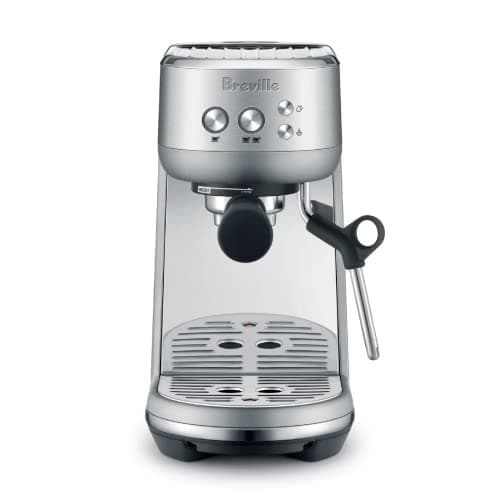
The machine. The Bambino is a small machine with unusually serious internals. A ThermoJet heater reaches brew temperature in about three seconds, which is the single feature that makes espresso realistic on a weekday morning — there is no waiting ritual. Behind it sits a real 54mm portafilter with low-pressure pre-infusion, and it ships with both pressurized and non-pressurized baskets, so you can start forgiving and switch once the grinder is dialed in.
| Portafilter | 54mm (pressurized & non-pressurized baskets included) |
|---|---|
| Boiler | ThermoJet — heats in ~3 seconds |
| Pump pressure | 15 bar (about 9 bar at the puck) |
| Pre-infusion | Low-pressure pre-infusion |
| Milk | Manual steam wand |
| Water tank | 47 oz / 1.4 L (removable) |
| Dimensions | ~7.7 x 12.6 x 12.2 in |
| Weight | ~11 lbs |
The honest cons: the steam wand is manual, so microfoam takes practice — if you want the machine to texture milk for you, that is the Bambino Plus, and our Bambino vs Bambino Plus comparison settles whether the difference is worth it. The single thermocoil means you brew, then steam, never both, which shows when you are making drinks for four. And the small footprint means a small tank and a light machine that can slide on the counter as you lock in the portafilter.
The grinder. The Encore ESP is the reason this kit works. It runs 40mm M2 conical steel burrs across 40 stepped settings, and critically the espresso half of that range (settings 1–20) is geared to about 20 microns per step— fine enough that you can walk a shot in rather than jumping straight past it. It also arrives with a 54mm dosing cup and a 58mm portafilter adapter, so it fits this kit and the next one.
| Burrs | 40mm M2 conical (steel, user-replaceable) |
|---|---|
| Grind settings | 40 stepped (1-20 espresso, 21-40 filter) |
| Espresso step size | ~20 microns per step |
| Filter step size | ~90 microns per step |
| Motor | DC, ~550 RPM, ~70 W |
| Bean hopper | 8 oz / 230 g |
| Included | 54mm dosing cup + 58mm portafilter adapter |
Cons: the adjustment is stepped, not stepless, so there will be days when the setting you want sits between two clicks and you compensate with dose instead. Retention is not zero, which matters if you switch beans often, and it is a plastic-bodied grinder that looks less impressive than it performs. The full Baratza Encore ESP review covers it in detail, and espresso grinders under $200 lists the alternatives at this price.
The scale, and the two upgrades. The Timemore Black Mirror Basic 3 reads to 0.1 g with a timer and a real-time flow-rate display, which turns a shot from a guess into a measurement; its cons are minor at the price: it is splash-resistant (IPX3) rather than waterproof, and its timer and flow-rate modes take a few minutes to learn. After a few weeks two accessories genuinely change the cup: a WDT tool, whose fine needles break up clumps so water cannot channel through the puck, and later a bottomless portafilter, which shows you exactly where an extraction is going wrong. Neither is needed on day one, and the portafilter is actively unhelpful before your grind is close.
The buy-once kit: 58mm, and no second machine
The kits above are built around convenience and value. This one is built around a standard. The 58mm portafilter is the commercial size, which means baskets, tampers, distribution tools, precision screens and bottomless portafilters are all made for it in quantity, and the machine underneath is a repairable metal appliance rather than a sealed consumer product. Buy this and the next decade of purchases are accessories, not replacements.
| Item | What it is | Role | Price |
|---|---|---|---|
| Gaggia Classic Evo Pro | 58mm single-boiler semi-automatic | Core | $505.09Buy |
| Eureka Mignon Notte | 50mm flat burr, stepless | Core | $299.00Buy |
| Timemore Black Mirror Basic 3 | 0.1 g scale, timer, flow rate | Core | $59.00Buy |
| Normcore 58.5mm tamper V4 | Spring-loaded, 15/25/30 lb springs | Core | $42.99Buy |
| 58mm bottomless portafilter | Naked portafilter + double basket | Add soon | $29.99Buy |
| Normcore knock box 1L | Holds 20-25 pucks | Add later | $56.69Buy |
Prices shown are from Amazon as of October 17, 2026 and change often — the button always goes to the current listing. Some links may earn us a commission at no extra cost to you.
The machine. The Gaggia Classic Evo Pro is deliberately old-fashioned: rocker switches, a single aluminum boiler, a largely stainless body, and a 58mm commercial portafilter. There is no automation to hide behind, which is exactly why people keep them for years — parts are available, the modding community is large, and nothing about the machine caps what a practiced user can get out of it.
| Portafilter | 58mm (commercial standard) |
|---|---|
| Boiler | Single aluminum boiler |
| Heating element | ~1425 W |
| Pump | 15-bar vibratory pump (commonly modded toward 9 bar) |
| Milk | Manual steam wand (commercial-style) |
| Build | Largely stainless steel; repairable and moddable |
| Heat-up | ~5-10 min to temperature |
The honest cons are the flip side of all that. It takes five to ten minutesto come up to temperature, so it is a machine you switch on and walk away from — nothing like the Bambino's three seconds. A single boiler means brewing and steaming are separate operations with a wait between them, temperature stability depends on your timing rather than a PID, and the learning curve is the steepest here. It also asks for maintenance: gaskets, screens and descaling are consumables, not optional, as our descaling guide covers. Our Gaggia Classic Pro review is the full write-up.
The grinder. The Mignon Notte is the step that matters most in this kit. 50mm flat burrs with stepless micrometric adjustmentmean you are no longer choosing between two clicks — you can move the grind by an arbitrarily small amount and settle exactly where the shot wants to be. It is built in Italy in a metal case and doses straight into the portafilter.
| Burrs | 50mm flat (steel) |
|---|---|
| Adjustment | Stepless (micrometric knob) |
| Grind range | Espresso to pour over |
| Dosing | Manual (press portafilter to grind) |
| Hopper | ~5.5 oz bean hopper |
| Build | Metal case, hand-assembled in Italy |
Cons: stepless adjustment is less forgiving, not more— there are no numbered settings to return to, so you learn to find your point by taste and by keeping notes. It is a hopper grinder rather than a purpose-built single-doser, so coffee sits in it and there is some retention between doses; if you switch beans constantly, look at our single-dose grinder picks instead. It is also loud, and the small hopper needs regular topping up. The Eureka Mignon Notte review has the detail.
The 58mm accessories.A spring-loaded tamper removes tamp pressure as a variable by applying the same force every time — the Normcore V4 ships with 15, 25 and 30 lb springs, so you pick one and stop thinking about it. Its cons: it is heavier and pricier than a plain flat tamper, and the spring mechanism is one more thing to keep clean. Add a bottomless portafilter once you are pulling consistent shots, because it turns every extraction into a diagnostic, and a knock box whenever banging spent pucks into the trash gets old.
If you drink milk drinks, add one thing
For most households milk drinks are the majority of what gets made, and the steam wand only does half the job — the vessel does the rest. A 12 oz stainless pitcher with a defined spout is the right size for one or two drinks: enough room for the milk to roll and fold into microfoam, small enough that it actually gets there. A pitcher too large for the drink will not texture properly no matter how good your technique is.
The cons are worth stating plainly: 12 oz is limiting if you routinely make three or four milk drinks at once, and bare steel gives you no visual cue for temperature the way a thermometer or a hand on the side does. Whichever kit you choose, how to steam milk is the technique guide, and best milk frothing pitcher covers the other sizes.
What to skip, and what to add later
The fastest way to overspend on a first setup is buying accessories in the wrong order. Some are transformative, some are decoration, and a couple actively work against you early on.
- Skip: a cheap blade grinder, or pre-ground coffee. Neither can produce an even espresso grind, and no machine compensates. This is the one non-negotiable in the whole guide.
- Skip: a bottomless portafilter on day one.It is a diagnostic tool. Before your grind is roughly dialed in it only tells you what you already know — it is spraying — while making a mess of the counter.
- Skip: pressurized baskets, once the grinder can do the work. Useful training wheels on the try-it kit; a ceiling everywhere else.
- Add early: a WDT tool. The cheapest fix for channeling, and it works on every basket size.
- Add early: descaler and a backflush detergent. Boring, and the difference between a machine that lasts a decade and one that does not. See how to clean an espresso machine.
- Add later: a knock box, a dosing funnel, a better tamper. Quality-of-life upgrades. Buy them when the routine annoys you, not before.
For what all of this costs to runonce it is on the counter — beans per shot, milk, electricity and maintenance, against a daily cafe habit — we do the arithmetic in the true cost of home espresso.
Which kit is yours
Three questions settle it.
- Are you not yet sure you will enjoy this? The try-it kit. Spend little, keep the grinder and the scale, and upgrade the machine deliberately once you know what you actually want from it.
- Do you know you will stick with it, and want good coffee on a weekday? The sweet-spot kit. This is the answer for the largest number of households: a three-second heat-up, a real 54mm basket, and a grinder good enough that the machine becomes the limiting factor rather than the coffee.
- Would you rather buy once and keep it? The buy-once kit, on the 58mm standard. Accept the slow heat-up and the learning curve; you get a repairable machine and stepless grind control in return.
Whichever list you take, the order of operations after delivery is the same: how to pull an espresso shot for ratio and timing, the grind size chart for where to start the grinder, and why is my espresso bitterwhen the first ones taste wrong — which they will. If you would rather compare machines on their own before committing to a whole kit, our best home espresso machines roundup covers the category one pick at a time, and home espresso for beginners walks through the thinking behind every choice on this page. Buying any of this for somebody else instead? Our gifts for coffee loversguide sorts the same gear by budget and by what the recipient already owns — including the fitment traps that ruin most coffee presents.
Frequently asked questions
What do I need for a complete home espresso setup?
At minimum three things: a burr grinder that reaches espresso fineness with small adjustment steps, a pump espresso machine, and a scale that reads to 0.1 grams with a timer. Fresh whole beans are the fourth. Puck-prep tools such as a WDT tool, a good tamper and a bottomless portafilter genuinely help, but they are second purchases — they improve a setup that already works rather than making one work.
How much should a beginner spend on a home espresso setup?
There are three sensible levels. A try-it setup built around an entry pump machine and a hand grinder lands under about $300 all-in and exists to tell you whether you enjoy the process. A sweet-spot setup pairing a Bambino-class machine with a dedicated espresso grinder is roughly $550-$650, and is what most people who know they will stick with it should buy. A buy-once 58mm setup with a stepless grinder sits around the $1,000 mark. Those are planning brackets, not quotes — live prices are on the buy buttons.
Should I spend more on the espresso machine or the grinder?
Give the grinder a bigger share than feels natural. Espresso depends on a fine, even, finely adjustable grind because the puck's resistance is what lets the pump build pressure, and no machine can fix an inconsistent grind. A modest machine with a capable grinder beats an expensive machine fed by a cheap one. None of the kits on this page spend more than about two thirds of the total on the machine.
Can you build a decent espresso setup for under $500?
Yes, and there are two honest ways to do it. The first is an entry pump machine with a good hand grinder and a basic scale, which comes in well under that and leaves room for beans. The second is to put more of the budget into a dedicated electric espresso grinder and pair it with a small semi-automatic — that lands closer to $550-$650 once a scale is included, so slightly above $500 but a materially better setup. What does not work is spending the whole $500 on the machine.
Do I need a scale for espresso?
Yes, and it is the cheapest item in every kit. Espresso is a ratio — roughly 1:2 dose to yield in about 25-30 seconds — and you cannot hit a ratio you are not measuring. A scale that reads to 0.1 grams with a built-in timer is enough; kitchen scales that round to whole grams cannot resolve the difference between an 18 g and a 19 g dose, which is a difference you can taste.
Is a hand grinder good enough for espresso?
For one or two drinks a day, yes. A good hand grinder puts steel burrs and fine adjustment in your hand for a fraction of what an equivalent electric costs, and it has very low retention. The trade is physical: grinding espresso-fine by hand takes real effort and around a minute per dose, so if you make several milk drinks each morning an electric grinder is worth the money.
What is a 58mm portafilter and does it matter?
58mm is the commercial portafilter diameter, and it matters because of the ecosystem around it. Baskets, tampers, distribution tools, precision screens and bottomless portafilters are all made for 58mm in quantity, so a machine on that standard can be upgraded for years instead of replaced. Breville's 54mm is the other well-supported home size. A small pressurized basket, by contrast, is a dead end — forgiving while you learn, but it caps how good the shot can get.
Sources
- Breville — Bambino (BES450) product specifications
- Baratza — Encore ESP product specifications
- Gaggia — Classic Evo Pro product page & specifications
- Eureka — Mignon Notte product page
- De'Longhi — Stilosa (EC260) product page and specifications
- Timemore — Chestnut C3 ESP and Black Mirror scale product pages
- Specialty Coffee Association — espresso brewing standards
- National Coffee Association — espresso and grinding basics
Keep reading
Buying your first setup?
See how we pick — compiled specs, cost-per-shot math, and honest trade-offs — then dig into the guides. No fake test lab, no rankings for hire.