Explainer
Do You Need a Grinder for Espresso?
Short answer: yes, and it matters more than which machine you bought. Here is exactly what pre-ground coffee takes away, the one situation where it is fine, and where the real floor sits.
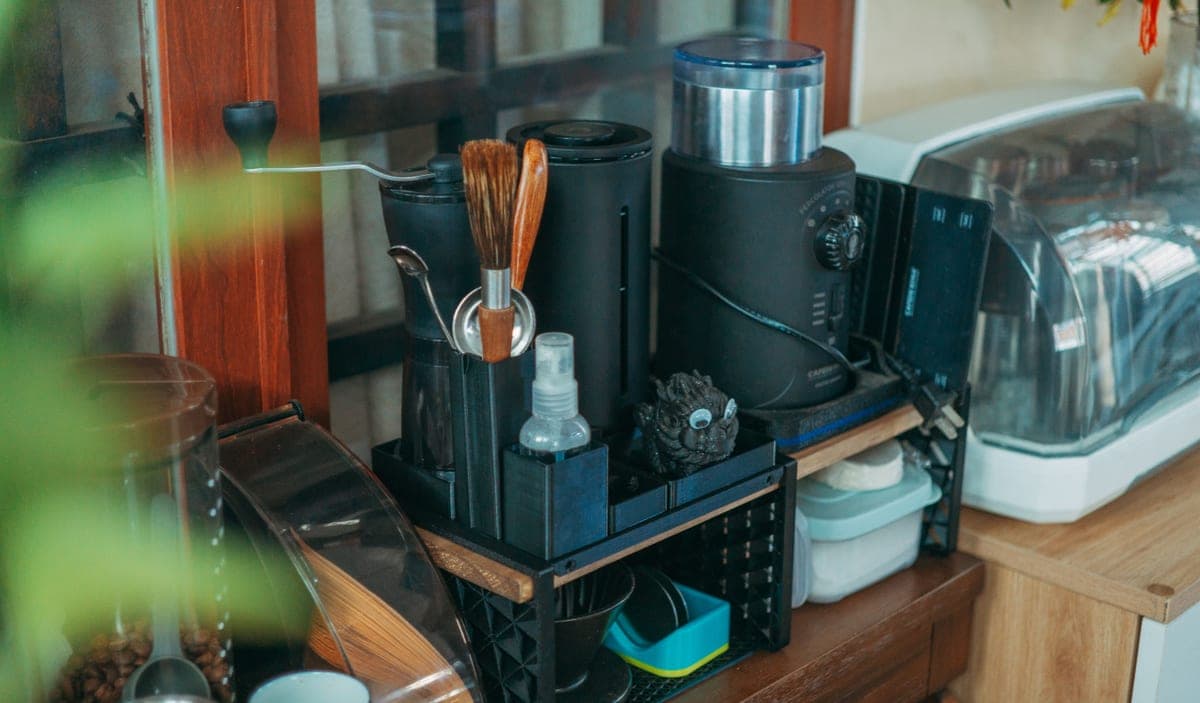
This question usually arrives at the worst possible moment: the machine has been ordered, the budget is spent, and somebody has just mentioned that you also need a grinder. So here is the answer without hedging, followed by exactly why, and what the cheapest honest way out looks like.
Why espresso is different from filter coffee
You can make perfectly good French press or drip coffee with pre-ground beans. Plenty of people do, for years, happily. Espresso is a different physical problem, and the difference is pressure.
A filter brewer pours water through a loose bed of coffee under gravity. If the grind is a bit off, the brew is a bit weak or a bit strong, and you adjust the ratio or the time. An espresso machine forces water through a compacted puck at around 9 bar, and that only works if the puck offers exactly the right amount of resistance. Too little and the water blasts through in seconds; too much and nothing comes out at all.
The thing that sets that resistance is grind size, and the window is genuinely narrow — far narrower than for any filter method, as our grind size chart shows visually. Pre-ground espresso coffee is one fixed point somewhere in that region, chosen by a roaster who has never seen your machine, your basket or your water.
Grind is the only control you actually have
Here is the part that makes the case concrete. Pulling a shot has three variables: dose in, liquid out, and time. Dialing in means fixing the first two — a standard double is roughly 18 g in and about 36 g out — and then adjusting until the time lands in range.
The only lever that changes the time is the grind. That is the whole mechanism. So when a shot runs in 12 seconds and tastes sour, the fix is to grind finer; when it takes 45 and tastes harsh, the fix is to grind coarser.
With pre-ground coffee, that lever does not exist. You can change the dose slightly, and you can tamp harder (which does very little, and mostly encourages channeling), and then you have run out of options. You are stuck with whatever the bag happens to produce in your machine. This is why so many new owners conclude their machine is faulty — it is not; the adjustment knob is missing.
| Symptom | The fix | Available with pre-ground? |
|---|---|---|
| Shot gushes in under 15 seconds | Grind finer | No |
| Shot chokes, barely drips | Grind coarser | No |
| Sour and thin | Grind finer, check distribution | Partly |
| Harsh and bitter | Grind coarser, check dose | Partly |
| Tastes flat and stale | Fresher beans, ground now | No |
The staling problem, which is separate and also real
Even if the grind were perfect, pre-ground coffee has a second problem: it has far more surface area exposed to air than whole beans do, and it has had that exposure since the day it was packed.
Grinding is what starts the clock. Whole beans hold their aromatics and their dissolved carbon dioxide for weeks; ground coffee loses both quickly. That carbon dioxide matters practically, not just aesthetically — it is a significant part of what creates crema, which is why stale coffee produces a thin, pale, quickly-collapsing layer no matter how good the machine is.
This is why a modest grinder plus supermarket whole beans usually beats no grinder plus expensive pre-ground: the first gives you fresh coffee you can adjust, the second gives you neither.
The one case where pre-ground is genuinely fine
If your machine is using a pressurized (dual-wall) basket, pre-ground coffee works. That basket has a restrictor underneath that generates the back-pressure mechanically, so the coffee bed does not have to. Almost any grind will produce a small dark drink with foam on top.
That is a legitimate way to own an espresso machine, and if a reliable milk drink before work is all you want, it is a perfectly reasonable place to stop. Be clear about the trade, though: because the restrictor is generating the pressure, better beans, a better tamp and better technique change very little. You have capped the machine.
The moment you fit the single-wall basket that almost certainly came in the same box, the grinder stops being optional. Our pressurized vs non-pressurized guide covers exactly what changes.
Machine money vs grinder money
The most common and most expensive mistake in home espresso is spending the entire budget on the machine. For espresso, the grinder changes what is in the cup more than the machine does, because the machine's job — hot water at about 9 bar — is something almost every real machine does competently, while grinding evenly and finely enough is something cheap grinders genuinely cannot do.
A useful planning rule: budget roughly the same for both, and if you have to tip the balance, tip it toward the grinder. A $300 machine with a $200 grinder will consistently out-perform a $450 machine with a $50 one. If the machine is already bought and the money is gone, the answer is not a cheap electric grinder — it is a good hand grinder, which buys far more grind quality per dollar.
Our best home espresso setup page costs three complete, balanced kits if you want to see what that split looks like assembled, and the true cost of home espresso covers the running side.
What 'espresso-capable' actually means
Not every burr grinder can make espresso, and the specs that matter are not the ones on the front of the box. Two things decide it.
- It has to physically reach espresso fineness.Plenty of perfectly good grinders bottom out at a filter grind and cannot go finer — the Fellow Ode Gen 2 is a well-regarded example, and Fellow states plainly that it is not suitable for espresso. A grinder that cannot reach the range is not a budget espresso grinder; it is a filter grinder.
- It has to adjust finely once it gets there. The useful measure is microns per step, not the number of settings printed on the dial. Around 20 microns per step is workable — that is roughly what the Baratza Encore ESP offers across its espresso range. Stepless grinders remove the question entirely.
What to buy, at three budgets
Three grinders that genuinely clear the bar, at three very different prices. All three appear in our wider best grinders for espresso guide.
The cheapest thing that works: Timemore Chestnut C3 ESP. 38mm S2C stainless conical burrswith a fine adjustment dial, and the "ESP" matters — it is the espresso-tuned variant, set up for the fine end of the range rather than the filter end. It grinds evenly enough that your puck prep, not the grinder, becomes the limit, which is remarkable at the price. The honest cost is your arm: this is a hand grinder, every morning.
The sensible first electric: Baratza Encore ESP. Its 40 settings are split deliberately — 1-20 for espresso at roughly 20 microns per step, 21-40 for filter — which is fine enough that one click adjusts a shot rather than overshooting it. The 40mm M2 conical burrs are user-replaceable, and it ships with a 54mm dosing cup and a 58mm portafilter adapter, so it fits most home machines out of the box. The honest cons: stepped rather than stepless, and hopper-fed, so bean changes need a purge.
When you want to stop compromising: Eureka Mignon Notte. 50mm flat steel burrs and a genuinely stepless micrometric dial in a hand-assembled Italian metal chassis, dosing straight into the portafilter. Stepless means you can land anywhere rather than choosing between two clicks. The honest cons: no number to write down when you change beans, a real hopper with real retention, and no timer or grind-by-weight.
| Grinder | Type | Burrs | Adjustment | Price |
|---|---|---|---|---|
| Timemore Chestnut C3 ESP | Hand | 38mm conical | Stepped dial, espresso-tuned | $99.00Buy |
| Baratza Encore ESP | Electric | 40mm conical | 40 steps (~20µm espresso) | $199.95Buy |
| Eureka Mignon Notte | Electric | 50mm flat | Stepless micrometric | $299.00Buy |
Prices shown are from Amazon as of Sep 18, 2026 and change often — the button always goes to the current listing. Some links may earn us a commission at no extra cost to you.
If you already own a grinder
Before buying anything, check whether what you have already qualifies. Three common cases:
- A filter burr grinder.Check whether it physically reaches espresso fineness — many do not. The Baratza Encore and the Encore ESP look almost identical and are not the same grinder in this respect, which is the whole point of our Encore vs Encore ESP comparison.
- A hand grinder bought for pour over. Often it reaches espresso fineness but adjusts too coarsely to dial in usefully. Check the microns-per-click figure if the manufacturer publishes one.
- A machine with a grinder built in.If you own a Breville Barista Express, Pro, Impress or Touch, you already have a grinder — 16 to 30 settings depending on the model. Only the Bambino line needs a separate one; our best grinder for a Breville guide sorts out which is which.
And once the grinder is in place, two small things finish the job: a scale, so the dose is a number rather than a habit, and a WDT tool to break up the clumps every grinder produces. Then work through how to pull an espresso shot, which is the part the grinder finally lets you control.
Frequently asked questions
Do you need a grinder for espresso?
Yes, in practice. Espresso forces water through a compacted puck at around 9 bar, and the resistance that makes that work comes from the grind. Grind size is also the only variable you adjust when a shot runs too fast or too slow — so without a grinder, your machine effectively has no working controls. The one exception is a pressurized (dual-wall) basket, which generates the pressure mechanically and works with pre-ground coffee, at the cost of capping how good the result can get.
Can you use pre-ground coffee in an espresso machine?
It will brew, especially in a pressurized basket, but you lose two things. First, adjustment: pre-ground coffee is a single fixed grind chosen by the roaster, so when a shot runs too fast or too slow there is nothing to change. Second, freshness: ground coffee loses aromatics and the dissolved carbon dioxide that creates crema far faster than whole beans do, which is why stale pre-ground gives a thin, pale, quickly-collapsing layer.
What is the cheapest grinder that works for espresso?
The Timemore Chestnut C3 ESP is the least money we would put in front of an espresso machine and still expect a real shot — 38mm S2C stainless conical burrs, tuned for the fine end of the range rather than the filter end. The cost is that it is a hand grinder, so you crank for about a minute every morning. If you want an electric, the Baratza Encore ESP is the sensible floor, with roughly 20 microns per step across its espresso range.
Is a blade grinder good enough for espresso?
No. A blade grinder smashes rather than grinds, producing boulders and dust in the same batch with no control over size. You cannot build even resistance across a puck made of both, so water channels through the fine areas regardless of how you tamp. For drip coffee a blade grinder is a compromise you can live with; for espresso it is a non-starter.
Should I spend more on the espresso machine or the grinder?
Budget roughly the same for both, and if you have to tip the balance, tip it toward the grinder. Almost every real espresso machine delivers hot water at about 9 bar competently, while grinding finely and evenly enough is exactly what cheap grinders cannot do. A $300 machine with a $200 grinder consistently beats a $450 machine with a $50 one.
Can I use my pour over grinder for espresso?
Check two things. First, whether it physically reaches espresso fineness — many filter grinders bottom out well short, and Fellow for example states that the Ode Gen 2 is not suitable for espresso. Second, how finely it adjusts: espresso lives in a narrow band, so what matters is microns per step rather than the number of settings. Around 20 microns per step is workable; much coarser and you will keep overshooting.
Sources
- Baratza — Encore ESP specifications: 40mm M2 burrs, 40 stepped settings, espresso step size, included 54mm dosing cup and 58mm adapter
- Timemore — Chestnut C3 ESP specifications: S2C burr set
- Eureka — Mignon Notte product page: 50mm flat burrs, stepless micrometric adjustment
- Fellow — Ode Gen 2 specifications: 64mm flat burrs, filter-only grind range (not suitable for espresso)
- Breville — the Barista Express (BES870) instruction book: integrated grinder settings, single and dual wall baskets
- Specialty Coffee Association — grind, extraction and particle distribution fundamentals
Keep reading
Buying your first setup?
See how we pick — compiled specs, cost-per-shot math, and honest trade-offs — then dig into the guides. No fake test lab, no rankings for hire.