Buying Guide
The Best Espresso Grinder Under $1000
A thousand dollars buys the two things the cheaper brackets cannot: burrs big enough to change particle distribution, and a dose you do not have to weigh twice. Six picks ranked on published specs - plus an honest look at where on this ladder the money stops buying better espresso.
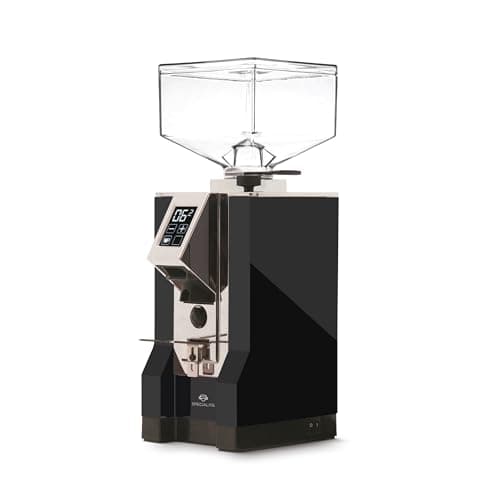
Under $1000 the best espresso grinder for most people is the Eureka Mignon Specialita, because it is the cheapest grinder here that behaves like the one in a cafe. Fifty-five millimeter flat hardened-steel burrs, genuinely stepless micrometric adjustment, a 310 W motor turning at 1350 RPM, and a timed touchscreen that repeats a dose without you standing over it. If you would rather the grinder weighed the dose than timed it, the Eureka Mignon Libra is the same burr set with a scale in the base. If you want the largest burrs money buys in this bracket, the Turin DF83 Gen 2 fits 83mm flat burrs into a single-dose body.
This is the top rung of a ladder we have built one bracket at a time. Our best espresso grinder under $200 guide covers the bracket where the question is whether a grinder reaches espresso fineness at all; under $300 is where stepless adjustment first appears; under $500is where 64mm flat burrs and true single dosing arrive. Everything on this page can dial in a shot, so the ranking is about dose repeatability, burr geometry and workflow — and about being honest that the last few hundred dollars of this budget buy less than the first few hundred did.
What $1000 actually buys in an espresso grinder
Three specs are still improving as you cross out of the $500 bracket, and one thing that sounds like an upgrade mostly is not.
Burr diameter keeps climbing, and it is the real variable. A 50mm burr set at $300 becomes 55mm, 64mm or 83mm here. More cutting edge passing the same 18 g dose means each bean spends less time being chopped and more time being cut once, which generally tightens particle distribution and lowers the heat the coffee picks up on the way through. Our flat vs conical burr explainer covers what each geometry does to the cup; the short version is that at this budget nearly everything worth buying is flat, and diameter is the honest published number to compare.
The grinder starts deciding the dose.Below $500 you set a time and weigh the result. Here you can buy a load cell — the Libra and the Vario W+ both weigh the grounds as they fall and stop at the target, to a published 0.1 g. That removes the most common source of shot-to-shot variation in a home setup, which is often not grind size at all but a dose that drifted by half a gram because the beans aged and started flowing differently.
Retention drops to a rounding error.Single-dose grinders like the DF64 and DF83 publish retention figures under 0.1 g, with a bellows to puff the chute clear and a plasma ionizer to stop static holding fines inside. That matters less for consistency than the marketing implies, and more if you change beans often: grounds held in a grinder are yesterday's coffee in today's basket.
How we ranked these
On published manufacturer and retailer specifications, not on lab tests we did not run — units we claim to have tested: zero, which is also what our methodology page says. For an espresso grinder under $1000, in this order:
- Burr diameter, geometry and material. Published figures only. Bigger flat burrs cut more evenly per rotation and run cooler at the same throughput, and a coating (titanium nitride on two picks here) extends the life of the cutting edge.
- Adjustment resolution. Stepless beats fine steps, and fine steps beat coarse ones. At this price stepless is close to the norm, so the differentiator becomes whether the dial carries a scale you can read and return to.
- Dose repeatability. Grind by weight beats grind by time, which beats grind until it looks right. This is the spec that actually changes shot-to-shot consistency at this budget.
- Workflow and footprint. Hopper-fed versus single dose, height under a cabinet, and whether you can grind straight into a portafilter with both hands free.
- Serviceability.Replaceable burrs, available parts and a distributor that answers the phone — a grinder you can re-burr is a cheaper decade than one you replace.
We do not rank on brand reputation, on star ratings we invented, or on a figure we could not source. Where a manufacturer publishes one number and a retailer publishes another, we print both rather than the flattering one.
At a glance
| Grinder | Burrs | Adjustment | Dosing | Workflow | Price |
|---|---|---|---|---|---|
| Eureka Mignon Specialita | 55mm flat steel | Stepless micrometric | Timed (touchscreen) | 300 g hopper | $599.00Buy |
| Eureka Mignon Libra | 55mm flat steel | Stepless micrometric | By weight, to 0.1 g | 300 g hopper | $799.00Buy |
| Baratza Vario W+ | 54mm flat steel (Ditting) | 230 macro + micro steps | By weight (load cell) | 300 g hopper + 120 g bin | $599.95Buy |
| Turin DF83 Gen 2 | 83mm titanium-coated flat | Stepless | Single dose | Bellows + dosing cup | $499.00Buy |
| DF64 Gen 2 | 64mm flat steel | Stepless | Single dose | Bellows + dosing cup | $389.00Buy |
| 1Zpresso J-Ultra | 48mm titanium-coated conical | 8 microns per click, 500 clicks | Single dose (hand) | Catch cup | $199.00Buy |
Prices shown are from Amazon as of October 25, 2026 and change often — the button always goes to the current listing. Some links may earn us a commission at no extra cost to you.
Best overall under $1000: Eureka Mignon Specialita
Who it is for: the buyer with a semi-automatic machine who wants a grinder that will still be the right grinder in ten years, and who loads a hopper rather than weighing beans every morning.
The Specialita is the Mignon most home setups end at. It takes the stepless micrometric mechanism Eureka uses across the range and pairs it with 55mm flat hardened-steel burrs driven by a 310 W motor at 1350 RPM, which retailer spec sheets rate at 1.4–1.8 g/s for espresso and 1.9–2.5 g/s for brew. At those rates an 18 g dose lands in roughly ten to thirteen seconds, and the touchscreen timer repeats it without you standing over it.
Stepless is the part worth being precise about. Every stepped grinder eventually puts the shot you want between two clicks, and the usual workaround is to change the dose instead of the grind — which fixes the flow rate and moves the ratio. The Specialita's knob turns continuously, so the grind itself stays the adjustment. For a sour shot or a bitter one, that is the difference between correcting the cause and working around it.
| Burrs | 55mm flat, hardened steel |
|---|---|
| Adjustment | Stepless micrometric |
| Motor | 310 W, 1350 RPM, direct drive |
| Throughput | 1.4-1.8 g/s espresso; 1.9-2.5 g/s brew |
| Hopper | 300 g |
| Dosing | Timed, touch display with dose counter |
| Dimensions | 350 x 120 x 180 mm (H x W x D) |
| Weight | 5.6 kg |
What we like: the narrowest footprint on this page at 120mm wide, a metal body heavy enough that it does not walk across the counter, the stepless mechanism Eureka has been building for commercial bars for decades, and a dose counter that tells you when the burrs are due for attention.
The honest cons: it is hopper-fed, so it holds grounds and is a poor choice if you switch beans every few days — the single-dose picks below exist for exactly that buyer. It times the dose rather than weighing it, which means the dose drifts as beans age and you still need a scale (our best coffee scale guide covers that, and do I need a scale for espresso explains why). Stepless cuts both ways: there is no number to write down, so returning to a setting after a bean change is a feel exercise. And at 350mm tall it needs clearance, which rules out some under-cabinet spots.
If this is more grinder than you need, the Eureka Mignon Notte is the same stepless mechanism with 50mm burrs and no display, for roughly half the price.
Best grind-by-weight: Eureka Mignon Libra
Who it is for:the buyer who has decided that the dose, not the grind, is what keeps moving — and who would rather pay a machine to solve it than weigh every basket.
The Libra is the Specialita with a scale underneath it. Same 55mm flat burrs, same stepless micrometric adjustment, same 310 W motor at 1350 RPM and 300 g hopper— but the base contains a load cell, and the grinder stops when the grounds on it reach the target. Eureka publishes the accuracy as within 0.1 g.
That sounds like a convenience feature and is really a consistency feature. A timed grinder delivers a mass that depends on how the beans are flowing that week; a weighed grinder delivers the number you asked for. If you have ever pulled a shot that ran long and then discovered the basket held 17.2 g instead of 18 g, this is the spec that fixes it.
| Burrs | 55mm flat, hardened stainless steel |
|---|---|
| Adjustment | Stepless micrometric |
| Dosing | Grind by weight, published accuracy 0.1 g |
| Motor | 310 W, 1350 RPM |
| Throughput | 1.4-1.8 g/s espresso |
| Hopper | 300 g |
| Dimensions | 124 x 430 x 192 mm (W x H x D) |
| Weight | 5.6 kg |
What we like: the dose stops being a variable, the burr set is the same proven 55mm flat, and stored targets mean espresso and brew do not fight over one dose.
The honest cons: it is the most expensive grinder on this page, and the premium over the Specialita buys a scale rather than better grinding — a cheap kitchen scale and a little patience get you the same dose accuracy more slowly. A load cell is also one more component that can need calibration or service, in a grinder that otherwise has very little to go wrong. It is hopper-fed, with the same retention caveat as the Specialita. At 430mm it is the tallest Mignon, so measure the cabinet first. And Eureka publishes the Libra at 220–240 V / 310 Wfor its home market — the US retail unit is the 120 V version of the same grinder, so treat the wattage as indicative rather than a figure to plan a circuit around.
Best for espresso and filter in one grinder: Baratza Vario W+
Who it is for: the household that pulls shots in the morning and brews a V60 or a French press in the afternoon, and refuses to own two grinders.
The Vario W+ is the only grinder here designed around that double life. It runs 54mm Ditting-designed flat steel burrs— Ditting being a commercial grinder maker, which is why the burr profile covers so much ground — across 230 settings from Turkish to cold brew, reached through a macro lever plus a micro adjustment. A load cell in the base handles weight-based dosing with up to three stored presets, so espresso at 18 g and filter at 30 g are two button presses rather than two re-dials.
Retailer spec sheets list it at 110 V / 130 W, burr speed 1350 RPM, a 300 g hopper and a 120 g grounds bin, in a 5.1 x 7 x 14.5 in body weighing about 9 lb. That is the lightest electric grinder on this page by a wide margin.
| Burrs | 54mm flat steel, Ditting-designed |
|---|---|
| Adjustment | 230 settings via macro lever + micro steps |
| Dosing | By weight (load cell), 3 presets |
| Motor | 110 V / 130 W, 1350 RPM burr speed |
| Hopper | 300 g; 120 g grounds bin |
| Dimensions | 5.1" W x 7" D x 14.5" H |
| Weight | ~9 lb |
What we like: the widest genuinely usable grind range on the page, weight dosing with presets so the two brew methods stop interfering, Baratza's parts-and-repair support, and a footprint light enough to move.
The honest cons: 230 stepped settings is not stepless, and at the fine end some buyers do find the shot they want sitting between two micro steps. The 130 W motor is the least powerful here, so it grinds slower than the Eurekas. The body will feel light to anyone coming from a metal Mignon. And a grinder that spans Turkish to cold brew is a grinder you will be re-dialing every time you change brew method — our espresso and pour over grinder guide goes further into whether one grinder for two jobs is the right call at all.
Most burr per dollar: Turin DF83 Gen 2
Who it is for: the single-dosing enthusiast who wants commercial burr geometry at home and does not mind a tall, heavy machine on the counter.
The DF83 Gen 2 is what happens when you take a cafe grinder's burr set and drop the hopper. 83mm titanium-coated flat burrs— the largest on this page by a clear margin — on a 550 W motor at 1400 RPM, with stepless adjustment on a polished collar with a dial indicator, a published retention figure under 0.1 g, a plasma (ion) generator in the chute to break static cling, and an anti-popcorn dosing collar so beans do not bounce while the last few grind. It ships with a dosing cup, a quick-release cup adapter, bellows, a 500 g hopper for when you do want to batch, a brush and a dosing ring.
Eighty-three millimeters of burr is not a vanity number. The dose spends less time in the grind chamber, the burrs stay cooler, and the fines fraction generally falls — which tends to show up as a shot that is easier to keep from channeling. Our espresso channeling guide covers the puck-prep half of that problem.
| Burrs | 83mm flat, titanium-coated |
|---|---|
| Adjustment | Stepless (collar with dial indicator) |
| Motor | 550 W, 1400 RPM (retailer specification) |
| Retention | Under 0.1 g (manufacturer figure) |
| Static control | Plasma / ion generator in the chute |
| Dosing | Single dose; bellows + dosing cup; 500 g hopper included |
| Weight | ~10.8 kg |
What we like: the largest burrs available anywhere near this money, stepless control with a readable indicator, retention low enough to stop being a variable, and an accessory set that does not need a single aftermarket purchase.
The honest cons: at roughly 10.8 kg this is the heaviest grinder here and it is tall, so it needs dedicated counter space rather than a corner. Single dosing means a slower routine — weigh beans, pour, grind, puff the bellows — every single shot. An 83mm flat burr set on a 550 W motor is also loud; this is not a quiet-kitchen grinder. The DF-series is sold under several brand names by different distributors, so warranty and support quality vary by seller in a way a Baratza or Eureka does not. And stock on this exact model runs thin — check the live listing before you plan around it.
Best value under $1000: DF64 Gen 2
Who it is for: almost everyone who came to this page with $1000 in mind and would rather spend half of it.
The DF64 Gen 2 is the grinder we recommend most often on this site, and it sits here as the honest floor of the bracket rather than its bottom rung. 64mm flat stainless burrs, stepless adjustment, a 250 W motor at roughly 1400 RPM, single-dose workflow with a 50 g bellows hopper, retention under 0.1 g and the same plasma generator for static. It is also the most upgraded grinder in home espresso: the aftermarket burr options for a 64mm DF are deep enough that you can change the character of the grinder years from now without replacing it.
| Burrs | 64mm flat (stainless steel) |
|---|---|
| Adjustment | Stepless |
| Motor | 250 W, ~1400 RPM |
| Dosing | Single dose (50 g bellows hopper) |
| Retention | Under 0.1 g (manufacturer figure) |
| Static control | Plasma generator (ionizer) |
| Size / weight | 10" D x 5.2" W x 12" H, ~15 lb |
What we like: 64mm flat burrs for roughly 40% of this budget, stepless control, near-zero retention, and a burr upgrade path nothing else here matches.
The honest cons: the same single-dose slowness as the DF83, no weight-based dosing at all, no display, and the same multi-distributor warranty muddle. It is also heavy for its size at about 15 lb. And if you step up to the 83mm burrs instead, you are paying for burr diameter and very little else — the rest of the grinder is largely the same idea.
Our best single-dose grinders guide covers the wider single-dose field, including the filter-focused alternatives.
Best reason to spend far less: 1Zpresso J-Ultra
Who it is for: the buyer who pulls one or two shots a day and would rather put the rest of the budget into the machine or the beans.
We include a hand grinder on a $1000 page deliberately, because the J-Ultra has the finest numbered adjustment of anything listed above it. 48mm titanium-coated conical burrs and an external adjustment ring at 100 clicks per rotation, 8 microns per click, across 500 total clicks, with a 35–40 g capacity in a body weighing 670 g. No electric grinder on this page publishes a smaller repeatable step than 8 microns, and every click has a number you can write down.
| Burrs | 48mm titanium-coated heptagonal conical |
|---|---|
| Adjustment | External ring, 8 microns per click, 500 clicks total |
| Capacity | 35-40 g |
| Weight | 670 g |
| Dosing | Single dose by definition - catch cup |
What we like: the finest numbered steps on the page, no meaningful retention, no counter footprint at all, and the ability to take it with you — see our travel coffee gear guide.
The honest cons: espresso-fine grinding is the hardest work a hand grinder does, so budget close to a minute of cranking per double shot, every day, indefinitely. There is no timer, no display and no weight dosing, so a scale is mandatory. And it cannot keep up with a household — if two or three people want drinks before work, buy electric. Full detail is in our 1Zpresso J review and the head-to-head against the Comandante C40 MK4.
Where the money stops helping
We would rather say this plainly than sell up the page. The biggest single improvement in espresso quality comes from getting anygrinder with real stepless or fine-stepped adjustment and burrs of 50mm or more — which happens around $300. The second comes from a dose you can repeat, which you can buy as a load cell here or solve with a cheap scale and ten seconds of patience. Everything after that is real but small: tighter particle distribution, less heat, a nicer workflow.
So the genuinely useful question at this budget is not which grinder is best but where the rest of the money should go. If your machine is a single boiler that struggles with temperature, a better machine will change more cups than 83mm burrs will. If you are still buying supermarket beans, better coffee will change more than either. And if you do not yet own a grinder at all, do I need a grinder for espresso is the page to read before this one.
The honest comparison point in the other direction: the Breville Smart Grinder Procosts about a fifth of this budget, grinds straight into a 58mm portafilter and will make espresso most people would happily drink. It is beaten on every spec on this page — and the gap it loses by is smaller than the price difference suggests.
How to choose
Hopper or single dose first. If you drink the same beans all week and want a fast morning, buy hopper-fed: the Specialita or the Libra. If you change beans constantly and care about what is sitting in the chute, buy single dose: the DF64 or the DF83.
Then decide whether you want the grinder to weigh. If the dose is what keeps drifting, the Libra and the Vario W+ are the only picks here that fix it in hardware. If you already weigh every basket, that premium buys you nothing.
Then take the biggest burrs the workflow allows.Between two grinders with the same dosing and the same adjustment, diameter is the published spec that still improves the cup — which is how the DF83 earns its place.
If you brew filter as well as espresso, the Vario W+ is the only grinder here built for both ends of the dial, and our best grinder for espresso and pour over guide ranks that field properly. If you are buying your first espresso grinder rather than your second, start at best grinders for espressoinstead — this page is the ceiling of the ladder, not the entry.
Frequently asked questions
What is the best espresso grinder under $1000?
The Eureka Mignon Specialita for most buyers. It pairs 55mm flat hardened-steel burrs with genuinely stepless micrometric adjustment and a 310 W motor at 1350 RPM in a 5.6 kg metal body only 120mm wide, which is the closest thing in this bracket to a cafe grinder scaled for a kitchen. If you want the grinder to weigh the dose instead of timing it, the Eureka Mignon Libra is the same burr set with a load cell in the base, published accurate to 0.1 g.
Is a $1000 espresso grinder worth it over a $300 one?
It is a real improvement but a much smaller one than the price gap suggests. Going from no grinder to a 50mm stepless grinder around $300 changes the cup enormously; going from there to 55-83mm burrs with weight dosing mostly buys tighter particle distribution, less heat in the grounds and a better workflow. If your machine cannot hold brew temperature or you are buying stale beans, fix those first - they will change more cups than burr diameter will.
Do bigger burrs actually make better espresso?
Bigger flat burrs generally produce a tighter particle distribution and run cooler at the same throughput, because more cutting edge passes the same dose in fewer rotations. That tends to show up as a shot that is easier to keep from channeling rather than a dramatic change in taste. Diameter is also one of the few honest published specs you can compare across brands, which is why we rank on it - but it is not a substitute for stepless adjustment or a repeatable dose.
Should I buy grind-by-weight or grind-by-time?
Grind by weight is more consistent, because a timed grinder delivers a mass that changes as beans age and flow differently. The Eureka Mignon Libra and Baratza Vario W+ both use a load cell and publish dose accuracy around 0.1 g. That said, a kitchen scale costs a fraction of the premium and gets you the same accuracy with one extra step - so buy weight dosing for the convenience, not because the shot cannot be good without it.
Is a single-dose grinder better than a hopper grinder for espresso?
Only if you change beans often. Single-dose grinders like the DF64 Gen 2 and Turin DF83 Gen 2 publish retention under 0.1 g, so there is effectively no stale coffee waiting in the chute - which matters most when yesterday's beans are a different roast from today's. The cost is a slower routine every single shot: weigh beans, pour them in, grind, then puff the bellows. If you drink the same bag all week, a hopper grinder is faster and the retention is largely irrelevant.
How loud are espresso grinders at this price?
It varies by design rather than by price, and not in the direction you might expect. Eureka's Mignon line is built around sound insulation and is the quietest group here; the 83mm single-dose grinders with 550 W motors are the loudest, because a bigger burr set turning faster moves more air. If noise matters in your kitchen, that is an argument for the Specialita or Libra over the DF83.
Can I use these grinders for filter coffee too?
All of them physically can, but only the Baratza Vario W+ is designed for it - 230 settings spanning Turkish to cold brew, with stored presets so espresso and filter do not fight over one dial position. The Eureka Mignon Specialita publishes a brew throughput of 1.9 to 2.5 g/s and will grind for pour over perfectly well, but you will be re-dialing it every time you switch. The single-dose DF grinders handle both ranges too; you just lose the preset convenience.
Sources
- Eureka - Mignon Specialita published specifications via retailer spec sheets (55mm flat hardened-steel burrs, stepless micrometric adjustment, 310 W / 1350 RPM direct drive, 300 g hopper, 1.4-1.8 g/s espresso and 1.9-2.5 g/s brew throughput, touch display with dose counter, 350 x 120 x 180 mm, 5.6 kg)
- Eureka - Mignon Libra published specifications via retailer spec sheets (55mm flat hardened stainless burrs, grind by weight to 0.1 g, stepless micrometric adjustment, 1350 RPM, 310 W at 220-240 V in Eureka's own listing, 300 g hopper, 124 x 430 x 192 mm, 5.6 kg)
- Baratza - Vario W+ published specifications via retailer spec sheets (54mm Ditting-designed flat steel burrs, 230 macro/micro settings Turkish to cold brew, load cell weight dosing with three presets, 110 V / 130 W, 1350 RPM burr speed, 300 g hopper and 120 g grounds bin, 5.1 x 7 x 14.5 in, ~9 lb)
- Turin / Coffee Tech - DF83 Gen 2 published specifications via retailer spec sheets (83mm titanium-coated flat burrs, stepless collar adjustment with dial indicator, 550 W at 1400 RPM, retention under 0.1 g, plasma/ion generator, anti-popcorn dosing collar, included bellows, dosing cup and adapter, 500 g hopper, ~10.8 kg)
- DF64 Coffee - DF64 Gen 2 single dose grinder specifications (64mm flat burrs, stepless, 250 W at ~1400 RPM, 50 g bellows hopper, retention under 0.1 g, plasma generator)
- 1Zpresso - J-Ultra specifications (48mm titanium-coated heptagonal conical burr, external ring at 100 clicks per rotation and 8 microns per click, 500 clicks total, 35-40 g capacity, 670 g)
- Breville - Smart Grinder Pro BCG820 product page (60 settings, stainless conical burrs, 0.2-second dose timer, 50-54mm and 58mm portafilter cradles) - the comparison point used in 'where the money stops helping'
- Amazon product listings for each pick - model identity verified against brand and model in the listing title, current availability and live price capture
- Specialty Coffee Association - grind, extraction and particle distribution fundamentals
Keep reading
Buying your first setup?
See how we pick — compiled specs, cost-per-shot math, and honest trade-offs — then dig into the guides. No fake test lab, no rankings for hire.