Single Review
1Zpresso J Review
A compact stainless-steel hand grinder built around 48mm conical burrs and a numbered internal adjustment ring. The 1Zpresso J leans toward pour over, French press and cold brew, travels well, and grinds far above its size — as long as you know its range is filter-first.
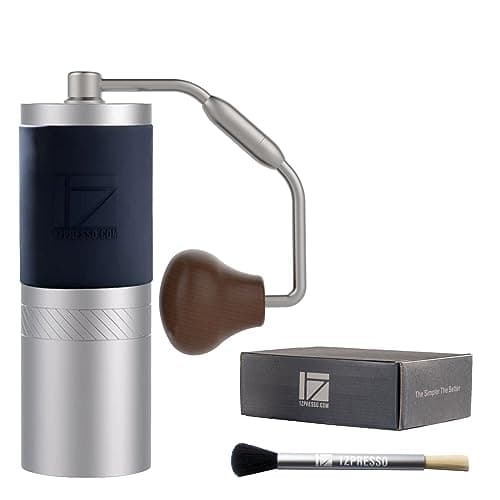
A well-made, compact hand grinder with large 48mm conical burrs and near-zero retention — a filter-first workhorse for pour over, French press and cold brew that grinds well above its size, held back only by an internal dial and modest capacity.
- Best for
- Filter and travel drinkers who want a compact, no-power hand grinder for pour over, French press, drip and cold brew
- Price context
- A mid-priced hand grinder; the money goes into the burrs rather than a motor, so grind quality punches above its price
The 1Zpresso Jis a compact stainless-steel hand grinder built around one very good idea: put a large, high-quality burr set in a body you can hold in one hand and carry anywhere. Its 48mm conical steel burrs are bigger than most manual grinders bother with, and a numbered internal adjustment dial lets you land on a setting and come back to it exactly. The result is a filter-first workhorse — happiest with pour over, drip, French press and cold brew — that grinds well above its size and needs no power at all. It is the hand grinder most everyday brewers should look at first.
A note on honesty first: we don't run a lab. This review compiles 1Zpresso's published specifications, cross-checks them against verified owner feedback, and does the reasoning — the same method we use on every product, described on our methodology page. We have not put a particle analyzer to the J; what follows is what the design and the numbers tell you, honestly framed.
Who the 1Zpresso J is for
The J is for the filter drinker who wants café-grade grinding without a café-grade countertop appliance. If your mornings are pour over, batch drip, French press, AeroPress or a jug of cold brew, the J covers every one of them from a single, portable tool. It is also the grinder to reach for if you travel and refuse to compromise: the foldable handle and compact body pack down small, and because there is no motor, it works on a campsite or in a hotel room exactly as well as it does at home. If you have already read our best hand grinder guide and want the all-round pick explained in full, this is that grinder.
It is a less obvious choice for two buyers. First, anyone grinding for a whole household every morning — hand grinding is a pleasure for a cup or two and a chore at volume. Second, the committed espresso obsessive who wants the finest possible resolution at the espresso end; the J can pull a shot, but 1Zpresso builds finer-stepped models aimed squarely at espresso if that is your only drink. For everyone brewing mostly filter, though, the J is the sweet spot.
What the specs say
The headline is the burr set. The J runs 48mm conical steel burrs, which is a large set for a hand grinder — bigger than the 38–40mm burrs in most manual and many electric grinders. Larger burrs grind faster and, more importantly, more evenly, because each bean spends less time bouncing around and more time being cut cleanly. That even particle size is the whole reason to buy a burr grinder: it is what gives pour over its clarity and keeps a French press free of muddy fines.
| Type | Manual (hand) grinder |
|---|---|
| Burrs | 48mm conical (steel) |
| Adjustment | Numbered, 30 clicks/turn (~25 microns/click) |
| Capacity | ~30-35 g per grind |
| Retention | Very low |
| Handle | Foldable |
The adjustment is the other half of the story. The J uses a numbered dial with 30 clicks per rotation, each click moving the burrs roughly 25 microns. Numbered adjustment matters more than it sounds: you can write down "filter at 4.2, French press at 6" and return to it precisely, which takes the guesswork out of switching brew methods. Capacity is a sensible ~30–35 g per grind— a comfortable single or double filter dose — and retention is very low, so what you weigh in is very close to what drops out. There is no hopper of stale beans sitting on top; you grind fresh, one dose at a time.
What it's like to live with
Three things define daily life with the J. The first is that it grinds fast for a hand grinder. Those large 48mm burrs chew through a filter dose in well under a minute, so the arm work never feels like a penance for a morning cup. The second is very low retention: because there is no hopper column and the grind path is short, almost nothing stays behind between doses. Switch from a washed Ethiopian to a chocolatey Colombian and you are not tasting a ghost of yesterday's coffee in the first cup.
The third is repeatability. The numbered internal dial clicks into defined positions, so once you have found your pour over number you can leave it, brew French press for a week, and click straight back. Dialing in is straightforward: pick a starting point from a grind size chart, taste, and nudge a click or two coarser or finer. For the filter brewing this grinder is built for, that is all the control you need — and the numbered scale means you never lose your place.
It is also, simply, a nice object to use. It is near-silent next to any electric grinder, the foldable handle packs flat, and the whole thing is light enough to travel without a second thought. For pour over specifically, it is one of the grinders our best grinder for pour over guide keeps coming back to.
Maintenance is refreshingly simple. With no motor and few moving parts, cleaning is a matter of brushing the burrs and body out now and then; there is nothing to service and nothing to fail the way an electric grinder's motor or electronics can. Owners routinely report years of daily use from a single J, which is part of the value calculation — you are buying a tool, not a consumable. It is the kind of purchase that quietly pays for itself against the electric grinders it out-grinds at the same price, and the reason a good hand grinder so often outlives the machine it was bought to feed.
Its range — and the espresso caveat
Here is the honest framing that will make or break your buying decision: the 1Zpresso J is a filter-first grinder. Its 30-click ring and ~25-micron steps give lovely resolution across the coarse-to-medium range where pour over, drip, French press and cold brew live, and that is where it is at its best. It canreach espresso fineness — the steps are fine enough to dial a shot in a few clicks — but espresso is not the range it is optimized for, and by hand a fine espresso dose asks for real effort and more turns.
If espresso is your main drink and you want the finest possible resolution at that end, the sibling to look at is the espresso-focused 1Zpresso J-Ultra, which shares the J's 48mm burr diameter but moves the adjustment to an external ring at 100 clicks per rotation and roughly 8 microns per click — about three times finer than the J's stepping. (It is also the model that replaced the older J-Max in 1Zpresso's espresso line.) The plain J is the better buy for the person who brews mostly filter and pulls the occasional shot; the J-Ultra is the better buy for the person whose day revolves around espresso. Match the grinder to the drinks you actually make.
Alternatives worth considering
If the J is close but you want the last word in build quality and plan to keep a hand grinder for a decade, step up to the Comandante C40 MK4. Its high-nitrogen Nitro Blade burrs and gift-grade construction cost noticeably more, but it is the buy-once grinder many enthusiasts settle on — our J-Ultra vs Comandante C40 MK4 comparison covers that step up directly, and our Comandante C40 MK4 review has the detail. If your budget is tighter, a smaller-burr grinder like the Timemore Chestnut C3 ESP grinds cleanly for less, at the cost of more turns per dose and a lighter feel in the hand.
And if the honest truth is that you would rather flip a switch — or you grind for a busy household — a hand grinder may be the wrong tool no matter how good it is. Grinding every dose by hand is pleasant for one or two cups a day and tedious at volume. In that case an electric burr grinder is the smarter buy; our best hand grinder guide sits alongside the electric picks so you can compare the two approaches before you commit.
Verdict
The 1Zpresso J is the hand grinder we would hand most filter drinkers. Its large 48mm conical burrs grind fast and evenly, the numbered 30-click ring makes settings easy to note and return to, and near-zero retention means every cup reflects exactly the beans you measured. It needs no power, it travels beautifully, and it grinds well above its price and its size. The honest limits are real but narrow: the internal dial is a touch less convenient than an external ring, the ~30–35 g capacity asks for a refill on big batches, its range is filter-first rather than espresso-tuned, and you do the cranking. Go in wanting a compact, do-most-things filter and travel grinder and the J will delight you; want a dedicated espresso tool and the finer-stepped J-Ultra is the sibling to buy instead.
What we liked
- 48mm conical steel burrs are larger than most hand grinders carry, so it grinds faster and more evenly
- Numbered adjustment ring with 30 clicks per rotation makes settings easy to note and return to
- Very low retention — what you weigh in is very close to what you brew, with almost nothing left behind
- No electricity needed: it travels, camps and rides out a power cut, and it is near-silent
- Foldable handle and compact body pack down small for a bag or a carry-on
What gave us pause
- Internal adjustment dial is a little less convenient than the external-ring 1Zpresso models
- Range is filter-first — it can reach espresso, but the espresso-focused J-Ultra steps far finer (8 microns per click against ~25)
- Modest ~30-35 g capacity means big French press batches need a refill
- You grind every dose by hand, which is pleasant for a cup or two and tiring for a household
Frequently asked questions
Is the 1Zpresso J good for espresso?
It can pull espresso, but it is a filter-first grinder. Its numbered 30-click ring moves the burrs about 25 microns per click, which is fine enough to dial a shot in a few clicks, but by hand a fine espresso dose takes real effort. If espresso is your main drink and you want the finest resolution at that end, the espresso-focused 1Zpresso J-Ultra is the sibling to look at instead — an external ring at 100 clicks per rotation and roughly 8 microns per click, against the plain J's 30 clicks at about 25 microns.
What brew methods is the 1Zpresso J best for?
Filter methods: pour over, batch drip, French press, AeroPress and cold brew. Its 48mm conical burrs grind fast and evenly across the coarse-to-medium range where those methods live, and its numbered dial makes it easy to note a setting for each one and return to it exactly.
How big a dose can the 1Zpresso J grind at once?
About 30 to 35 grams per grind, which is a comfortable single or double filter dose. That is plenty for one or two cups, but a large French press batch may need a refill. Retention is very low, so what you weigh in is very close to what you get out.
Does the 1Zpresso J hold its grind setting?
Yes. It uses a numbered internal dial with 30 clicks per rotation that clicks into defined positions, so you can note your number for each brew method — say pour over at one setting, French press at another — and click straight back to it. The internal dial is a little less convenient to reach than the external ring on some 1Zpresso models, but it is very repeatable.
Is a hand grinder like the 1Zpresso J worth it over electric?
On grind quality per dollar, usually yes. Because a hand grinder has no motor or electronics to pay for, nearly its whole cost goes into the burrs, so the J's 48mm conical set rivals grinders costing much more. The trade-off is effort — you grind each dose by hand, which is fine for a cup or two a day but slow for a household. If you would rather flip a switch, an electric burr grinder is the better fit.
Sources
Keep reading
Buying your first setup?
See how we pick — compiled specs, cost-per-shot math, and honest trade-offs — then dig into the guides. No fake test lab, no rankings for hire.