Comparison
Breville Barista Express vs Pro vs Impress: Which Should You Buy?
Three all-in-one Brevilles, the same 54mm brew path, and three completely different answers to what goes wrong in a home shot. The right one depends on which problem you actually have.
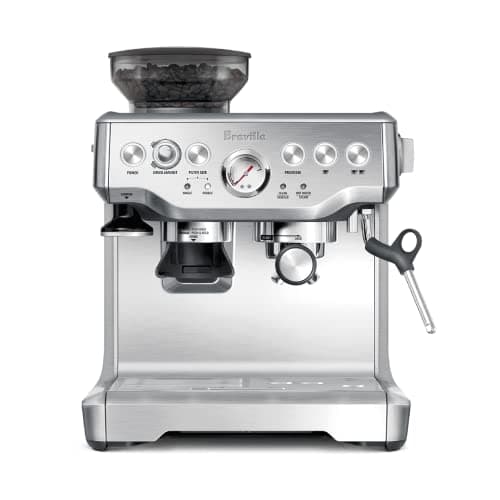
These are the three machines most people end up choosing between once they decide they want a Breville with the grinder built in. They look similar, they cost within a few hundred dollars of each other, and the marketing does a poor job of explaining what actually separates them.
Here is the thing that makes the decision tractable: the espresso is the same. All three run a 54mm portafilter, a 15 bar Italian pump delivering about 9 bar at the puck, and low-pressure pre-infusion. None of them pulls a better shot than the others by virtue of being more expensive. What each one buys you is a fix for a different specific problem— waiting, adjusting, or getting the puck right — and if you do not have that problem, you should not pay for the fix.
What all three share
| Portafilter | 54mm (single and dual wall baskets) |
|---|---|
| Pump pressure | 15 bar Italian pump (9 bar at the puck) |
| Pre-infusion | Low-pressure pre-infusion |
| Grinder | Integrated conical burr, sealed bean hopper |
| Milk | Manual steam wand — you texture it yourself |
| Bean hopper | About 250 g / half a pound |
| Format | All-in-one: grind, dose, tamp and brew in one footprint |
That shared list is most of the machine. All three are semi-automatic: you still pull the shot, you still steam the milk, and none of them will make a latte while you look at your phone. If hands-free milk is what you want, the Barista Touch line is where that lives — our Breville lineup decoder works through the whole range, including what each name suffix means.
The three real differences
Strip out the marketing and there are exactly three things that change between these machines.
- The heater. The Express and the Impress both use a ThermoCoil with PID control, which needs a genuine warm-up and needs to change modes between brewing and steaming. The Pro uses ThermoJet, which Breville rates at extraction temperature in about three seconds and which switches to steam without a wait. On a weekday morning serving several people, this is the single biggest practical difference in the group.
- Grind resolution. 16 settings on the Express, 25 on the Impress, 30 on the Pro — and the Pro uses Baratza European Precision Burrs. More settings across the same range means smaller adjustments, which means dialing a shot in rather than jumping past it.
- Whether the machine preps the puck. Only the Impress does. Its intelligent dosing system calculates the dose, Auto Dose Correct adjusts the next one if the last was off, and an assisted tamping lever applies 10 kg of pressure with a 7-degree twist finish. On the other two, the dose and the tamp are your wrist's problem.
At a glance
| Barista Express | Barista Pro | Express Impress | Price | |
|---|---|---|---|---|
| Heater | ThermoCoil + PID | ThermoJet, ~3 sec | ThermoCoil, 200°F + PID | |
| Grind settings | 16 | 30 | 25 | |
| Burrs | Stainless conical | Baratza European Precision | Conical | |
| Dosing | Manual dose control | Manual | Intelligent + Auto Dose Correct | |
| Tamping | You | You | Assisted lever, 10 kg + 7° twist | |
| Temp control | PID | Digital PID, ±2°C | PID at 200°F | |
| Interface | Analog + pressure gauge | LCD with grind/extraction progress | Analog + dose indicator | |
| Water tank | 67 oz / 2 L | 67 oz | 2 L | |
| Buy | $689.99Buy | $849.95Buy | $799.95Buy |
Prices shown are from Amazon as of Sep 18, 2026 and change often — the button always goes to the current listing. Some links may earn us a commission at no extra cost to you.
Barista Express (BES870XL): the value pick
The Barista Express is the machine that created this category, and it is still the cheapest way into it. A stainless conical burr grinder with 16 settings and dose control feeds a 54mm portafilter, brewed by a ThermoCoil with PID temperature control and a 15 bar pump delivering 9 bar at the puck, with a generous 67 oz / 2 L removable tank.
| Type | Semi-automatic, all-in-one (integrated grinder) |
|---|---|
| Grinder | Stainless conical burr — 16 grind settings, dose control |
| Bean hopper | 1/2 lb (about 250 g), sealed |
| Portafilter | 54mm (single & dual wall baskets) |
| Boiler | ThermoCoil with PID temperature control |
| Pump pressure | 15 bar (9 bar at the puck) |
| Pre-infusion | Low-pressure pre-infusion |
| Milk | Manual steam wand |
| Water tank | 67 oz / 2 L (removable) |
The honest cons.Sixteen grind settings is the fewest here, and on a fussy bean you can find yourself between two settings with no way to split the difference — which is where a lot of Express inconsistency comes from. The ThermoCoil needs a real warm-up and a wait between brewing and steaming. And the built-in grinder cannot be upgraded independently: if it fails, the whole machine goes in for service.
Our full Barista Express review covers the grinder in detail.
Barista Pro (BES878): the one that stops you waiting
The Pro is the Barista Express rebuilt around speed. It drops the ThermoCoil for the ThermoJet heating system, which reaches extraction temperature in about three secondsand switches from espresso to steam instantly — no waiting for the boiler to change modes between the shot and the milk.
It also carries the best grinder in this group: Baratza European Precision Burrs with 30 grind settings, plus digital PID regulation to within ±2°C and an LCD that animates grind and extraction progress so you can watch what the machine is doing rather than guess.
| Type | Semi-automatic, all-in-one (integrated grinder) |
|---|---|
| Grinder | Baratza European Precision Burrs — 30 grind settings |
| Portafilter | 54mm |
| Boiler | ThermoJet — extraction temperature in ~3 seconds |
| Temperature control | Digital PID, ±2°C |
| Pump pressure | 15 bar Italian pump (9 bar extraction) |
| Pre-infusion | Low-pressure pre-infusion |
| Milk | Manual steam wand |
| Interface | LCD with grind & extraction progress |
| Bean hopper / tank | 1/2 lb / 67 oz |
| Power | 1680 W, 120 V |
The honest cons.You do all the puck prep yourself — no assisted dose or tamp — so the Impress beats it on consistency despite usually costing less. The milk is manual. And it is a large, heavy appliance that will own a meaningful stretch of counter.
Barista Express Impress (BES876): the one that preps the puck
The Impress is the Barista Express with the two steps beginners get wrong taken away. Its intelligent dosing system calculates the dose and Auto Dose Correct adjusts the next one if the last was off. Then an assisted tamping lever applies a consistent 10 kg of pressure with a 7-degree "barista twist" finish, producing a level, polished puck every time instead of whatever your wrist managed that morning.
That matters more than it sounds. An uneven tamp is the most common cause of channeling, and channeling is the most common cause of a sour, thin, disappointing shot. Breville also stepped the grinder up to 25 settings and the tank to a genuinely large 2 L.
| Type | Semi-automatic, all-in-one (integrated grinder) |
|---|---|
| Grinder | Integrated conical burr — 25 grind settings |
| Dosing | Intelligent dosing + Auto Dose Correct |
| Tamping | Assisted lever — 10 kg, 7-degree twist finish |
| Portafilter | 54mm stainless steel |
| Boiler | ThermoCoil, 200°F with PID control |
| Pump pressure | 15 bar Italian pump (9 bar extraction) |
| Milk | Manual steam wand |
| Bean hopper / tank | 250 g / 2 L |
The honest cons.It keeps the slower ThermoCoil heater, so you pay a premium over the Express and still wait for warm-up — the Pro is the model that fixes that, not this one. The assisted tamp is a mechanism, and mechanisms can wear or jam. It is one of the taller machines in the range, so measure cabinet clearance before ordering. And the milk is still entirely on you.
Barista Express vs Barista Pro, head to head
This is the most common version of the question, and it has a clean answer: you are paying for time and grind resolution, not for better espresso.
The Pro's ThermoJet heater is ready in about three seconds against a ThermoCoil that wants a proper warm-up, and it switches between brewing and steaming without the pause the Express makes you take. If one person makes one drink at a leisurely weekend pace, that matters very little. If three people want drinks before work, it is the difference between the machine keeping up and the machine being a queue.
The grinder is the quieter upgrade and, over a year, probably the more important one. Going from 16 to 30 settingsacross the same range roughly halves the size of each adjustment, which is the difference between landing on the right grind and bracketing it. The Pro also adds the LCD, which turns "something is wrong with this shot" into a visible grind and extraction progress readout.
Buy the Pro if mornings are busy or you intend to change beans often. Buy the Express if they are not and you would rather put the difference toward better beans or a scale.
Barista Express vs Express Impress, head to head
Same heater, same brew path, same manual wand. Everything you are paying for sits in the twenty seconds between grinding and locking in the portafilter.
On the Express, you grind into the basket, judge the dose, tamp with whatever force your wrist supplied, and hope it was level. On the Impress, the machine doses, corrects the next dose based on the last, and tamps with a repeatable 10 kg and a 7-degree twist. The upgrade is not a better shot — it is the same shot every time, which for most home users is the thing actually missing.
The trade is honest and specific: you keep the slow ThermoCoil, you pay a premium, and you add a mechanism. If you already prep a level puck confidently — and a WDT tool plus a decent tamperget most people there for a fraction of the price difference — the Impress is solving a problem you no longer have.
Which one to buy
- Budget is the constraint, or one drink a day. The Barista Express. It makes the same espresso as the other two and leaves money for beans and accessories.
- Several drinks, several people, on a weekday. The Barista Pro. Three-second heat-up and instant steam switching is the only upgrade here that changes how the machine fits your morning.
- Your shots come out differently every day and you do not want to learn why. The Barista Express Impress.
- You want hands-free milk too. None of these three. Look at the Barista Touch Impress in our Breville lineup guide, or at the best machines for milk drinks.
- You already own a good grinder. Buy none of them. A Bambino Plusplus the grinder you have will outperform any of these three for less money — which is the argument we work through in Barista Express vs Bambino.
Whichever you choose, the accessory that improves all three most is not an accessory at all: fresher beans. The integrated grinder in every one of these is good enough that stale supermarket coffee, not the machine, will be the limit.
Frequently asked questions
What is the difference between the Breville Barista Express and the Barista Pro?
Two things. The Pro replaces the Express's ThermoCoil heater with ThermoJet, which Breville rates at extraction temperature in about three seconds and which switches to steam without a wait; and it upgrades the grinder from 16 settings to 30 using Baratza European Precision Burrs, with digital PID to within 2 degrees C and an LCD showing grind and extraction progress. The brew path, the 54mm portafilter and the 15 bar pump are the same, so the espresso itself is not better — the machine is just faster and finer to adjust.
Is the Barista Express Impress worth the extra money over the Barista Express?
It depends on whether puck prep is your weak point. The Impress adds intelligent dosing with Auto Dose Correct and an assisted tamping lever that applies 10 kg with a 7-degree twist, which removes the most common cause of channeling. It also steps the grinder from 16 to 25 settings. What it does not do is fix the slow ThermoCoil heater. If your shots are already consistent, a WDT tool and a good tamper solve the same problem for far less.
Which is better, the Barista Pro or the Barista Express Impress?
They fix opposite problems and cost close to the same money. The Pro fixes waiting — three-second heat-up, instant steam switching, and the finest grind adjustment of the three. The Impress fixes inconsistency — it doses and tamps for you. Neither fixes both. Buy the Pro for a busy household, the Impress if your shots vary day to day.
Do the Barista Express, Pro and Impress pull the same espresso?
Mechanically, yes. All three use a 54mm portafilter, a 15 bar Italian pump delivering about 9 bar at the puck and low-pressure pre-infusion, so none of them is capable of a better shot than the others. The differences are in how quickly the machine is ready, how finely you can adjust the grind, and whether the machine preps the puck for you.
Do any of these machines froth milk automatically?
No. All three have a manual steam wand, so texturing the milk is a skill you learn. Breville's automatic milk systems live on the Bambino Plus and the Barista Touch line instead. If hands-free milk matters more to you than the built-in grinder, that is the part of the range to look at.
Can you use a bottomless portafilter on the Barista Express, Pro or Impress?
Yes — all three take a standard 54mm portafilter, and 54mm bottomless portafilters listed for the Barista Express, Pro and Touch are widely available. A naked portafilter is the cheapest way to see whether your puck is channeling, which is exactly the fault the Impress's assisted tamp is designed to prevent.
Sources
- Breville — the Barista Express (BES870) product specifications and instruction book: 54mm portafilter, 16 grind settings, ThermoCoil with PID, 2 L tank
- Breville — the Barista Pro (BES878) product page: 30 grind settings, Baratza European Precision Burrs, ThermoJet heating, 15 bar Italian pump / 9 bar extraction
- Breville — the Barista Express Impress (BES876) product page: 54mm portafilter, 25 grind settings, ThermoCoil at 200°F with PID, 15 bar pump / 9 bar extraction
- Amazon listings (Creators API) — current availability, PID ±2°C, LCD interface, assisted tamping at 10 kg with 7-degree twist, hopper and tank capacities, wattage
- Specialty Coffee Association — espresso brewing standards
Keep reading
Buying your first setup?
See how we pick — compiled specs, cost-per-shot math, and honest trade-offs — then dig into the guides. No fake test lab, no rankings for hire.