Single Review
Breville Barista Express Impress (BES876) Review
The all-in-one that doses and tamps for you: a 22 lb assisted tamp with a 7-degree twist, a dose gauge that corrects the next shot, and 25 grind settings. Here's the honest breakdown, specs first.
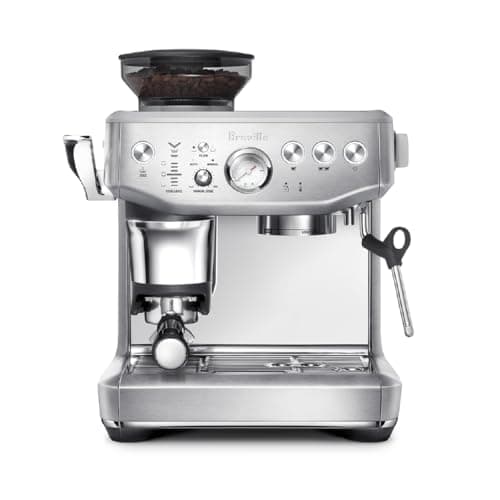
The most beginner-proof all-in-one Breville makes: the machine measures the dose, tells you when it is right, corrects the next one and tamps at a repeatable 22 lb, so channeling from a crooked tamp stops being your problem — you still wait on a ThermoCoil heater and still dial in the grind yourself.
- Best for
- First-time buyers whose shots come out different every morning and who want puck prep taken out of their hands
- Price context
- Upper-mid-tier all-in-one; sits above the Barista Express and around the Barista Pro
Most bad home espresso is not the machine's fault. It is a crooked tamp, an uneven dose, and the channeling that follows — water finding the path of least resistance through the puck and running thin, sour coffee out of one side of the basket. The Breville Barista Express Impress exists to take that variable away. It is the Barista Express with the puck prep rebuilt: the machine calculates the dose, shows you on a gauge whether the basket is under or over, corrects the next grind, and tamps with a lever at a constant 22 lb (10 kg) finished with a 7-degree barista twist. The 54mm brew path, the 15 bar pump and the ThermoCoil heater carry over unchanged.
A note on honesty first: we have not run this machine in a lab. This review compiles Breville's published specifications and the BES876 instruction book, cross-checks them against a named hands-on review, and does the reasoning — the same method we use on every product, described on our methodology page. Prices move constantly, so we talk in brackets, not stale numbers; the live figure is in the buy box below.
Who the Barista Express Impress is for
This is the machine for the buyer whose shots are inconsistent and who does not want to fix that by learning technique. If your espresso is fine one morning and sour and fast the next, and you suspect your tamp is the reason, the Impress addresses it directly — and it addresses it on the machine, with a gauge you read and a lever you pull, rather than by asking you to buy a scale, a distributor and a WDT tool and learn to use all three. It is also a genuinely good fit for a household where more than one person makes coffee, because the dose and tamp do not depend on whose hands are doing it.
It is not the machine for someone whose complaint is waiting. The Impress keeps the slower ThermoCoil heater, so if you want a machine that is ready in seconds and switches to steam instantly, that is the Barista Pro, which fixes the opposite problem for similar money. It is not for the buyer who already owns a good standalone grinder either: in that case a Bambino Plusplus your grinder costs less, takes half the counter, and will out-grind anything built into a Barista. And it is not for someone who wants the drink made for them at a button press — that is a super-automatic, a different class of machine entirely.
What the specs say
Strip out the puck prep and this is a Barista Express: a semi-automatic single-heater machine with an integrated conical burr grinder, a 54mm stainless portafilter, a 15 bar Italian pump delivering low-pressure pre-infusion followed by 9 bar extraction, and a ThermoCoil heating system with PID that Breville rates at 200°F. Three things are different from the Express: the Impress Puck System, the grinder stepping up from 16 to 25 grind settings, and a dose level gauge in place of guesswork. Notably, unlike the Barista Pro, it keeps the analog extraction pressure gauge rather than swapping it for a screen.
| Type | Semi-automatic, all-in-one (integrated grinder, assisted puck prep) |
|---|---|
| Puck prep | Impress Puck System — intelligent dosing, dose gauge, Auto Dose Correct, assisted tamp |
| Tamp force | 22 lb (10 kg) with a 7° barista twist finish |
| Grinder | Precision conical burr — 25 settings, lower number = finer (start at 16) |
| Dose | About 18 g double; manual lists 8-11 g single and 16-19 g double |
| Portafilter | 54mm stainless steel, single & dual wall baskets (1 & 2 cup) |
| Heating | ThermoCoil with electronic PID, 200°F, adjustable ±4°F in 2°F steps |
| Pump pressure | 15 bar Italian pump; low-pressure pre-infusion, 9 bar extraction |
| Target extraction | 25-30 seconds per the manual's guide |
| Interface | Analog extraction pressure gauge, dose level indicator, tamp indicator |
| Milk / hot water | Manual 360° swivel steam wand; hot water spout, max 8 fl oz per pour |
| Bean hopper / tank | 8.8 oz / 250 g hopper; 67 fl oz / 2 L removable tank with filter |
| Dimensions / weight | ~14.4 x 12.2 x 16.6 in (W x D x H); ~23.7 lb |
| Power | 1750 W, 120 V, 60 Hz |
| In the box | Razor dose trimming tool, 480 ml milk jug, single & dual wall baskets, water filter + holder, cleaning disc, tablets, brush, steam wand tool, descaling powder, Allen key |
Two spec lines are easy to skim past and worth knowing. The brew temperature is adjustable ±4°F in 2°F incrementsfrom the 200°F default, set with a button combination at power-on — genuinely useful when a light roast tastes thin at the default. And the machine is heavy and deep at roughly 23.7 lb and 12 in front to back, plus clearance above for the hopper and room to swing the tamp lever. Measure the space under your cabinets before ordering.
What the Impress Puck System actually does
It is worth being precise here, because "automatic tamping" oversells it. The Impress system is four connected things, and Breville documents each one.
Intelligent dosing. The grinder runs on a learned time rather than a fixed one, and calculates the dose based on the last grind. You lock the portafilter into the cradle and press Dose; it stops itself. The dose level gauge then lights up a scale from severe under-dose through ideal to severe over-dose, so the machine tells you where you actually landed instead of leaving you to guess or weigh. Assisted tamping is the lever: push it down until the machine beeps and it compresses the puck at a constant 22 lb (10 kg), finishing with a 7-degree twist that polishes the surface. Breville recommends tamping twice for the most polished puck. Finally, Auto Dose Correct takes what the gauge saw and adjusts the next grind time automatically.
The honest limits fall straight out of that description. The system controls how much coffee and how hard it is pressed. It does not control how finethe coffee is, which is the variable that actually decides whether your shot runs in 25 seconds or 12 — you still dial that in yourself on the grind dial, exactly as on any other machine. And correction is not instant: the manual is explicit that when you change grind size, the new auto dose time is calculated after your next tamp and applied to the cycle after that. So a grind change costs you two throwaway shots before the dosing settles.
There is also a ceiling on what it can fix. If the basket comes out over-dosed, the machine cannot take coffee back out — it flags it, and you trim the puck with the Razor tool, which is why that tool is still in the box. If it comes out under-dosed, the Dose button blinks "A Bit More" and a short top-up grind brings it to level, though Breville notes this can take two or three top-up cycles. You can also switch the whole thing off and dose manually with a dial.
The grinder and the dose loop
The grinder is an integrated precision conical burr unit with 25 settings, where a lower number is finer, and Breville recommends starting at 16. That is a meaningful improvement in resolution over the Barista Express's 16 steps, and it sits below the 30 steps and Baratza burrs of the Barista Pro. Because grinding happens with the portafilter clamped in the cradle, almost nothing lands on the counter — Breville markets this as "less mess" and it is one of the machine's quiet wins over a grind-and-tamp workflow.
The honest read on it comes from two places. Breville's own manual recommends purging the retained grinds left in the burrs or chute before the first coffee of the day, which tells you retention is not zero; in auto mode a purge also means pulling the portafilter, discarding that coffee and re-seating it to get back to standby. And Arne Preuss at Coffeeness, who tested the machine hands-on (review updated May 2025), landed on grind setting 11rather than the recommended 16 for his best results, and still found consistency hard to hold shot to shot — "all too often the machine left me scratching my head and wondering what had changed." He also notes that pulling the portafilter out mid-grind makes "a big mess."
That is the fair summary: 25 stepped settings on a grinder that is bolted to the machine is a real ceiling. It is enough for most medium-roast espresso and not much more, it cannot be upgraded on its own, and light roasts that want a very fine, very precise grind will expose it. If you expect to chase single-origin light roasts, buy a machine without a grinder and put the money into one from our best grinders for espressoguide instead — and if you are not sure that matters, we make the case either way in do I need a grinder for espresso.
What it's like to live with
The routine is short. Lock the portafilter into the grinding cradle, press Dose and let it stop itself, check the dose gauge, pull the tamp lever down until it beeps, release it, move the portafilter to the group head and press 1 CUP or 2 CUP. Breville's own extraction guide is the same one printed on every Barista machine: aim for 25 to 30 seconds, with the shot the consistency of dripping honey; too fast and pale means grind finer, dripping and dark means coarser. The preset volumes stop the shot for you, both are programmable, and holding a cup button runs a manual pre-infusion for as long as you hold it.
The heater is the part you feel every morning. It is a ThermoCoil, not the ThermoJet from the Pro and Bambino, and Coffeeness measured about 40 secondsto ready. That is not long in absolute terms, but it is the difference between a machine you switch on and use and one you switch on and wait for — and the same limitation applies between brewing and steaming, where the single heater has to change temperature before the wand is ready. For one or two drinks that is a pause; for four back to back it adds up. Coffeeness also reported the machine having a hard time with temperature controlin testing, which is worth weighing against Breville's PID claim.
The analog pressure gaugeis a genuine advantage this machine has over its more expensive sibling. The Pro replaced its gauge with an LCD shot clock; the Impress keeps the needle, and Coffeeness found it gave "valuable feedback on extraction." A gauge shows a choked puck or a channeling shot while it is happening, which is exactly the fault the assisted tamp is meant to prevent — so the two features work together. If your shot pressure spikes and the needle pins, you know to go coarser before you have tasted anything.
Milk and hot water
Milk is fully manual, on a 360-degree swivel steam wand. Breville's instructions are the standard two-phase routine: stretch the milk with the tip just at the surface to introduce air, then submerge it slightly to spin a vortex and heat through, stopping at 140-149°F (60-65°C)— when the jug is hot to comfortably touch — then purge and wipe the wand. Coffeeness rates the wand as capable of "silky microfoam" while calling it "not the most powerful," and found it no better than the original Barista Express's. That is the trade the Impress makes: it automates the puck, not the milk. If milk is your main reason for buying, the Bambino Plus textures it for you automatically, and our how to steam milk guide is the shortcut for everyone else.
There is also a dedicated hot water spout, which the Bambino line does without. It is for Americanos and for pre-heating cups, and it pours a maximum of 8 fl oz (240 ml)at a time. On a machine with a slower heater, pre-heating the cup and the portafilter with it is not a nicety — it is how you stop your first shot of the day landing in cold ceramic.
Impress vs Barista Express vs Barista Pro
All three are all-in-one Brevilles with a built-in grinder, the same 54mm brew path, the same 15 bar pump with pre-infusion and PID temperature control. They differ in exactly one dimension each. The Barista Express is the cheapest and the baseline: 16 grind settings, ThermoCoil, manual dose and tamp with the Razor. The Impress spends the difference on consistency: 25 settings, intelligent dosing, the dose gauge, Auto Dose Correct and the assisted tamp — and keeps the slow heater. The Barista Pro spends it on speedinstead: ThermoJet to brew temperature in about three seconds, an instant switch to steam, 30 settings with Baratza burrs — and leaves every step of puck prep to you.
So the question is not which is better, it is which fault you are buying out of. Shots that vary day to day: Impress. A queue of people waiting for drinks: Pro. Neither problem, tightest budget: the Express. If you want both fixed in one box, that is the Barista Touch Impress, at a substantially higher price. Our Barista Express vs Pro vs Impress comparison puts the three side by side spec for spec, and the best Breville espresso machine guide decodes what every name in the lineup means. One thing that does not change across any of them: the portafilter is 54mm, not the commercial 58mm standard, which our portafilter size guide explains in terms of the accessories you will buy later.
Cleaning & maintenance
The manual is specific, and this machine has one extra job the others do not. Replace the water filter every three months— Breville says doing so reduces how often the machine needs descaling, and more often if your water is hard. The CLEAN / DESCALE light does double duty: it flashes when the group needs a cleaning cycle with the included disc and tablet, and it glows solidwhen a descale is due. Descaling on the BES876 runs in stages through the coffee components, then the steam and hot water circuits via the steam dial, using the included descaling powder — and Breville warns against using bottled water for it, because the dissolved solids leave deposits behind.
The extra job is the puck prep assembly itself: the tamp cover lifts out, and the tamping chute and lever mechanism need wiping down so coffee does not build up where the tamp lands. It takes seconds, and skipping it is how a machine that tamps consistently stops tamping consistently. Our how to descale an espresso machine guide covers the routine in general, and what water to use in an espresso machine explains why the filter interval does more for the machine's life than any cleaning product.
Alternatives worth considering
If the waiting bothers you more than the inconsistency, the Barista Pro is the same money spent on a three-second heater and a better grinder. If you want the assisted puck prep and the fast heater andautomatic milk, that is the Barista Touch Impress, for a lot more. If you already own a grinder — or would rather buy a good one — the Bambino Plus gives you a ThermoJet heater and an automatic steam wand in a much smaller footprint, and a standalone grinder will beat any built-in at the same total spend. If you would rather have a 58mm machine you can repair and modify for a decade, a Gaggia Classic Evo Pro plus a grinder is the enthusiast route. And if you want the whole field ranked rather than one machine argued, start with best espresso machines with a built-in grinder or best espresso machine under $1000.
Verdict
The Barista Express Impress is the most beginner-proof machine Breville makes that still counts as real espresso. It solves the two steps that ruin the most home shots — dose and tamp — and it solves them visibly, with a gauge that tells you what happened and a lever that repeats itself, so a household of several people gets the same puck every time. That is worth real money to the right buyer. Go in knowing what it does not fix: you still find your own grind setting, a grind change costs you two settling shots, an over-dose still needs the Razor, the milk is entirely your skill, and the ThermoCoil keeps you waiting roughly forty seconds where the Pro waits three. If your shots are inconsistent, this is the right Breville. If they are slow, buy the Pro instead. Before either, read the true cost of home espressoso the running costs hold no surprises. Note that Breville sells this machine in several colorways whose stock and pricing move independently — the buy box below tracks the listing we link.
What we liked
- The assisted tamp applies a repeatable 22 lb (10 kg) with a 7-degree twist finish, which removes the single most common beginner cause of channeling
- Intelligent dosing plus the dose level gauge tells you on the machine whether the basket is under, ideal or over — no scale needed to see the problem
- Auto Dose Correct adjusts the next grind time for you, and the 'A Bit More' top-up tops off an under-dose without starting over or wasting coffee
- The portafilter stays locked in the cradle through grinding, dosing and tamping, so there is far less mess on the counter than grind-and-tamp machines
- Keeps the analog extraction pressure gauge the Barista Pro dropped — the fastest way to see a choked or channeling puck as it happens
- Real 54mm brew path with 15 bar pump, low-pressure pre-infusion, PID at 200°F adjustable ±4°F, a 2 L tank and a dedicated hot water spout
What gave us pause
- ThermoCoil, not ThermoJet: Coffeeness measured about 40 seconds to ready, where the Barista Pro reaches brew temperature in about three seconds
- Assisted tamping does not dial in your grind — Coffeeness still landed on setting 11 rather than Breville's recommended 16, and found shot-to-shot consistency hard to hold
- The Razor trimming tool is still in the box because you still need it: the machine cannot fix an over-dose, only flag it
- Auto Dose Correct is slow to learn — change the grind size and the new dose time only applies two cycles later, per Breville's own manual
- 25 stepped settings on a machine-locked grinder is a real ceiling: no stepless adjustment, and you cannot upgrade the grinder without replacing the machine
- Single heating system, so you brew then steam, and the ThermoCoil takes a moment to change over; the wand is capable but not the most powerful
Frequently asked questions
What is the difference between the Breville Barista Express and the Barista Express Impress?
Both are all-in-one machines with the same 54mm portafilter, 15 bar pump, low-pressure pre-infusion and ThermoCoil heating with PID at 200°F. The Impress adds the Impress Puck System — intelligent dosing that calculates the dose, a dose level gauge that shows whether the basket is under or over, Auto Dose Correct that adjusts the next grind, and a lever that tamps at a consistent 22 lb (10 kg) with a 7-degree twist — and steps the grinder from 16 grind settings to 25. The Express is cheaper and leaves dose and tamp entirely to you.
Does the Barista Express Impress tamp for you?
Yes, with a lever rather than a motor. You push the assisted tamp lever down until the machine beeps and it compresses the puck at a constant 22 lb (10 kg), finishing with a 7-degree twist to polish the surface; Breville recommends tamping twice for the most polished puck. What it does not do is choose your grind size, and it cannot remove coffee from an over-dosed basket — the machine flags an over-dose and you trim the puck with the included Razor tool.
Is the Barista Express Impress good for beginners?
It is the most beginner-friendly machine in Breville's manual lineup, because the two steps beginners get wrong — dose weight and tamp — are measured and performed by the machine, and the dose gauge shows you what happened rather than leaving you guessing. It still asks you to dial in grind size yourself and to steam milk by hand on a manual wand, so it is beginner-proof puck prep, not a push-button machine.
How long does the Barista Express Impress take to heat up?
It uses a ThermoCoil heating system rather than the ThermoJet found in the Barista Pro and the Bambino line. Coffeeness, testing hands-on, measured around 40 seconds to ready status. The same single heater serves brewing and steaming, so there is also a short wait when switching from pulling a shot to texturing milk. If heat-up time is your main frustration, the Barista Pro reaches extraction temperature in about three seconds.
Does the Barista Express Impress have a pressure gauge?
Yes. Unlike the Barista Pro, which replaced the analog gauge with an LCD, the Impress keeps an espresso extraction pressure gauge on the front panel alongside the dose level indicator. It is genuinely useful next to the assisted tamp: the gauge shows a choked or channeling puck while the shot is running, which tells you to adjust grind size before you taste anything.
How much maintenance does the Barista Express Impress need?
Breville's manual says to replace the water tank filter every three months — more often with hard water — which reduces how often the machine needs descaling. The CLEAN / DESCALE light flashes when the group needs a cleaning cycle with the included disc and tablet, and glows solid when a descale is due; the descale runs through the coffee components and then the steam and hot water circuits. On top of the usual routine, wipe down the tamp cover and tamping chute so coffee buildup does not affect how the assisted tamp seats.
Sources
- Breville — the Barista Express Impress (BES876) product page: Impress Puck System delivering a constant 22 lb impression with a 7° barista twist on an 18 g dose, integrated conical burr grinder with 25 grind settings and auto-correcting dose, ThermoCoil at 200°F with PID, 15 bar Italian pump, low-pressure pre-infusion followed by 9 bar extraction, 54mm stainless portafilter, dimensions and included accessories
- Breville — the Barista Express Impress BES876 US instruction book (PDF): components and rating (120 V, 1750 W), 250 g hopper, 2 L tank, dedicated hot water outlet (max 8 fl oz) and pressure gauge, 25 grind settings with No.16 recommended start, the two-cycle lag after a grind change, 'A Bit More' top-up, Razor trimming for an over-dose, grinder purge before the first coffee, tamp-twice recommendation, 8-11 g / 16-19 g dose and 25-30 second target, brew temperature adjustable ±4°F, three-month water filter interval, cleaning and descale cycles
- Amazon listing for BES876BSS via the Creators API (checked 2026-09-26): model number, New condition with the featured offer, feature bullets incl. intelligent dosing, Auto Dose Correct and 10 kg assisted tamping, item weight 23.7 lb, dimensions, 2-year limited warranty
- Coffeeness — Breville Barista Express Impress review by Arne Preuss (hands-on, updated May 21, 2025): about 40 seconds to ready, best results at grind setting 11 rather than the recommended 16, shot-to-shot consistency difficulty, mess when removing the portafilter mid-grind, pressure gauge feedback, steam wand assessment
Keep reading
- Barista Express vs Pro vs Impress: which should you buy? →
- Best Breville espresso machine (whole lineup decoded) →
- Breville Barista Express (BES870) review →
- Breville Barista Pro (BES878) review →
- Best espresso machines with a built-in grinder →
- Pressurized vs non-pressurized portafilters →
- How to pull an espresso shot →
Buying your first setup?
See how we pick — compiled specs, cost-per-shot math, and honest trade-offs — then dig into the guides. No fake test lab, no rankings for hire.