Single Review
Timemore Chestnut C3 ESP Review
The cheapest hand grinder we would trust to dial in a real espresso shot — because of one spec: a 30-click dial that moves 0.0233mm at a time, against 0.0833mm on the standard C3. Here is the honest breakdown, and how to avoid buying the wrong one.
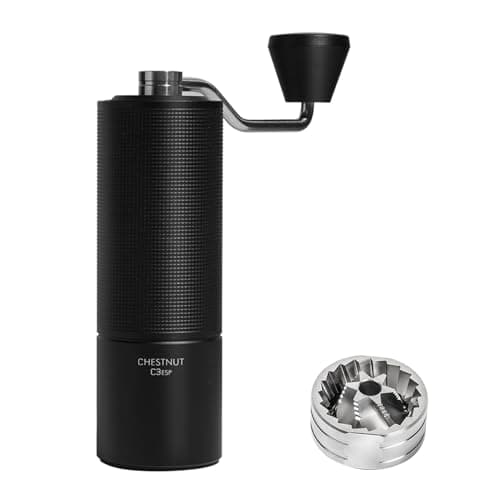
The value benchmark for espresso-capable hand grinding: a 0.0233mm-per-click dial and 38mm S2C660 burrs in an all-metal body for less than almost any electric grinder worth owning — provided you accept that the dial lives under the catch cup and that every double shot costs you a minute of cranking.
- Best for
- Espresso drinkers on a tight budget, and anyone who wants one grinder that travels and still grinds fine enough for a real shot
- Price context
- Budget tier — the least expensive grinder on this site with genuine espresso adjustment; the ESP Pro and C5 ESP Pro sit above it
Most hand grinders sold as “espresso capable” are not. They have burrs that can physically close down to espresso fineness, and an adjustment dial so coarse that one click takes you from a choked shot to a gusher with nothing usable in between. The Timemore Chestnut C3 ESP exists to fix exactly that one problem, and the fix is a single number: 0.0233mm per click.
That is the whole story of this grinder, and it is why we have had it wired as the value pick on our best hand grinder and best espresso grinder under $200 guides for months. This is the dedicated review.
A note on honesty first: we have not run this grinder in a lab. This review compiles Timemore's own published specifications, cross-checks them against retailer spec sheets and two named hands-on reviews, and does the reasoning — the same method we use on every product, described on our methodology page. Where sources disagree, we say so rather than picking the prettier number.
Who the Chestnut C3 ESP is for
This grinder is for the person who has worked out that the grinder matters more than the machine, and who does not have espresso-grinder money. If you have just bought a starter machine — a Gaggia Classic, a Bambino, a De'Longhi Stilosa — and you are grinding with something that came free or came from a supermarket, this is the single cheapest upgrade that will change what is in your cup. Our do I need a grinder for espresso guide makes the full argument for why.
It also suits a second buyer: someone who already owns a decent electric grinder and wants something that travels. At roughly 430 g with an all-metal body, the C3 ESP goes in a bag without ceremony, which is why it appears in our best travel coffee gear thinking.
It is the wrong grinder for two people. If you pull more than two or three shots a day, the cranking stops being charming — buy something electric. And if you brew only filter coffee, you are paying for espresso precision you will never use; the standard Chestnut C3 or a pour-over grinder does that job for less.
What the specs say
The burrs are 38mm S2C660 conical burrsin SUS420 stainless steel, CNC-machined, using Timemore's spike-to-cut geometry — a design the company carried down from its pricier Chestnut X line, reduced from 42mm to 38mm to fit this body. Spike-to-cut matters at espresso fineness: the leading edges break beans down before the cutting section sizes them, which is how a small burr set keeps fines under control instead of producing the dust that makes cheap grinders choke a basket.
| Type | Manual (hand) grinder |
|---|---|
| Burrs | 38mm S2C660 conical, SUS420 stainless steel, spike-to-cut, CNC-machined for concentricity |
| Burr lineage | Geometry from the Chestnut X line, reduced from 42mm |
| Adjustment | Internal dial beneath the burrs, reached by removing the catch cup |
| Adjustment precision | 30 clicks per rotation, 0.0233mm per click (~23 microns) |
| Standard C3 / C3S dial | 12 clicks per rotation, 0.0833mm per click (~83 microns) |
| Zeroing method | Turn the dial clockwise until it stops, then count clicks counter-clockwise |
| Grind range | Espresso through pour over to French press |
| Capacity | 20 g per Timemore's C3-series page; sigmacoffee and other retailers publish 25 g |
| Body material | Aluminum alloy with stainless steel; silicone base; no plastic internals |
| Shaft | Dual-bearing positioning |
| Handle | Fixed crank, 159mm |
| Weight | ~430 g net |
| Dimensions | ~147 x 52 mm (body) |
Two spec lines deserve flagging. First, capacity is published inconsistently: Timemore's own C3-series page groups the C3, C3 Pro, C3 ESP and C3 ESP Pro at 20 g, while retailer spec sheets and one hands-on reviewer state 25 g. We have not measured it. Either figure comfortably covers a double espresso dose of 18 g, which is what most buyers care about; neither covers a large French press in one fill.
Second, the handle is fixed. A great deal of writing about this grinder — including, until this review, a spec line on our own hand-grinder guide — describes the C3 ESP as having a foldable handle. It does not. The foldable handle is the defining feature of the C3 ESP Pro. If packing length matters to you, that distinction is the one worth paying for.
The 30-click dial, and why it is the entire product
Timemore publishes two dial specifications across the C3 series, and the gap between them is the reason this model exists:
| Standard dial (C3, C3S, C3S Pro) | Espresso dial (C3 ESP, ESP Pro) | |
|---|---|---|
| Clicks per rotation | 12 | 30 |
| Movement per click | 0.0833mm (~83 microns) | 0.0233mm (~23 microns) |
| Practical effect | Usable for filter; too coarse a jump to land an espresso shot | Fine enough to move shot time by a few seconds per click |
Espresso lives in a narrow band of roughly 200 to 400 microns, and the difference between a shot that runs in 20 seconds and one that runs in 32 is a small fraction of that band. On an 83-micron dial you step straight over the window you are aiming for: one click too fine chokes the machine, one click back and the shot gushes. On a 23-micron dial the same adjustment lands inside the window. That is not a marketing distinction, it is the difference between being able to dial in a coffee and not.
It is also why the non-ESP Chestnut models are a trap for espresso buyers, and why we spend a section below on the naming. The burrs across the C3 family are broadly the same 38mm S2C660 set. You are buying the dial.
Dialing in espresso: what the click numbers actually are
This is where most writing about the C3 ESP goes vague or invents a number, so here is exactly what two named reviewers report, with their equipment, so you can judge how much it transfers to yours.
Chris Clark at Brew Coffee Home (March 16, 2025) ground espresso at the 20-click setting, testing on a Breville Barista Pro, and got 17 g through the grinder in 1 minute 12 seconds— which he described as seriously impressive and effortless. He rated the resulting espresso as rich in texture with excellent body, while noting the precision ceiling discussed below.
JonDent (January 22, 2025), using a La Pavoni Professional lever machine, works between half a rotation and a little over one full rotation from zero— which on a 30-click dial is roughly 15 to 33 clicks. He reports needing only minor adjustments when dialing in a new coffee.
Those two independently land in the same region, so somewhere around 15 to 25 clicks from zero is a sensible place to startand then move by shot time. What we will not do is give you a single authoritative click number, because the zero point is set by where each individual unit's burrs actually touch, and it shifts with roast level, bean density and freshness. Treat any published click figure — including these — as a starting point, then dial by the clock. Our how to pull an espresso shot guide covers the target window, and the grind size chart covers where espresso sits relative to every other method.
What it is like to live with
The all-metal build is the first thing reviewers mention and it is not just an aesthetic point. An aluminum alloy body with a dual-bearing shaft resists the flex that makes cheap hand grinders produce uneven coffee: when the burr axle can wobble under load, the gap you carefully set stops being the gap the beans actually pass through. The silicone base keeps the grinder still on a counter and takes the edge off the noise. There are no plastic internals to wear out.
Grinding effort is genuinely good for the class. A minute and change for a 17 g espresso dose is fast — espresso is the hardest, slowest thing you can ask a hand grinder to do, and filter grinds go much quicker. But it is still a minute of cranking, and that is the honest daily cost of this grinder versus anything with a motor. If you make two milk drinks every morning before work, think carefully about whether you want that to be part of the routine.
Retention is the quiet advantage every hand grinder shares and this one is no exception: there is no hopper and no long chute, so what you put in comes out, and single dosing is simply how the grinder works rather than a feature you pay extra for. That is a real benefit over hopper-fed electrics like the Baratza Encore ESP at a similar price.
Which Chestnut C3 to buy — the naming is a minefield
Timemore sells an unusual number of near-identically-named grinders, and the marketplace listings make it worse. Buying the wrong one is the single most likely way to be disappointed by this recommendation, so here is the map, verified against live listings as this review was written:
| Model | Dial | Handle | Espresso? |
|---|---|---|---|
| Chestnut C3 ESP | Espresso — 30 clicks / 0.0233mm | Fixed, 159mm | Yes — this review |
| Chestnut C3 ESP Pro | Espresso — same 0.0233mm dial per published specs | Foldable | Yes — pay for the handle |
| Chestnut C3 / C3 (25g) | Standard — 12 clicks / 0.0833mm | Fixed | No — too coarse a step |
| Chestnut C3S | Standard — 12 clicks / 0.0833mm | Fixed | No |
| Chestnut C3S Pro | Standard — 12 clicks / 0.0833mm | Foldable | No |
| C5 ESP Pro | Espresso, larger 42mm burr platform | Foldable | Yes — a tier up in price |
Three practical rules follow. One:the letters “ESP” in the model name are the thing you are checking for — without them you get the 12-click dial, no matter how good the burrs are. Two:“Pro” on the C3 ESP buys the foldable handle, not a better dial; the published per-click figure is the same. Three: there are multiple live Amazon listings for what is nominally the same C3 ESP at different prices, and at least one separate listing that advertises an internal-adjustment version explicitly. We link the listing that has held the featured offer at the lowest price, but check the title says Chestnut C3 ESP before you click buy.
Honest limits
The precision ceiling is real.Twenty-three microns per click is transformative next to 83, but it is not stepless, and it is not the 8-micron adjustment of a 1Zpresso J-Ultra. Chris Clark put it plainly: 23 microns “doesn't quite offer enough control to perfect a shot,” and he sometimes adjusted his dose rather than the grind to land a yield. If you are chasing the last five percent of a light-roast shot on a prosumer machine, this is not your grinder — and that is fine, because it costs a fraction of what that grinder costs.
The internal dial is a workflow tax. Unscrew the cup, move the dial, reassemble, grind, taste, repeat. Dialing in a new bag takes meaningfully longer than on an externally-adjusted grinder. Once a coffee is dialed in you rarely touch it, so this lands hardest on people who rotate through a lot of different beans.
The burrs are small. At 38mm the C3 ESP needs more turns per dose than the 48mm 1Zpresso J, and you feel it on an espresso grind. It is the physics of the format, not a defect.
Alternatives worth considering
If the cranking is the objection, the Baratza Encore ESP is the obvious pivot: an electric grinder at a higher price with 40mm burrs, 20-micron espresso steps and an external dial, at the cost of hopper retention. Our Encore ESP review has the detail, and best espresso grinder under $200 puts the two side by side.
If you want a better hand grinder and will pay for it, the 1Zpresso Jbrings 48mm conical burrs and an external numbered dial — faster per dose, easier to adjust, noticeably more expensive. See our 1Zpresso J review or the full best hand grinder ranking. At the top of the format, the Comandante C40 MK4 is the one people keep for a decade.
And if espresso is genuinely not in your future, buy the standard Chestnut C3 or C3S instead and keep the difference — the 12-click dial is perfectly good for pour over and French press, which is exactly what it was designed for.
Verdict
The Chestnut C3 ESP earns its place by doing one thing that nothing else at its price does: it gives you fine enough grind adjustment to actually dial in an espresso shot, in a grinder built entirely from metal, light enough to travel, with the near-zero retention that comes free with the format. Against that, you are accepting a minute of cranking per double, a dial that hides under the catch cup, and a precision ceiling that a serious enthusiast will eventually hit.
For a first real grinder on a tight budget, or a second grinder that travels, it is still the one we point people toward. Just make certain the box says ESP. Pair it with a sensible starter machine from our best espresso machine for beginners guide, learn the technique in how to pull an espresso shot, and keep it honest with a proper cleaning routine.
What we liked
- The dial is the whole point: 0.0233mm per click over 30 clicks per rotation, roughly 3.6x finer than the standard C3's 0.0833mm at 12 clicks — this is what makes espresso dial-in possible at the price
- 38mm S2C660 CNC-machined stainless conical burrs, the spike-to-cut geometry inherited from Timemore's pricier Chestnut X line
- All-metal construction — aluminum alloy and stainless steel with a silicone base and no plastic internals
- Dual-bearing shaft keeps the burr axle steady, which is what keeps particle size even under hand pressure
- Fast for a hand grinder: Brew Coffee Home ground a 17 g espresso dose in 1 minute 12 seconds and called the action effortless
- Near-zero retention and genuine portability at roughly 430 g — weigh a dose in, get that dose back out
What gave us pause
- Adjustment is internal: the catch cup comes off to reach the dial, so every change while dialing in is a small disassembly
- Still stepped, and 23 microns is not infinitely fine — Brew Coffee Home found it 'doesn't quite offer enough control to perfect a shot' and sometimes adjusted the dose instead
- It is a hand grinder, so every double shot costs you a minute or so of cranking, every single morning
- 38mm burrs are smaller than the 1Zpresso J's 48mm, so a dose takes more turns
- Fixed 159mm handle — it does not fold, which makes it bulkier to pack than the ESP Pro
- Published capacity is inconsistent (Timemore says 20 g, retailers say 25 g) and either way a full French press dose needs two fills
- The model naming is a genuine minefield — the plain C3, C3S and C3S Pro all use the coarse 12-click dial and cannot do this job
Frequently asked questions
Is the Timemore Chestnut C3 ESP good for espresso?
Yes, and it is the cheapest hand grinder we would say that about. The reason is its dial: 30 clicks per rotation at 0.0233mm per click, roughly 23 microns, against 0.0833mm on the standard C3 dial. That is fine enough to move shot time by a few seconds per click, which is what dialing in requires. Two named reviewers report good espresso from it, on a Breville Barista Pro and a La Pavoni lever respectively. It is not a prosumer-grade grinder and will not give you the last few percent of control on a light roast.
What is the difference between the Timemore C3 and the C3 ESP?
The dial, not the burrs. Both use Timemore's 38mm S2C660 stainless conical burr set, but the standard C3 and C3S adjust in 12 clicks per rotation at 0.0833mm per click, while the C3 ESP adjusts in 30 clicks per rotation at 0.0233mm per click. On the standard dial a single click steps over the entire espresso window; on the ESP dial it lands inside it. If you are buying for espresso, the letters ESP in the model name are the thing to check.
What is the difference between the C3 ESP and the C3 ESP Pro?
The handle. Published specifications for both list the same 0.0233mm-per-click espresso dial and the same 38mm S2C660 burrs; the ESP Pro's distinguishing feature is a foldable crank handle, which makes it shorter to pack. The plain C3 ESP has a fixed 159mm handle. If you travel with the grinder, the Pro is worth the small premium; if it lives on a counter, it is not.
What click setting is espresso on the Timemore C3 ESP?
Start somewhere around 15 to 25 clicks from zero and then dial by shot time. Timemore's documented method for finding zero is to turn the adjustment dial clockwise until it stops, then count clicks counter-clockwise. For reference, Brew Coffee Home ground espresso at 20 clicks on a Breville Barista Pro, and JonDent works between roughly half and one full rotation from zero on a La Pavoni lever. There is no single correct number: the zero point depends on where your individual unit's burrs touch, and it shifts with roast level and bean freshness.
How do you adjust the grind on the Timemore C3 ESP?
You unscrew the catch cup to reach the adjustment dial, which sits beneath the burrs. Turn it clockwise until it stops to establish zero, then count clicks counter-clockwise to your setting. This is the grinder's main workflow drawback compared with externally-adjusted hand grinders such as the 1Zpresso range, because changing one click during dial-in means taking the cup off and putting it back on each time.
Is the Timemore C3 ESP better than the Baratza Encore ESP?
They solve the same problem differently. The C3 ESP grinds more evenly for less money and has essentially no retention, so single dosing is automatic — but you turn a crank for about a minute per double shot and the dial is internal. The Encore ESP costs more, is electric, has larger 40mm burrs, an external dial and finer 20-micron espresso steps, but it is hopper-fed with moderate retention. Choose the C3 ESP on grind quality per dollar and portability; choose the Encore ESP if you do not want to grind by hand every morning.
Sources
- Timemore — official Chestnut C3 series specifications (burr spec, 12-click standard vs 30-click espresso dial, mm per click, capacity)
- Sigma Coffee — Timemore Chestnut C3 ESP published specification (38mm SUS420 S2C660 burrs, 430 g net weight, 147 x 52 mm, 25 g capacity, 159mm handle)
- Brew Coffee Home — Timemore C3 review (C3S and C3 ESP), Chris Clark, March 16 2025: 20-click espresso setting on a Breville Barista Pro, 17 g in 1 min 12 s, internal dial, precision ceiling
- JonDent — Timemore C3 ESP grinder, January 22 2025: espresso at half to one rotation from zero on a La Pavoni Professional, all-metal build and silicone base notes
- Amazon product listings for the Chestnut C3 ESP, C3 ESP Pro, C3S, C3S Pro and C5 ESP Pro — model identity, condition and availability verified via the Amazon Creators API immediately before publication
Keep reading
Buying your first setup?
See how we pick — compiled specs, cost-per-shot math, and honest trade-offs — then dig into the guides. No fake test lab, no rankings for hire.