Buying Guide
The Best Espresso Machines for an Office in 2026
A shared machine fails for reasons a home machine never does: nobody was trained, nobody cleans it, and everyone wants something different. Five machines chosen for exactly that.
Office coffee machines do not usually fail because they were the wrong machine. They fail because the shot is now being pulled by fourteen people, none of whom read the manual, one of whom will tip a full drip tray into a keyboard, and none of whom regard the milk system as their responsibility. A machine that is a pleasure at home can become a grievance at work purely by being shared.
So this page ranks on a different axis from our best super-automatic machines guide, which judges bean-to-cup machines on cup quality and features. Here, the questions are: can somebody use it correctly with no training, how many drinks can it make back to back, and who has to clean what, how often.
Why an office machine is a different problem
Four things change the moment a machine moves from a kitchen to a workplace.
- Nobody is trained, and nobody will be. A semi-automatic machine with a portafilter and a steam wand asks for grinding, dosing, tamping and milk texturing. In a shared setting those steps do not get learned, they get skipped, and the result is bad coffee blamed on the machine. This is why every recommendation below is bean-to-cup or pod, not a portafilter machine.
- Throughput is spiky.Nobody wants a coffee for two hours, then eight people want one in ten minutes. What matters is not average use but how the machine copes with a queue — grind speed, brew-group cycle time and water tank size.
- Milk is a hygiene problem, not a feature.Warm milk residue in a tube is unpleasant within a day. In a home that is one person's job; in an office it is nobody's. The milk architecture — is it a carafe you can lift out and put in the fridge, a two-part unit you can rinse in seconds, or a set of tubes you have to run a cleaning cycle through — matters more than the microfoam quality.
- Somebody has to own it. Water, beans, descaling and the drip tray are all recurring jobs. A machine with a removable brew group you can rinse under a tap forgives a lot more neglect than a sealed one.
What we weighted
We rank on published manufacturer specifications rather than tests we did not run — our full approach is on the methodology page. For this use case, in order:
- One-touch operation. Can a colleague get a cappuccino by pressing one clearly-labelled thing? Anything requiring judgement will be done wrong.
- Milk system serviceability. How few actions does it take to make the milk path safe again after a drink, and can it live in a fridge between uses?
- Removable brew group. A brew group you can pull out and rinse is the single best defence against a machine that nobody deep-cleans.
- Water capacity and filtration.Refilling a small tank six times a day is how a machine becomes hated. Filtration matters more in an office because descaling is exactly the kind of maintenance that never gets done — see what water to use.
- Honest running cost per cup. Beans are far cheaper per drink than capsules; capsules need no grinder maintenance and produce no puck waste. We put numbers on the trade below.
At a glance
| Machine | Type | Milk | Brew group | Best for | Price |
|---|---|---|---|---|---|
| Philips 3200 LatteGo | Bean-to-cup | LatteGo (tube-free, 2-part) | Removable | Most offices | $559.08Buy |
| De'Longhi Magnifica Evo | Bean-to-cup | Manual frother wand | Removable | Small teams, value | $802.75Buy |
| Gaggia Magenta Prestige | Bean-to-cup | One-touch milk carafe | Removable | Milk drinks at volume | $849.00Buy |
| Jura E8 | Bean-to-cup | Fine Foam Frother G3 | Internal | Larger offices | $2,599.00Buy |
| Nespresso VertuoPlus | Pods | Add a frother | None | Lowest commitment | $165.74Buy |
Prices shown are from Amazon as of Sep 18, 2026 and change often — the button always goes to the current listing. Some links may earn us a commission at no extra cost to you.
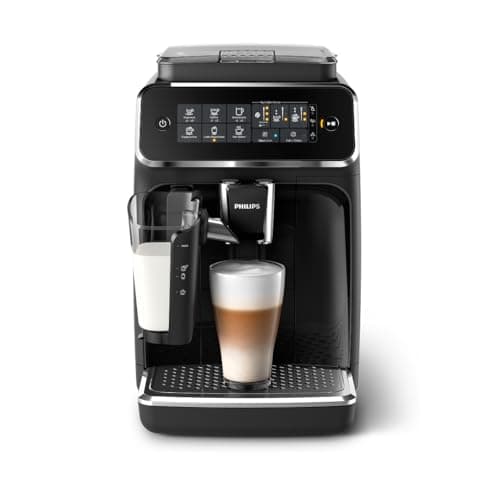
Best overall for an office: Philips 3200 Series LatteGo
The LatteGo milk system is the reason this is our pick, and it is a genuinely office-specific reason. It is tube-free and made of two partsthat come apart and rinse in seconds — no milk lines to clean, nothing to run a cycle through, nothing to forget. In a shared kitchen, the milk unit that gets cleaned is the one that takes ten seconds to clean.
The rest is a solid bean-to-cup: a ceramic burr grinder with 12 settings, one-touch espresso, coffee, cappuccino, latte macchiato and americano, a removable brew group you can rinse under a tap, an ~61 oz / 1.8 L water tank and AquaClean filter compatibility, which is the right answer for an office on hard water.
| Type | Bean-to-cup super-automatic |
|---|---|
| Grinder | Ceramic burr (12 grind settings) |
| Milk | LatteGo automatic (tube-free, 2-part) |
| Drinks | One-touch espresso, coffee, cappuccino, latte macchiato, americano |
| Brew group | Removable (rinse under the tap) |
| Filter | AquaClean compatible |
| Water tank | ~61 oz / 1.8 L |
The honest cons.Ceramic burrs and 12 settings are a modest grinder, so enthusiasts will find the espresso unremarkable next to a portafilter machine. The 1.8 L tank still needs refilling more than once on a busy day in a larger office. And the drinks menu is fixed — nobody is making a ristretto to order.
Best value for a small team: De'Longhi Magnifica Evo
For five to ten people who mostly drink black coffee, this is the least money that buys freshly ground bean-to-cup. Steel conical burrs with 13 grind settings, one-touch espresso, coffee, long and doppio+, a removable brew group, and a 15 bar pump.
| Type | Bean-to-cup super-automatic |
|---|---|
| Grinder | Steel conical burr (13 grind settings) |
| Milk | Manual frother wand (adjustable) |
| Drinks | One-touch espresso, coffee, long, doppio+ |
| Brew group | Removable |
| Pump pressure | 15 bar |
The honest cons, and they are office-shaped. The milk is a manual frother wand, which means somebody has to operate it and somebody has to wipe it — exactly the step a shared machine handles worst. If your office drinks cappuccinos, this is the wrong machine and the Philips or the Gaggia is the right one. If your office drinks black coffee and the occasional splash of milk, it is the best value here by a distance.
Our full De'Longhi Magnifica Evo review has the detail, including the trim-level trap: the same machine name ships with either a manual frother or the automatic LatteCrema carafe depending on the model number, so check which one you are ordering.
Best for milk drinks at volume: Gaggia Magenta Prestige
If most of the office drinks cappuccinos and lattes, the milk architecture should decide the purchase, and the Magenta Prestige has the most office-friendly arrangement: a one-touch integrated milk carafe that lifts out as a unit, so it can go straight in the fridge between the morning rush and the afternoon one rather than sitting warm on a counter.
| Type | Bean-to-cup super-automatic |
|---|---|
| Grinder | Ceramic burr (adjustable) |
| Milk | One-touch integrated milk carafe |
| Display | Color TFT |
| Brew group | Removable |
| Pump pressure | 15 bar |
| Over ice | Dedicated lower-temperature iced-coffee program |
The colour TFT display is worth more in an office than at home, because it labels the drinks in words rather than symbols, and the dedicated iced-coffee program quietly solves a summer argument.
The honest cons. A carafe is a bigger object to clean than the Philips two-part unit, and it does still need regular attention. It costs meaningfully more than the Philips for a broadly similar standard of coffee. And Gaggia does not publish a grind-setting count for this model, so we will not quote one.
Best for a larger office: Jura E8
The E8 is the machine to buy when the problem is volume rather than budget. Jura builds its machines around commercial-adjacent service assumptions, and two specifics matter here: the P.E.P. Pulse Extraction Process, which pulses water through the puck to get a more complete extraction on short drinks, and CLARIS Smart filter compatibility, which is how you stop an office machine scaling up when nobody is descaling it.
| Type | Bean-to-cup super-automatic |
|---|---|
| Grinder | P.A.G.2 burr (adjustable) |
| Extraction | P.E.P. Pulse Extraction Process |
| Milk | Automatic Fine Foam Frother G3 |
| Display | 3.5-inch color display + six buttons |
| Filter | CLARIS Smart compatible |
| Water tank | ~64 oz / 1.9 L |
The six physical buttons next to the display are, genuinely, an office feature: people who will never learn a menu will press a labelled button.
The honest cons. It costs several times what the Philips does, and the coffee is better but not several times better. Its milk system uses tubes rather than a lift-out carafe, so the cleaning burden is higher than the Philips even though the machine is more capable. And Jura parts and service run through a dealer network rather than a high-street repair shop.
Lowest commitment: Nespresso VertuoPlus
There is an honest case for skipping bean-to-cup entirely. A pod machine has no grinder to wear, no brew group to clean and no milk lines at all, which removes every maintenance job an office is bad at. The VertuoPlus pours five cup sizes from espresso to a 14 oz Alto at one button, ejects capsules automatically into an internal bin, and has a rotating tank that helps in a cramped kitchen. Our Amazon link is the Deluxe bundled with an Aeroccino frother.
The honest cons, and they are the whole argument.Every cup costs a capsule, forever, and Vertuo is a closed system — the pods must come from Nespresso, so there is no shopping around. Somebody empties the capsule bin. And the coffee is consistent rather than good. Our Nespresso Original vs Vertuo comparison matters here: for an office that mostly drinks espresso, the Original line accepts third-party capsules and costs meaningfully less to run.
Beans or pods, for a team
This is the decision that costs or saves the most money over the life of the machine, and it is worth doing the arithmetic rather than the vibe.
| Bean-to-cup | Pods | |
|---|---|---|
| Up front | Higher | Much lower |
| Per cup | Cost of beans only | Cost of a capsule, every cup |
| Grinder maintenance | Yes — burrs are a wear item | None |
| Milk cleaning | Yes, daily | Only if you add a frother |
| Waste per cup | A puck into an internal bin | A capsule into a bin |
| Who it suits | Regular, predictable daily volume | Occasional or unpredictable use |
The crossover is mostly about volume. A team drinking a handful of coffees a day will never recover a bean-to-cup machine's purchase price in capsule savings; a team drinking twenty a day will, and quickly. Work out your real daily count first, then multiply a capsule price by 250 working days and compare it against beans — the same exercise we run for home setups in the true cost of home espresso.
The rules that keep an office machine working
The machine is maybe half of it. These are the things that decide whether it is still working in two years.
- Name one owner.Not a rota — one person who checks water, beans and the drip tray. Shared responsibility for an appliance means no responsibility.
- Put the milk unit in the fridge, every time. This is the single rule that most improves an office machine, and it is why a lift-out carafe or a two-part LatteGo unit is worth paying for.
- Filter the water from day one.An office machine will not get descaled on schedule, so prevention has to be automatic. Use the manufacturer's own filter cartridge and set a calendar reminder to change it. Our descaling guide covers what happens when you do not.
- Buy beans in smaller bags, more often.A 5 lb sack in an open hopper goes stale long before it is finished. Medium roasts are the safest choice for a mixed audience — see our bean picks.
- Rinse the brew group weekly. Thirty seconds under a tap on the machines above with a removable group. It is the difference between a machine that lasts and one that tastes stale by spring.
How to choose
- Mixed drinks, 5-25 people, and nobody wants to be the barista. The Philips 3200 LatteGo. The two-part milk unit is the office-specific reason.
- Mostly black coffee, tight budget. The De'Longhi Magnifica Evo— accepting that its manual wand means milk drinks are somebody's job.
- Cappuccinos all day. The Gaggia Magenta Prestige, for the lift-out carafe and the labelled colour display.
- A larger office, hard water, real volume. The Jura E8.
- Occasional use, or nobody will maintain anything. The Nespresso VertuoPlus— and read the Original vs Vertuo comparison before you commit to a pod supply chain.
One thing we would not do: put a semi-automatic portafilter machine in a shared kitchen and hope. A beginner-friendly machinemakes far better coffee than anything on this page — in the hands of someone who learned it. In an office, that person leaves, and the machine becomes an ornament.
Frequently asked questions
What is the best espresso machine for an office?
For most offices of roughly 5 to 25 people, the Philips 3200 Series LatteGo. It is a one-touch bean-to-cup machine with a ceramic burr grinder and a removable brew group, and its LatteGo milk system is tube-free and made of two parts that rinse in seconds — which matters because milk cleaning is the maintenance job a shared kitchen neglects first. For a larger office on hard water, the Jura E8 with a CLARIS filter is the more capable choice.
Should an office buy a bean-to-cup machine or a pod machine?
It comes down to daily volume. A pod machine has no grinder, no brew group and no milk lines, so it removes every maintenance job an office handles badly — but every single cup costs a capsule, forever. A bean-to-cup machine costs more up front and far less per cup. Count your real daily drinks, multiply a capsule price by about 250 working days, and compare that against beans plus the machine.
Why not put a normal espresso machine in the office?
Because a portafilter machine needs somebody to grind, dose, tamp and texture milk, and in a shared setting those steps get skipped rather than learned. The result is bad coffee that gets blamed on the machine. Every recommendation here is bean-to-cup or pod for that reason: the machine has to work correctly for someone who has never been shown how.
How do you keep an office coffee machine hygienic?
Name one owner rather than a rota, put the milk unit in the fridge after every rush rather than leaving it warm on the counter, rinse the removable brew group weekly under a tap, and filter the water from day one so that scale never becomes a crisis. Machines with a lift-out milk carafe or a tube-free two-part unit survive shared use far better than ones with internal milk tubing.
How many people can a home super-automatic machine serve?
Roughly 5 to 25 people is the realistic band for the machines on this page, depending on how spiky your demand is. Above about forty drinks a day you are into commercial territory — a plumbed-in machine with a service contract — which is a different category of product entirely and not one we cover.
Does an office espresso machine need a water filter?
More than a home one does, because descaling is exactly the maintenance that never gets scheduled in a shared kitchen. Use the manufacturer's own cartridge — AquaClean on the Philips, CLARIS on the Jura — and set a calendar reminder to replace it. Do not switch to distilled or de-mineralised water to avoid scale; manufacturers including Breville specifically advise against it because it affects both taste and how the machine is designed to function.
Sources
- Philips — 3200 Series LatteGo specifications (ceramic burrs, 12 grind settings, LatteGo two-part milk system, AquaClean, tank capacity)
- De'Longhi — Magnifica Evo specifications (steel conical burrs, 13 grind settings, removable brew group, 15 bar)
- Gaggia — Magenta Prestige product page (integrated milk carafe, colour TFT display, removable brew group, iced-coffee program)
- Jura — E8 product page (P.A.G.2 burr, P.E.P. Pulse Extraction Process, Fine Foam Frother G3, CLARIS Smart, tank capacity)
- Nespresso — VertuoPlus Deluxe product page (Centrifusion, five cup sizes, auto capsule ejection, rotating tank)
- Breville — Barista Express (BES870) instruction book: water guidance for espresso machines
Keep reading
Buying your first setup?
See how we pick — compiled specs, cost-per-shot math, and honest trade-offs — then dig into the guides. No fake test lab, no rankings for hire.