Buying Guide
The Best Cold Brew Coffee Makers in 2026
Five makers for smooth, low-acid cold brew - ranked on filter quality, capacity, airtight storage and whether they pour ready-to-drink or concentrate. Plus the truth that the vessel barely matters.
Cold brew is the most forgiving coffee there is: coarse grounds steeped in cool water for 12 to 24 hours, then strained. No heat, no timing, no technique — time does the work, and the result is a smooth, naturally sweet, low-acid coffee you keep in the fridge. Which is why the honest starting point for this guide is a little awkward for a page about buying gear: the maker is really just a vessel and a filter. What separates a great cold brew maker from a mediocre one is not the brand on the carafe but how well its filter controls fines, how much it holds, how airtight it stays in the fridge, and whether it's built to pour a ready-to-drink cup or a concentrate you cut with water or milk.
Our overall pick is the OXO Good Grips Cold Brew Coffee Maker, because its Rainmaker top solves the one thing beginners get wrong — wetting the grounds evenly — and it strains through a genuinely fine stainless mesh. But you don't strictly need any of these. A French press makes very good cold brew (steep coarse grounds overnight, then press slowly), and a plain wide-mouth mason jar with a cloth or nut-milk bag works too. This guide is about which purpose-built maker earns its place, and why.
How cold brew works: grind, ratio, steep
Cold brew is immersion brewing without heat. You combine coarse grounds and cool (room- temperature or refrigerated) water, let them steep for 12 to 24 hours, then separate the grounds from the liquid. Because you never apply heat, far fewer of the acidic and bitter compounds that hot water pulls out end up in the cup — that's the source of cold brew's famously smooth, mellow character. The National Coffee Association notes the same trade-off in reverse: without heat to speed things along, extraction simply takes much longer, which is why the steep runs into hours rather than minutes.
Grind. Go coarse and even. Too fine and you get silt in the cup and a harsh, over-extracted batch; the classic muddy cold brew is almost always a grind problem, not a maker problem.
Ratio. Cold brew is measured by the weight of coffee to water. A common starting point for a ready-to-drink brew is roughly 1 part coffee to 8 parts water; for a concentrateyou dilute later, people go stronger, around 1 part coffee to 4 or 5 parts water. As a real-world reference, Hario's own instructions for the 1000ml Mizudashi call for about 80g of medium-coarse coffee to a full liter of water — then adjust to taste from there.
Steep.Twelve hours makes a lighter, brighter cup; push toward 18–24 hours for a rounder, stronger one. Steep in the fridge for the cleanest flavor. When it's done, strain once and — this matters — get the grounds out. Coffee left sitting on spent grounds keeps extracting and drifts bitter, which is exactly why an airtight maker that separates cleanly beats a jar-and-cloth setup for everyday use.
How we picked
We don't run a test lab, and we won't pretend to. Every maker here was evaluated against its published manufacturer specifications, the design details that decide clarity, capacity and storage, and verified owner feedback — our full approach is on the methodology page. For a cold brew maker specifically, we weighted four things:
- Filter quality (fines control).This is the whole game. A fine, well-made stainless mesh — or a double layer — catches the small particles that make cold brew gritty. A coarse or flimsy screen lets sediment through no matter how careful your grind.
- Capacity. Cold brew is a batch process you do every few days, so size is a lifestyle choice: a 1-liter pot for one drinker, a 2-quart pitcher or jar for a household.
- Airtight storage. Because the brew lives in the fridge for up to two weeks, a genuinely airtight, leak-proof lid keeps it fresh and lets you store the vessel on its side or in a door.
- Ready-to-drink vs concentrate.Some makers are built to brew a cup you pour straight; others are designed around a strong concentrate you dilute. Neither is better — they suit different routines, and we flag which each one is for.
At a glance
The field side by side. Tap any "view" button for the live Amazon price; the number shown at checkout is the one that applies.
| Cold brew maker | Capacity | Filter | Brews | Price |
|---|---|---|---|---|
| OXO Good Grips | 32 oz glass | Rainmaker + stainless mesh | Concentrate | $49.99Buy |
| Takeya Deluxe | 2 qt (64 oz) Tritan | Fine mesh | Concentrate | $34.99Buy |
| Hario Mizudashi | 1000ml glass | Reusable mesh basket | Ready-to-drink | $20.50Buy |
| County Line Kitchen | 64 oz glass jar | Stainless mesh | Either | $26.99Buy |
| OVALWARE Airtight | 1.5L glass | Laser-cut stainless | Concentrate | $46.99Buy |
Prices shown are from Amazon as of October 17, 2026 and change often — the button always goes to the current listing. Some links may earn us a commission at no extra cost to you.
Best overall: OXO Good Grips Cold Brew Coffee Maker (32 oz)
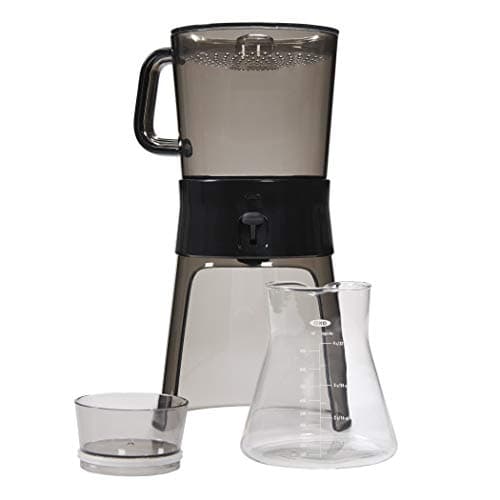
The OXO is the maker we point most people toward because it removes the two ways a beginner can go wrong. First, its perforated Rainmakerlid sits on top and distributes the water evenly over the whole bed of grounds, so you get balanced saturation instead of dry pockets and channels. Second, when the 12–24 hour steep is done, you set the brewer on its borosilicate glass carafe and flip a switch: gravity draws the concentrate down through an ultra-fine reusable stainless steel mesh, hands-free and mess-free. The result is a clean, consistent concentrate, and you can drop in a paper filter for an even clearer cup. It brews about 32 oz of concentrate, and the whole thing disassembles to store flat.
| Capacity | 32 oz concentrate (borosilicate glass carafe) |
|---|---|
| Filter | Ultra-fine reusable stainless mesh (+ optional paper) |
| Saturation | Perforated Rainmaker top for even wetting |
| Brews | Concentrate (dilute to taste) |
| Storage | Silicone-sealed stopper; disassembles flat |
What we like: the Rainmaker genuinely helps beginners get even extraction, the switch-and-drain is the tidiest strain of any maker here, and the fine mesh plus optional paper gives you a clean cup. The honest downsides: it has the most parts to rinse, it takes up real countertop space while brewing, and it makes concentrate rather than a pour-straight cup — a plus if you like control, a small extra step if you don't. For most people it's still the one to buy.
Best value: Takeya Deluxe Cold Brew Coffee Maker (2 qt)
The Takeya is the pick when you want durability and easy fridge living without spending much. The pitcher is BPA-free Tritan plastic— shatter-proof, stain- and odor-resistant — with a patented airtight, leak-proof lid, so once it's brewed you can lay the whole 2-quartpitcher on its side to fit a shelf or door without a drip. You load coarse grounds into the tall fine-mesh filter basket, fill with water, steep, then lift the basket out; the brew keeps up to two weeks sealed. It's top-rack dishwasher safe, and there's no glass to break, which makes it the natural choice for a busy kitchen or the office.
| Capacity | 2 quart / 64 oz |
|---|---|
| Material | BPA-free Tritan (shatter-proof) |
| Filter | Tall fine-mesh coffee filter basket |
| Lid | Patented airtight, leak-proof (stores on its side) |
| Care | Top-rack dishwasher safe |
What we like: the airtight lid is the best of the group for storage, the plastic body is effectively unbreakable and travels well, and it makes a big, days-worth batch for very little money. The downsides: the mesh isn't as fine as the OVALWARE's, so a careless grind shows up as more sediment; some buyers simply prefer glass to plastic on taste principle; and the 2-quart size, while it stores on its side, is a lot of pitcher if you only drink a cup a day.
Best budget: Hario Mizudashi Cold Brew Pot (1000ml)
Hario's Mizudashi is cold brew stripped to its essentials: a heatproof borosilicate glass pot, a polypropylene lid, and a tall reusable polyester mesh basketthat runs almost the full depth of the carafe. You spoon coarse grounds into the basket, pour water over, cap it and leave it in the fridge — no paper filter to buy, nothing to assemble. It brews a full liter (about 34 oz)of ready-to-drink cold brew, and because the basket lifts straight out, cleanup is a rinse. Hario recommends roughly 80g of coffee to the liter, steeped around 18 hours. It's made in Japan and costs about what you'd pay for a couple of bags of good beans.
| Capacity | 1000ml / ~34 oz (ready-to-drink) |
|---|---|
| Material | Heatproof borosilicate glass; polypropylene lid |
| Filter | Removable reusable polyester mesh basket |
| Brews | Ready-to-drink (no paper needed) |
| Origin | Made in Japan |
What we like: the simplest maker here, taste-neutral glass, a reusable basket with nothing to replace, and a fridge-door-friendly footprint at the lowest price. The downsides: the polyester mesh is coarser than a fine stainless filter, so grind matters more if you hate sediment; the glass can break; and at one liter it's sized for one person or a couple, not a crowd. As a first cold brew maker, it's hard to beat for the money.
Best large batch: County Line Kitchen Cold Brew Maker (64 oz)
If cold brew is a household staple, the County Line Kitchen is the workhorse. It's a heavy-duty wide-mouth glass mason jar holding a full 64 oz (2 quart / 1.9 L), fitted with a heavy-duty stainless steel mesh filterthat drops into the neck and a flip-cap, leak-proof lid for easy pouring. The wide mouth makes it simple to add grounds and to scrub clean, the built-in handle helps you move a heavy full jar, and the parts are dishwasher safe. It's essentially the mason-jar method done properly — which is fitting, because a plain wide-mouth jar is the classic DIY cold brew vessel, and this is that idea with a filter and lid that actually work.
| Capacity | 64 oz / 2 quart / 1.9 L |
|---|---|
| Material | Heavy-duty wide-mouth glass mason jar |
| Filter | Heavy-duty stainless steel mesh |
| Lid | Flip-cap, leak-proof; built-in handle |
| Care | Dishwasher-safe parts |
What we like: a big batch for a household, a genuinely easy-to-clean wide mouth, and a sturdy handle plus flip-cap that make daily pouring painless. It brews either strength — fill it for ready-to-drink or run it stronger for concentrate. The downsides: it's a large, heavy jar that eats a fridge shelf; the metal mesh, while fine, passes a touch more sediment than the OVALWARE's laser-cut filter; and glass demands a bit of care. For volume, it's the value champion.
Best for concentrate: OVALWARE Airtight Cold Brew Maker (1.5L)
The OVALWARE is the choice when you want the cleanest possible concentrate. Its filter is an 18/8 rust-free, laser-cut medical-grade stainless steelcylinder — noticeably finer than a woven mesh — so it holds back the fines that make concentrate gritty, which matters more the stronger you brew. The extra-thick borosilicate glass carafe holds 1.5L (51 oz), seals with a BPA-free silicone airtight cap that keeps the concentrate fresh up to two weeks, and is shaped to sit neatly on a fridge shelf. A nice bonus: the same filter makes it an excellent loose-leaf tea infuser, hot or cold, so it does double duty.
| Capacity | 1.5L / 51 oz |
|---|---|
| Material | Extra-thick borosilicate glass |
| Filter | 18/8 laser-cut medical-grade stainless (very fine) |
| Lid | Airtight BPA-free silicone seal (up to 2 weeks fresh) |
| Bonus | Doubles as a loose-leaf tea infuser (hot or cold) |
What we like: the finest filter of the group for a grit-free concentrate, a properly airtight seal, generous capacity, and genuine versatility with tea. The downsides: it's a premium glass carafe that costs more and can break, the very fine filter benefits from a quick rinse right after brewing so it doesn't clog, and like the OXO it's built around concentrate you dilute rather than a pour-straight cup. For concentrate lovers, it's the best-built option here.
Ready-to-drink vs concentrate: which do you want?
This is the fork that decides how a maker fits your day, so it's worth settling before you buy.
Ready-to-drinkmeans you brew at a drinking strength (around 1:8 coffee to water) and pour it straight over ice or into a mug. It's the simplest routine — no math at the counter — and it's what the Hario Mizudashi is built around. The catch is storage: a full-strength brew takes up as much fridge space as you drink, and it doesn't keep quite as long as a strong concentrate.
Concentratemeans you brew much stronger (around 1:4 to 1:5), then cut each serving with water, milk, or ice to taste. It stores compactly, lasts up to two weeks sealed, and flexes from a light iced coffee to a punchy base for a cold-brew latte. The OXO, OVALWARE and Takeya are all concentrate-first; the County Line jar happily does either. The trade-off is one extra step — and a moment of dialing in your dilution — every time you pour.
How to choose a cold brew maker
A few questions settle it.
How much do you hate sediment?Filter fineness is the single biggest quality difference. The OVALWARE's laser-cut stainless and the OXO's fine mesh (with optional paper) give the cleanest cups; a standard woven mesh (Hario, Takeya, County Line) is perfectly good but leans harder on you grinding coarse and even. Whatever you pick, a burr grinder does more for clarity than the maker does — start with the grind size chart and a quality grinder like our pour over grinder picks run coarse.
How much do you brew? One drinker is well served by the 1-liter Hario or 32 oz OXO; a household that goes through cold brew fast wants the 64 oz County Line or 1.5L OVALWARE; the 2-quart Takeya splits the difference and stores flat.
Glass or plastic?Glass (OXO, Hario, County Line, OVALWARE) is taste-neutral and easy to clean but can break. Shatter-proof Tritan (Takeya) survives drops and travel, at the cost of some people's preference for glass.
Do you even need a dedicated maker? Honestly, no — a French pressmakes excellent cold brew (steep coarse grounds overnight, press slowly in the morning), and a wide-mouth mason jar with a cloth bag works in a pinch. A purpose-built maker earns its keep with a better filter, airtight storage and a cleaner strain — not with any magic in the brew itself. If you're still mapping out your setup, our pour over guide and coffee vs espresso primer cover where cold brew fits alongside your other methods.
The bottom line
For most people the OXO Good Grips Cold Brew Coffee Makeris the smartest buy — the Rainmaker gets your extraction even, the switch-and-drain strains clean, and the fine mesh (plus optional paper) makes a genuinely clear concentrate. Want durable, airtight value for a household? The Takeya Deluxe. Trying cold brew for the first time on a budget? The Hario Mizudashi is the elegant minimum. Brewing for a crowd? The 64 oz County Line Kitchenjar. Chasing the cleanest, strongest concentrate — and a tea infuser on the side? The OVALWARE Airtight. But remember the rule that outranks every one of them: the maker is just a vessel, so put your effort into a coarse, even grind and a long, cold steep — that's what makes cold brew taste like cold brew.
The brewer is only half of it. Our best coffee beans for cold brew guide covers the roasts a long cold steep rewards, and cold brew vs iced coffee is worth reading first if you are not certain this is the method you want.
Frequently asked questions
What is the best cold brew coffee maker?
For most people, the OXO Good Grips Cold Brew Coffee Maker. Its perforated Rainmaker top wets the grounds evenly for balanced extraction, and a switch drains the finished concentrate through an ultra-fine stainless mesh (with an optional paper filter) for a clean cup. If you want the finest filter for a grit-free concentrate, the OVALWARE Airtight uses a laser-cut medical-grade stainless filter; for durable, airtight value, the Takeya Deluxe is a shatter-proof 2-quart pitcher.
Does the cold brew maker really matter, or can I use a French press or mason jar?
The vessel matters far less than the grind and the steep. A French press makes very good cold brew - steep coarse grounds in cool water overnight, then press slowly - and a wide-mouth mason jar with a cloth or nut-milk bag works too. A purpose-built maker earns its price with a finer filter (less sediment), airtight fridge storage, and a cleaner, easier strain, not with any difference in the brew chemistry itself.
What grind size should I use for cold brew?
Coarse and even - coarser than French press, roughly the texture of raw sugar or coarse sea salt. Because the water steeps for 12 to 24 hours, fine particles over-extract into bitterness and slip through the filter as sediment. A burr grinder that produces uniform coarse grounds is the single biggest upgrade you can make to a cold brew cup. See our grind size chart for a visual reference.
What's the difference between cold brew concentrate and ready-to-drink?
Concentrate is brewed strong (around 1 part coffee to 4-5 parts water) and diluted with water, milk, or ice at serving time; it stores compactly, lasts up to two weeks sealed, and makes a great base for cold-brew lattes. Ready-to-drink is brewed at drinking strength (around 1:8) and poured straight. Makers like the OXO, OVALWARE and Takeya are concentrate-first; the Hario Mizudashi brews ready-to-drink; the County Line jar does either.
How long does cold brew take, and how long does it keep?
Steep 12 to 24 hours - about 12 for a lighter, brighter cup and up to 18-24 for a stronger, rounder one - ideally in the fridge. Once you strain out the grounds, cold brew keeps well refrigerated for up to about two weeks, and a strong concentrate in an airtight maker holds the longest. Always remove the grounds after steeping; coffee left sitting on spent grounds keeps extracting and turns bitter.
Sources
- OXO - Good Grips Cold Brew Coffee Maker product page
- Takeya USA - Cold Brew Coffee Maker specifications
- Hario USA - Mizudashi Cold Brew Coffee Pot (1000ml)
- County Line Kitchen - 64 oz Cold Brew Mason Jar Maker (Amazon listing)
- OVALWARE - RJ3 Airtight Cold Brew Maker (1.5L)
- National Coffee Association - How to brew cold brew coffee
Keep reading
Buying your first setup?
See how we pick — compiled specs, cost-per-shot math, and honest trade-offs — then dig into the guides. No fake test lab, no rankings for hire.