Buying Guide
Moka Pot Sizes Explained: Which Cup Size Should You Buy?
The most misunderstood thing about buying a moka pot: a 'cup' is a small Italian espresso serving, not a mug. Here's what each size really pours, and how to pick yours in a minute.
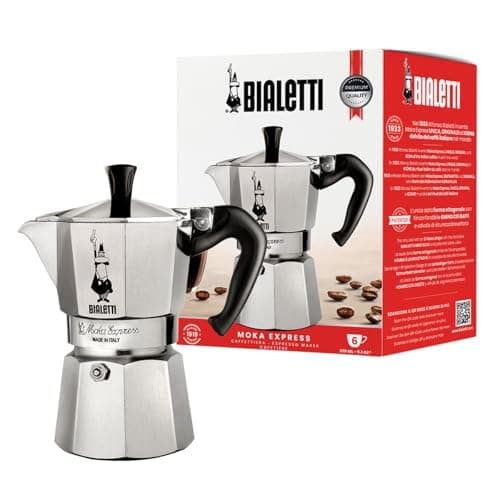
Almost everyone buys their first moka pot in the wrong size, and it isn't their fault. The number on the box — 3 cup, 6 cup, 9 cup — does not mean what an American kitchen assumes it means. A moka pot "cup" is a small Italian espresso serving, not an 8 oz mug, which is why so many proud new 6-cup owners end up staring at a pot that filled two mugs and stopped.
This page fixes that with one table. Below is Bialetti's own published brewed volume for every size in the Moka Express range, what each one means in mugs, and a straight recommendation for one person, two people and a household. If you already own a pot and just want to identify it, skip to what size is the pot I own.
The 'cup' problem, in one sentence
Bialetti is explicit about this. On its own product listings the company notes that "the cup size refers to an espresso cup which is approximately 30 mls" — roughly one ounce. So a "6-cup" moka pot is not promising six mugs of coffee; it is promising six small, concentrated Italian-style servings, which together come to about a mug and a half of very strong coffee. That is the whole misunderstanding, and once you see it the sizing stops being confusing.
There is one honest wrinkle worth knowing, because it explains why different websites quote different numbers. Bialetti's nominal "cup" is about 30 ml, but the brand's own brewed volumefigures work out closer to 45–65 ml per cup depending on the size — the 1-cup pot is listed at 60 ml, not 30. The nominal figure describes the traditional serving; the brewed-volume figure describes what actually comes out of the spout. Use the brewed volumes below, because that is the number that ends up in your kitchen.
Moka pot size chart: what each size actually pours
These are Bialetti's published approximate brewed-coffee volumes for the Moka Express range, with the mug conversion done for you. A standard American mug is about 240 ml / 8 oz, but moka coffee is concentrated — most people drink it in smaller servings, or lengthen it with hot water or milk.
| Size | Brewed volume | In mugs | Realistically serves |
|---|---|---|---|
| 1 cup | 60 ml / ~2 oz | A quarter mug | One small, very strong serving |
| 2 cup | 90 ml / ~3 oz | A third of a mug | One espresso-style serving |
| 3 cup | 130 ml / ~4.4 oz | Just over half a mug | One person |
| 4 cup | 185 ml / ~6.3 oz | Three-quarters of a mug | One generous mug |
| 6 cup | 250 ml / ~8.5 oz | One full mug | Two people |
| 9 cup | 410 ml / ~13.9 oz | Under two mugs | Three to four small servings |
| 12 cup | 595 ml / ~20 oz | Two and a half mugs | A household or guests |
Which size should you buy?
Here is the short version, and for most people it is the only paragraph on this page they need. Buy the size that matches the number of drinkers, not the number of cups you imagine.One person: 3-cup. Two people: 6-cup. Three or more, or you have people over: 9-cup. The trap is buying big "to have the option," which backfires for a reason we cover in why you must brew it full— a moka pot cannot be half-filled without hurting the coffee.
If you are genuinely torn between two sizes, size down. Brewing a small pot twice is mildly annoying; brewing a big pot half empty makes bad coffee every single time. And if you are still deciding whether a moka pot is the right brewer at all, our best moka pot roundup compares the Moka Express against the Brikka, the Venus and the stainless alternatives, and moka pot vs espresso machine settles the "is it real espresso" question.
For one person: the 3-cup
The 3-cup pours about 130 ml— a little over half a standard mug of intensely concentrated coffee. That is exactly right for one person, because moka coffee is not meant to be drunk by the mugful. Drink it as two small servings, or pour the whole thing into a mug and lengthen it with hot water for something closer to an Americano. It heats fast, uses less coffee, and is the size most solo drinkers should own.
People reach for the 6-cup instead because "three cups" sounds tiny. It isn't. The 6-cup makes twice this much, which for one person means drinking too much coffee or pouring half away — and you cannot brew a 6-cup half full to split the difference.
For two people: the 6-cup
The 6-cup is the default Moka Express for a reason. At roughly 250 ml it fills one full mug of concentrate, which splits neatly into two servings, or stretches to two mugs once you have added milk or water. It is the size you picture when you picture a moka pot, it is the easiest to find gaskets and filters for, and it is the one we point most two-person households toward.
It is also the size to buy if you are hesitating between solo and shared use — on the condition that you will genuinely brew it full most mornings. If you mostly brew for yourself and only occasionally for two, a 3-cup plus a second brew is the better setup.
For a household or guests: the 9-cup
The 9-cup steps up to about 410 ml— call it three to four small servings, or two mugs of properly strong coffee. This is the size for a household of three, for a weekend when people are over, or for anyone who drinks moka coffee long with hot water and gets through a lot of it.
Two honest warnings. It takes noticeably longer to come up to temperature, and it needs a burner it can sit on without wobbling. More importantly, it still needs to be brewed full to taste right, so do not buy it as an "occasionally big" pot for a one-person kitchen. If you want capacity andflexibility, two pots is the honest answer — a 3-cup for weekdays and a 9-cup for company.
On Amazon, the 9-cup is currently sold only by a reseller, as a bundle with a small wooden stirring spoon. The pot in the box is the standard Bialetti Moka Express 9-cup.
Prices shown are from Amazon as of October 17, 2026 and change often — the button always goes to the current listing. Some links may earn us a commission at no extra cost to you.
Why you can't just half-fill a bigger pot
This is the fact that turns moka pot sizing into a real decision rather than a preference, and it is the best argument for buying small. A moka pot only works full. Both chambers are designed around a fixed volume: you fill the boiler to just below the safety valve, you fill the funnel basket level with grounds, and the resulting steam pressure pushes water up through a properly packed bed of coffee.
Underfill the boiler and you change the pressure the pot was engineered around. Underfill the basket and water channels through a loose, shallow puck instead of extracting evenly — the classic thin, sour, metallic moka cup. You cannot dose a 9-cup like a 3-cup and get 3-cup coffee out of it; you get bad 9-cup coffee. Buy the size you will fill.
What size is the moka pot I already own?
If you inherited a pot or lost the box, there are two reliable ways to identify it. The quickest: look underneath. Most Bialetti pots have the cup size stamped or embossed on the base, usually alongside the model name.
If the base is worn smooth, measure the water. Fill the bottom chamber to just below the safety valve, then pour that water into a measuring jug. Roughly 100 ml means a 3-cup, roughly 200 ml a 6-cup, and roughly 350–400 ml a 9-cup. You always start with more water than you finish with coffee, because the grounds retain some and some stays behind as steam — which is why the boiler figure runs ahead of the brewed volumes in the chart above.
Knowing the size matters for more than pride, because it sets your dose. Fill the basket level with medium-fine grounds and do not tamp; that works out to roughly 7 g per cup size, so around 21 g for a 3-cup and 42 g for a 6-cup. If you want to be precise about it, our coffee-to-water ratio guide covers how to weigh a brew properly, and a basic coffee scale makes it repeatable.
Frequently asked questions
How many cups does a 6-cup moka pot actually make?
About 250 ml (roughly 8.5 oz) of finished coffee — one full American mug of concentrate, not six mugs. A moka pot 'cup' is a small Italian espresso-style serving, and Bialetti notes that the cup size refers to an espresso cup of approximately 30 ml. In practice a 6-cup pot serves two people comfortably.
What size moka pot should I get for one person?
The 3-cup. It pours roughly 130 ml, a bit over half a mug of concentrated coffee — right for one person, either as two small servings or as one mug lengthened with hot water. The common mistake is buying the 6-cup because 'three cups' sounds small; it makes twice as much, and a moka pot has to be brewed full to taste right.
Can I brew less coffee in a bigger moka pot?
No, and this is the main reason to buy the right size. A moka pot is engineered around a full boiler and a level, untamped basket. Underfilling the boiler changes the pressure the pot was designed around, and underfilling the basket lets water channel through a shallow puck instead of extracting evenly — the result is thin, sour coffee. Buy the size you will actually fill.
What size moka pot do I have?
Check the underside first — most Bialetti pots have the cup size stamped on the base. If it has worn away, fill the boiler to just below the safety valve and pour that water into a measuring jug: roughly 100 ml means a 3-cup, roughly 200 ml a 6-cup, and roughly 350-400 ml a 9-cup. You always start with more water than you finish with coffee.
Which Bialetti size is best?
The 6-cup is the best all-rounder and the most widely stocked, which also makes gaskets and filters easiest to find. But 'best' really means 'matches your household': 3-cup for one person, 6-cup for two, 9-cup for three or more. If you're torn between two sizes, size down — brewing a small pot twice beats brewing a big pot half empty.
How much coffee do I put in a moka pot?
Fill the funnel basket level with medium-fine grounds and don't tamp it. That works out to roughly 7 g per cup size — about 21 g for a 3-cup and 42 g for a 6-cup. The basket is the dose: if it's level and the boiler is filled to just under the safety valve, you have the right ratio without weighing anything.
Sources
Keep reading
Buying your first setup?
See how we pick — compiled specs, cost-per-shot math, and honest trade-offs — then dig into the guides. No fake test lab, no rankings for hire.