Buying Guide
The Best Coffee Canister in 2026
Most "airtight" canisters do exactly one thing: they trap air in with your beans. The ones worth buying remove it. Five picks sorted by mechanism - plunger, manual vacuum, electric vacuum and plain airtight - with the capacity and cleaning catches nobody puts on the box.
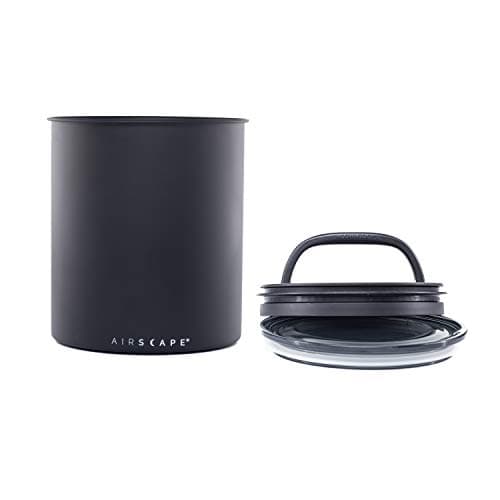
For most people the answer is an Airscape, and the reason is mechanical rather than aesthetic: its patented inner lid pushes air out of the canister, while an ordinary airtight jar seals air in alongside the coffee. If you want the air actively drawn down rather than displaced, the Fellow Atmosputs a vacuum pump in the lid — with one restriction Fellow publishes and most buyers miss. And if the budget is firm, the Coffee Gator and the Coffeevac both do the basics in an opaque body for a fraction of the price.
This page exists because coffee storage is the one piece of gear where the marketing word and the useful feature have come apart. Almost everything on the shelf says “airtight.” Very little of it says what happens to the oxygen already in the jar when you close the lid, which is the only question that matters. Our how to store coffee beans guide covers the storage rules themselves; this page ranks the hardware.
What actually stales coffee
The National Coffee Association names four enemies, in order: air, moisture, heat and light. A canister can only address two of them directly — air and light — which is why its material and its lid mechanism are the whole specification. Heat and moisture are about where you put it, which means a cool, dark cupboard rather than the shelf above the espresso machine.
Two details from the NCA's guidance shape every pick below. First, coffee is hygroscopic: it pulls in moisture, odors and tastes from the air around it, so a seal that keeps the kitchen out is doing real work. Second, the NCA recommends opaque containers and explicitly treats attractive glass jars of beans as decor. That single line disqualifies a large share of what gets sold as a coffee canister.
For scale, the NCA's own published freshness windows for opened coffee transferred into an airtight container are roughly 1–3 weeks for whole beans at room temperature and 1–2 weeks for ground. A good canister works at the top of those ranges rather than extending them indefinitely. Nothing here makes a three-week-old bag taste new.
The three mechanisms, and what each actually does
1. Plain airtight.A gasketed lid that stops air exchange. It keeps kitchen humidity and odors out, and it keeps whatever air was in the jar when you closed it sitting against your beans. As the coffee level drops, the volume of trapped air rises — which is why a half-empty airtight jar is worse than a full one. Useful, cheap, and the floor rather than the ceiling.
2. Air displacement (the plunger).Planetary Design's Airscape uses a patented inner lid that you push down onto the coffee; air escapes through a valve as the lid travels, and the company's own description is explicit that this is the difference from “traditional airtight containers that trap air inside.” The headroom shrinks as the coffee does, which solves the half-empty-jar problem by design.
3. Vacuum.Fellow's Atmos builds a pump into the lid; you twist it (or press a button on the electric version) and it draws the air down, with an indicator that shows the vacuum is holding. Fellow publishes the trade-offs plainly: twist the lid every 4–5 days to maintain the seal, and the lid is not dishwasher safe because of the integrated pump.
A fourth thing you will see is a one-way CO2 valve, as on the Coffee Gator and on most retail bags. That is a degassing feature, not a de-oxygenating one: fresh roasted coffee releases carbon dioxide for days after roasting, and the valve lets it out without letting air in. Good to have, frequently confused with a vacuum. It is not one.
How we ranked these
We have not run a staling trial in a lab, and we do not publish invented test results. These picks are ranked on published mechanism and published specification, with every listing verified live and purchasable immediately before publication — the method described on our methodology page. Six criteria, in this order:
What it does to the air. Removal beats displacement beats trapping. This is the ranking axis.
Opacity. The NCA recommends opaque. Every pick here is opaque, which ruled out a large number of cheaper glass canisters that are otherwise fine objects.
Capacity against the bag you actually buy. A canister that holds 11 oz is the wrong canister for a 12 oz bag. This catches more buyers than any other spec, and we give the published figure for every pick.
Whether it can take ground coffee.Not all of them can, and the restriction is the manufacturer's, not ours.
Cleaning. Coffee oils build up. A lid that cannot go in the dishwasher is a lid you have to remember to wash by hand.
Repairability. Gaskets and plungers are the parts that fail. A manufacturer that sells replacements turns a canister into a decade-long purchase.
At a glance
| Canister | Mechanism | Published capacity | Grounds? | Price |
|---|---|---|---|---|
| Airscape (2.2 lb) | Patented plunger lid forces air out | Up to 2.5 lb whole coffee (maker); listed as 2.2 lb | Yes | $47.49Buy |
| Fellow Atmos 0.7 L | Twist-to-lock vacuum pump in the lid | 0.7 L / 11 oz beans | No - maker advises whole bean only | $34.95Buy |
| Fellow Atmos Electric 0.7 L | Push-button auto-seal vacuum | 0.7 L | No - same restriction | $69.95Buy |
| Coffee Gator 16 oz | Airtight steel + one-way CO2 valve | 16 oz | Yes | $21.99Buy |
| Coffeevac 1 lb | Patented airtight seal, opaque body | 1 lb | Yes - listed for grounds and beans | $18.00Buy |
Prices shown are from Amazon as of October 10, 2026 and change often — the button always goes to the current listing. Some links may earn us a commission at no extra cost to you.
Best overall: Airscape
The Airscape is the pick because of one design decision. Planetary Design's patented inner lid is a plunger with a valve in it: you set it on top of the coffee and push, and the air in the headspace is forced out through the valve rather than being sealed in with the beans. The company's own product copy draws the contrast directly with “traditional airtight containers that trap air inside,” and that is a fair description of what most of the market is.
The practical consequence is that an Airscape gets better as the coffee runs down, because you simply push the inner lid further. Every other mechanism here has to work harder against a growing volume of headspace.
The listing we link is the large one — Amazon calls it 2.2 lb, Planetary Design's own page for this size says it holds up to 2.5 pounds of whole coffee. It is built from galvanized steel with a food-safe matte painted finish, it stacks, it has a non-slip base, and it is opaque. Planetary Design also sells replacement plungers and lids, which is the quiet reason this is a long-term buy rather than a disposable one.
Honest cons.This size is big: if you buy 12 oz bags, you will have a mostly empty canister, which is the opposite of the point — buy a smaller Airscape instead. The two capacity figures (Amazon's 2.2 lb against the maker's 2.5 lb) do not agree, and we are quoting both rather than picking the prettier one. On this larger size the steel is galvanized with a painted interior rather than the bare stainless used on smaller models, which a customer review on Planetary Design's own site complains about directly. And the most common real-world grumble, also published on the maker's own reviews, is that coffee sticks to the underside of the plastic plunger and ends up on the counter — a minor mess every time, forever.
Best vacuum canister: Fellow Atmos 0.7 L
The Atmos is the one piece of coffee storage that genuinely removes air rather than displacing or trapping it. The pump lives in the lid; you twist, the air comes out, and a window on the lid shows you the vacuum is holding. Fellow markets the result as “Fresh 2x Longer” and describes the mechanism as creating a sealed vacuum space that slows oxidation. A release button breaks the seal when you want to get at the beans.
It is also, straightforwardly, the nicest of these to use. The twist is quick, the indicator removes the guesswork, and at 0.7 L it is the right size for a counter rather than a pantry.
Honest cons, all four of them from Fellow's own published guidance. It is not for ground coffee: Fellow recommends storing whole bean only, warning that ground coffee and other fine substances may clog the intake valve, prevent a proper seal, and may void the warranty. That is the single most important thing to know before buying one, and it is not on the front of the box. The vacuum decays: Fellow advises twisting the lid every 4–5 days to maintain the seal, so this is an active container, not a set-and-forget one. It is not dishwasher safe, because of the integrated pump. And the 0.7 L body holds 11 oz of beansby the listing's own figure, which means a standard 12 oz bag will not quite fit — size up to the 1.2 L if that is how you buy.
Best hands-off option: Fellow Atmos Electric
The electric Atmos exists for one specific failure mode: the twist you forget. Fellow's own instruction is to re-twist the manual version every 4–5 days, and a canister whose freshness claim depends on a chore is only as good as your memory. The electric version seals at the push of a button instead, which makes the maintained vacuum the default state rather than a habit.
Everything else is the Atmos as described above: the same lid-mounted pump principle, the same 0.7 L body, the same indicator. Fellow also lists the electric version as suitable for loose leaf tea, nuts and other dry goods, so it is not a single-purpose object.
Honest cons.It is the most expensive thing on this page by a clear margin, for a convenience rather than a capability — the vacuum itself is no stronger than the one you get by twisting. It inherits the whole-bean-only restriction and the hand-wash requirement. It needs power, which is one more thing to charge or replace on a kitchen counter. And it is still 0.7 L, so the 12 oz bag problem applies here too unless you choose the 1.2 L version.
Best budget pick: Coffee Gator 16 oz
The Coffee Gator is the sensible floor of this category and the pick for most people who are not going to spend Fellow money. It is opaque stainless steel, it seals, and Coffee Gator's listings for the range specify a one-way CO2 release valve, a date-tracker dial on the lid and a measuring scoop in the box. The 16 oz size is a genuine match for a 12 oz retail bag with room to spare, which is more than most of this page can say.
The date dial deserves a word, because it is the feature here most likely to change your coffee. Staling is a function of time since roast, and almost nobody remembers when they opened the bag. A dial you set once turns that from a guess into a fact, and it pairs with the freshness windows in our storage guide.
Honest cons.It is an airtight container, not an air-removing one — the CO2 valve vents the gas the beans give off but does nothing about the oxygen already inside, so a half-empty Coffee Gator is working against a jar of air. The scoop is a nice inclusion and not a substitute for a scale, since scoops measure volume and espresso is a weight. Build quality is good for the money rather than good in absolute terms. And there are several near-identical listings in different sizes and colors, so check the capacity on the listing you are buying rather than the photo.
Best under $20: Coffeevac 1 lb
The Coffeevac is what you buy when you want three canisters rather than one — one for espresso beans, one for filter, one for decaf — without spending more on storage than on coffee. Tightpac lists it as a patented airtight container with a 1 lb capacity, available with a black cap and black body, which is the configuration we link because it is the opaque one. Crucially, the listing specifies use for both ground coffee and whole beans, which is the gap the Atmos leaves open.
It is plastic, it is light, and it is the only pick here cheap enough to buy in multiples without thinking about it. For pre-ground coffee in particular — where the freshness clock runs at roughly half the speed of whole beans, by the NCA's figures — getting it out of a folded-over bag and into something sealed and opaque is the whole win.
Honest cons.It is marketed as a vacuum container, and we are not going to describe a mechanism the listing does not publish — treat it as a very good airtight seal and judge it on that. Plastic picks up coffee oils and, over years, smell; the clear-body variant of the same product fails the opacity test, so make sure you are buying the black one. It is the least pleasant of these to have on a counter. And at 1 lb it is a pantry object more than a display one.
The capacity question, which catches everyone
The standard American retail bag is 12 oz. Specialty roasters frequently sell 340 g (the same thing) or 250 g, and warehouse coffee comes in 2 lb and up. Match the canister to the bag, not to the photograph.
| If you buy... | Choose | Why |
|---|---|---|
| 12 oz bags from a roaster or supermarket | Coffee Gator 16 oz, or a smaller Airscape | A whole bag fits with a little headroom, and the canister is never mostly empty |
| 12 oz bags and you want a vacuum | Fellow Atmos 1.2 L, not the 0.7 L | The 0.7 L body is listed at 11 oz of beans - a 12 oz bag will not quite go in |
| 2 lb or larger bulk bags | Airscape 2.2 lb | Its plunger closes down as the level drops, so bulk storage does not mean a jar of air |
| Pre-ground coffee | Coffee Gator or Coffeevac | Fellow advises against ground coffee in an Atmos - it can clog the vacuum intake valve |
| Several different coffees at once | Coffeevac, two or three of them | Cheap enough to buy in multiples; separate canisters beat one big mixed one |
What we don't recommend
Clear glass jars.They look wonderful and they are the wrong material. The NCA recommends opaque containers and treats glass jars of beans as decor, because light compromises flavor. If you already own one and love it, keep it in a dark cupboard and the problem mostly goes away — but do not buy one for a sunlit counter.
The retail bag, long term.Roasters' bags are built for the journey from the roastery to your kitchen, not for the three weeks after you open them. Even with a resealable strip and a degassing valve, a rolled-down bag holds a surprising amount of air. Transfer it.
A canister in the freezer, opened daily.Freezing works on the NCA's own terms — a genuinely airtight container, and no more than about a week's worth removed at a time — and fails completely if you thaw and refreeze the whole supply every morning, because condensation forms on the coffee. The full guidance is in our storage guide.
A grinder hopper as storage.Tempting, and a slow leak of freshness: a hopper is neither airtight nor opaque, and beans left sitting in one stale while they pick up oils from the chamber. Dose what you need and keep the rest in the canister — which is also the reason single dose grinders exist, and why hoppers get a mention in how to clean a coffee grinder.
How to choose
Buy the Airscape if you want the best mechanism and will match the size to your bag. The plunger is the only design here that gets better as the coffee runs out, the body is opaque steel, and the parts are replaceable.
Buy the Fellow Atmosif you grind your own whole beans, keep the canister on the counter, and will actually re-twist it every few days. It is the only true vacuum here, and the only one with a published restriction serious enough to disqualify it for anyone who buys pre-ground — which, if you own an espresso machine, you should not be doing anyway. Our do I need a grinder for espresso guide explains why.
Buy the Electric Atmos only if you know yourself well enough to admit you will not do the twist.
Buy the Coffee Gator or the Coffeevacif you want the 90% answer for a small fraction of the money. Opaque, sealed, cheap, and in the Coffee Gator's case with a date dial that will do more for your coffee than the extra mechanism in a vacuum lid.
And whichever you buy, the ranking of things that actually change your cup goes: fresh beans, then a decent grinder, then a scale, then storage. A canister protects coffee that was good when you bought it. It cannot improve coffee that was not.
Frequently asked questions
What is the best coffee canister?
For most people, an Airscape. Its patented inner plunger lid forces air out of the canister as you push it down onto the coffee, where a conventional airtight jar simply seals the existing air in with your beans — and because the plunger travels further as the coffee level drops, it keeps working as the canister empties. If you specifically want air removed by a pump rather than displaced, the Fellow Atmos is the better mechanism, with the significant caveat that Fellow advises using it for whole beans only.
Do vacuum coffee canisters really work?
They do remove air, which is the main cause of staling, and Fellow markets the Atmos as keeping coffee fresh twice as long. Two practical limits are worth knowing, both published by Fellow: the vacuum needs re-establishing by twisting the lid every 4-5 days, and ground coffee can clog the intake valve, prevent a proper seal and may void the warranty. A vacuum canister is an active container, not a set-and-forget one.
Should a coffee canister be glass or stainless steel?
Opaque, which in practice means steel or an opaque plastic. The National Coffee Association recommends opaque containers because light compromises flavor, and it advises treating decorative glass jars of beans as decor rather than storage. A glass canister kept in a dark cupboard is a reasonable compromise; a glass canister on a sunlit counter is working against you.
Can you put ground coffee in a Fellow Atmos?
Fellow advises against it. Its own product guidance recommends storing only whole bean coffee in an Atmos, warning that ground coffee or other fine substances may clog the intake valve, prevent a proper vacuum seal, and may also void the warranty. If you buy pre-ground, use an airtight canister without a vacuum pump instead — the Coffee Gator and Coffeevac picks on this page are both listed for grounds.
How long does coffee stay fresh in an airtight canister?
The National Coffee Association's published figures for opened coffee transferred into an airtight container are about 1-3 weeks for whole beans at room temperature and 1-2 weeks for ground coffee, with 2 weeks refrigerated and 3-4 months frozen. A canister helps you reach the top of those windows rather than exceed them. Buying smaller bags more often does more for freshness than any container.
What size coffee canister do I need?
Match it to the bag you buy. The standard American retail bag is 12 oz, so a 16 oz canister holds one bag with a little headroom. Watch the published figures rather than the look of the thing: a 0.7 L Fellow Atmos is listed at 11 oz of beans, so a 12 oz bag will not quite fit and you want the 1.2 L. If you buy bulk, the 2.2 lb Airscape is the pick, because its plunger closes the headspace as the level drops.
Is a one-way valve the same as a vacuum?
No, and the two get confused constantly. A one-way CO2 valve lets the carbon dioxide that freshly roasted coffee gives off escape without letting air back in — that is degassing. A vacuum actively removes the air that is already inside. A canister with a valve and no pump, like the Coffee Gator, is an airtight container with a useful extra, not a vacuum canister.
Sources
- National Coffee Association - Storage and shelf life: air, moisture, heat and light as coffee's enemies, coffee as hygroscopic, the recommendation for opaque containers and the treatment of glass jars as decor, transfer out of retail packaging, freezing conditions, and the freshness table (beans 1-3 weeks at room temperature, 2 weeks refrigerated, 3-4 months frozen, ground coffee 1-2 weeks)
- Planetary Design - Airscape Classic product page: patented plunger lid that pushes out excess oxygen 'unlike traditional airtight containers that trap air inside', restaurant-grade stainless steel, BPA-free, stackable with non-slip base, replacement lids and plungers; plus the published customer reviews quoted for the plunger-residue and painted-interior cons
- Planetary Design - Airscape Kilo product page: patented inner lid that forces air out, galvanized steel with food-safe matte painted finish, storage capacity up to 2.5 pounds of whole coffee
- Fellow - Atmos Vacuum Canister product page: vacuum pump in the lid, 'Fresh 2x Longer', twist-to-lock with vacuum indicator and release button, twist the lid every 4-5 days to maintain the seal, not dishwasher safe, and the published recommendation to store whole bean coffee only because ground coffee may clog the intake valve and may void the warranty
- Amazon product listings for all five picks - published capacity, finish, included accessories, condition and availability verified via the Amazon Creators API immediately before publication; displayed prices come from the same API and carry an as-of timestamp
Keep reading
Buying your first setup?
See how we pick — compiled specs, cost-per-shot math, and honest trade-offs — then dig into the guides. No fake test lab, no rankings for hire.