Single Review
Philips 3200 Series LatteGo Review
The super-automatic that solved the one thing people actually abandon these machines over: cleaning the milk system. Philips' LatteGo is two plastic parts and no tubes, rinsed in about fifteen seconds. Around it sits a 12-step ceramic grinder, a 15 bar pump and a deliberately short five-drink menu - a narrow machine that is very good at being narrow.
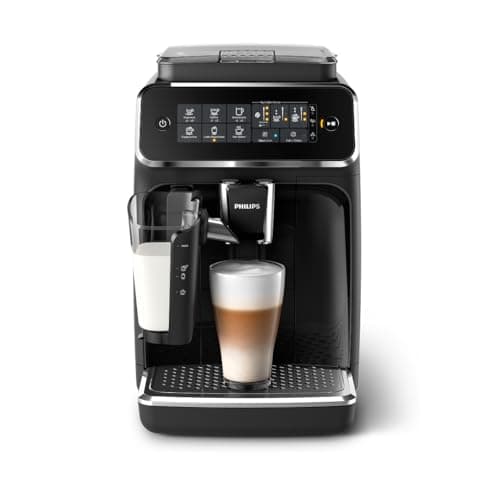
The super-automatic to buy if the reason you want one is that you do not want to clean one. The two-part, tube-free LatteGo carafe removes the single biggest daily chore in this category, and the ceramic grinder, removable brew group and AquaClean filtration mean the rest of the maintenance is unusually light too. The cost is a deliberately short five-drink menu and espresso that is consistent rather than excellent.
- Best for
- Households that want one-touch cappuccinos and lattes every morning with no technique, no puck prep and the least daily cleaning of any automatic milk system
- Price context
- Mid bracket for bean-to-cup super-automatics, below the carafe-and-touchscreen premium tier - check the live price, since listings across this family move a lot
Most super-automatic espresso machines are abandoned for one reason, and it is not shot quality. It is the milk system. A carafe with internal tubes and channels needs rinsing after every drink and a full strip-down regularly, and the machine that is too much hassle at 7am stops getting used. The Philips 3200 Series LatteGo is built around a fix for exactly that problem, and it is the reason we recommend it to more people than any other bean-to-cup machine.
The LatteGo carafe is two plastic parts with no tubes. Milk is drawn up, mixed with steam at high speed in a chamber formed where the two parts meet, and delivered to the cup; because there is no tubing, there is nothing for milk to dry inside. Philips rates the clean-down at roughly 15 seconds under a tap, and both the carafe and the drip tray are dishwasher safe. That single design decision is most of what you are paying for.
We do not run a lab and we have not pulled comparison shots on this machine. Every figure below comes from Philips or a verified retail listing, the listing we link was checked as live and purchasable immediately before publication, and where Philips publishes nothing we say so rather than estimating — the method described on our methodology page.
Who it's for
Buy this machine if you want cappuccinos and lattes at a button press, every morning, with no technique to learn and the least cleaning any automatic milk system asks of you. That is a specific and very common want, and the 3200 serves it better than machines costing considerably more.
Do not buy it if you want to make espresso rather than have it made. A super-automatic uses a fixed brew routine, an integrated grinder tuned for consistency over ultimate fineness, and a forgiving extraction, because all three are what make one-touch brewing reliable. You cannot adjust a dose, change a basket, or texture milk by hand. If any of that sounds like something you want to do, a semi-automatic plus a real grinder is the better path, and our semi-automatic vs super-automatic comparison takes that decision apart variable by variable, including what the semi-auto route really costs once the grinder is in the total.
LatteGo is the whole product
It is worth being precise about why a tube-free carafe matters so much, because on a spec sheet it reads like a minor convenience.
A conventional automatic milk system pulls milk through a narrow tube into a mixing chamber, usually with a one-way valve and a few internal bends on the way. Milk proteins and fats coat all of that, and warm residue in a dark tube is exactly the environment you would design if you wanted bacteria. So the manufacturer builds in a rinse cycle, you run it after every session, and every few weeks you take the assembly apart with a brush. Skipping it is how these machines start tasting of old milk.
LatteGo has no tube and no valve. The two parts snap together to form the mixing chamber, and they come apart into two smooth plastic pieces with nothing inside to reach into. You rinse them, or you put them in the dishwasher. Philips also sells the carafe with a storage lid so it goes straight into the fridge with the milk still in it, which removes the other daily chore — decanting.
The honest limit of the design is that it does one kind of foam. There is no milk temperature setting and no foam-texture control; what comes out is a dense, fairly stiff cappuccino-style foam. For a latte it is a little firmer than a barista would pour, and there is no steam wand to override it with. If you care about the difference between a latte and a flat white, this machine makes neither exactly — it makes its own drink, consistently.
The ceramic grinder, and what 12 steps means
The 3200 grinds with 100% ceramic burrs adjustable in 12 steps, and Philips publishes a life claim of at least 20,000 cups. Both figures deserve unpacking, because ceramic is a material we are usually cautious about.
Ceramic stays sharp far longer than steel and does not corrode, which is why it suits a machine that will grind unattended for years. Its weakness is brittleness: a stone in a bag of beans can chip ceramic where steel would shrug. In a hopper machine with no foreign-object path that risk is lower than in a hand grinder, and the 20,000-cup claim is the manufacturer putting a number against it. That is the context in which ceramic is the right call here, and it is the opposite of the advice we give for a standalone grinder in our coffee grinder buying guide.
Twelve steps is not many.A standalone espresso grinder in this price range would offer stepless adjustment or forty-plus numbered settings, because dialing in a shot means moving the grind in increments small enough to shift the extraction by a few seconds. Twelve steps spanning a super-automatic's whole working range cannot do that, and it is not meant to: the machine compensates with three aroma-strength settings and a published brew window of 90–98 C, adjusting dose and contact rather than particle size. The result is a cup that lands in the same place every time. It is also a ceiling you cannot raise.
One thing the grind adjustment is genuinely useful for: bean choice. A dark Italian espresso blend and a lighter specialty roast want different settings, and twelve steps is enough to move between the two. Our espresso bean guide covers which bags suit a machine like this, and the short answer is that medium-to-dark blends are the easy life here.
The five-drink menu
Philips sells this model on five one-touch beverages— espresso, coffee and cappuccino plus other milk recipes — with three strength settings and three temperature settings, and a touch panel with a “My Coffee Choice” menu for adjusting strength and volume per drink.
Five is the shortest menu in this bracket, and whether that matters is a genuine question rather than a rhetorical one. Count the drinks your household actually orders. If the honest answer is “a cappuccino, a latte and a long black,” the 3200 covers it and the longer menus on pricier machines are listing copy you will never use. If somebody in the house wants a flat white, a cortado and an iced drink by name, look at the step up — our best super-automatics roundup ranks the field by drink range among other things.
The adjustable 85–145 mm spout is the unglamorous spec that affects daily use more than the drink count. The low setting clears an espresso cup without a long fall through the air; the high setting takes a travel mug. Machines with a fixed spout force you to pick one.
Maintenance: the quiet win
Three specs here add up to the lowest-maintenance machine in its bracket, and they are the ones most buyers skip.
AquaClean filtration: no descaling for up to 5,000 cups.Scale is what kills espresso machines, and descaling one is the job everybody postpones — our descaling guideexists because of how often it gets left too long. Philips' claim is conditional and the condition matters: the filter must be replaced when the machine prompts you. Replace it on schedule and the descale cycle is years away; ignore the prompts and you are back to normal. Our water guide covers what is actually in your tap water and why it matters.
A fully removable brew group. This is the part that does the dosing, tamping and extracting, and on many machines it is sealed inside. On the 3200 it comes out and rinses under the tap. That is the difference between a machine you can maintain and one that needs a service visit when it gums up.
A 12-puck waste container with front access.Twelve drinks before it needs emptying, reachable from the front rather than by pulling the machine out from the wall. On a counter-depth machine — this one is about 17 inches deep per the retailer specification sheet — front access is not a small thing.
The honest limits
You cannot raise the ceiling. There is no basket to change, no dose to adjust in grams, no pre-infusion to extend. The extraction is what Philips set it to be. That is the deal with every super-automatic and it is the single reason to think twice.
One foam, no override.No milk temperature control, no texture control, no steam wand. If the automatic foam is wrong for your drink, there is no manual path to a different one — unlike a machine with a wand, where steaming milk by hand is always available.
The carafe is a wear part. LatteGo is plastic, it goes in the dishwasher, and it will eventually craze or lose its seal. Philips sells replacements; budget for one at some point rather than treating the machine as a sealed unit.
Two figures Philips does not publish for this variant: wattage and weight.The listing states 120 V / 60 Hz but no wattage, and no retailer sheet we checked gave a weight. We are not going to invent either. It means power draw and counter load cannot be compared against rivals on paper.
Which 3200 you are actually buying
This is the practical warning. “Philips 3200 Series LatteGo” is a family, not a model: EP3241 and EP3246 both carry the 3200 name, and each comes in regional suffixes (/50, /54, /74) that differ in finish, plug and sometimes drink count and milk system. The specifications above are for the EP3241 variant, and the listing we link is the one we verified as live and purchasable in the US.
Before you buy from anywhere else, check the model number against the drink count and the milk system in the description, not the series name on the front of the box. A 3200 with a classic-frother wand instead of LatteGo is a different machine with the same marketing name, and the whole argument for this one is the carafe.
Alternatives worth a look
| Machine | Milk | Grinder | Best when | Price |
|---|---|---|---|---|
| Philips 3200 LatteGo | Auto, tube-free 2-part | Ceramic, 12 steps | Easiest daily cleaning | $529.00Buy |
| De'Longhi Magnifica Evo | Manual frother wand | Steel conical, 13 settings | Simpler bean-to-cup, manual milk | $785.99Buy |
| Gaggia Magenta Prestige | Auto carafe | Ceramic burrs | Longer drink menu | $859.55Buy |
| Breville Bambino Plus | Automatic steam wand | None (buy separately) | You want to make the shot | $499.95Buy |
Prices shown are from Amazon as of November 7, 2026 and change often — the button always goes to the current listing. Some links may earn us a commission at no extra cost to you.
De'Longhi Magnifica Evo— the simpler bean-to-cup machine, with a steel conical grinder across 13 settings and a 15 bar pump, but a manual frother wand instead of an automatic carafe, so milk drinks are not one-touch. Check the live price on both before deciding: these two listings cross over regularly, and the Magnifica is not reliably the cheaper machine. Honest con: you are back to texturing milk yourself, which is most of what the 3200 exists to avoid. See the Magnifica Evo review.
Gaggia Magenta Prestige— a longer drink menu and a carafe milk system for people who want more named beverages. Honest con: a tube-and-carafe system is exactly the daily cleaning job LatteGo removes.
Breville Bambino Plus— the opposite philosophy, and worth considering if this review has made you doubt whether you want an automatic at all. It is a compact semi-automatic with an automatic steam wand and a three-second heat-up, and it has no grinder, so budget for one. Honest con: you now own two appliances and a learning curve. Our Bambino Plus review and espresso machine buying guide cover that fork in the road.
Verdict
The Philips 3200 LatteGo is a narrow machine that is very good at being narrow. It makes five drinks, it makes one kind of foam, and it makes both of those things reliably every morning with roughly fifteen seconds of cleaning and no descaling for thousands of cups. For a household whose honest order list is a cappuccino, a latte and a black coffee, that is the right set of compromises and the LatteGo carafe is a genuine engineering answer to the reason these machines get shoved to the back of the counter.
It is the wrong machine if you want to improve. There is no dose to change, no basket to swap, no wand to override the milk with — the ceiling is set and you cannot move it. If you read that sentence with any regret, buy a semi-automatic and a grinder instead, and start with the best espresso machines for beginners.
The 3200 is also our pick in the budget band — see best super-automatic espresso machines under $1,000 for how it compares with the two rivals under that line.
What we liked
- The LatteGo carafe is two parts with no tubes and no internal channels - Philips rates it at about a 15-second rinse, and it is dishwasher safe
- 100% ceramic burrs adjustable in 12 steps, with a published life claim of at least 20,000 cups
- AquaClean filtration means no descaling for up to 5,000 cups if the filter is changed when prompted
- The brew group is fully removable and rinses under the tap - a user-serviceable part, not a sealed assembly
- Published brew temperature window of 90-98 C, which is a figure most machines in this bracket do not state at all
- Adjustable spout from 85 to 145 mm, so it clears a tall travel mug as well as a demitasse
- Front-access waste container holding 12 pucks, so a day's drinks do not need emptying mid-morning
What gave us pause
- Five drinks is the shortest menu in the bracket - no flat white, no cortado, no programmable custom recipes beyond strength and volume
- No milk temperature or foam-texture control: the LatteGo makes one kind of foam, well, and that is all it makes
- Espresso quality is good-and-consistent, not exceptional - a fixed brew routine with a forgiving extraction is the price of one-touch
- The LatteGo carafe is plastic and lives in the fridge between uses; it is a wear part you will eventually replace
- Philips publishes no wattage or weight for this variant, so power draw and counter load cannot be compared on paper
- The 3200 sits in a family of near-identical variants (EP3241, EP3246 and regional suffixes) that differ in drink count and finish - it is easy to buy the wrong one
- No steam wand at all, so there is no manual override when the automatic foam is not what the drink needs
Frequently asked questions
Is the Philips 3200 LatteGo worth it?
It is, if the reason you want a super-automatic is that you do not want to maintain one. The tube-free two-part LatteGo carafe rinses in about 15 seconds and is dishwasher safe, the brew group comes out and rinses under the tap, and AquaClean filtration means no descaling for up to 5,000 cups provided you change the filter when prompted. That maintenance package is the best in its bracket. What you are not buying is a ceiling you can raise - the extraction is fixed and the drink menu is five items.
How many drinks does the Philips 3200 make?
Five one-touch beverages, including espresso, coffee and cappuccino plus other milk recipes, with three aroma-strength settings and three temperature settings, and a My Coffee Choice menu for adjusting strength and volume per drink. That is the shortest menu in its price bracket. Count what your household actually orders before deciding whether it matters - for most people it is three drinks, not ten.
How do you clean the LatteGo milk system?
You take it apart into two pieces and rinse them, or put them in the dishwasher. There are no tubes, no one-way valve and no internal channels, which is the entire point of the design - Philips rates the rinse at about 15 seconds. The carafe also takes a storage lid so you can put it in the fridge with milk still in it rather than decanting after every session.
Does the Philips 3200 need descaling?
Not for up to 5,000 cups, on one condition: the AquaClean water filter must be replaced when the machine prompts you. That is Philips' published claim and the condition is the important half of it. Replace the filter on schedule and a descale is years away; ignore the prompts and you are back to descaling on a normal interval like any other machine.
How many grind settings does the Philips 3200 have?
Twelve, on 100% ceramic burrs that Philips rates for at least 20,000 cups. Twelve steps is far fewer than a standalone espresso grinder offers, and that is deliberate: a super-automatic adjusts dose and contact time rather than particle size, using three strength settings and a 90-98 C brew window. The grind steps are genuinely useful for moving between a dark blend and a lighter roast, not for dialing a shot to the second.
Can you use a travel mug with the Philips 3200?
Yes. The coffee spout is adjustable from 85 to 145 mm, so it raises for a tall mug and drops close to an espresso cup. Very tall insulated bottles may still not clear it, so measure yours against 145 mm if that is the main way you drink coffee.
Philips 3200 vs De'Longhi Magnifica Evo - which should I buy?
Buy the Philips if you want one-touch milk drinks, because the Magnifica Evo uses a manual frother wand and so its lattes are not one-touch at all. Buy the Magnifica Evo if you mostly drink black coffee and want the cheapest sensible route into freshly ground bean-to-cup - it has a steel conical grinder with 13 settings and a 15 bar pump, and you simply will not use the carafe you did not pay for.
What is the difference between the EP3241 and EP3246?
They are both sold as the 3200 Series, and the differences sit in finish, regional suffix and in some cases drink count and milk system. The specifications in this review are for the EP3241 variant and the listing we link is the one we verified as live in the US. Before buying one elsewhere, check the model number against the drink count and the milk system in the description rather than trusting the series name - a 3200 with a classic frother wand instead of LatteGo is a materially different machine.
Does the Philips 3200 LatteGo make good espresso?
It makes consistent espresso rather than exceptional espresso, and the reason is structural. One-touch reliability requires a fixed brew routine, a grinder tuned for consistency over ultimate fineness and a forgiving extraction, so you get the same reasonable cup every time with no skill involved. A dialed-in semi-automatic with a serious grinder will beat it at its best - and will also be worse on the mornings you are in a hurry.
Sources
- Philips - 3200 Series LatteGo (EP3241/54) published specifications via authorized retailer specification page: 100% ceramic grinder adjustable in 12 steps rated at least 20,000 cups, LatteGo two-part tube-free milk system cleaned in about 15 seconds or in the dishwasher, 5 beverages, 3 aroma-strength and 3 temperature settings, 90-98 C Aroma Extract brewing temperature, 15 bar pump, 1.8 L water tank, 275 g bean container, 12-serving waste container with front access, no descaling for up to 5,000 cups with AquaClean, fully removable brew group, adjustable 85-145 mm spout, 9.6 x 17 x 14.6 in, 120 V / 60 Hz
- Philips - 3200 Series LatteGo fully automatic espresso machine listing verified live and purchasable before publication (brand, model and LatteGo milk system confirmed on the listing title)
- Philips - 3200 Series EP3241/54 official product page
- De'Longhi - Magnifica Evo specification as published on the verified Amazon listing (steel conical burr grinder with 13 settings, 15 bar pump, removable brew group, manual adjustable frother wand)
- Specialty Coffee Association - espresso extraction and brewing fundamentals
Keep reading
Buying your first setup?
See how we pick — compiled specs, cost-per-shot math, and honest trade-offs — then dig into the guides. No fake test lab, no rankings for hire.