Buying Guide
The Best Grinder for an AeroPress in 2026
The AeroPress is the one brewer that spans fine to coarse, so the grinder you want is the one with the widest usable range and the most steps inside it. Five picks, ranked on published range and adjustment resolution.
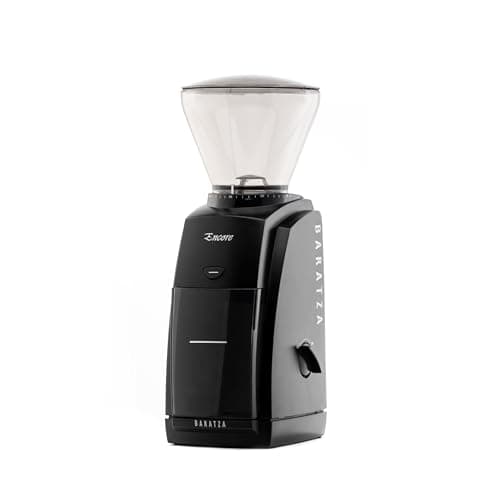
For most AeroPress drinkers the answer is the Baratza Encore, and it wins on range rather than on refinement. AeroPress recommends a medium-finegrind as the starting point — around setting 11–13 on an Encore, by AeroPress's own reference — but the brewer is unusual in that it works well anywhere from near-espresso fine on a short recipe to French press coarse on a long inverted steep. The Encore's published range of roughly 250 to 1200 microns across 40 stepped settings covers that entire span, so no AeroPress recipe you find online is out of reach. If you want finer control for a fraction of the money, the Timemore Chestnut C3 ESP moves 0.0233mm per click. If you want a buy-once hand grinder, take the Comandante C40 MK4.
This page is separate from our espresso grinder guidefor one reason: espresso grinders are geared for a narrow fine band and often run out of travel before they get coarse enough for a three-minute AeroPress steep. The AeroPress asks for the opposite — a wide range with enough steps inside it that you can walk a recipe in rather than jump over it.
What grind an AeroPress actually needs
Medium-fine to start, and then whatever your recipe asks for. AeroPress's own guidance is a medium-fine grind — finer than drip, well short of espresso — brewed at about 185°F / 85°C, and our how to use an AeroPress guide walks that method through step by step. Our grind size chart describes the AeroPress band as table salt for short brews moving toward sand for longer ones, which is a wider description than any other brewer on that chart gets.
That width is the whole buying problem. The AeroPress is a sealed chamber with a paper filter and hand pressure behind it, so it tolerates a grind that would choke a drip cone or blow straight through a French press. Short, fine recipes extract fast and taste intense; long, coarse inverted recipes taste cleaner and lighter. Both are legitimate, and a grinder that cannot reach both ends limits which recipes you can actually run.
Two specs follow from that. First, usable rangematters more than peak fineness — a grinder that only does espresso-fine is the wrong tool here. Second, consistency matters because the press amplifies it: a bed of dust and boulders resists the plunger unevenly, which is why a too-fine grind makes the plunger genuinely hard to push. If you are shoving on the plunger, the grind is too fine, not the brewer's fault.
How we ranked these
On published specifications and manufacturer documentation, not on lab tests we did not run — units we claim to have tested: zero. For an AeroPress that means three things, in this order:
- How much of the AeroPress range the grinder covers. Fine recipes and coarse inverted recipes are both real, so a grinder that reaches only one end is only half useful.
- Adjustment resolution. Microns or millimetres per step, where the maker publishes it. The AeroPress rewards small corrections because the brew time is short enough that a big jump overshoots.
- Burr type, build and serviceability.Conical or flat, steel, and whether burrs and parts can be replaced — a grinder you can re-burr is a cheaper decade.
We do not rank on brand reputation or on a star rating we invented. Where a manufacturer publishes a figure and a retailer publishes a different one, we say so rather than picking the flattering number.
At a glance
| Grinder | Type | Burrs | Adjustment | Price |
|---|---|---|---|---|
| Baratza Encore | Electric, hopper | 40mm conical | 40 stepped, ~250-1200 microns | $149.95Buy |
| Timemore Chestnut C3 ESP | Hand | 38mm conical | 30 clicks/turn, 0.0233mm per click | $99.00Buy |
| Comandante C40 MK4 | Hand | 39mm conical Nitro Blade | ~40 clicks per turn | $319.00Buy |
| Fellow Ode Gen 2 | Electric, single dose | 64mm flat | 31 stepped (filter range only) | $399.95Buy |
| 1Zpresso Q | Hand | Heptagonal conical | 30 clicks per turn (internal) | $99.00Buy |
Prices shown are from Amazon as of October 10, 2026 and change often — the button always goes to the current listing. Some links may earn us a commission at no extra cost to you.
Best overall for an AeroPress: Baratza Encore
Who it is for: anyone who brews one or two AeroPresses a day and wants to press a button, change recipes freely, and keep the grinder for years.
The Encore is the grinder AeroPress itself uses as a reference point — their guidance cites an Encore setting of 11–13 for a medium-fine brew — which tells you everything about the fit. Baratza publishes a range of roughly 250 to 1200 microns across 40 stepped settings, so the AeroPress's whole working band sits inside the dial with coarse territory left over for French press and fine territory left over for a short, intense recipe.
| Burrs | 40mm conical (steel, user-replaceable) |
|---|---|
| Grind settings | 40 stepped (macro ring + micro adjust) |
| Grind range | ~250-1200 microns (pour over to French press) |
| AeroPress reference setting | 11-13 for medium-fine (per AeroPress) |
| Motor | DC, gear + electronic speed reduction, ~550 RPM |
| Bean hopper | 8 oz / ~225 g |
| Espresso | Not fine enough for true espresso |
| Build | Repairable - user-replaceable burrs and parts |
What we like: the AeroPress band sits mid-dial, the reference setting is published so you start close to right, the burrs and parts are user-replaceable through Baratza's US channel, and the slow ~550 RPM motor keeps the grounds cool. The honest cons: it is notan espresso grinder and Baratza says so, so do not buy it planning to add a machine later — the Encore ESP is the version for that. It is hopper-fed, so some grounds linger between doses and you purge when you switch beans. And the plastic body feels its price.
Our full Baratza Encore review covers the long-term ownership case, and Encore vs Virtuoso+ works through the upgrade question.
Best budget pick: Timemore Chestnut C3 ESP
Who it is for: the one-or-two-cup AeroPress drinker on a tight budget who wants precise control and does not mind cranking.
The precision pick on this page is also the cheapest thing on it. Timemore publishes the ESP dial at 30 clicks per rotation at 0.0233mm per click— roughly 23 microns — against 12 clicks at 0.0833mm on the standard C3 dial. For the short, fine AeroPress recipes where a single step changes the cup, that finer click is exactly the spec you want. Its 20 g capacity also matches a standard AeroPress dose in one grind.
| Type | Manual (hand) grinder |
|---|---|
| Burrs | 38mm S2C660 conical, SUS420 stainless, CNC-machined |
| Adjustment | Internal dial, 30 clicks per rotation, 0.0233mm per click |
| Standard C3 dial, for contrast | 12 clicks per rotation, 0.0833mm per click |
| Capacity | 20 g per Timemore's C3-series page; several retailers list 25 g |
| Body | Aluminum alloy and stainless steel, no plastic internals |
| Handle | Fixed, 159mm |
| Weight | ~430 g |
What we like: the finest published click here, an all-metal build at a price where plastic is normal, and a one-grind AeroPress dose. The honest cons: it is a hand grinder, so every brew costs effort — fine for a mug, tiring if you are making four. The dial is internal, so changing grind means reaching under the burrs rather than turning a ring. And because the ESP dial is tuned toward the fine end, it is the wrong pick if coarse inverted recipes or French press are your main brew.
Our Chestnut C3 ESP reviewhas the full model decoder — the C3S and the ESP Pro are different grinders, and the difference is the dial.
Best hand grinder: Comandante C40 MK4
Who it is for: the AeroPress drinker who wants one grinder for life and cares about clarity in the cup more than about saving money.
The C40 is the hand grinder filter brewers talk about, and the AeroPress is squarely a filter brewer. Its 39mm conical Nitro Blade burrs are cut from high-nitrogen steel, and adjustment is a clicked dial at around 40 clicks per rotation— defined positions you can count back to, which matters when you keep two recipes on the go. Capacity is ~40–45 g, comfortably more than a single AeroPress dose.
| Type | Manual (premium) grinder |
|---|---|
| Burrs | 39mm conical Nitro Blade (high-nitrogen steel) |
| Adjustment | Clicked dial (~40 clicks/turn) |
| Capacity | ~40-45 g per grind |
| Build | Premium body, glass and polymer catch jars |
What we like: burrs designed for exactly this kind of brewing, repeatable clicked positions, a capacity that covers a double AeroPress dose in one go, and a build that is genuinely a keep-forever object. The honest cons: it is the most expensive hand grinder here by a wide margin and the money buys burr quality and build rather than more range. It is filter-first, so it is not the grinder to buy if espresso is coming later. And it is still a hand grinder, with the daily cranking that implies.
Our Comandante C40 MK4 review goes deeper, and best hand grinders ranks it against the wider manual field.
Best electric upgrade: Fellow Ode Gen 2
Who it is for: the household brewing several filter cups a day that wants flat burrs and a single-dose workflow, and has no espresso machine in the plan.
The Ode Gen 2 is a filter grinder and Fellow says so plainly — it is not suitable for espresso, and its range bottoms out around 250–300 microns. On an AeroPress page that is close to ideal: all 31 stepped settings are spent inside the filter range, so you get fine resolution exactly where an AeroPress brews instead of half a dial you will never use. The 64mm flat burrs are the largest set here.
| Burrs | 64mm flat (steel) |
|---|---|
| Grind settings | 31 stepped |
| Dosing | Single dose (~100 g bean capacity) |
| Grind range | Filter methods; bottoms out ~250-300 microns |
| Espresso | Not suitable (per Fellow) |
| Retention | Very low (single-dose design) |
| Extras | Anti-static technology, magnetic catch cup, built-in knocker |
What we like: every step lands in the range you brew in, very low retention so one dose does not contaminate the next, big flat burrs, and a catch cup you can pour straight into the AeroPress chamber. The honest cons: it cannot make espresso and will never be able to, so it closes a door the Encore only half closes. Single dosing means weighing beans every brew. And it is the most expensive grinder on this page.
Our Fellow Ode Gen 2 review covers the filter-only question in detail, and flat vs conical burrs explains what the burr geometry actually changes.
Best for travel with an AeroPress Go: 1Zpresso Q
Who it is for: anyone packing an AeroPress Go Plus into a bag, or working with a counter that has no room for an electric grinder.
The Q is 1Zpresso's entry point and the smallest sensible grinder here: around 465 g with a foldable handle, a heptagonal stainless conical burr and a 30-click internal dial. It holds roughly 15–20 g per grind, which is a standard AeroPress dose, and it needs no power — which is the entire point when the kettle is a camp stove.
| Type | Manual (travel) grinder |
|---|---|
| Burrs | Heptagonal conical (stainless steel) |
| Adjustment | Internal dial, 30 clicks/turn |
| Capacity | ~15-20 g per grind |
| Weight | ~465 g |
| Handle | Foldable (packs very small) |
What we like: light enough to justify packing, holds a full AeroPress dose, folds flat, and there is nothing to plug in or break. The honest cons: the adjustment is internal and fiddly, so this is a grinder you set for a trip rather than change daily. The 15–20 g capacity means two grinds for an AeroPress XL. And its burrs are smaller and slower than the rest of 1Zpresso's line.
Our best travel coffee gear guide pairs it with a packable brewer and a heat source.
Why not a blade grinder
Because the plunger will tell you. A blade grinder chops rather than mills, producing dust and boulders in one batch. In an AeroPress the dust blocks the paper filter while the boulders give up almost nothing, so you get a press that fights you and a cup that is bitter and weak at the same time. Our burr vs blade comparison works through the mechanism, and best burr coffee grinders covers the general case.
Pre-ground coffee is a different trade-off. Supermarket pre-ground is cut for drip, which is in the AeroPress's range, so it will make a drinkable cup — it simply will not let you change anything, and it has been staling since the day it was packed. If a grinder is not in the budget this month, buy the smallest bag you can find and see how to store coffee beans for why bag size matters more than people expect.
How to choose
- One or two AeroPresses a day, want to press a button? The Baratza Encore. Published AeroPress reference setting, replaceable parts.
- Tight budget, one cup at a time? The Timemore Chestnut C3 ESP— the finest click here for the least money.
- Want to buy once? The Comandante C40 MK4.
- Several filter cups a day, no espresso machine ever? The Fellow Ode Gen 2.
- Travelling with an AeroPress Go? The 1Zpresso Q.
One caveat worth stating plainly: if an espresso machine is anywhere in your plans, buy for espresso instead and let the AeroPress ride along. Espresso needs a far finer, more precisely adjustable grind than an AeroPress does, so an espresso-capable grinder covers both, while a filter grinder covers only one. Our best grinders for espresso guide ranks that field, and do I need a grinder for espresso answers the question behind it.
Frequently asked questions
What grind size is best for an AeroPress?
Medium-fine to start - finer than drip, well short of espresso, which AeroPress's own guidance puts at roughly setting 11 to 13 on a Baratza Encore. The AeroPress is unusual in that it also brews well much finer on a short recipe and much coarser on a long inverted steep, so treat medium-fine as the starting point rather than the only answer. If the plunger is hard to push, go a step or two coarser.
What is the best grinder for an AeroPress?
The Baratza Encore for most people. Its published range of roughly 250 to 1200 microns across 40 stepped settings covers every AeroPress recipe from fine and short to coarse and inverted, AeroPress publishes a reference setting for it, and the burrs and parts are user-replaceable. On a tight budget the Timemore Chestnut C3 ESP hand grinder moves 0.0233mm per click, the finest published adjustment of any grinder on this page.
Can I use an espresso grinder for an AeroPress?
Yes, and if you also pull espresso you should. Espresso needs a finer and more precisely adjustable grind than an AeroPress does, so an espresso-capable grinder covers both brewers. The only thing to check is that it gets coarse enough for the longer AeroPress recipes - dedicated espresso grinders are geared toward the fine end and some run out of travel before they reach a coarse inverted grind.
Is a hand grinder good enough for an AeroPress?
Yes, and for a single cup it is arguably the better buy. Hand grinders in this bracket use the same conical burr geometry as electrics, and the Timemore Chestnut C3 ESP publishes a finer click than any electric here. The trade is effort: one AeroPress dose is a comfortable crank, four in a row is work, so match the grinder to how many cups you actually brew.
Do I need a burr grinder for an AeroPress, or will a blade grinder do?
A burr grinder. A blade grinder chops instead of milling, producing dust and boulders in the same batch - the dust blocks the AeroPress paper filter so the plunger fights you, and the boulders under-extract, so the cup tastes bitter and weak at once. If a grinder is not in the budget yet, buy pre-ground coffee cut for drip in the smallest bag available.
What grinder setting should I use for an AeroPress on a Baratza Encore?
AeroPress cites 11 to 13 on an Encore for its recommended medium-fine grind. Start at 12, brew at around 185 degrees Fahrenheit, and adjust one setting at a time: coarser if the press is hard to push or the cup tastes bitter, finer if the coffee tastes weak and sour.
Sources
- AeroPress - Original coffee maker product page and brewing guidance (medium-fine grind, ~185F water, Encore 11-13 reference setting)
- AeroPress - Go Plus travel coffee system product page
- Baratza - Encore product specifications (40mm conical burrs, 40 stepped settings, ~250-1200 micron range, user-replaceable parts)
- Timemore - official Chestnut C3 series specifications (38mm S2C660 burrs, 12-click standard dial vs 30-click ESP dial, mm per click, capacity)
- Comandante - C40 MK4 Nitro Blade specifications (39mm high-nitrogen steel conical burrs, clicked dial, capacity)
- Fellow - Ode Brew Grinder Gen 2 specifications (64mm flat burrs, 31 settings, single-dose design, filter-only guidance)
- 1Zpresso - Q series specifications (heptagonal conical burr, 30-click internal dial, foldable handle, weight)
- Specialty Coffee Association - brewing and extraction standards
Keep reading
Buying your first setup?
See how we pick — compiled specs, cost-per-shot math, and honest trade-offs — then dig into the guides. No fake test lab, no rankings for hire.