How-To
How to Make a Latte at Home
A latte is a double shot of espresso and about six ounces of steamed milk with a thin layer of foam. Getting it right is almost entirely about the milk - and the mistake nearly everyone makes is using too little coffee.
A latte is a double shot of espresso — about 18 g of coffee yielding roughly 36 g in the cup — topped with around 6 oz of steamed milk and a thin layer of microfoam, served in an 8 to 10 oz cup. Pull the shot, steam the milk to 140–150°F while swirling it into a glossy paint-like texture, then pour it into the espresso from low and close. The whole thing takes about three minutes once you can texture milk.
The one mistake that ruins more home lattes than any other is not enough coffee. A single shot in a 10 oz cup disappears entirely, and the result tastes like sweet warm milk. Use a double. Our single shot vs double shot guide explains why the double is also the easier shot to pull.
What a latte actually is
All the milk-and-espresso drinks are the same two ingredients in different proportions with the foam textured differently. That is the whole taxonomy:
| Drink | Espresso | Milk | Foam |
|---|---|---|---|
| Latte | Double | ~6 oz steamed | Thin layer of microfoam |
| Cappuccino | Double | Less milk | Thick, airy foam cap |
| Flat white | Double | Less milk than a latte | Very thin, glossy microfoam |
| Cortado | Double | ~2 oz | Minimal |
| Macchiato | Single or double | A spoonful | A mark of foam |
So a latte is the milkiest of the standard drinks and the one with the least foam relative to its size. That makes it the easiest to get drinkable and the hardest to make excellent, because with that much milk there is nowhere for a weak shot or flat-textured milk to hide. Our cappuccino vs latte and latte vs flat white guides cover the neighbours in detail.
The ratio, and the usual mistake
Work backwards from the cup. An 8 oz cup takes a double shot and about 6 oz of milk. A 12 oz cup needs roughly 9 oz of milk and really wants twodouble shots if the coffee is to taste of anything — which is why large coffee-shop lattes are usually built on more espresso than you would guess.
Three numbers are worth committing to memory:
- Dose: ~18 g for a double on a 58mm basket, ~18–19 g on a 54mm Breville. Our double shot dose guide has the figures by basket size.
- Yield: ~36 gof espresso in the cup, at a 1:2 ratio, in roughly 25–30 seconds.
- Milk temperature: 140–150°F / 60–65°C.Below that the drink is lukewarm; above about 160°F the milk sugars scald and the sweetness turns flat and eggy.
Pour coldmilk from the fridge into a cold pitcher, and only as much as you need — milk expands as you texture it, and you cannot re-steam what you do not use without wrecking it.
The method, step by step
- Pour cold milk into the pitcher.Fill to just below the spout's lowest point — about 6 oz in a 12 oz pitcher. The milk needs room to grow.
- Pull the double shot into the cup. 18 g in, about 36 g out, 25–30 seconds. How to pull an espresso shot covers this half. Pull it first: espresso goes stale in the cup within a couple of minutes, so the milk should be waiting on the coffee, not the reverse.
- Purge the steam wand. A short blast clears condensed water that would otherwise thin your milk.
- Stretch, then swirl.Tip the wand just under the surface until you hear a steady paper-tearing hiss — that is air going in. Two to four seconds is enough for a latte. Then sink the tip deeper to stop the hissing and let the milk spin into a smooth vortex.
- Stop at 140–150°F. Without a thermometer: the pitcher becomes uncomfortable to hold for more than a second or two. Turn the steam off before you lower the pitcher.
- Wipe the wand immediately with a damp cloth and purge again. Dried milk is the main cause of a blocked wand.
- Groom the milk. Tap the pitcher once on the counter to pop large bubbles, then swirl it until the surface looks like wet paint with no visible bubbles at all.
- Pour. See below.
Our how to steam milk guide covers the stretch-and-swirl phase in more depth, including what each sound means.
Texturing the milk
The goal is microfoam: milk with air folded so finely into it that the foam and the liquid are one glossy substance rather than hot milk with a head of bubbles on it. Microfoam is what makes a latte taste sweet and feel silky, and it is the only kind of milk you can pour patterns with.
Two phases, in this order and never the other way round:
- Stretchingadds air. The wand tip sits just below the surface and you hear a tearing hiss. For a latte you want very little — two to four seconds — because a latte is a thin foam layer, not a foam cap. A cappuccino stretches longer.
- Texturing breaks the air up. Sink the tip, angle it off-center, and the milk spins into a whirlpool that shears the bubbles into nothing. This phase is longer than the stretch and it is what separates microfoam from froth.
Get the order wrong — add air once the milk is already hot — and you get large stiff bubbles that will not integrate. There is no recovering it; start again with fresh cold milk.
The pour
Swirl the pitcher one last time. Tilt the cup toward you at about 30 degrees and start pouring from high up, into the center, letting the milk sink under the espresso and mix. When the cup is roughly half full, bring the spout down close to the surfaceand let the flow increase — this is when the white foam starts to sit on top and a pattern becomes possible. Level the cup as it fills and finish by drawing the stream through the center.
If latte art is the goal, the pour is the last thing to worry about, not the first: no pour rescues badly textured milk, and well-textured milk makes a decent pattern almost by itself. Practice the steaming until the surface looks like paint, and the art will follow.
Without an espresso machine
You can make a genuinely good latte with no espresso machine at all. What you need is concentrated coffee and textured milk, and both have cheap routes.
For the coffee: a moka potmakes a strong, syrupy brew that is the traditional base for a caffè latte in Italy, and it is the best substitute by a clear margin — our moka pot vs espresso machine comparison is honest about where it falls short. An AeroPress brewed at a very high ratio works too. Drip coffee does not: it is not concentrated enough to survive six ounces of milk.
For the milk:warm it in a saucepan or the microwave to 140–150°F and then foam it with a handheld whisk or a jug frother. You will not get pourable latte art this way, but you will get a sweet, properly hot, foamed latte. Our how to froth milk without a frother guide covers the jar and whisk methods if you want to spend nothing at all.
The pitcher you need
Who it is for: anyone with a steam wand. This is the one purchase that is genuinely not optional.
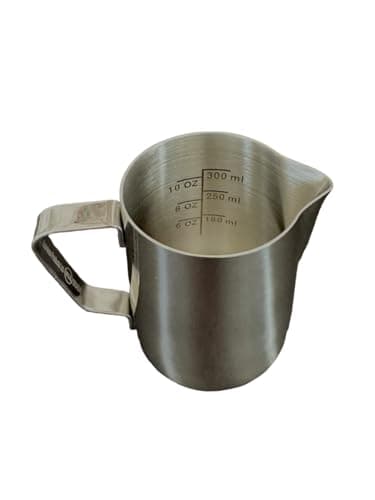
Milk texture depends on the vessel. A straight-sided jug will not spin milk into a vortex, and a rounded spout will not lay a line of foam. You want a tapered pitcher with a sharp spout, sized to the drink: a 12 oz pitcher is right for one latte, because milk needs headroom and a half-empty large pitcher will not swirl properly.
| Capacity | 12 oz |
|---|---|
| Material | Stainless steel |
| Interior | Etched fill line |
| Spout | Sharp, tapered (built for latte art) |
| Handle | Handled |
| Best for | One-to-two drinks; learning latte art |
What we like: the etched line removes the guesswork about how much milk to pour, the sharp spout is the feature latte art actually depends on, and bare stainless lets you judge temperature by hand. The honest con: 12 oz caps you at one drink at a time, so a two-latte household may want a 20 oz as well. Our best milk frothing pitchers guide covers the sizes and shapes.
If you have no steam wand
Who it is for: moka pot and AeroPress drinkers, and anyone whose machine has no wand.
A standalone jug frother heats and textures in one step, which is the simplest possible route to latte milk. The Aeroccino 3 is the standard one: one-touch operation with hot froth, cold froth and warm-milk modes, and auto shut-off.
| Type | Standalone electric jug frother |
|---|---|
| Froth capacity | ~130 ml / 4.4 oz (foam line) |
| Warm-milk capacity | ~240 ml / 8.1 oz (max line) |
| Modes | Hot froth, cold froth, warm milk |
| Interior | Nonstick coated |
| Operation | One-touch, auto shut-off |
The honest cons: it makes foam rather than true pourable microfoam, so latte art is off the table; the temperature is fixed rather than selectable; and the nonstick interior should be hand-washed. For a latte specifically, use the warm milkor hot-froth mode at the max line rather than the foam line — a latte wants mostly liquid milk.
On the cheapest possible route, a handheld whisk foams milk you have already warmed yourself:
| Type | Handheld electric whisk |
|---|---|
| Power | 2 x AA batteries |
| Whisk | Stainless steel spring whisk |
| Heats milk | No (foams pre-warmed milk) |
| Also good for | Matcha, shakes, hot chocolate |
It does not heat the milk, so you still need a pan or a microwave, and the foam is coarser than a jug frother's. For under ten dollars it is still the best value on this page. Our best milk frothers guide ranks the whole category.
If you are buying a machine
Who it is for: the buyer whose main reason for wanting an espresso machine is lattes.
If lattes are the point, buy for the steam system rather than the brew group. The Bambino Plus is our usual recommendation for exactly this buyer: an automatic steam wand with selectable milk temperature and texture, which textures milk to a consistent standard without the learning curve, and a manual mode for when you want to practice. It is also small enough for a crowded counter.
The honest cons: it has no grinder, so budget for one separately, and the automatic wand being good is precisely why some owners never learn to steam by hand. Our Bambino Plus review covers it in full, best espresso machines for lattes ranks the field, and best coffee beans for a lattecovers the other half of the drink — beans whose chocolate and caramel sweetness survives six ounces of milk.
Prices shown are from Amazon as of October 17, 2026 and change often — the button always goes to the current listing. Some links may earn us a commission at no extra cost to you.
Troubleshooting
- Tastes like warm milk. Not enough coffee. Use a double shot, and two doubles in a 12 oz cup.
- Big bubbles instead of foam. You added air too long, or added it after the milk was already warm. Stretch for two to four seconds at the start only, then sink the tip and swirl.
- Foam separates from the milk within a minute.Under-textured. The swirl phase was too short — keep the vortex going until the surface is glossy.
- Tastes scalded or oddly eggy.Over-heated past about 160°F. Stop at 140–150°F; the pitcher should be just too hot to hold.
- The shot tastes sour, or bitter. That is the espresso, not the milk — see why is my espresso sour and why is my espresso bitter.
- Milk will not foam at all. Check the carton. Many non-barista plant milks simply do not hold foam, and whole dairy or barista oat is the fix.
- The steam wand is weak or blocked. Dried milk. Wipe and purge after every single use, and see how to clean a milk frother.
Frequently asked questions
How do you make a latte at home?
Pull a double shot of espresso - about 18 g of coffee yielding roughly 36 g in the cup - into an 8 to 10 oz cup. Steam about 6 oz of cold milk to 140-150F, stretching it for only two to four seconds to add a little air and then swirling it into a glossy vortex. Groom the milk by tapping and swirling, then pour from high into the center, dropping the pitcher close to the surface as the cup fills.
What is the ratio for a latte?
Roughly one part espresso to three parts milk: a double shot, about 36 g in the cup, with around 6 oz of steamed milk in an 8 oz cup. Scale the coffee with the cup - a 12 oz latte needs about 9 oz of milk and really wants two double shots, which is why large coffee-shop lattes use more espresso than people expect.
Can you make a latte without an espresso machine?
Yes. You need concentrated coffee and textured milk, and both have cheap routes: a moka pot makes the best espresso substitute - it is the traditional base for a caffe latte in Italy - and an AeroPress brewed at a high ratio also works. Warm the milk to 140-150F in a pan or microwave and foam it with a handheld whisk or a jug frother. Drip coffee is not concentrated enough to stand up to six ounces of milk.
What temperature should latte milk be?
140 to 150F, or 60 to 65C. Below that the drink is lukewarm by the time you drink it; above about 160F the milk sugars scald and the natural sweetness turns flat and slightly eggy. Without a thermometer, stop when the pitcher becomes uncomfortable to hold for more than a second or two - and turn the steam off before lowering the pitcher.
Why does my homemade latte taste like milk?
Almost always because there is not enough coffee in it. A single shot vanishes in a 10 oz cup - use a double, and two doubles in anything larger. The second cause is under-extracted espresso: a shot that ran too fast is weak as well as sour, and milk amplifies that rather than hiding it.
What milk is best for a latte?
Whole dairy milk is the easiest to texture, because fat and protein together make stable microfoam. Skim foams more aggressively but coarsely. Among plant milks, barista-formulated oat is the most reliable - many standard almond and rice milks will not hold foam at all, so if your milk refuses to texture, try a different carton before blaming your technique.
Do I need a milk pitcher to make a latte?
If you have a steam wand, yes. A tapered pitcher is what spins milk into the vortex that creates microfoam, and a sharp spout is what lets you lay foam on the surface - a straight-sided jug does neither. A 12 oz pitcher is the right size for one latte, because the milk needs headroom and a half-empty large pitcher will not swirl properly.
Sources
- Specialty Coffee Association - espresso and milk beverage standards
- National Coffee Association - espresso and coffee drink definitions
- Breville - Bambino Plus (BES500) product specifications: automatic steam wand with selectable milk temperature and texture, manual mode
- Nespresso - Aeroccino 3 product specifications (froth and max fill lines, hot and cold froth modes, one-touch operation)
- Rattleware - 12 oz etched latte art pitcher product documentation
Keep reading
Buying your first setup?
See how we pick — compiled specs, cost-per-shot math, and honest trade-offs — then dig into the guides. No fake test lab, no rankings for hire.