Single Review
Rancilio Silvia Review
Commercial hardware in a 30-pound home shell: a brass brewing group, a chrome-plated brass portafilter rated to 21 g, and a thermostat where you might have expected a PID. Here is what Rancilio's own spec sheet says, what it leaves out, and which Silvia in the lineup you actually want.
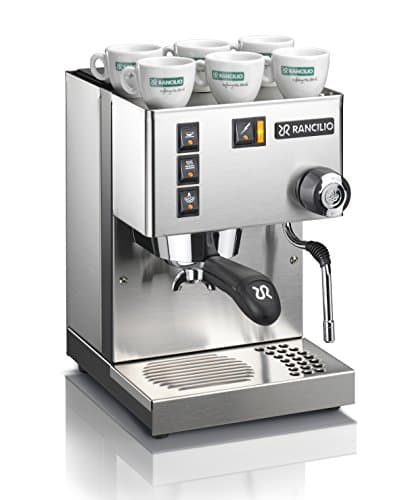
The most commercial hardware you can buy in a single-boiler home machine: a brass brewing group, a 21 g chrome-plated brass portafilter and 14 kg of thermal mass, built to be repaired rather than replaced. What you are not buying is convenience — there is no PID, no pressure gauge, no shot timer and no simultaneous brew and steam, so the machine asks you to supply the consistency its electronics do not.
- Best for
- The deliberate upgrader who already owns a real espresso grinder and wants a 58mm manual machine built like cafe equipment
- Price context
- Upper mid tier — roughly double a Gaggia Classic Evo Pro, and well under the Silvia Pro X that adds the PID and the second boiler
The Rancilio Silviais the machine people buy when they have decided that home espresso is a long-term arrangement. It has been in Rancilio's home line for decades, it is built out of the same material the company puts in cafe equipment, and it is deliberately, almost stubbornly, unhelpful: there is no PID, no pressure gauge, no shot timer and no power-on timer. Rancilio's own specification sheet says so in plain language.
That combination — excellent hardware, minimal assistance — is what makes the Silvia divisive. It is why we have had it wired as the manual-machine splurge on best espresso machines under $1000 and in luxury coffee gifts, and why our Gaggia Classic Pro vs Rancilio Silvia comparison ends up recommending the cheaper machine to most readers. This is the dedicated review we owed it.
One honesty note before the specs. We have not run this machine in a lab, and we do not publish invented test results. What follows is built on Rancilio's own published technical specification for the Silvia, cross-checked against the live Amazon listings for every machine in the Silvia family, with the reasoning done openly — the same method described on our methodology page. Where Rancilio publishes nothing, we say that rather than filling the gap.
Who the Rancilio Silvia is for
There is one buyer this machine fits almost perfectly: someone who already owns a proper espresso grinder, has pulled shots for a while on something cheaper, and has worked out that what they want next is not more features but better hardware. If you know what a 58mm basket is, you own a scale, and the phrase “heat soak” means something to you, the Silvia is a machine you can keep for a very long time.
It also suits the buyer who thinks in repairs. Rancilio is a commercial manufacturer, the Silvia's design has barely moved in years, and the consequence is that gaskets, group screens, thermostats and switches are ordinary serviceable parts. That is a different proposition from a sealed appliance with a bonded milk system.
It is the wrong machine for two people. If this would be your firstespresso machine, the absence of a PID, a gauge and a timer means you will be learning technique and fighting temperature drift simultaneously — our best espresso machine for beginners guide exists for exactly that reason. And if you want milk drinks for a table of four, a single 0.3-liter boiler will make you wait between every one; a super-automatic or a latte machine is the honest answer there.
What the specs say
Everything in this table comes from Rancilio's own technical specification page for the Silvia, including the entries that read as absences. Those absences are specified, not omitted: Rancilio explicitly lists “Pressure gauge (coffee boiler): No” and “Power-on timer: No”.
| Type | Single-group, single-boiler semi-automatic espresso machine for home use |
|---|---|
| Brewing group | Brass |
| Coffee boiler | 0.3 liter |
| Temperature regulation | Manual |
| Brew temperature control | Thermostat (no PID fitted) |
| Portafilter | Chrome-plated brass with weight-balanced ergonomic handle; accepts filters up to 21 g |
| Filter baskets | 8 g / 16 g standard; 14 g / 18 g listed as available |
| Steam wand | Stainless steel, with a stainless steel steam knob |
| Pump | Vibration pump, one |
| Water supply | Built-in 2-liter water tank |
| Power supply | 120 V, 60 Hz (also 220-240 V, 50-60 Hz) |
| Power draw | 950-1000 W at 120 V; 1150 W at 230 V |
| Width | 235 mm / 9.3 in |
| Height | 340 mm / 13.4 in |
| Depth | 290 mm / 11.4 in |
| Weight | 14 kg / 30.8 lb |
| Adjustable feet | No |
| Pressure gauge | No |
| Power-on timer | No |
| Auto-off | Listed as available on EU models only |
| Capsule option | Pods & Caps kit listed as an optional accessory |
What the brass actually buys you
Strip away the reputation and the Silvia's case rests on one specification: the brewing group is brass. On most machines at half this price the group is aluminum, and on cheaper machines still it is aluminum wrapped in plastic. The difference is thermal: a heavy brass group absorbs heat slowly, holds a great deal of it, and gives it back steadily. Once the metal is genuinely saturated, the water hitting your puck arrives at a temperature that does not move much from the first second of the shot to the last.
The 14 kg / 30.8 lb machine weight is the same story told at the scale of the whole appliance. Thermal mass is not a marketing word here — it is why this machine needs a longer warm-up than a thin-walled one and why it rewards that warm-up with stability. The chrome-plated brass portafilter extends it one step further: brass in the basket carrier means the puck is not being chilled by the vessel holding it, which is a real and frequently underrated variable.
Rancilio rates that portafilter for filter baskets up to 21 g, with 8 g and 16 g baskets standard and 14 g and 18 g listed as available. That is a genuinely useful range. A machine that takes an 18 g basket is a machine you can dial in with modern recipes rather than being stuck at a dose the hardware chose for you.
And because the basket is 58mm — the commercial standard, as our portafilter size guidesets out — the whole accessory aftermarket is open to you. Precision baskets, a bottomless portafilter, a 58.5mm tamper and a WDT tool all fit without hunting for an odd size.
The four things it deliberately doesn't have
This is the part of the review that decides the purchase, and it is all on the manufacturer's own spec sheet.
1. No PID. Rancilio lists temperature regulation as manual and brew temperature control as a thermostat. A thermostat switches the element on and off around a setpoint, so brew water temperature cycles in a sawtooth instead of holding a line. The traditional workaround is temperature surfing — timing your shot against the heating light so you catch the cycle in a consistent place. The modern workaround is fitting a PID kit, and a healthy aftermarket exists for exactly that. Either way it is a skill you learn or a modification you buy.
2. No pressure gauge.There is no readout of what is happening in the group. You diagnose a shot by taste, by time and by the look of the stream, which is a perfectly valid way to work — see why is my espresso sour and why is my espresso bitter— but it is slower to learn on than a machine that shows you the number.
3. No timer, either kind. No shot timer, so you time extractions yourself; and no power-on timer, so the machine cannot pre-heat itself before you wake up. Combine that with the thermal mass and the practical consequence is real: this is a switch-it-on-and-wait machine, every single morning.
4. One boiler, 0.3 liters.Brewing and steaming need different temperatures, and one small boiler can only be at one of them. You pull the shot, wait for the boiler to climb to steam temperature, texture the milk, then wait for it to come back down before the next shot. For one or two drinks that cadence is fine and quickly becomes automatic. For four it is tedious, and no amount of technique fixes it — that is what the Silvia Pro X's second boiler is for.
What it's like to live with
Warm-up is a commitment, and Rancilio does not quote a figure. We are not going to invent one. What the specification tells you is enough to plan around: 14 kg of machine, a brass group, a thermostat rather than a PID, and no power-on timer. The ready light indicates the boiler, not the group, so the light will come on well before the metal that actually touches your water is saturated. Leave it on past the light with the portafilter locked in, and run a blank shot through the group before the real one. That single habit does more for the cup on this machine than most upgrades.
The steam wand is a genuine strength. It is stainless steel and controlled by a stainless steel steam knob rather than a lever, which means you can open it a fraction at a time instead of all-or-nothing. That is the control you need to stretch and then roll milk properly; our how to steam milkguide covers the technique. The trade-off is that a manual wand gives you nothing for free — there is no temperature probe and no automatic shutoff, so you judge it by hand and by sound.
The footprint is smaller than the weight suggests.At 235mm wide and 290mm deep the Silvia occupies less counter than most bean-to-cup machines, though it is taller than it looks at 340mm — check your cabinet clearance, because filling a 2-liter top-loading tank needs headroom. The absence of adjustable feet is the one ergonomic miss: on a counter that is not quite level there is no fix in the machine.
Maintenance is ordinary, and mandatory. Nothing here is self-cleaning, so the routine is yours: backflush the group, keep the basket and screen clean, and descale on schedule. Our cleaning guide and descaling guide cover the sequence, and because scale is the main thing that kills a boiler, start with the right water rather than chasing the problem later.
Which Silvia to buy — the model decoder
“Rancilio Silvia” is a family, not a single machine, and three of its members sit on the same retail shelf at very different prices. Every listing below was checked live immediately before publication, so the identities are current even though the prices will move.
| Listing | What it actually is | Who it's for |
|---|---|---|
| Rancilio Silvia (the machine reviewed here) | The standard single-boiler Silvia: brass group, 0.3 L boiler, thermostat, no PID. Sold under more than one Amazon listing, including a plain stainless steel one, at the same price | The deliberate upgrader who will surf temperature or fit a PID later |
| Rancilio Silvia M | The current revision of the same single-boiler platform, listed in other colorways such as white. Same class of machine, not a feature upgrade | Anyone who wants the standard Silvia in a finish the base listing doesn't carry |
| Rancilio Silvia, PID installed | A standard Silvia with a third-party PID fitted before sale, listed at a few hundred dollars more | Buyers who want the temperature problem solved on day one and don't want to open the case |
| Rancilio Silvia Pro X | A different machine: dual boiler with a 1-liter capacity, PID temperature control, roughly double the standard Silvia's price | Anyone whose actual complaint is the single boiler and the temperature cycling |
The decision that matters is the last row. If you read the cons above and your reaction was “the lack of a PID is the problem,” you do not want a standard Silvia with a mod plan — you want to price the Pro X and decide honestly whether the gap is worth it. If your reaction was “the brass group is the point and I will manage the rest,” the standard machine is the one to buy.
The grinder question, which is not optional
A Silvia fed by a cheap grinder is a worse espresso machine than a De'Longhi Stilosa fed by a good one. That is not a rhetorical flourish; grind distribution is the variable that decides whether nine bars of water moves evenly through a puck or channels around it, and no amount of brass compensates for a grinder that cannot hold a setting. Our do I need a grinder for espresso guide makes the full argument.
Practically: if buying the Silvia means skipping the grinder, buy a Gaggia Classic Evo Pro and a real grinder instead and you will drink better coffee for less money. If the grinder is already handled, the Silvia makes sense. Our best grinder for espresso roundup is the starting point, and best espresso grinder under $500 is the bracket that matches a machine at this level. A scale is the other non-negotiable, because nothing on this machine measures anything for you.
Alternatives worth considering
Gaggia Classic Evo Pro— the obvious alternative and the one we recommend more often. It puts you on the same 58mm commercial platform, in a steel machine, for roughly half the price, with the largest and best-documented mod community in home espresso. Its boiler is aluminum rather than brass, and that is the real gap. The full head-to-head is in Gaggia Classic Pro vs Rancilio Silvia.
Breville Bambino Plus— the opposite philosophy. A thermojet heater that is ready in seconds, automatic milk texturing to a chosen temperature, and a 54mm basket instead of 58mm. It will get a decent drink into your hand faster and with less skill than the Silvia ever will; it will not be the machine you are still repairing in fifteen years. See the Bambino Plus review.
Rancilio Silvia Pro X— the in-family upgrade, with the dual boiler and the PID that the standard machine lacks, at roughly double the price. If your objection to the Silvia is specifically the temperature cycling and the brew-then-steam wait, this is the machine that answers it rather than a mod.
A factory-PID machine at a similar price— the strongest argument against the Silvia is not another Silvia, it is what else this money buys. Before committing, read best espresso machines under $1000 and best home espresso machine with the cons list above in mind.
Verdict
The Rancilio Silvia is the right machine for a narrow and real kind of buyer: someone who wants commercial hardware, a serviceable body and a 58mm platform, who already owns the grinder, and who understands that the consistency this machine can produce has to come from their routine rather than its electronics. For that person it is close to a lifetime purchase, and the brass group is the reason.
For almost everyone else, the honest recommendation is different. If the lack of a PID bothers you, pay for the Pro X or a factory-PID machine instead of buying a project. If the price would come out of the grinder budget, buy the Gaggia and the grinder. And if you are shopping for your first machine, the Silvia will teach you a great deal, slowly, while you also learn everything else — which is why our beginner guide points elsewhere.
Buy it for the hardware, with the grinder already sorted, and you will not regret it. Buy it for the badge and it will simply make you wait.
What we liked
- A brass brewing group — the single spec that separates this machine from everything near its price, and the reason its temperature holds through a shot once it is properly heat-soaked
- A chrome-plated brass portafilter rated by Rancilio for filters up to 21 g, with a weighted ergonomic handle carried down from the company's commercial machines
- 14 kg / 30.8 lb of machine: thermal mass you can feel, and a body that does not shift when you lock in a basket
- 58mm commercial basket size, so baskets, tampers, WDT tools and bottomless portafilters are all off-the-shelf parts
- A 2-liter tank, which is generous for a single-boiler machine of this footprint
- Rancilio is a commercial equipment manufacturer and the Silvia has been in production for decades — parts, gaskets and service documentation are genuinely available, which is what makes a machine a decade-long purchase instead of a five-year one
- Manual steam wand with a stainless steel steam knob rather than a lever, which gives finer control over steam pressure than most home machines allow
What gave us pause
- No PID. Rancilio lists temperature regulation as manual and brew temperature control as a thermostat, which means brew temperature cycles with the heating element and you manage it yourself
- No pressure gauge and no power-on timer, by Rancilio's own spec sheet — you get no readout of what the pump is doing and no scheduled warm-up
- Single 0.3-liter boiler, so brewing and steaming happen in sequence, never together; a second milk drink means waiting for the boiler to change state
- No adjustable feet, which matters more than it sounds on an uneven counter for a machine this heavy
- The auto-off function is listed as available only on EU models, so a US machine stays on until you switch it off
- No shot timer, no pre-infusion and no volumetrics — every dose, every ratio and every stop is on you and your scale
- It is the most expensive way to buy a single-boiler machine, and at this price machines with factory PIDs and heat exchangers come into view
- It needs a good grinder to make any sense at all; paired with a cheap one it will lose to a far cheaper machine fed properly
Frequently asked questions
Is the Rancilio Silvia worth it?
It is worth it for one specific buyer: someone who already owns a capable espresso grinder, wants a 58mm manual machine built from commercial parts, and is willing to manage brew temperature themselves. The hardware is genuinely better than anything near its price — a brass brewing group, a chrome-plated brass portafilter rated to 21 g, 14 kg of thermal mass and a serviceable body. It is not worth it if the money would otherwise go toward a grinder, or if you want the machine to help you; Rancilio's own spec sheet confirms there is no PID, no pressure gauge and no timer of any kind.
Does the Rancilio Silvia have a PID?
No. Rancilio's technical specification lists temperature regulation as manual and brew temperature control as a thermostat. That means brew temperature cycles with the heating element rather than being held at a setpoint, and the two standard answers are temperature surfing or fitting an aftermarket PID kit. Amazon also carries a listing for a Silvia with a PID already installed by a third party at a few hundred dollars more, and the Silvia Pro X ships with PID control from the factory.
What is the difference between the Rancilio Silvia and the Silvia Pro X?
The Pro X is a dual-boiler machine with PID temperature control and a 1-liter capacity, listed at roughly double the standard Silvia's price. The standard Silvia is a single-boiler machine with a 0.3-liter boiler and a thermostat. In daily use the difference is that the Pro X can brew and steam without waiting between the two and holds brew temperature electronically, while the standard Silvia asks you to work around both. If the single boiler and the temperature cycling are your objections, the Pro X is the machine that fixes them.
How big is the Rancilio Silvia's boiler and water tank?
Rancilio publishes a 0.3-liter coffee boiler and a built-in 2-liter water tank. That is roughly 10 fl oz of boiler and 68 fl oz of tank; some retailer listings round these to 12 fl oz and 74 fl oz. The 0.3-liter figure is the one that shapes daily use, because a boiler that small has to change temperature between brewing and steaming rather than doing both at once.
What size portafilter does the Rancilio Silvia use?
58mm, the commercial standard. Rancilio's spec sheet describes a chrome-plated brass portafilter with a weight-balanced ergonomic handle that accepts filter baskets up to 21 g, with 8 g and 16 g baskets standard and 14 g and 18 g listed as available. Because it is 58mm, standard aftermarket baskets, bottomless portafilters, 58.5mm tampers and distribution tools all fit — see our portafilter size guide for how the sizes map across brands.
Is the Rancilio Silvia good for beginners?
It is a poor first machine for most people, despite being an excellent machine. With no PID, no pressure gauge, no shot timer and a single small boiler, a beginner ends up learning dose, grind, tamp and milk technique at the same time as compensating for temperature drift. That is a lot of variables at once. A machine that stabilizes temperature for you lets you learn the technique first — our best espresso machine for beginners guide covers those options. The Silvia makes far more sense as a second machine bought deliberately.
How much power does the Rancilio Silvia use, and does it switch itself off?
Rancilio lists 950-1000 W at 120 V / 60 Hz, and 1150 W on a 230 V supply. The auto-off function is listed as available only on EU models, so a US machine stays powered until you switch it off manually. There is also no power-on timer, which means the machine cannot pre-heat on a schedule — with this much thermal mass, that is the specification you will notice most on a weekday morning.
Sources
- Rancilio Group — Model Silvia official technical specifications (brass brewing group, 0.3 L coffee boiler, 2 L tank, thermostat temperature control, 21 g portafilter capacity, 8/16 g and 14/18 g baskets, 950-1000 W at 120 V, 235 x 340 x 290 mm, 14 kg, no pressure gauge, no power-on timer, no adjustable feet, EU-only auto-off)
- Amazon product listings for the Rancilio Silvia, Silvia M, Silvia with PID installed and Silvia Pro X — model identity, condition and availability verified via the Amazon Creators API immediately before publication
- Rancilio Group — Rancilio brand and Silvia home line overview
Keep reading
Buying your first setup?
See how we pick — compiled specs, cost-per-shot math, and honest trade-offs — then dig into the guides. No fake test lab, no rankings for hire.