Single Review
Fellow Opus 2 Review
The stepless grinder at a stepped-grinder price. Fellow's second-generation Opus pairs 48mm hardened burrs with a continuous dial that spans 200 to 1200 microns in 3.1 turns and a near-zero-retention path that gives back what you weighed in - a genuinely unusual package under $200, and one with a specific blind spot.
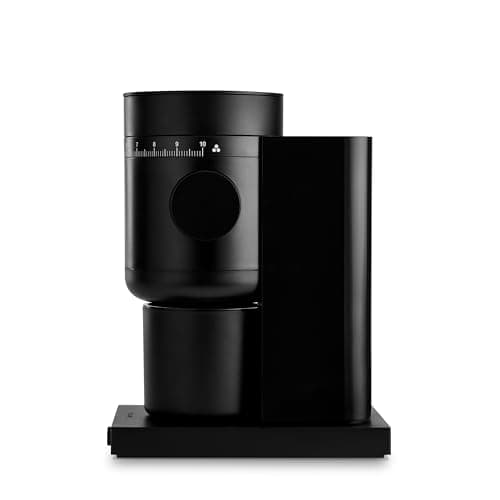
The most capable mechanism under $200 for anyone who rotates beans: a stepless dial with nothing out of reach, 48mm hardened burrs, and a retention path designed to hand back the dose you weighed in. The cost is that stepless means no number to write down, and the 100 g hopper is a single-dose hopper whether you wanted one or not.
- Best for
- Drinkers who keep two or three bags open, single dose from small bags of specialty coffee, or brew both espresso and filter on one grinder
- Price context
- Entry bracket - the same money as the stepped electric grinders it competes with, which is the whole argument for it
The Fellow Opus 2 is the only grinder we know of near its price that is stepless. Every direct competitor — the Baratza Encore ESP, the Breville Smart Grinder Pro, the Timemore Chestnut C3 ESP— moves in defined clicks. The Opus 2 turns continuously through roughly 200 to 1200 microns in about 3.1 turns of the dial, which means no grind setting is ever out of reach. That is a mechanism normally found two price brackets up.
The second thing Fellow built this grinder around is retention. A 100 g hopper, a built-in ionizer and a short exit path add up to a grinder designed to hand back the dose you weighed in rather than a blend of today's bean and last week's. If you keep two or three bags open at a time, that single property changes your mornings more than burr size does.
What the Opus 2 is not is a dedicated espresso grinder, and it is not the grinder for someone who wants a number to come back to. This review is about where that line falls.
A note on honesty first: we do not run a lab. This review compiles Fellow's published specifications and retailer specification sheets and does the reasoning — the same method we use on every product, described on our methodology page. Units we claim to have tested: zero. Where nobody publishes a figure, we say so rather than estimating one.
Who the Opus 2 is for
Buy it if you buy small bags of good coffee and change them often. The Opus 2 is built like a single-dose grinder wearing a small hopper: you weigh 18 g in, you get close to 18 g out, and the next bean is not contaminated by the last one. It is also the right pick if you brew bothespresso and filter on one grinder, because a stepless dial crossing 200–1200 microns can serve both ends properly instead of splitting a fixed number of clicks between them — the problem our espresso-and-pour-over grinder guide exists to solve.
Do not buy it ifyou want to write a recipe down. Stepless grinders have no numbers, so “setting 9” does not exist — you navigate by shot time and taste, and if the dial gets knocked you start again. If your espresso machine arrives this week and you have never dialed in a shot, numbered clicks shorten that learning curve considerably, which is why our under-$200 grinder roundup does not make this the automatic first pick for a first-time espresso buyer.
Also skip it if you drink the same dark roast all year and want to fill a hopper on Sunday. A 100 g hopper holds about four doses. That is a feature when you single dose and a daily annoyance when you do not.
What the specs say
It is worth being clear about which numbers come from where. The burr diameter, stepless adjustment, hopper and container capacities, the 54mm and 58mm adapters, the ionizer, the auto-stop and the two-year warranty are Fellow's own published specifications, carried on the retailer specification sheets we fetched. The micron range, the 3.1-turn figure, the 400 RPM motor speed and the 300 W drawcome from retailer specification sheets rather than Fellow's own copy, so we attribute them. Fellow publishes no micron-per-turn figure and no particle-distribution figure, which is a real gap on a grinder sold partly on espresso ability.
| Burrs | 48mm hardened stainless steel conical |
|---|---|
| Adjustment | Stepless - continuous, no detents |
| Dial travel | Full range in ~3.1 turns (retailer specification) |
| Grind range | ~200-1200 microns, espresso to cold brew (retailer specification) |
| Micron per turn | Not published by Fellow |
| Motor | 300 W, ~400 RPM (retailer specification) |
| Retention | Near-zero, built-in ionizer (per Fellow) |
| Bean hopper | 100 g, removable, plastic |
| Grounds capacity | 110 g container; grinds up to 100 g at a time |
| Included cups | 100 g filter catch cup, 30 g espresso cup, magnetic bases |
| Portafilter adapters | 54mm and 58mm (both in the box) |
| Dispensing | Doserless |
| Auto-stop | Yes, with jam detection (retailer specification) |
| Grind guidance | Laser-marked reference on the lid |
| Cord | 900 mm (35.4 in) (retailer specification) |
| Dimensions | 206 x 130 x 267 mm (8.1 x 5.1 x 10.5 in) |
| Weight | 2.3 kg (5.1 lb) |
| Housing | Plastic |
| Warranty | 2 years, serviced by Fellow |
Two figures on that list are worth pausing on. 48mm burrsare larger than the 40mm M2 set in the Encore ESP, and burr diameter matters because a larger set cuts more beans per revolution at the same RPM, which generally means less heat and a tighter particle spread — the reasoning our flat vs conical burrs guide works through properly. And 400 RPM is slow by entry-grinder standards, which is the right direction for espresso: slower burrs generate less heat and less static.
The stepless dial is the whole product
A stepped grinder moves in clicks. Its advantage is memory: setting 12 is setting 12 forever, so you can record a recipe, come back a month later on a different bag, and have a reference point. Its limitation is granularity. When the grind you want sits between click 12 and click 13, you cannot have it, and the usual workaround is to change the dose or the basket instead of the grind.
A steplessgrinder turns continuously. Nothing is between two settings because there are no settings. For espresso that is the more capable mechanism, because espresso is the one brew method where the difference between a good and a bad shot can be a few microns — which is exactly the ceiling our Smart Grinder Pro review describes owners hitting once they start dialing in seriously.
The cost is navigation. You get a laser-marked reference on the lid and 3.1 turns of travel, and that is it. The practical method is to mark your own position: set the dial, pull a shot, note the time, and move in small consistent increments — roughly an eighth of a turn is a meaningful step for espresso on a 3.1-turn range. Write down the shot time rather than the setting, because the shot time is the only number the grinder gives you.
Retention: the second real feature
Retention is how much ground coffee stays inside the grinder after a dose — in the chute, on the burr carrier, clinging to plastic by static. On a hopper-fed grinder that coffee comes out inside the nextdose, which is harmless if you drink one bean and genuinely annoying if you do not. Fellow's answer is a short exit path, a removable hopper and an ionizer that neutralizes the static charge grinding creates, which is what keeps grounds falling into the cup instead of sticking to the walls.
Fellow describes the result as near-zero retention. We have not measured it and we are not going to publish a figure we did not measure — but the design logic is sound and it is the same logic the much more expensive single-dose grinders in our single-dose grinder guide are built on. If you rotate a light roast for filter and a darker one for espresso, this is the specification that decides whether one grinder can serve both without a purge dose every time.
The practical consequence is nicer than it sounds. You weigh 18 g of beans into the hopper, grind, and the 30 g espresso cup catches close to 18 g of grounds. No purge, no shaking the chute, no second dose to flush the first bean out. That is the routine a $600 single-dose grinder sells, at entry-grinder money.
Is it good enough for espresso?
Yes, with a caveat that matters. The bottom of the range is listed at roughly 200 microns, which is genuine espresso fineness — fine enough to choke a machine, which is the only test that counts. The 30 g cup and the included 54mm and 58mm adapters mean it doses into a basket out of the box, so it pairs with a Breville Bambino (54mm) or a Gaggia Classic Pro (58mm) without buying anything extra. The stepless dial means you will never be told the shot you want is unavailable.
The caveat is burr geometry. 48mm conical burrsare a good set for an all-purpose grinder, and they are larger than most things at this price — but at the fine end they are working harder than a 50mm flat set, and flat burrs are generally credited with a tighter particle distribution for espresso. That is not a figure either Fellow or its rivals publish, so treat it as the mechanical reasoning it is, not a measurement. In practice it means the Opus 2 will dial a shot in and will not be the last word on one; the grinders that are live one bracket up, in our under-$500 roundup.
The other espresso reality: this grinder does not weigh anything. The cups hold grounds, they do not measure them, so a 0.1 g scale is a required purchase and not an optional one. Our coffee scale guide covers the ones that fit under a portafilter, and do I need a scale for espresso makes the case if you are not convinced.
And if you are still weighing up whether you want a portafilter at all, our semi-automatic vs super-automatic comparison is the decision that comes before this one — a bean-to-cup machine includes its own grinder, so a separate grinder like the Opus 2 only makes sense on the semi-automatic side. On that side, a puck screen is the other cheap accessory worth knowing about, for keeping the group head clean rather than improving the shot.
Filter and cold brew on the same grinder
This is where the stepless dial earns its keep twice. A stepped dual-purpose grinder has to split a fixed number of clicks between espresso and filter, and whichever end gets fewer clicks gets worse resolution — the Encore ESP solves it by dedicating settings 1–20 to espresso at roughly 20 microns per step and 21–40 to filter at roughly 90. A continuous dial has no such budget to allocate.
The listed ~1200 micron coarse end reaches French press and cold brew territory, which means one grinder genuinely covers an AeroPress, a V60, a French press and a cold brew maker as well as a portafilter. Match the dial position to the method with our grind size chart, and accept that you will re-find your espresso position every time you come back from a coarse grind — the price of having no numbers.
The 100 g filter catch cup is the right size for this half of the job: 100 g of beans is a large French press or three pour overs, so the cup is not the constraint. The hopper is.
The honest limits
No numbers. This is the headline trade and it is not a small one. A stepped grinder lets you hand the machine to someone else, or come back after three weeks away, and reproduce a shot from a written note. The Opus 2 cannot do that. If you share a kitchen with someone who adjusts things, this is a real daily cost.
The hopper is 100 g.Four doses, roughly. Fellow chose this deliberately — a small hopper is part of how you get low retention — but it means the grinder expects you to weigh beans in every time. Treat it as a single-dose grinder with a lid, because that is what it is.
Undocumented resolution. Fellow publishes no micron-per-turn figure and no particle-distribution data. A grinder sold on espresso capability that will not state its adjustment resolution cannot be compared on paper with a Baratza, which publishes roughly 20 microns per espresso step. That absence is itself information.
Plastic, and an undocumented repair path.The housing and hopper are plastic at a price where the Breville alternative is stainless steel, and Fellow does not publish burrs and gearbox parts as user-replaceable the way Baratza does through its US channel. The warranty is two years and serviced by Fellow, which is fair; the ten-year repairability story is Baratza's, not Fellow's.
Static with oily roasts.The ionizer exists because grinding creates charge, and it helps — but dark, oily beans are messier in every grinder with a plastic exit path, and nothing in the specification sheet changes that.
Alternatives worth considering
| Grinder | Pick it over the Opus 2 when | Price |
|---|---|---|
| Baratza Encore ESP | You want numbered espresso steps and a documented repair path | $199.95Buy |
| Breville Smart Grinder Pro | You want a metal body, a 450 g hopper and a programmable dose timer | $199.95Buy |
| Eureka Mignon Notte | You are ready to pay a bracket more for 50mm flat burrs and stepless micrometric adjustment | $299.00Buy |
Prices shown are from Amazon as of November 6, 2026 and change often — the button always goes to the current listing. Some links may earn us a commission at no extra cost to you.
The head-to-head most buyers at this price are actually deciding is Fellow Opus 2 vs Baratza Encore ESP, and the short version is a clean split: the Opus 2 has the better mechanism, the Encore ESP has the better teaching aid and the better repair story. If you want a metal appliance with a dose timer instead, the Encore ESP vs Smart Grinder Pro comparison covers that side of the field.
If you are willing to go up a bracket, the real step change is flat burrs with stepless micrometric adjustment — the Eureka Mignon Notte is where that starts, and our under-$300 and under-$500 roundups rank the field either side of the line. Grinding by hand instead? The best hand grinders deliver more adjustment resolution per dollar than any electric grinder at this money, at the cost of your mornings.
Verdict
The Opus 2 is the right grinder for a specific and fairly common person: someone who buys good coffee in small bags, changes it often, brews more than one way, and would rather have every grind setting available than have a number to write down. For that buyer it does something nothing else near the price does — stepless adjustment across 200 to 1200 microns, 48mm hardened burrs, an ionizer-assisted retention path, and a 30 g cup with both portafilter adapters in the box.
It is the wrong grinder for a first-time espresso buyer who needs numbers, for anyone who wants to fill a hopper and forget it, and for anyone chasing the last five percent of a shot, which lives with 50mm flat burrs a bracket up. Rate it on what it is: an all-purpose grinder with a high-end mechanism and an entry-grinder body, honest about the first and compromised on the second.
What we liked
- Stepless adjustment at a price where every direct rival is stepped - no grind setting is out of reach
- Near-zero retention with a built-in ionizer, so yesterday's bean does not turn up in today's shot
- 48mm hardened conical burrs - larger than the 40mm sets fitted to the grinders it competes with
- Ships a 30 g espresso cup plus 54mm and 58mm portafilter adapters, so it doses into a basket out of the box
- One grinder genuinely covers espresso through cold brew, with ~200-1200 microns across 3.1 dial turns
- Narrow 130mm footprint, so it fits beside a compact machine rather than in front of one
What gave us pause
- Stepless means there is no setting number to write down - knock the dial and your recipe is gone
- The 100 g hopper is a single-dose hopper; if you wanted to fill it and forget it, this is the wrong grinder
- Fellow does not publish a micron-per-turn figure or a particle-distribution figure, so espresso resolution cannot be compared on paper
- 48mm conical burrs at the fine end are outclassed on distribution by the 50mm flat sets one bracket up
- Plastic housing and plastic hopper at a price where the Breville alternative is stainless steel
- Fellow does not publish the burrs as a user-replaceable part the way Baratza does, so the repair path is less documented
- No scale and no weight-based dosing - the cups hold grounds, they do not measure them
Frequently asked questions
Is the Fellow Opus 2 good for espresso?
It is capable of espresso and it is not a dedicated espresso grinder. The listed range bottoms out around 200 microns, which is fine enough to choke a machine - the test that matters - and the stepless dial means no target grind is unreachable. It also ships a 30 g dosing cup with 54mm and 58mm portafilter adapters, so it doses into a basket out of the box. The limit is that 48mm conical burrs at the fine end are generally outperformed on particle distribution by the 50mm flat sets one price bracket up, and Fellow publishes no distribution figure either way.
What is the difference between the Fellow Opus and the Opus 2?
The headline change Fellow and its retailers state is the adjustment mechanism: the original Opus used a stepped dial with a 40mm burr set, and the Opus 2 is stepless with 48mm hardened stainless burrs. We are not going to list further differences that nobody publishes - if a spec is not stated by Fellow or on a retailer specification sheet, we leave it out.
How many grind settings does the Opus 2 have?
None, in the usual sense. It is stepless, which means the dial turns continuously rather than clicking between numbered positions, and retailer specification sheets put the full travel at about 3.1 turns across roughly 200 to 1200 microns. The practical consequence is that you cannot write a setting number down - you record shot time instead and move the dial in small, consistent increments.
Does the Fellow Opus 2 retain grounds?
Fellow designs against it and describes retention as near-zero, helped by a built-in ionizer that neutralizes the static charge grinding creates, a removable 100 g hopper and a short exit path. We have not measured the figure and will not publish one we did not measure. The design intent is clear though: this is built to hand back the dose you weighed in, which is why it suits anyone rotating between two or three bags.
Does the Opus 2 fit a 58mm portafilter?
Yes. Fellow includes both a 54mm and a 58mm portafilter adapter plus a 30 g espresso cup, so it doses directly into a Breville 54mm basket or a 58mm basket on a Gaggia, Rancilio or De'Longhi machine without buying an accessory.
How big is the Opus 2 hopper?
100 g, and it is removable. That is roughly four espresso doses, so this grinder expects you to weigh beans in rather than fill a hopper for the week. The small hopper is part of how the low-retention design works, but it is a genuine inconvenience if you drink one bean all year and wanted a set-and-forget grinder.
Fellow Opus 2 or Baratza Encore ESP - which should I buy?
Buy the Opus 2 if you rotate beans or brew both espresso and filter, because stepless adjustment and near-zero retention are exactly what that habit needs. Buy the Encore ESP if your first espresso machine is arriving and you want numbers to learn with - it dedicates settings 1 to 20 to espresso at roughly 20 microns per step - or if a documented user-replaceable repair path matters to you, which is Baratza's genuine advantage. We have a full head-to-head between the two on the site.
Do I still need a scale with the Opus 2?
Yes. Neither the 100 g catch cup nor the 30 g espresso cup weighs anything - they hold grounds, they do not measure them. A 0.1 g scale is the cheapest accuracy you can buy alongside any grinder at this price, and it matters more here than on a stepped grinder because shot time is the only feedback a stepless dial gives you.
Sources
- Fellow - Opus 2 Conical Burr Grinder product specifications (48mm hardened stainless conical burrs, stepless adjustment, near-zero retention with built-in ionizer, 100 g removable hopper, 100 g filter catch cup and 30 g espresso cup with magnetic bases, 54mm and 58mm portafilter adapters, doserless, automatic stop, 2-year warranty serviced by Fellow, plastic housing)
- Whole Latte Love - Fellow Opus 2 specification sheet (SKU 72714: conical steel burrs 48mm, stepless, doserless, 100 g bean hopper, 110 g grounds container, 100 g filter and 30 g espresso bins, 54 and 58mm portafilter adapters, automatic stop, easy access to burrs, 2-year manufacturer's warranty, plastic housing, stepless adjustment named as the major improvement over Opus Gen 1)
- The Roaster's Pack - Fellow Opus 2 (120V) specification sheet (stepless, full range in 3.1 turns; 200-1200 microns espresso to cold brew; 400 RPM; 300 W; 100 g hopper; 100 g standard and 30 g espresso catch cups; 54mm and 58mm adapters; integrated ionizer; true autostop with jam detection; 900 mm cord; laser-marked grind guidance on the lid)
- Baratza - Encore ESP specifications (40mm M2 conical burrs, 40 stepped settings split 1-20 espresso / 21-40 filter at roughly 20 and 90 microns per step, 54mm dosing cup and 58mm adapter, user-replaceable parts via Baratza's US channel)
- Breville - Smart Grinder Pro (BCG820) product page (60 stepped settings, programmable 0.2-second dose timer, 50-54mm and 58mm portafilter cradles, stainless steel housing)
- Amazon product listing for the Fellow Opus 2 - model identity verified against brand and model in the listing title (48 mm burrs, stepless grind adjustment, espresso to cold brew range, anti-static, auto stop), availability confirmed In Stock and live price captured
- Specialty Coffee Association - grind, extraction and brewing fundamentals
Keep reading
Buying your first setup?
See how we pick — compiled specs, cost-per-shot math, and honest trade-offs — then dig into the guides. No fake test lab, no rankings for hire.