Buying Guide
The Best Puck Screen for Espresso in 2026
A puck screen is a $13 metal disc that sits on top of your coffee. It will keep your group head clean, and it will not fix a bad shot. Six picks sorted by the two specs that actually decide the purchase - the diameter that fits your basket, and the thickness your machine has room for.
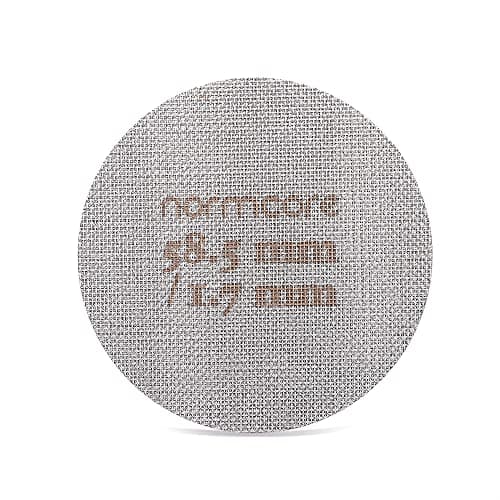
A puck screen— also sold as a contact screen, a lower shower screen or a puck diffuser — is a thin metal mesh disc you drop on top of the tamped coffee before you lock the portafilter in. It costs between $7 and $23, it is the cheapest espresso accessory anybody sells, and it is also the one surrounded by the most overclaiming.
Here is the short version of this guide, so you can stop reading if that is all you need. A puck screen reliably does onething: it keeps loose grounds and coffee oil off your machine's shower screen, which is maintenance Breville itself calls essential. Everything else — better extraction, less channeling, more flavor clarity — is somewhere between plausible and unproven, and we are not going to tell you otherwise. What that means for buying is that you should spend the minimum needed to get the right diameter and a thickness your machine has room for, and ignore the marketing entirely.
We do not run a lab and we have not pulled comparison shots for this page. Every pick below was verified live and purchasable immediately before publication, and every specification is taken from the manufacturer or the verified listing — the method described on our methodology page. Where no controlled evidence exists, we say so instead of inventing a number.
What a puck screen is, and what it is not
Your espresso machine has a shower screen: a perforated disc in the group head that water passes through on its way to the coffee. A puck screen is a second, removable disc that sits at the other end of that gap, resting on the coffee itself. Water leaves the shower screen, crosses a few millimeters of headspace, and hits the puck screen before it reaches the grounds.
It is not a replacement for a shower screen, it is not a filter basket, and it is not a paper filter. The mesh openings on the screens here run between 100 and 200 microns— coarse enough that espresso grounds mostly do not pass through, fine enough that water does so freely. A paper filter, by contrast, filters oils and fines out of the drink. A puck screen does not change what ends up in your cup; it changes what ends up on your machine.
Two things happen mechanically when you add one. First, the top surface of the puck is held under a rigid plate, so when the coffee swells during pre-infusion it presses against metal mesh instead of smearing into the group head. Second, water arriving in jets from a small number of shower-screen holes meets a continuous mesh before it meets coffee. The first effect is the one you will notice; the second is the one everybody sells.
What a puck screen actually does, honestly
It keeps the group head clean. This is real and it is the reason to buy one. Breville's own cleaning guidance for the Barista Pro states that “it is essential to keep the shower screen clean of loose grounds and coffee oil buildup,” and the puck screen is the laziest way to make that easier — grounds that would have stuck to the group stick to a disc you can rinse under the tap. If you have ever twisted the portafilter out and watched wet coffee rain down the group, this is the fix, and $13 is a fair price for it. Our espresso machine cleaning guide covers the rest of that job.
It gives you a tidier, drier puck. A rigid screen holds the puck face flat, which is why owners consistently report that spent pucks knock out firmer and in one piece. If your pucks come out soupy, read why is my espresso puck wetfirst — the cause is usually the machine's solenoid behavior or your dose, and a screen tidies the symptom rather than curing it.
It may help water distribution. Nobody has proved how much.We looked for a controlled trial and could not find one we were able to verify. What exists is vendor testing and forum consensus, and published guides to the subject grade the extraction-yield evidence as weak while grading the group-head-cleanliness benefit as strong. Treat any specific percentage you see quoted online — in either direction — as unverified. We are not quoting one.
It does not fix channeling. This is the claim worth being blunt about. Channeling happens inside the puck, where water finds a low-resistance path through unevenly distributed coffee. A screen sits on the surface, so the most it can do is even out the water arriving at the surface. If you are fighting channeling, the tools that address the cause are a WDT tool, a level tamp, and a bottomless portafilterto see what you are actually doing — all covered in our espresso channeling guide.
The two specs that decide the purchase
Almost every puck screen sold is a 316 stainless steel mesh disc and they are far more alike than the marketing suggests. Two numbers decide whether one works on your machine, and both of them catch buyers out.
1. Diameter — and it is not the number on your machine. A basket described as 58mm takes a 58.5mm screen, and a basket described as 54mm — the Breville and Sage standard — takes a 53.3mmscreen. That is not a misprint by the sellers: the screen is sized to the internal diameter near the top of the basket, not the nominal basket name, and it is meant to sit with a slight interference fit so it does not slide around. Buy a “54mm” screen for a Breville and it may not drop in. If you do not know which size you have, our portafilter size guide covers 51mm, 54mm and 58mm and how to measure yours in thirty seconds. This is the single most common mistake with this product.
2. Thickness — because it eats your headspace. The gap between a tamped puck and the shower screen is a few millimeters, and a 1.7mm disc consumes most of it. Functionally, adding a thick screen behaves like adding dose: the puck sits closer to the group, and on a machine with a tight head or with an already-generous dose it can end up pressed against the shower screen. If your basket is already full to the line, buy a 0.5mm or 0.8mm screen rather than reducing your recipe to accommodate an accessory. Our double-shot dose reference gives you the headroom conversation in grams.
Three more specs matter less, but they do matter:
Mesh fineness (microns). The screens here run 100µm, 150µmand finer-etched variants. Finer mesh spreads water more evenly and adds slightly more flow resistance; coarser mesh is more forgiving and clogs less. 150µm is the sensible default. If you move from no screen to a fine one and your shots run slower, that is the screen, and the fix is a click coarser on the grinder.
Material and coating. 316 stainless steelis the standard and the right answer — it is the more corrosion-resistant of the two common food-grade steels, which matters for a part that lives wet. A titanium PVD coating over 316 is a genuine upgrade for one reason only: coffee oils release from it more easily, so it stays clean with less scrubbing.
Rigidity.Thick perforated discs (0.8–1.7mm) hold their shape and lift out in one piece for years. Very thin mesh screens are more easily bent or distorted, which is the trade you accept for saving headspace. A magnet pin, as on the IMS screen, exists because getting a 0.5mm disc off a wet puck with a fingertip is genuinely annoying.
At a glance
| Puck screen | Fits | Thickness | Mesh | Price |
|---|---|---|---|---|
| Normcore 58.5mm (1.7mm) | 58mm baskets | 1.7mm | 150 micron, 316 stainless | $13.99Buy |
| Normcore 53.3mm (1.7mm) | 54mm Breville / Sage baskets | 1.7mm | 150 micron, 316 stainless | $13.99Buy |
| Normcore 58.5mm (0.8mm) | 58mm baskets | 0.8mm | 316 stainless | $13.99Buy |
| IMS Big Bang Ultra Thin | 58mm baskets (58.3mm disc) | 0.5mm | Etched, with magnet pin | $22.90Buy |
| Normcore 58.5mm Titanium PVD | 58mm baskets | 1.7mm | 100 micron, 316 stainless + titanium PVD | $18.99Buy |
| MHW-3BOMBER 58.5mm | 58mm baskets | 0.8mm | Dual-layer stainless | $12.99Buy |
Prices shown are from Amazon as of November 6, 2026 and change often — the button always goes to the current listing. Some links may earn us a commission at no extra cost to you.
Four of the six are Normcore, and that is not laziness — Normcore is the brand that publishes a full specification for every variant (diameter, thickness in millimeters, mesh in microns, steel grade) and sells the same disc in every size and thickness combination a home machine needs. On a product class full of unbranded discs with no stated mesh figure, publishing the spec is the differentiator.
Best overall: Normcore 58.5mm Puck Screen, 1.7mm / 150 micron
If you have a 58mm machine — a Gaggia Classic Pro, a Rancilio Silvia, a De'Longhiin the 58mm range, or anything prosumer — this is the one to buy and the decision takes thirty seconds. It is a 1.7mm thick 316 stainless disc with 150 micron filtration, which is the configuration that has become the default in this category for good reasons: thick enough to be rigid, mesh coarse enough not to clog with fines, steel grade appropriate for something that lives wet.
The 1.7mm thickness is the thing to check against your own setup. It is the most robust disc here and it is also the one that takes the most headroom, so if you dose at the top of your basket's range, go to the 0.8mm version below rather than dropping your dose. On a standard 18–20 g double in a 58mm basket there is normally room.
Honest cons: at 1.7mm it is the thickest screen on this page, which makes it the worst choice for a tight group; 150 micron is a middle setting rather than the finest available; and the plain 316 finish holds coffee oil more stubbornly than the PVD-coated version, so it wants a proper soak in machine detergent every few weeks rather than a rinse.
Best for 54mm Breville and Sage baskets: Normcore 53.3mm
This is the same disc — 1.7mm, 150 micron, 316 stainless — cut to 53.3mm for the 54mm baskets fitted to Breville and Sage machines. If you own a Bambino, Bambino Plus, Barista Express, Barista Pro or Barista Touch Impress, this is your screen and the 58.5mm one above is not.
It is worth understanding why the number is 53.3 and not 54, because the mismatch is what sends people back to the returns page. Breville's portafilter is universally described as 54mm, but the usable internal diameter at the top of the basket is a shade under that, so screens are cut to 53.3mm to drop in and sit flat. Everything in our portafilter size guide applies: measure the basket, not the box.
Honest cons:the headspace point is sharper on Breville machines than on 58mm ones, because the 54mm baskets are shallower in proportion and Breville's own recommended doses already fill them — if the screen sits proud of the basket rim after tamping, you have over-dosed for a screen and should either drop a gram or use a thinner disc. Same oil-retention note as the plain 58.5mm version.
Best when headspace is tight: Normcore 58.5mm, 0.8mm
Same brand, same 58.5mm diameter, same 316 stainless — at 0.8mm instead of 1.7mm. It gives back roughly a millimeter of headroom above the puck, which does not sound like much until you remember that the whole gap is only a few millimeters wide. This is the version to buy if you dose heavy, if your spent puck already shows an imprint of the shower screen, or if you simply do not want to change a recipe that works to accommodate a $14 accessory.
The trade is rigidity. A 0.8mm disc is still a proper perforated plate rather than a floppy mesh, and it will outlast most of what it sits in, but it is easier to dish or bend than the 1.7mm version — so do not use it as a lever to pry a stuck puck out of the basket.
Honest cons: the listing does not state a micron figure for this thickness the way the 1.7mm versions do, so if a specific mesh size matters to you, buy one of the two that publishes it; thinner discs are fiddlier to lift off a wet puck without a magnet; and it costs the same as the thicker disc, so you are paying for less metal to solve a geometry problem.
Best ultra-thin: IMS Big Bang Ultra Thin 0.5mm
IMS is the Italian company that makes precision filter baskets and shower screens for a large share of the commercial espresso industry, which is the reason to take its version seriously. The Big Bang Ultra Thin is 0.5mm and 58.3mmacross, making it the thinnest screen on this page by a clear margin — it costs you almost no headspace at all, which makes it the safest choice if you have no idea how much room your group has.
The feature that justifies the price over a $13 disc is the magnet pin. A 0.5mm disc stuck flat to a wet puck is genuinely hard to pick up; the pin gives you something to grab, and the magnet keeps it attached rather than rolling into the sink. On a screen this thin that is a usability fix, not a gimmick.
Honest cons:it is the most expensive pick here by roughly double, which is a lot of money for a product whose main benefit is easier cleaning; at 0.5mm it is the easiest to deform if you are careless with it; the published specification is thinner than Normcore's — IMS states the diameter and the thickness but the listing does not give a micron figure; and 58.3mm is a slightly tighter fit than 58.5mm in some baskets, which is fine but worth knowing if yours is on the small side of tolerance.
Best fine mesh: Normcore 58.5mm Titanium PVD, 1.7mm / 100 micron
Two differences from the standard disc, both real. The mesh is 100 micron rather than 150, which is the finest figure published by anything on this page, and the 316 stainless carries a titanium PVD coating— a hard, thin, physically deposited surface layer that coffee oils release from more readily than bare steel. In practice that means less scrubbing over the life of the screen, which for a part you rinse every single day is the benefit that compounds.
The finer mesh is a genuine spec improvement and also the reason to think about it rather than default to it: finer openings distribute water more evenly and add flow resistance, so expect a slightly slower shot at the same grind and be ready to go a click coarser. If you do not own a grinder with the resolution to make that adjustment comfortably, the 150 micron version is the more forgiving buy — our Fellow Opus 2 review and under-$300 grinder roundupcover what “a click coarser” costs you on different mechanisms.
Honest cons: it is the same 1.7mm thickness as the standard disc, so it solves nothing for a tight group; a 100 micron mesh clogs faster with fines than a 150 micron one and needs a more diligent rinse; PVD is a surface coating and surface coatings eventually wear, so do not take it as a permanent property; and it costs around a third more than the plain version for a benefit that is cleaning convenience, not cup quality.
Best budget pick: MHW-3BOMBER 58.5mm, 0.8mm dual-layer
The cheapest screen here that still states its specification. MHW-3BOMBER's 58.5mm, 0.8mm dual-layer stainlessdisc (model FG5590) does the same job as the Normcore 0.8mm for less money, and the dual-layer construction — two bonded mesh layers rather than one plate — gives it reasonable stiffness for the thickness. If you are not sure whether you will like using a puck screen at all, this is the one to find out with.
MHW-3BOMBER also sells a 54mm (53.3mm) version for Breville and Sage baskets at a similar price, so the budget route exists for both machine families.
Honest cons: no micron figure is published, so you are buying a mesh of unstated fineness; the brand does not publish the steel grade the way Normcore publishes 316; dual-layer screens are harder to clean properly than a single plate because oils collect between the layers; and the saving over the Normcore equivalent is a dollar or two, which is not much of a reason to give up a published specification.
How to use and clean one
Using it takes one extra second. Dose, distribute with a WDT tool, tamp level, then set the screen flat on the puck and lock in as normal. It should sit inside the basket, below the rim, with no gap at the edge. If it rides up on the rim or will not sit flat, you have either the wrong diameter or too much coffee in the basket — those are the only two causes.
Cleaning itis the part people get wrong, and getting it wrong converts a maintenance aid into a maintenance job. Rinse it under hot water the moment you knock the puck out, while the oils are still liquid and the grounds have not dried into the mesh. Every week or two, soak it in espresso machine detergent along with your basket and portafilter — the same routine and the same chemicals as our cleaning guide already describes for backflushing. Use a soft brush, never an abrasive pad, and do not bend a thin screen flat again by force once it has dished.
A screen you do not clean is worse than no screen. Rancid coffee oil in a 100 micron mesh sitting directly on fresh coffee is a flavor problem you have added to your machine, and it is the one genuine downside of the whole product class.
When to skip the puck screen entirely
If you own a pressurized portafilter. Pressurized baskets create back-pressure at a valve rather than through the coffee bed, so the water distribution a screen is supposed to improve is not what determines your shot in the first place. Our pressurized vs non-pressurized portafilter guide explains why, and the honest answer is to put the $14 toward a non-pressurized basket instead.
If your machine has no real headspace. Some compact machines have very little gap above a full basket. If your spent puck already comes out with the shower screen pattern printed on it, adding 1.7mm of metal makes that worse, not better. Go thin, or go without.
If you are buying it to fix a bad shot.Sour, bitter, fast, gushing — none of those is a puck screen problem. Start with why is my espresso sour, why is my espresso bitter and espresso channeling, and spend the money on grind resolution or a scale if those point there. A screen bought for the wrong reason is $14 wasted and one more thing to wash.
If you only brew filter. Obvious, but worth saying: this is an espresso accessory and it has no application in a pour over, French press or moka pot. If you are choosing between espresso and everything else, our semi-automatic vs super-automatic comparison is a better use of your next ten minutes — and note that a super-automatic has no portafilter at all, so a puck screen is not an option on one.
Frequently asked questions
Do puck screens actually make a difference?
To your machine, yes; to your cup, probably very little. The benefit that is mechanically obvious and widely reported is a cleaner group head - grounds and oils land on a disc you can rinse rather than on the shower screen that Breville's own guidance says it is essential to keep clean. The claimed extraction and flavor benefits are a different matter: we could not find a controlled trial we were able to verify, and published guides to the subject grade that evidence as weak. Buy one to make cleaning easier, not to improve your espresso.
What size puck screen do I need for a Breville?
53.3mm. Breville and Sage machines use what everyone calls a 54mm portafilter, but the usable internal diameter at the top of the basket is slightly under 54mm, so puck screens for them are cut to 53.3mm. That applies to the Bambino, Bambino Plus, Barista Express, Barista Pro and Barista Touch Impress. A 58.5mm screen will not fit any of them.
What thickness puck screen should I buy?
Start at 1.7mm if you dose normally and want the most durable disc, and go to 0.8mm or 0.5mm if headspace is tight. Thickness is subtracted from the gap between your tamped puck and the shower screen, so a thick screen behaves a little like a heavier dose. The diagnostic is easy: if your spent puck already shows the shower screen's pattern pressed into it, you do not have room for a 1.7mm screen.
Does a puck screen stop channeling?
No. Channeling happens inside the coffee bed, where water finds a path of least resistance through unevenly packed grounds. A puck screen sits on the surface, so at most it evens out the water arriving at the top of the puck. The tools that address the actual cause are a WDT tool for distribution, a level tamp, and a bottomless portafilter so you can see where the shot is going wrong.
What micron puck screen is best, 100 or 150?
150 micron is the better default and 100 micron is the better spec. Finer mesh distributes water slightly more evenly and adds flow resistance, which means a slower shot at the same grind setting and a click coarser to compensate - fine if your grinder has the resolution, annoying if it does not. Finer mesh also clogs faster with fines and needs a more diligent rinse. If you are buying your first screen, take 150.
Can you use a puck screen with a bottomless portafilter?
Yes - they are unrelated parts. The screen sits on top of the coffee inside the basket; a bottomless portafilter removes the spouts underneath so you can watch the extraction. In fact they pair well, because the bottomless view is how you tell whether your distribution problems were ever a surface issue a screen could help with.
How often should you replace a puck screen?
When it stops sitting flat or stops cleaning up. A rigid 1.7mm 316 stainless disc, rinsed daily and soaked in machine detergent every week or two, lasts years. Thin mesh screens are shorter-lived because they dish and crease, and dual-layer screens eventually hold oil between the layers that no amount of rinsing shifts. A creased screen does not distribute water evenly and at these prices there is no reason to keep using one.
Is 316 stainless steel important for a puck screen?
It is the grade you want, and the fact that a brand publishes it is more informative than the grade itself. 316 is the more corrosion-resistant of the two common food-grade stainless steels, which matters for a part that spends its life wet and hot. Plenty of unbranded screens never state a grade or a mesh figure at all; on a $13 product, publishing the specification is the clearest signal available.
Sources
- Breville - how to clean the shower screen (Barista Pro BES878) support page: "it is essential to keep the shower screen clean of loose grounds and coffee oil buildup"
- Normcore - 58.5mm Puck Screen specification as published on the verified Amazon listing (1.7mm thickness, 150 micron filtration, 316 stainless steel, lower shower screen for 58mm portafilter baskets)
- Normcore - 53.3mm Puck Screen specification as published on the verified Amazon listing (1.7mm thickness, 150 micron, 316 stainless steel, metal contact screen for 54mm portafilter baskets)
- Normcore - 58.5mm Puck Screen 0.8mm specification as published on the verified Amazon listing (0.8mm thickness, 316 stainless steel, lower shower screen for 58mm portafilter baskets)
- Normcore - 58.5mm Titanium PVD Puck Screen specification as published on the verified Amazon listing (316 stainless steel with titanium PVD coating, 1.7mm thickness, 100 micron mesh)
- IMS - Big Bang Ultra Thin Puck Screen specification as published on the verified Amazon listing (0.5mm thickness, 58.3mm diameter, magnet pin)
- MHW-3BOMBER - 58.5mm Espresso Puck Screen FG5590 specification as published on the verified Amazon listing (0.8mm dual-layer stainless steel, fits 58mm portafilter baskets)
- Complete Home Barista - puck screen effectiveness guide: its own evidence grading (cleaner group head "strong"; even water distribution "moderate"; reduced channeling "limited"; improved extraction yield "weak"; flavor clarity "anecdotal"), plus guidance that screen thickness occupies headspace and that screens add flow resistance
- Normcore puck screen user manual as reproduced by manuals.plus (316 stainless steel, 1.7mm thickness, 150 micron filtration, 2.3 x 2.3 x 0.07 in, for 58mm portafilter baskets)
- Specialty Coffee Association - espresso extraction and brewing fundamentals
Keep reading
Buying your first setup?
See how we pick — compiled specs, cost-per-shot math, and honest trade-offs — then dig into the guides. No fake test lab, no rankings for hire.