Buying Guide
The Best Coffee Beans in 2026
There is no single best bag of coffee - there is a best bag for the way you brew. Seven whole-bean picks on live prices, from a supermarket dark roast to a specialty espresso blend, plus the five things printed on a bag that actually predict whether you will like what is inside it.
The short answer
There is no single best bag of coffee, and any page that tells you otherwise is guessing on your behalf. What there is, reliably, is a best bag for how you brew and what you drink. If you want one answer for a kitchen with a machine and a dripper in it, buy Stumptown Hair Bender— it is roasted to work both ways, which almost no flagship blend genuinely is. If you want the most coffee for the least money without drinking something bad, the budget pick is Peet's Major Dickason's Blend, and the cheapest per ounce on the page is the 2.2 lb bag of Lavazza Super Crema. Pulling espresso? Intelligentsia Black Cat. Brewing through paper? Stumptown Holler Mountain. Drinking lattes? La Colombe Nizza.
Two honesty notes before the picks, because they change how you should read them. First, every tasting note on this page comes from the roaster's own published copy and is labeled as such — it is marketing language, not measurement, and we have not cupped these coffees side by side. What we can assess is the stuff that is actually on the bag and actually predicts outcomes: roast level, whether a roast date is printed, blend versus single origin, bag weight, and the species in it. Second, the four decisions below matter more than which of these seven bags you choose. A great bag ground in a blade grinder and brewed at the wrong ratio is worse than a supermarket bag done properly.
Prices come from the live price layer with the as-of date under the table. Coffee is sold in wildly different bag sizes — 10 oz to 2.2 lb on this page alone — so compare per ounce, not per bag. Divide the live price by the weight in the spec tables and the ranking changes a lot.
What actually matters on a bag
Five things on a bag of coffee predict whether you will enjoy it. Everything else — the altitude, the varietal, the farm photograph, the tasting-note poetry — is interesting, and downstream of these.
1. Whole bean, not ground. This is the only non-negotiable on the list. Ground coffee has hundreds of times the surface area exposed to oxygen, and the aromatic compounds that make coffee smell like coffee are gone within about fifteen minutes of grinding. Every pick here is whole bean. If you do not own a grinder yet, buy one before you buy better beans: our coffee grinder buying guide works through the decision in order, and burr vs blade explains why the cheap option is not a cheap version of the right thing.
2. A printed roast date.Not a "best before" date — those are set a year or two out and tell you nothing. A roasted-on date tells you where the bag is in its life. Coffee needs a few days off-gassing after roasting (longer for espresso, where fresh CO2 makes shots gush and taste sour), and it is at its best from roughly one to four weeks. Specialty roasters print the date; most supermarket brands do not, which is a real and specific reason to prefer the former even when the coffee inside is similar.
3. Roast level matched to the brewer, not to taste alone.This is where most money gets wasted. Darker roasts are more soluble and more forgiving: they dissolve readily, so an imperfect grind or ratio still gives you something drinkable, which is why dark and medium-dark dominate espresso and moka pot. Light roasts are dense and harder to extract, so on a beginner espresso machine with a modest grinder they routinely come out sour and thin — not because the coffee is bad, but because the setup cannot get into it. Our light roast vs dark roast for espresso covers this properly, and it is the single most useful thing to read before spending $25 on a bag.
4. Blend or single origin. A blend is engineered for consistency and balance, and it is re-blended as crops change so that the bag you buy next year tastes like the one you bought this year. A single origin is a snapshot of one place and one harvest: more distinctive, more seasonal, and much less predictable. For espresso, where you dial in a grind setting and want it to stay dialed, a blend is the easier life. For pour over, where variation is part of the appeal, single origin is where it gets interesting. Six of the seven picks here are blends, on purpose.
5. Species, and bag weight.Nearly all specialty coffee is 100% arabica. Robusta — the other commercial species — has roughly twice the caffeine, a harsher, rubbery edge, and produces notably thicker, longer-lasting crema, which is exactly why traditional Italian espresso blends include it. It is not a defect; it is a choice, and on this page only Lavazza Super Crema makes it. Bag weight is the other number people skip: a 10 oz specialty bag and a 2.2 lb Italian bag can be the same money, and the per-ounce gap between the picks here is close to two to one.
At a glance
Seven bags, what each one is for, and the specifications that decide it. Tap any button for the live Amazon price; compare per ounce using the weight column.
| Coffee | Best for | Roast | Weight | Price |
|---|---|---|---|---|
| Stumptown Hair Bender | One bag for the whole kitchen | Medium | 18 oz | $21.48Buy |
| Peet's Major Dickason's Blend | Budget, and forgiveness | Dark | 18 oz | $14.99Buy |
| Stumptown Holler Mountain | Pour over, drip, AeroPress | Medium (organic) | 12 oz | $14.98Buy |
| Intelligentsia Black Cat | Espresso | Espresso roast | 12 oz | $14.27Buy |
| La Colombe Nizza | Lattes and cappuccinos | Medium | 12 oz | $14.79Buy |
| Lavazza Super Crema | Value by weight, thick crema | Medium espresso | 2.2 lb | $26.99Buy |
| Kicking Horse Three Sisters | Organic and fair trade | Medium | 10 oz | $12.49Buy |
Prices shown are from Amazon as of November 22, 2026 and change often — the button always goes to the current listing. Some links may earn us a commission at no extra cost to you.
Best coffee beans overall: Stumptown Hair Bender
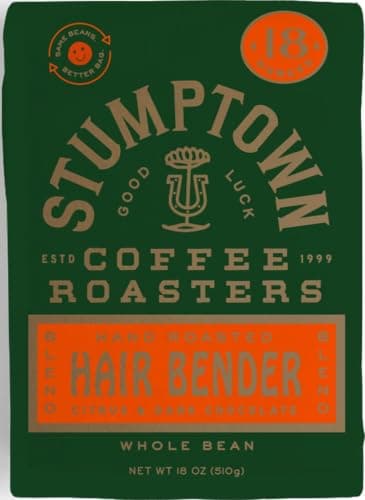
Hair Bender is Stumptown's flagship and the reason we put it at the top is narrow and practical: it is one of very few widely available blends that is genuinely built to work as espresso and as filter coffee. Most blends are optimized for one or the other and merely tolerable in the other. That matters in a real kitchen, where a machine and a dripper share a cupboard and nobody wants two open bags going stale in parallel. The roaster describes it as a multi-origin blend — Latin American, African and Indonesian components — with citrus and dark chocolate character, and the bag carries a printed roast date.
| Roast level | Medium |
|---|---|
| Type | Multi-origin blend |
| Weight | 18 oz whole bean |
| Roast date printed | Yes |
| Suits | Espresso, pour over, AeroPress, drip |
| Roaster's notes | Citrus and dark chocolate (roaster's own copy) |
The honest cons.It is a mid-to-upper price per ounce, and a blend designed to do two jobs is by definition not the absolute best choice for either — a dedicated espresso blend will dial in more easily, and a dedicated filter coffee will be brighter in a V60. Being a medium roast, it is less forgiving on an entry-level espresso setup than a dark roast is: expect to actually dial it in rather than pull the first shot and be happy. The 18 oz bag is more than a single person will finish inside a month at one cup a day, which argues for splitting it into a sealed canisterrather than leaving the bag open. And the published tasting notes are the roaster's, not ours.
Budget pick: Peet's Major Dickason's Blend
Major Dickason's is the bag we would hand someone who has never bought whole-bean coffee and does not want a lecture. It is a dark roast blend, it costs supermarket money for an 18 oz bag, it is stocked almost everywhere in the United States so you are not dependent on shipping, and the dark roast makes it the most forgiving coffee on this page— soluble enough that a slightly wrong grind or a careless ratio still produces something you would drink. It has also been reviewed publicly for decades, which is unusual for a supermarket blend and means the claims about it are checkable rather than purely promotional.
| Roast level | Dark |
|---|---|
| Type | Blend |
| Weight | 18 oz whole bean |
| Roast date printed | No |
| Suits | Drip, French press, moka pot, forgiving espresso |
| Roaster's notes | Rich, complex, full-bodied (roaster's own copy) |
The honest cons.There is no roast date on the bag, so you cannot tell whether you are buying coffee roasted three weeks ago or three months ago — and on a supermarket shelf it is usually the latter. Dark roasting flattens origin character by design: this will never taste like a bright Ethiopian, because it is not trying to. Dark roasted beans go oily, and oily beans gum up a grinder chute and need cleaning out more often — see how to clean a coffee grinder. And if you are chasing the fruit-and-florals end of specialty coffee, this is the wrong bag entirely.
Best for pour over and filter: Stumptown Holler Mountain
If most of your coffee goes through paper — a V60, a Chemex, an AeroPress, a drip machine — this is the bag. Holler Mountain is a certified organic medium roast that the roaster describes as sweet with citrus zest, caramel and hazelnut character, and the practical point is that it sits in the roast band where filter brewing works best: developed enough to extract without perfect technique, light enough that the paper has something to reveal rather than just a wall of roast. It carries a printed roast date, and at 12 oz it is a bag one person can realistically finish fresh.
| Roast level | Medium |
|---|---|
| Type | Blend, certified organic |
| Weight | 12 oz whole bean |
| Roast date printed | Yes |
| Suits | Pour over, drip, AeroPress, French press |
| Roaster's notes | Citrus zest, caramel, hazelnut (roaster's own copy) |
The honest cons.Per ounce it is one of the more expensive bags here, and the organic certification is part of why — worth it if you want it, a premium you are paying for nothing if you do not. As a medium roast it is less forgiving than the Peet's on a sloppy brew, and it needs a reasonably even grind to show what it is doing, which means a burr grinder rather than a blade. It is not an espresso blend: it can be pulled, but it will be brighter and more acidic than most people want from a shot, and fussier to dial in. And again, the tasting notes are the roaster's published copy. Our best coffee beans for pour over page goes deeper on this intent.
Best for espresso: Intelligentsia Black Cat Classic Espresso
Espresso is a different job from filter coffee, and Black Cat is a blend that exists to do that job. Intelligentsia re-blends it seasonally with the explicit goal of keeping the espresso behaviorstable — how it tastes as a short shot, how it holds up under milk, where it wants to sit on a grind dial — rather than keeping a single origin recipe fixed. That is the right priority for anyone who has dialed in a machine and does not want to start over with every bag. It is sold as a 12 oz whole-bean bag with a roast date.
| Roast level | Espresso roast (medium to medium-dark) |
|---|---|
| Type | Seasonal blend, re-blended for consistency |
| Weight | 12 oz whole bean |
| Roast date printed | Yes |
| Suits | Espresso, moka pot, milk drinks |
| Roaster's notes | Sweet, syrupy, chocolate and fruit (roaster's own copy) |
The honest cons.It is a premium price for a small bag, and espresso eats coffee: at 18 g a double shot, a 12 oz bag is about nineteen doubles, so the per-drink cost is higher than the bag price suggests. Because the blend changes seasonally, the coffee you love this spring will not be identical next spring — consistency of behavior is the promise, not consistency of flavor. It needs a grinder that can actually resolve espresso increments; on a general-purpose grinder you will not find the window. And it wants a week or so of rest after the roast date before it stops gushing. Our best coffee beans for espresso covers the whole category, and the best grinders for espresso is the prerequisite purchase.
Best for lattes and milk drinks: La Colombe Nizza
Milk is the problem nobody warns you about. Six ounces of steamed milk will swallow a delicate coffee completely, which is why a bright, floral single origin that tastes wonderful in a V60 can taste like warm milk in a latte. Nizza is the pick here because it is a medium roast with milk-chocolate and nut weightin the roaster's own description — the kind of character that survives dilution and still reads as coffee through the foam. It is a 12 oz whole-bean bag.
| Roast level | Medium |
|---|---|
| Type | Blend |
| Weight | 12 oz whole bean |
| Suits | Lattes, cappuccinos, flat whites, drip |
| Roaster's notes | Milk chocolate and nuts (roaster's own copy) |
The honest cons.It is tuned for milk, which means it is not the most interesting bag here black — drink it as a straight filter coffee and it reads as pleasant and unremarkable next to the Stumptown bags. It is a smaller bag at a mid-to-high price per ounce. As a medium roast it is less forgiving than the dark-roast budget pick if your technique is still rough. And it only pays off if you actually have a way to texture milk properly: a steam wand or a decent frother, plus the technique in how to steam milk. Our best coffee beans for latte page is the deeper version of this section.
Best value by weight: Lavazza Super Crema
Super Crema is the bag to buy when the household drinks a lot of coffee and the per-ounce number is what matters. It is a 2.2 lbbag — roughly three times the weight of the specialty bags above — and on current pricing it is comfortably the cheapest per ounce on this page. It is also the only pick here that is not 100% arabica: it is an arabica and robusta blend, which is a deliberate Italian espresso choice rather than a corner cut. Robusta is what produces the thick, persistent crema the name refers to, and it adds body and caffeine.
| Roast level | Medium espresso roast |
|---|---|
| Type | Arabica and robusta blend |
| Weight | 2.2 lb / 1 kg whole bean |
| Roast date printed | No (best-before date only) |
| Suits | Espresso, moka pot, milk drinks, drip |
| Roaster's notes | Honey and almond, creamy body (roaster's own copy) |
The honest cons.A 2.2 lb bag is only a bargain if you drink it while it is fresh; one person at a cup a day will be three months into it by the end, and the last third will taste flat however well you store it. Robusta divides people — it brings a rubbery, slightly bitter edge that specialty drinkers often dislike, and roughly twice the caffeine per gram, which matters if you are sensitive. There is no roast date, only a best-before. And it is a conventional commodity blend with no organic or fair trade certification, which may or may not matter to you. Decant it: an airtight canister with the rest left sealed in the bag is the difference between month three being drinkable and not.
Best organic and fair trade: Kicking Horse Three Sisters
If certification matters to you, this is the pick that does not make you pay a large premium for it. Three Sisters is certified organic and fair trade, a medium roast blend the roaster describes with cocoa, nut and brown-sugar notes, and it is the cheapest bag on this page by sticker price. The roast level makes it genuinely dual-purpose for non-espresso brewing: coarse in a French press, medium in a dripper, and it behaves in both.
| Roast level | Medium |
|---|---|
| Type | Blend, certified organic and fair trade |
| Weight | 10 oz whole bean |
| Suits | Drip, French press, pour over, cold brew |
| Roaster's notes | Cocoa, nuts, brown sugar (roaster's own copy) |
The honest cons. The bag is 10 oz, not 12 or 18, so the attractive sticker price is less attractive per ounce than it looks — this is exactly the trap the weight column exists to catch. It is a supermarket-channel specialty bag rather than a fresh-roasted one, so roast date practice is inconsistent. It is not built for espresso and will be fussy if you try. And "organic" is a farming certification, not a quality grade: it tells you how the coffee was grown, not how it tastes.
Match the bean to your brewer
This page is the overview. Each brew method has a different extraction window, which means a different ideal roast level and grind, and we have a dedicated page for each one — go to the one that matches the gear on your counter.
| Espresso machine | Medium to medium-dark blends, rested about 7-14 days |
|---|---|
| Moka pot | Medium-dark, ground fine-ish but not espresso-fine |
| Pour over / Chemex / V60 | Light to medium, where clarity is the point |
| AeroPress | Medium, medium-fine grind - the most forgiving combination of bean and brewer |
| French press | Medium to dark, coarse grind, body over clarity |
| Cold brew | Medium to dark - cold water barely touches bright acids |
The deeper pages: best coffee beans for espresso, for pour over, for AeroPress, for French press, for cold brew, for moka pot and for lattes. If you are buying your very first bag and want the most forgiving options rather than the best ones, the best coffee for beginners is written for exactly that. And if you are still wondering whether espresso beans are a different product, coffee beans vs espresso beans settles it. Changing brewer rather than bean? Our AeroPress alternatives page compares seven manual brewers against the reasons people move on from one.
What we left out, and why
A roundup is also a set of exclusions, and these are ours.
Pre-ground coffee.Not on quality snobbery — on physics. The aromatics are gone within the hour. If you do not have a grinder, buying better pre-ground coffee is close to the worst return on money in this hobby; buying a cheap burr grinder and cheap beans beats it easily.
Flavored coffee. Syrup-coated beans leave residue in a grinder and in a portafilter that carries over into every subsequent brew. If you want vanilla in your coffee, add vanilla to your coffee.
Light-roast single origins, at the top of the page. Some of the most interesting coffee in the world is here, and it is also the category most likely to produce a sour, thin disappointment on a beginner espresso machine with a modest grinder. It is a second or third bag, not a first.
Pods and capsules. A different product with a different economics, covered separately in best Nespresso machines and Nespresso alternatives.
Anything we could not price or verify as currently on sale. Every pick above had a live listing with stock and a live price checked before publication. Where a coffee we like was unavailable, it is simply absent rather than listed with a dead link.
Keeping it fresh once it arrives
Buying good beans and then storing them badly is the most common way people waste this money. Three rules, and they are all about exposure. Air is the enemy, so keep the beans sealed and squeeze the air out of a resealable bag each time — or decant into a vacuum or valved canister. Buy in amounts you will finish inside about a month rather than stocking up, which is the real argument against the big-bag value play above. Do not refrigerate: a fridge is humid, and coffee absorbs odors readily. The freezer is genuinely fine for long-term storage in a properly sealed container, but take out only what you will use and do not refreeze.
How to store coffee beans goes through all of it, and the best coffee canisters page covers the vacuum and one-way-valve options if you want the hardware.
The bottom line
One bag for a kitchen that does espresso and filter? Stumptown Hair Bender. Smallest spend, most forgiveness, easiest to find? Peet's Major Dickason's Blend. Everything through paper? Holler Mountain. Dialing in a machine and wanting it to stay dialed? Intelligentsia Black Cat. Lattes? La Colombe Nizza. Most coffee per dollar, and thick crema? Lavazza Super Crema. Organic and fair trade without a big premium? Kicking Horse Three Sisters.
And the thing worth repeating, because it is the honest version of this page: if you are choosing between upgrading the bag and upgrading the grind, upgrade the grind. A burr grinder under $100 changes more cups than the difference between any two coffees on this page.
Frequently asked questions
What are the best coffee beans to buy?
For a kitchen that brews both espresso and filter coffee, Stumptown Hair Bender - it is one of few widely available blends genuinely roasted to work both ways. If price is the deciding factor, Peet's Major Dickason's Blend is a large bag of forgiving dark roast at supermarket money, and the 2.2 lb Lavazza Super Crema is the cheapest per ounce here. For espresso specifically, Intelligentsia Black Cat; for pour over, Stumptown Holler Mountain.
Are expensive coffee beans actually better?
Up to a point, and then it depends on your setup. Moving from commodity pre-ground to a fresh whole-bean blend is a large, obvious improvement. Moving from a good $15 bag to a $30 single origin is a change in character rather than a change in quality, and on an entry-level espresso machine with a modest grinder the expensive bag often tastes worse, because light roasts are harder to extract. Spend on a burr grinder before spending on rarer coffee.
Should I buy a blend or a single origin?
A blend for consistency, a single origin for character. Blends are engineered for balance and re-blended as crops change, so the bag stays predictable - which is what you want if you have dialed in an espresso grind and do not want to start over. Single origins are a snapshot of one place and one harvest: more distinctive, more seasonal, less repeatable. Six of the seven picks on this page are blends on purpose.
What roast level should I buy?
Match it to the brewer. Dark and medium-dark roasts are more soluble and more forgiving, which is why they dominate espresso and moka pot brewing. Light roasts are dense and need precise grind, temperature and ratio to extract properly, so on a beginner espresso setup they frequently come out sour. Medium is the safest all-round answer and is where most of this page sits.
Does a roast date matter more than a best-before date?
Yes, by a wide margin. A best-before date is set a year or two out and tells you nothing about freshness. A roasted-on date tells you where the bag is in its life: coffee wants a few days to off-gas after roasting - longer for espresso - and is generally at its best from about one to four weeks. Specialty roasters print it; most supermarket brands do not.
How much coffee is in a bag, and how should I compare prices?
Compare per ounce, not per bag. The picks on this page range from 10 oz to 2.2 lb, so sticker price is misleading - a 10 oz bag at a low price can cost more per cup than a 2.2 lb bag at three times the price. Divide the live price by the weight listed in each spec table. As a rough planning figure, a 12 oz bag is around 17 to 20 espresso doubles at 18 g, or about 20 to 24 filter cups at 15 g.
Is robusta bad coffee?
No, it is a different species with different properties. Robusta carries roughly twice the caffeine of arabica, more body, a harsher and sometimes rubbery edge, and it produces notably thicker and more persistent crema - which is why traditional Italian espresso blends include it deliberately. Lavazza Super Crema is the one pick here that uses it. Specialty roasters work almost exclusively in arabica, so if you prefer bright, delicate coffee you will probably prefer 100% arabica.
Sources
- Stumptown Coffee Roasters - Hair Bender published description and specifications: multi-origin blend, medium roast, roasted for espresso and filter, printed roast date (tasting notes are the roaster's own copy)
- Stumptown Coffee Roasters - Holler Mountain published description: certified organic medium roast blend, citrus zest / caramel / hazelnut notes as published by the roaster
- Peet's Coffee - Major Dickason's Blend published description: dark roast blend, whole bean, rich and full-bodied as published by the roaster; no roast date printed on retail bags
- Intelligentsia Coffee - Black Cat Classic Espresso published description: seasonal espresso blend re-blended to keep espresso performance consistent rather than a fixed origin recipe
- La Colombe - Nizza published description: medium roast blend with milk chocolate and nut notes as published by the roaster
- Lavazza - Super Crema published specifications: 1 kg / 2.2 lb whole bean, medium espresso roast, arabica and robusta blend, honey and almond notes as published by the roaster
- Kicking Horse Coffee - Three Sisters published description: certified organic and fair trade medium roast blend, 10 oz whole bean, cocoa / nut / brown sugar notes as published by the roaster
- National Coffee Association - coffee roast guide and storage guidance (roast levels and their characteristics; keep coffee airtight and away from heat, moisture and light; freezer storage in a sealed container)
- Specialty Coffee Association - arabica and robusta species characteristics, including robusta's higher caffeine content and crema contribution
- Amazon listings (Creators API) - live availability, current prices, bag weights and brand title verification for every ASIN on this page before publication
Keep reading
Buying your first setup?
See how we pick — compiled specs, cost-per-shot math, and honest trade-offs — then dig into the guides. No fake test lab, no rankings for hire.