Buying Guide
The Best Espresso Accessories in 2026
Most espresso accessory money gets spent in the wrong order. Eight picks ranked by how much they genuinely change what is in the cup, the thirty-second fitment check to do before you buy any of them, a separate 54mm list for Breville owners, and an honest section on what to skip.
The short answer
Espresso accessories are the easiest place in this hobby to spend $300 and change nothing in the cup. The useful ones are cheap, and the order you buy them in matters more than which brand you pick. So this page is ranked by effect on the shot, not by price or by what the market pushes hardest.
If you buy two things, buy a scale and a WDT tool. Between them they cost less than a decent tamper and they fix the two things that actually ruin home espresso: a dose you guessed, and a puck full of clumps. If you buy four, add a tamper and a bottomless portafilter— the second of which improves nothing by itself and is still one of the best purchases here, because it is the only way to see what your prep is doing. The budget pick is the WEIGHTMAN scale, which is also the first thing on the list.
Prices come from the live price layer with the as-of date under the table. Accessory pricing moves around a lot more than machine pricing, so check the button before assuming an upgrade is out of reach.
Do the fitment check first
Before any of this: measure your portafilter. Roughly half the accessory returns in home espresso are a fitment mistake, and it takes thirty seconds to avoid. Put a ruler across the inside rim of the basket seat and read the diameter in millimeters.
| 58mm | The commercial standard - Gaggia Classic, Rancilio, most prosumer machines. Accessories actually measure 58.3-58.5mm. |
|---|---|
| 54mm | Breville / Sage - Bambino, Bambino Plus, Barista Express, Pro, Touch. Accessories actually measure 53.3-54mm. |
| 51mm | De'Longhi Dedica, Stilosa, La Specialista. The thinnest accessory market of the three. |
| Proprietary | Ninja Luxe Cafe and most pod machines use their own baskets - third-party puck prep gear does not apply. |
The numbers on the box are nominal. A "58mm" tamper is machined at about 58.3 or 58.5mm so it clears the basket wall, and a "54mm" puck screen is usually 53.3mm for the same reason — which is why a 54.0mm screen sometimes will not seat. Our portafilter size guide covers all three sizes and how to measure your own, and it is worth two minutes before you order anything on this page.
How we ranked them
Every product below has a live retail listing we can price, and is assessed against published specifications: resolution and capacity for scales, diameter and material for puck-prep gear, hole specification for baskets, capacity and build for the rest. Our full approach is on the methodology page; we do not run a test lab and we say so.
The ranking rule is the part worth stating plainly. An accessory earns a high place only if it removes a variable from the shot— dose, distribution, tamp pressure, basket geometry — or shows you a variable you cannot otherwise see. Accessories that only make the routine nicer are still here, ranked lower and labeled as such. Anything sold on a claimed extraction benefit we could not verify is in the what to skip section instead, with the reason.
One thing this page will not do is pretend accessories can rescue a bad grind. If you are running a blade grinder or a general-purpose burr grinder with no espresso resolution, none of this will help and the money belongs in the grinder — see the best grinders for espresso and do I need a grinder for espresso.
At a glance
The eight, in buying order, with what each one actually removes from the equation. Tap any button for the live Amazon price.
| Accessory | What it fixes | Fitment | Price |
|---|---|---|---|
| WEIGHTMAN Espresso Scale | A dose you guessed | Any machine | $13.99Buy |
| Normcore WDT Tool V3 | Clumps and channeling | 58mm and 54mm baskets | $26.39Buy |
| Normcore Tamper V4 | Tamp pressure as a variable | 58.5mm | $35.19Buy |
| IMS Big Bang Basket 18-20 g | A stamped stock basket | 58mm | $25.79Buy |
| 58mm Bottomless Portafilter | Not being able to see the puck | 58mm | $29.99Buy |
| Rattleware 12 oz Pitcher | Milk you cannot pour | Any steam wand | $16.95Buy |
| MHW-3BOMBER Knock Box 1.2 L | Pucks in the sink | Any machine | $22.39Buy |
| Urnex Cafiza | Rancid oil in the group | Any machine with a group head | $19.99Buy |
Prices shown are from Amazon as of November 22, 2026 and change often — the button always goes to the current listing. Some links may earn us a commission at no extra cost to you.
1. A scale - buy this first
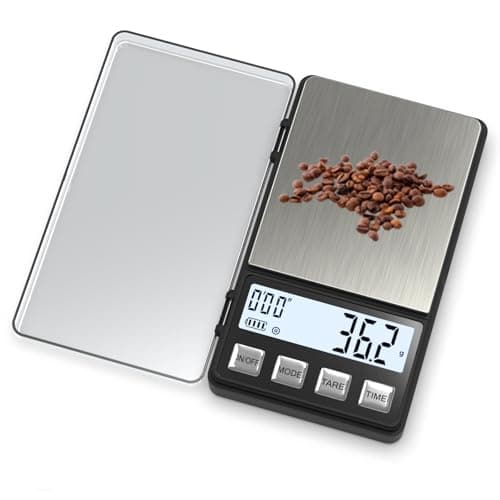
Espresso is a ratio, and you cannot hit a ratio you are not measuring. A scale with 0.1 g resolution and a timerturns "a shot" into "18 g in, 36 g out, 28 seconds" — and the moment you can write that down, every other adjustment you make becomes a controlled experiment instead of a guess. It is the cheapest thing on this page and it is first for a reason.
The WEIGHTMAN is the pick because it does the two things that matter for espresso — 0.1 g increments and a built-in timer — in a body thin enough to sit on a drip tray under a portafilter, which most kitchen scales are not. If you want the upgrade, the Timemore Black Mirror Basic 3 is an ultra-thin, better-built version of the same idea with USB-C charging.
| Resolution | 0.1 g |
|---|---|
| Capacity | 1000 g |
| Timer | Yes, built in |
| Profile | Thin enough for most drip trays |
| Role here | Budget pick, and the first thing to buy |
The honest cons.The 1000 g ceiling is fine for espresso but limiting if you also want one scale for brewing a full Chemex on. The build is light plastic, and no water-resistance rating is published — which matters on a drip tray, so keep it dry and do not pour over it. Response time on a budget scale lags a precision one slightly, which is noticeable when you are trying to cut a shot at an exact yield. And a thin scale under a portafilter can be awkward to read at an angle.
More options, including the drip-tray and pour-over-focused models, are in the best coffee scales, and do I need a scale for espresso makes the case at length.
2. A WDT tool - the biggest improvement per dollar
Grinders produce clumps. Clumps make the puck uneven, uneven pucks let water find a low-resistance path, and that path — channeling— is the single most common reason a home shot tastes sour and thin despite a correct dose and grind. A WDT tool is a set of fine needles you stir through the dry grounds before tamping, and it is the cheapest genuinely effective fix for it.
The Normcore V3 is the pick because of the stand. A WDT tool without somewhere to park it ends up on the counter with nine coffee-coated needles pointing up; the stand solves that and keeps the needles straight, which is the part that wears out.
| Needles | 9 prongs |
|---|---|
| Includes | Stand |
| Fits | 58mm and 54mm baskets |
| When to use it | After dosing, before tamping - every shot |
The honest cons.It adds a step to every shot, and about fifteen seconds. Fine needles bend and eventually break, so treat it as a consumable rather than a lifetime tool. It will not fix a grinder that produces genuinely inconsistent particle sizes — it redistributes what you have, it does not re-grind it. And it is easy to overdo: aggressive stirring against the basket wall can compact the edges, which creates the exact problem you were trying to avoid. Our best WDT tools page compares needle gauges and prong counts if you want to go deeper.
3. A tamper - remove the pressure variable
The tamper that came with your machine is usually too small for the basket and has no pressure reference, so the force you apply varies with how awake you are. A spring-loaded tamper fixes that structurally: it bottoms out at a set pressure and will not go further, so every puck gets the same compression. The Normcore V4 ships with 15 lb, 25 lb and 30 lb springs so you can pick one and stop thinking about it.
| Diameter | 58.5mm (for 58mm portafilters) |
|---|---|
| Type | Spring-loaded, fixed pressure |
| Springs included | 15 lb / 25 lb / 30 lb |
| What it fixes | Tamp pressure as an uncontrolled variable |
The honest cons.It is 58.5mm, so it does not fit a Breville — the 54mm equivalents are in the Breville list below. Spring-loading removes the feel you would otherwise develop, which some people genuinely prefer to learn instead. It is heavier and has more moving parts than a flat tamper, and the spring mechanism is one more thing that can go out of calibration. And the honest limit: tamp pressure is the leastimportant of the four puck variables — once it is consistent, consistency is all you get, and there is no further gain from tamping harder. How to tamp espresso explains why, and the best espresso tampers page covers flat, convex and calibrated options.
4. A precision basket - the one upgrade you can read the spec of
Stock baskets are stamped, and the holes vary in size, spacing and alignment from unit to unit. A precision basket is manufactured to a published hole specification and measured, which makes it the rare espresso upgrade where you can compare numbers rather than marketing. The IMS Big Bang is the pick: an 18-20 g double basket for 58mm portafilterswith IMS's published, measured perforation specification.
| Fitment | 58mm portafilters |
|---|---|
| Dose range | 18-20 g |
| Type | Precision double, measured perforations |
| Height | 23.5mm (h23.5 specification) |
| What it fixes | Uneven flow from a stamped stock basket |
The honest cons.The dose range is a real constraint, not a suggestion: run 14 g in an 18-20 g basket and you get too much headspace and a wet, broken puck. Basket height changes the gap between the puck and the shower screen, so swapping baskets can require adjusting your dose — check the clearance with a coin test before you blame the basket. It is 58mm only. And it is an incremental improvement: if your grind and distribution are rough, a precision basket will not rescue the shot, it will just show the problem more clearly. Our best precision baskets page has the 54mm options and the hole specifications side by side.
5. A bottomless portafilter - the diagnostic nobody budgets for
This one improves nothing on its own, and it still belongs this high. A bottomless (or "naked") portafilter has no spouts, so you watch the underside of the puck while the shot runs. Even extraction looks like a single dark stream forming in the middle; channeling looks like a jet firing sideways out of one spot, and it is unmistakable the first time you see it. There is no other way to know whether the problem in your cup is the grind, the distribution or the dose.
| Fitment | 58mm (fits Gaggia Classic and other 58mm machines) |
|---|---|
| Includes | Double shot filter basket, wood handle |
| What it shows | Channeling, edge sprays, uneven flow |
| Role here | Diagnostic, not an upgrade |
The honest cons.It sprays. A channeling shot in a bottomless portafilter redecorates the area around your machine, and that is the point, but it means more wiping while you learn. It also loses the spouts, so splitting a double into two cups is awkward and the stream falls further, cooling slightly. The included basket is a stock-grade basket, not a precision one. And it is a tool for diagnosis rather than daily use for many people — plenty of owners use it for a week, fix their prep, and go back to the spouted one. Our best bottomless portafilters page splits the options by machine, and pressurized vs non-pressurized explains why a pressurized basket makes all of this invisible.
6. A milk pitcher - if you drink milk drinks
If you only drink espresso and americanos, skip this entirely. If you drink lattes, the pitcher is not optional and the one that came with your machine is probably the wrong shape. What matters is a sharp, tight spout for pour control and a size that suits your drink: a 12 oz pitcher is right for one 6 to 8 oz latte, because milk needs headroom to expand and a half-empty big pitcher will not texture properly.
| Capacity | 12 oz |
|---|---|
| Material | Stainless steel |
| Spout | Sharp pour spout for latte art |
| Markings | Etched fill guides |
| Best for | One 6-8 oz milk drink at a time |
The honest cons.12 oz is a one-drink pitcher — making two lattes means two rounds of steaming, and if you regularly make drinks for two people a 20 oz pitcher is the better buy. Etched markings wear with dishwasher use. There is no built-in thermometer, so you are judging temperature by hand on the side of the jug (which is the standard method, but it has to be learned). And no pitcher textures milk on its own: the technique in how to steam milk is the part that matters, and a machine with an automatic wand does some of it for you. Sizes and shapes are compared in the best milk frothing pitchers.
7. A knock box - quality of life, honestly labeled
A knock box does nothing for your coffee. It is on this page because used pucks have to go somewhere, and the two free options are both bad: wet grounds block a sink drain over time, and knocking a portafilter on a bin edge eventually damages the portafilter. A box with a removable rubber knock bar and an anti-slip base takes the impact instead.
| Capacity | 1.2 L (about 15 pucks) |
|---|---|
| Knock bar | Removable |
| Base | Anti-slip |
| What it fixes | Nothing in the cup - it protects your drain and portafilter |
The honest cons.It takes counter space, which is the scarcest resource in a home espresso setup, and 1.2 L fills in a few days if two people drink espresso — so it is a daily emptying job, not a weekly one. The rubber bar is the wear part and goes soft over time. Knocking is also loud, which matters in a flat at 6 am. And a drawer-style box tucked under the machine is the better answer in a tight kitchen, at more money. The alternatives are in the best knock boxes.
8. Cleaner and descaler - the accessory nobody puts on a list
This is the accessory most likely to save a machine, and the one almost nobody buys until something goes wrong. Two different jobs, two different products. Backflush detergent(Cafiza is the long-standing standard) dissolves the coffee oil that builds up in the group head, the shower screen and the portafilter — rancid oil is the most common reason a machine that used to taste fine suddenly tastes bitter, and no amount of dialing in fixes it. Descaler is a separate acid product for the limescale inside the boiler, which is a performance and longevity issue rather than a flavor one.
| Product type | Espresso machine cleaning powder (backflush detergent) |
|---|---|
| Size | 566 g |
| Use on | Group head, shower screen, portafilter, baskets |
| Not for | Limescale inside the boiler - that needs a descaler |
The honest cons.Backflushing properly needs a three-way solenoid valve and a blind basket; on a machine without one you can only soak the removable parts, which is still worth doing but is not a true backflush. The powder is strong and must be rinsed thoroughly or the next shot tastes of detergent. A 566 g tub is far more than a home user gets through, so expect it to outlast several machines. And it is not a descaler — using the wrong product for scale does nothing. Our cleaners and descalers page separates the two, and how to clean an espresso machine plus how to descale give the routines.
If you own a Breville: the 54mm list
Breville and Sage machines — Bambino, Bambino Plus, Barista Express, Barista Pro, Barista Touch — use a 54mm brew path, and most of the accessory market defaults to 58mm. The categories are the same; the parts are not. The scale, the WDT tool, the milk pitcher, the knock box and the cleaner above are all size-agnostic and apply unchanged. These are the three that need the Breville version.
| Precision basket | IMS Precision 54mm 18-22 g (B62.52TH28E), or Normcore 54mm High Extraction 18 g |
|---|---|
| Puck screen | 53.3mm - not 54.0mm, which will not seat |
| Bottomless portafilter | 54mm, Breville/Sage fitment |
| Tamper | 53.3mm or 54mm - the 58.5mm tamper above will not fit |
The honest caveat for Barista Express and Barista Pro owners.Those machines have a built-in grinder with a dosing funnel, which makes a WDT tool slightly more awkward to use than it is with a standalone grinder — you dose into the basket in the cradle, then move it to a flat surface to stir. It is still worth doing. And on the Bambino and Bambino Plus, which ship with a pressurized dual-wall basket as well as a single-wall one, none of the puck-prep gear helps until you switch to the single-wall basket: a pressurized basket creates the pressure artificially and hides everything you are trying to control.
The machine-specific guides: the best grinders for Breville machines, the best Breville espresso machine and Barista Express vs Pro vs Impress if you are still choosing.
Worth it later, not now
Three more that are genuinely useful and simply rank below the eight above.
A distribution tool.A weighted leveler that spins across the top of the dose to even it out before tamping. It does a similar job to WDT from the top down rather than through the bed, and most people should own one or the other rather than both. If you dose consistently and hate the WDT routine, this is the swap — just set the depth for your actual dose, because a leveler adjusted for 18 g will compact a 20 g puck.
A puck screen. A fine metal mesh disc that sits on top of the puck. Here is our recorded position, unchanged: the benefit it reliably delivers is keeping grounds and oil off the shower screen, which means less cleaning. It does notfix channeling, because channeling happens inside the bed and a screen sits above it, and we have not been able to verify any controlled trial of an extraction benefit in either direction — so we quote no percentage. Buy it for cleanliness. Full detail in the best puck screens.
An airtight canister. Not espresso gear exactly, but it protects the most perishable thing in the setup. A valved or vacuum canister keeps a bag of beans drinkable for noticeably longer than a folded-over bag does, which matters most if you buy large bags. See the best coffee canisters, how to store coffee beansand — since the beans matter more than any of the hardware on this page — the best coffee beans.
What to skip
A ranked list is only useful if it also says no. These are the accessory categories we would not buy, and why.
An accessory "kit" bundle. The bundles that pair a tamper, a distributor, a mat and a scale are almost always the cheapest version of each part, and you end up replacing the two that matter. Buy the scale and the WDT tool individually for similar money.
A separate milk frother, if your machine has a steam wand.The wand is better at this than any handheld or jug frother, and it is already paid for. A frother is for machines with no wand at all — see the best milk frothers for that case, and how to froth milk without a frother for the free version.
Anything sold on a specific extraction percentage. If a product claims a numeric yield or extraction improvement and does not publish the method behind it, treat the number as marketing. We do not repeat figures we cannot trace to a published source.
Decorative tamping mats and brand-matched tool sets, as a first purchase. They are pleasant. They do nothing. Buy them after the eight above, with money you have left over, and enjoy them for what they are.
Accessories at all, if your grinder cannot do espresso. This is the biggest one. No tamper, basket or screen compensates for grounds that are the wrong size and wildly uneven. The honest advice is to put that money in a grinder: start with the best espresso grinders under $300 or, if the budget is tighter, a burr grinder under $100.
The bottom line
Buying one thing? A scale. Two? Add a WDT tool. Four? Add a tamper and a bottomless portafilter— one removes a variable, the other shows you the variables you have left. After that it is a precision basket if you want incremental gains on paper, a milk pitcher if you drink lattes, a knock box for your sink's sake, and backflush detergent because it is the cheapest insurance on the machine itself.
And measure your portafilter before you order any of it. 58mm, 54mm or 51mm is the difference between an upgrade and a return — the portafilter size guide takes thirty seconds. If you are putting a whole setup together from scratch, the best home espresso setup costs out three complete kits with the accessories included.
Frequently asked questions
What espresso accessories do I actually need?
A scale with 0.1 g resolution and a timer, and a WDT tool. Those two fix the two things that most often ruin a home shot - a dose you guessed and a puck full of clumps - and together they cost less than a good tamper. After that, a tamper to make tamp pressure consistent and a bottomless portafilter so you can see what your prep is doing. Everything else is a refinement or a convenience.
What is the best espresso accessory for a Breville Bambino or Barista Express?
The same scale and WDT tool as any other machine, because neither depends on portafilter size. Where Breville owners need the specific version is the basket, the puck screen, the bottomless portafilter and the tamper: Breville and Sage machines use a 54mm brew path, and accessories for them measure 53.3mm to 54mm rather than the 58.5mm standard. Note that puck-prep gear does nothing until you switch off the pressurized dual-wall basket the Bambino ships with.
Are espresso accessory kits worth buying?
Usually not. Bundled kits tend to pair the cheapest available version of each part, so the two items that matter most - the scale and the puck-prep tool - are the two you end up replacing. For similar money you can buy a decent scale and a decent WDT tool individually and skip the mat and the spoon.
Does a puck screen improve espresso?
It reliably keeps grounds and coffee oil off the shower screen, which means less cleaning. It does not fix channeling, because channeling happens inside the coffee bed and the screen sits above it. We have not been able to verify any controlled trial showing an extraction benefit in either direction, so we quote no percentage - buy one for cleanliness, not for shot quality.
Do I need both a WDT tool and a distribution tool?
Most people should own one, not both. A WDT tool stirs needles through the dry grounds and breaks up clumps inside the bed; a distribution tool levels and lightly compacts from the top. They address the same problem from different directions. WDT is cheaper and generally more effective on clumpy grinders; a leveler is faster and less messy, as long as you set its depth to the dose you actually use.
What size portafilter accessories do I need?
Measure the inside of your portafilter's basket seat. 58mm is the commercial standard used by Gaggia, Rancilio and most prosumer machines, and accessories for it are machined at 58.3-58.5mm. Breville and Sage machines are 54mm, with accessories at 53.3-54mm. De'Longhi Dedica, Stilosa and La Specialista are 51mm. Ninja and most pod machines use proprietary baskets, so third-party puck-prep gear does not apply.
Sources
- WEIGHTMAN - espresso scale listing specifications: 1000 g capacity, 0.1 g resolution, built-in timer, slim profile for drip-tray use
- Normcore - WDT Distribution Tool with Stand V3 published specifications: 9-prong needle head, included stand, fits 58mm and 54mm baskets
- Normcore - 58.5mm Coffee Tamper V4 published specifications: spring-loaded fixed-pressure tamper, 15 lb / 25 lb / 30 lb replacement springs included
- IMS - Big Bang Precision Filter Basket for 58mm portafilters, 18-20 g double, h23.5 specification; IMS Precision 54mm 18-22 g basket (B62.52TH28E) for Breville and Sage machines
- Urnex - Cafiza espresso machine cleaning powder product information: 566 g, backflush detergent for group head, shower screen, portafilter and baskets; separate Dezcal product for limescale
- Breville - published portafilter and basket specifications for the Bambino, Bambino Plus, Barista Express, Barista Pro and Barista Touch (54mm brew path; dual-wall pressurized and single-wall baskets supplied)
- Rattleware - 12 oz etched milk frothing pitcher listing specifications: stainless steel, pour spout, etched fill guides
- MHW-3BOMBER - espresso knock box listing specifications: 1.2 L capacity, removable knock bar, anti-slip base
- Amazon listings (Creators API) - live availability, current prices and brand/model title verification for every ASIN on this page before publication
Keep reading
Buying your first setup?
See how we pick — compiled specs, cost-per-shot math, and honest trade-offs — then dig into the guides. No fake test lab, no rankings for hire.